The data you forgot to deleteis the data you’ll wish you had.
Call recordings, transcripts, captured PII, old lead exports — they pile up and sit there long past the window you’re supposed to keep them, quietly turning into breach surface and discovery exposure. This scheduler computes each class’s purge-due date from your own retention policy and shows you exactly what’s overdue.
Scope note. This tool schedules purges from retention periods you supply as policy. It does not set retention periods, deletes nothing, and never schedules a legal-hold class for purge. What to keep and for how long — and what’s under hold — are legal questions; confirm them with counsel. It schedules records, not people. Not legal advice.
Nobody schedules the delete. So it never happens.
The most-overdue class — that the tool refuses to schedule.
The schedule is computed from the retention periods you supply and a pinned evaluation date. It deletes nothing and never schedules a held class — it tells you what’s due so you can purge it where the data lives.
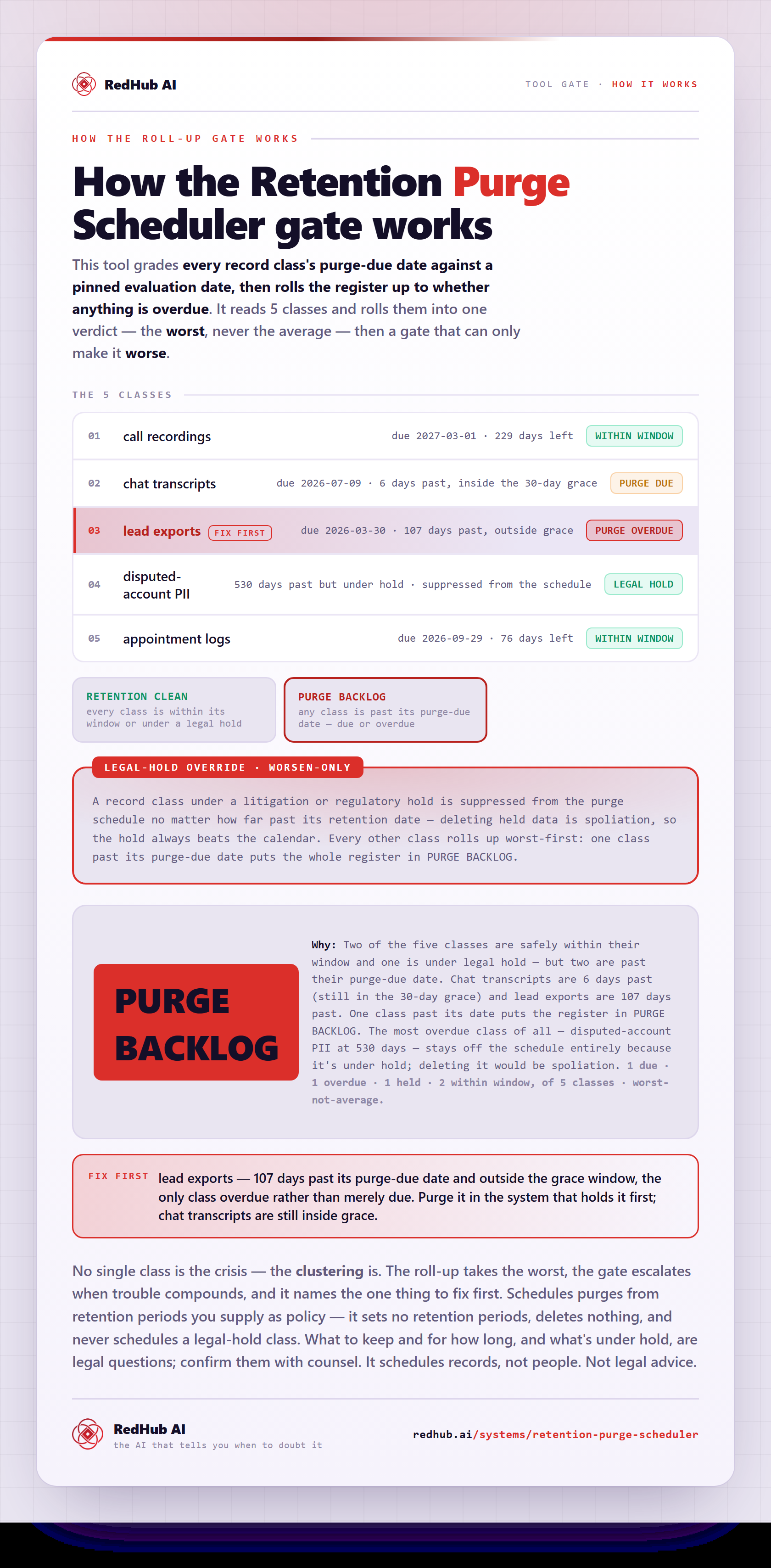
How the gate works, in one image
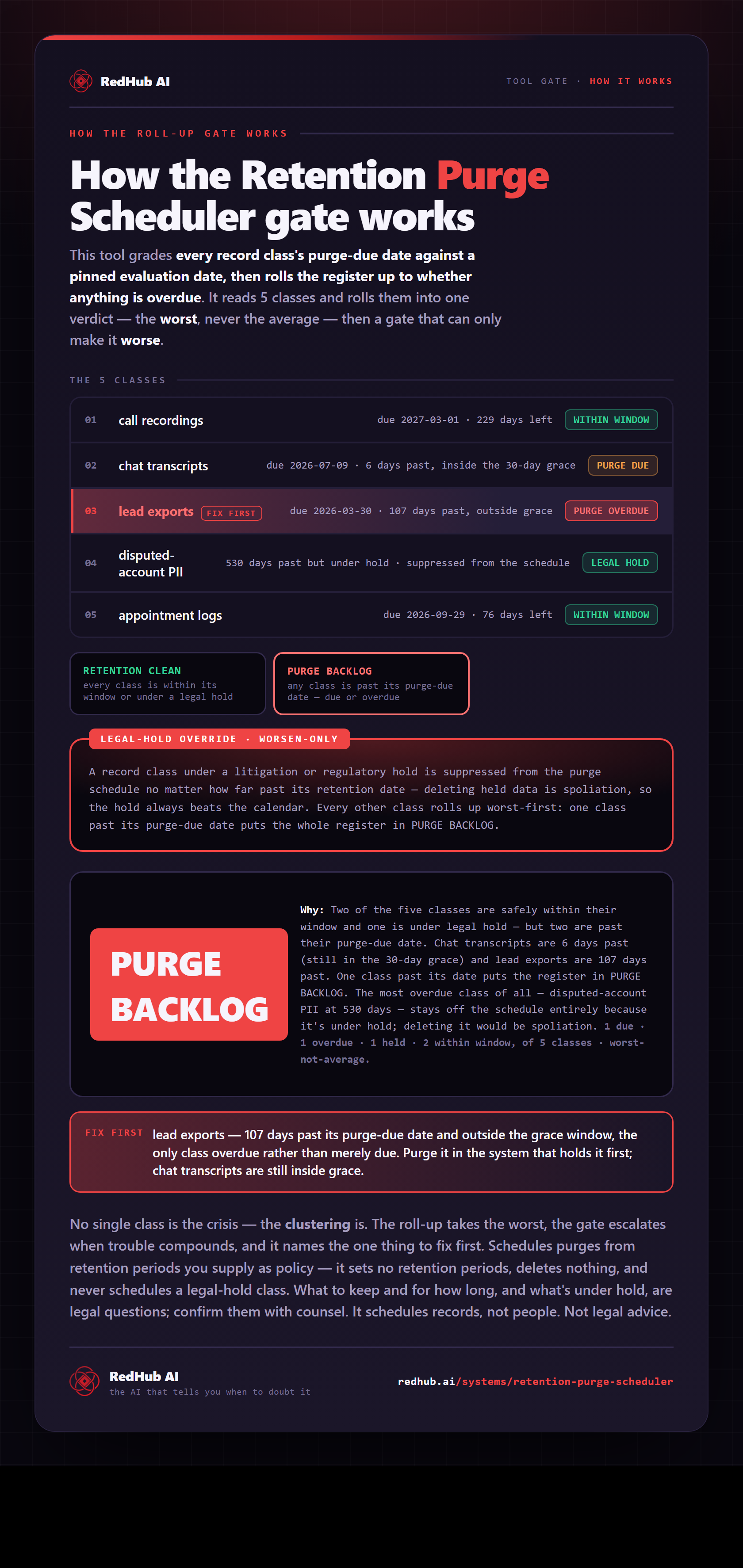
How the Retention Purge Scheduler rolls record classes up worst-first, suppresses anything under a hold, and reads PURGE BACKLOG when one class is overdue — the same math the demo runs, as a diagram you can share or embed anywhere.
View & embed the full diagramFeed it your register. Get a dated purge schedule.
A zero-dependency Python tool computes each class’s purge-due date and status against a pinned evaluation date. Here is its actual output on the shipped five-class sample — one due, one overdue, one held:
RETENTION PURGE SCHEDULER
========================================================
As of 2026-07-15   (grace 30 days)

PER RECORD CLASS
--------------------------------------------------------
call recordings        WITHIN WINDOW  2027-03-01  (229 days left)
chat transcripts       PURGE DUE      2026-07-09  (6 days past purge date)
lead exports           PURGE OVERDUE  2026-03-30  (107 days past purge date)
disputed-account PII   LEGAL HOLD     2025-01-31  (held - not scheduled)
appointment logs       WITHIN WINDOW  2026-09-29  (76 days left)

ROLLUP
--------------------------------------------------------
Record classes ........... 5
Within window ............ 2
Purge due ................ 1
Purge overdue ............ 1
Legal hold (suppressed) .. 1
Fix first ................ lead exports

VERDICT: PURGE BACKLOG

Schedules purges from retention periods you supply. It deletes nothing,
and never schedules a legal-hold class. It schedules records, not people.
Not legal advice.
Three rules the schedule holds to.
Over-retaining is a liability, not a safety margin
Every record kept past its purpose is more to breach, more to produce in discovery, and — for personal data — exposure under storage-limitation principles. A purge schedule is how you keep only what you should, on purpose.
A legal hold always beats the calendar
A class under litigation or regulatory hold is never scheduled for purge, however overdue its dates look. Deleting held data is spoliation, so the hold is a dispositive override — the date saying ‘purge’ never wins against it.
It schedules. You purge
The tool computes purge-due dates and names what’s overdue from the periods you supply. It sets no retention periods and deletes nothing — carrying out the purge stays with you, in the system that holds the data.
A purge scheduler. Not a deleter, not a retention policy.
- A calculator of purge-due dates from your retention periods.
- A status per class: within window, due, overdue, or held.
- Legal-hold aware — held data never lands on the schedule.
- Deterministic — pinned evaluation date, reproducible runs.
- A deletion tool — it deletes nothing and touches no records.
- A source of retention periods — you supply those as policy.
- A legal determination of how long to keep anything.
- A judge of people — it schedules records, never person.
Scope note. This tool schedules purges from retention periods you supply as policy. It does not set retention periods, deletes nothing, and never schedules a legal-hold class for purge. What to keep and for how long — and what’s under hold — are legal questions; confirm them with counsel. It schedules records, not people. Not legal advice.
Anyone accumulating records with a shelf life.
The data-hygiene layer of a voice line.
Cleans PII out of transcripts you keep. This schedules the purge of the ones you shouldn't keep at all.
ViewRecords which flows carry regulated data and whether retention is governed. This enforces the retention side.
ViewKeeps suppressed numbers out of dialing. Another discipline in the same call-data-hygiene family.
ViewThe parts worth pinning down before you buy.
Keep what you should.
On purpose. On schedule.
Turn your retention policy into a dated purge schedule, and see what you’ve been holding too long — without ever risking held data. One purchase, lifetime access, 12 months of updates. $59, once.
Sold by RedHub AI LLC · Secured by Stripe · redhub.ai