Cheap and well-lovedisn't the same as worth renewing.
Your AI and SaaS bill keeps climbing, and every tool feels essential at renewal time. This scorecard grades each vendor on reliability and whether the spend is justified — then refuses to justify renewing a business-critical vendor you can't rely on, no matter how good the price looks.
Every tool feels essential the week it's up for renewal.
Contracts roll over on autopilot. The decision that should happen — is this still worth it? — quietly never does.
A cheap tool that's deeply adopted feels like a keeper. But if it's a critical dependency that keeps going down, the price is the least of it.
Reliability isn't one factor among many for a vendor you depend on. It's a veto — and a weighted average will average it away.
Re-rate a vendor. Watch reliability override the price.
Reliability-floor gate: this is a business-critical vendor failing on a reliability dimension. DO NOT RENEW regardless of the score — you can't justify renewing a core dependency you can't rely on. Fix the reliability problem or plan a replacement.
Tap a signal (0–3) or toggle business-critical and watch the verdict move. Worked example as of 2026-06-25.
Reliability (uptime/SLA) — demand an SLA with credits, or plan migration off this dependency.
Same math as the workbook: weighted justification across six signals, plus a gate that forces DO NOT RENEW when a business-critical vendor fails the reliability floor — the way the shipped example scores 75 yet can't be renewed. It grades the vendor relationship from your own data, not people. Not financial advice.
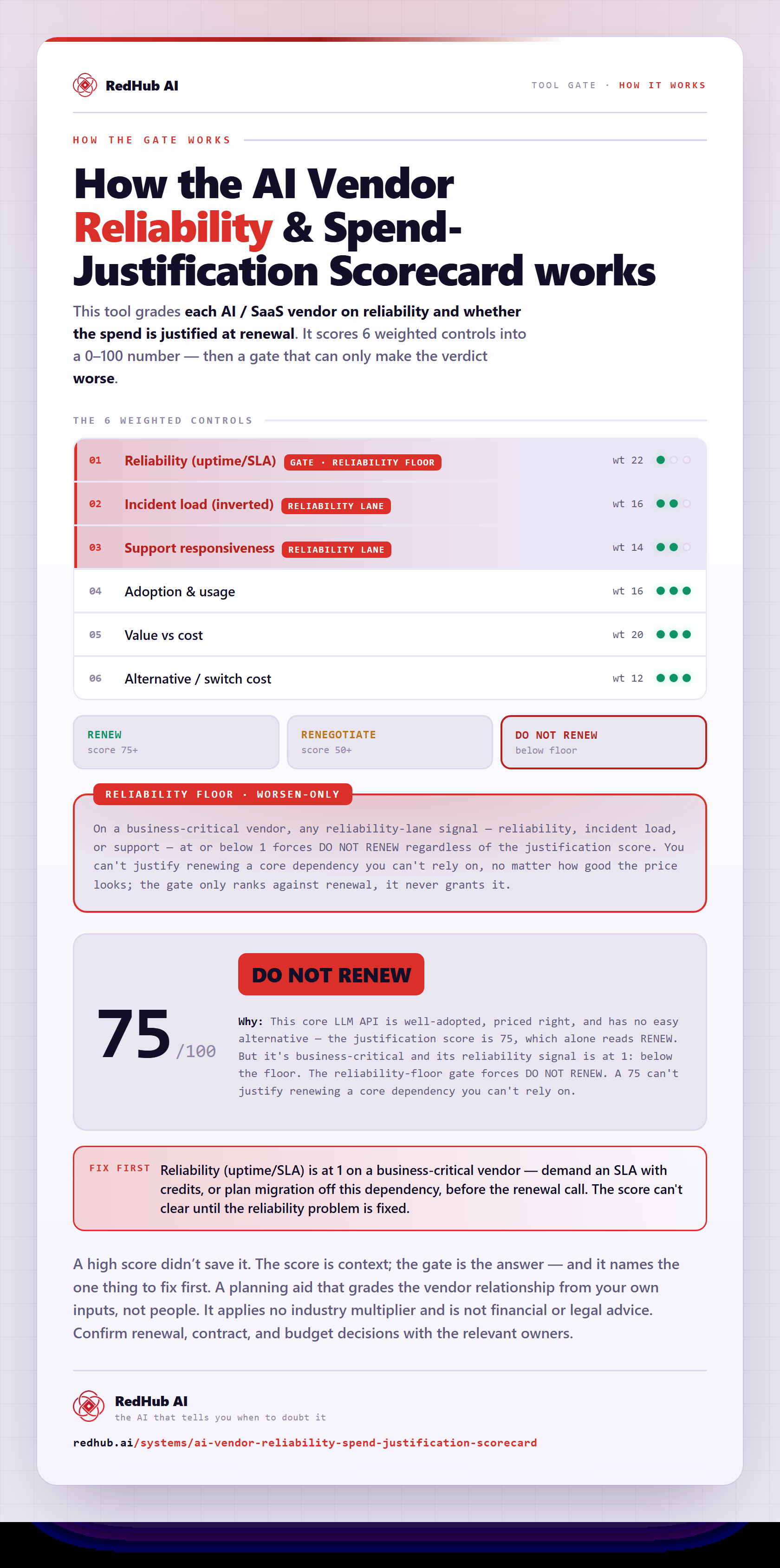
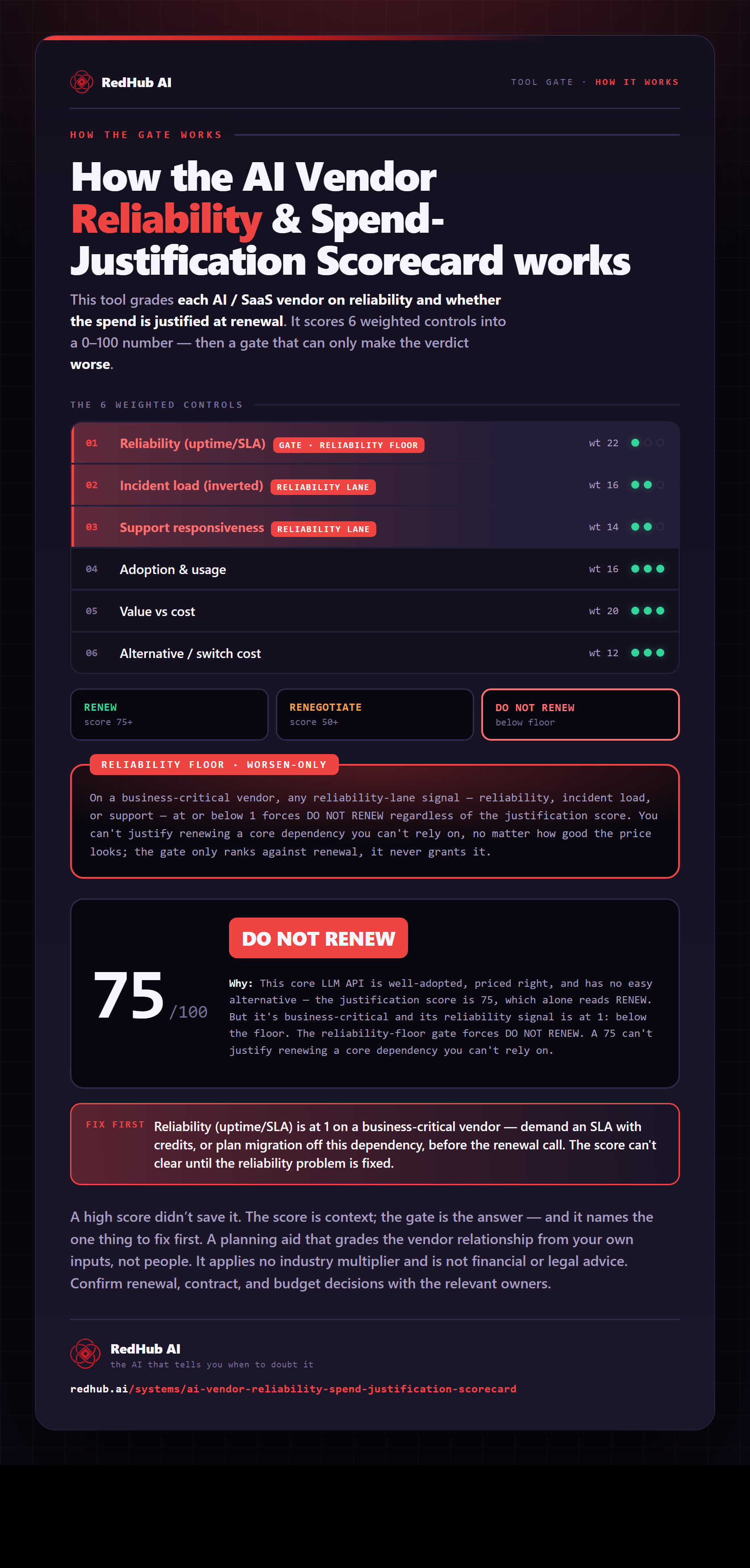
How the gate works, in one image
How the AI Vendor Reliability & Spend-Justification Scorecard scores a vendor and demotes a critical one to DO NOT RENEW when reliability bottoms out — the same math the demo runs, as a diagram you can share or embed anywhere.
View & embed the full diagramSix vendors. One that looks like a keeper but isn't.
This is the shipped example, scored by the rule the workbook and the demo both run. Read the core LLM API: it justifies at 75 on strong adoption and value, and it's still DO NOT RENEW — because it's a critical dependency with failing uptime. The economics looked fine; the reliability didn't.
AI Vendor Reliability & Spend-Justification Scorecard  (as-of 2026-06-25)
Grades the vendor relationship from your own data, not people. Not financial advice.
================================================================================
6 vendors  |  RENEW 2   RENEGOTIATE 2   DO NOT RENEW 2
--------------------------------------------------------------------------------
Core LLM API       [CRITICAL] justification  75  ->  DO NOT RENEW  [GATE: fails reliability floor]
Vector DB host     [CRITICAL] justification  96  ->  RENEW
Analytics add-on   [non-crit] justification  51  ->  RENEGOTIATE
Transcription API  [non-crit] justification  33  ->  DO NOT RENEW
Email delivery     [CRITICAL] justification  91  ->  RENEW
Niche scraper tool [non-crit] justification  53  ->  RENEGOTIATE
Three rules keep the renewal honest.
Reliability and value both feed the score — but for a business-critical vendor, reliability can veto the whole thing. Value can't buy it back.
Every signal comes from your own evidence — status pages, incident logs, invoices, usage. No industry multiplier, no vendor marketing.
It can lower a verdict to DO NOT RENEW; it never lifts a weak one. A RENEW has to be earned on justification and reliability both.
A renewal compass, not a finance model.
- A reliability + spend-justification score per vendor.
- A gate that vetoes renewing a critical, unreliable vendor.
- A playbook and runbook for the renewal conversation.
- Financial advice or a contract valuation.
- A usage/seat auditor (that's a different, complementary tool).
- A score of any person — it grades the vendor relationship.
A planning aid that grades the vendor relationship from your own inputs. It applies no industry multiplier and is not financial or legal advice. Confirm renewal, contract, and budget decisions with the relevant owners.
Anyone who signs off on the renewals.
The vendor & governance stack.
The privacy half of vendor management — is each data flow governed?
ViewWhat each connected vendor can actually reach inside your systems.
ViewWhere vendor review sits inside a full AI-governance program.
ViewEverything else you'd ask before buying.
Each AI/SaaS vendor on two axes from your own data — reliability (uptime/SLA, incident load, support responsiveness) and value (adoption, value vs cost, switching alternatives) — into a 0–100 spend-justification score, plus a verdict: RENEW, RENEGOTIATE, or DO NOT RENEW. You also flag whether the vendor is business-critical, which arms the reliability gate. It grades the vendor relationship, never a person, and applies no industry multiplier — every input is your evidence (status pages, incident logs, invoices, usage).
Because reliability is a veto, not just a weighted input. The reliability-floor gate is dispositive: if a vendor is business-critical and fails on any reliability dimension (uptime, incident load, or support), it's DO NOT RENEW no matter how high the justification score — strong adoption and value can't buy reliability back. In the worked example, the Core LLM API justifies at 75 on great economics but it's a critical dependency with failing uptime, so it gates to DO NOT RENEW. A weighted average would quietly average that failure away; this won't.
You decide — it's a flag you set for any vendor your operation genuinely depends on, where an outage hurts customers or stops work. The gate only applies to those: a critical vendor failing the reliability floor can't be renewed on economics alone. A non-critical vendor with the same reliability scores just loses points on the reliability axis; it isn't vetoed. That's deliberate — you can tolerate a flaky nice-to-have, but not a flaky core dependency.
Different object. A SaaS/subscription auditor grades utilization — paid vs used seats, right-sizing — and would happily keep a cheap, well-adopted tool. This grades reliability and renewal justification, and it won't renew that same tool if it's a critical dependency that keeps going down. The reliability veto is the part no seat auditor has. They're complementary: right-size seats with the auditor, decide renewals with this. It's also distinct from the Vendor Data-Flow Register, which grades data-flow governance (DPAs, cross-border), a privacy object.
No — it's a renewal compass, not a finance model or a contract valuation. It scores whether the spend is justified relative to reliability and value from the inputs you provide, and, where a signal is short, names the one thing to fix first (renegotiate price, demand an SLA, scope an alternative). It doesn't price contracts or model ROI in dollars; confirm renewal, contract, and budget decisions with the relevant owners. It's a planning aid, not financial advice.
One .xlsx Vendor Scorecard (the two-axis score, the reliability-floor gate, the per-vendor verdict and fix-first step), a Facilitator Playbook, a Vendor-Review Runbook, and a worked six-vendor example. It's deterministic and offline — opens in Excel, Google Sheets, or Numbers, nothing uploaded. Run it as a repeatable vendor-review cadence ahead of renewals.
Renew what earns it.
Replace what doesn't.
One purchase, lifetime access, 12 months of updates. $79, once.
Sold by RedHub AI LLC · Secured by Stripe · redhub.ai