Revenue through a partnerisn’t selling through one.
Your biggest distributor posts the largest number on the board — and hasn’t opened a new account in a year, running entirely on the house leads you hand it. That’s not a partner selling for you; it’s a margin share paid on a book you already own. This scorecard reads your closed sales records and grades every rep and distributor on what a revenue ranking can’t see: what they net you per hour, and how much new business they actually win.
The biggest number can be the emptiest slot.
Summit’s revenue — your top partner by a mile. It also opens accounts only from the leads you hand it: an ORDER-TAKER wearing a producer’s numbers. You’re paying channel margin for fulfillment you could run in-house.
Keystone’s margin per support hour — dead weight — and zero new accounts this period. Low net, no growth, pure legacy annuity. That’s the dead slot, and it forces the whole channel verdict.
Delta’s margin per hour, at 86% self-sourced new business — a third of Summit’s revenue and worth far more to you. The scorecard sees what the revenue ranking buries.
Six partners, two reads each — live.
| Partner | Margin | Hours | $/hr | New | Self | Contribution | Self-gen |
|---|---|---|---|---|---|---|---|
Ridgeline Reps REP | $264,000 | $629 | CARRYING THE LINE | SELLS FOR YOU | |||
Summit Distribution DISTRIBUTOR | $290,000 | $246 | PULLING THEIR WEIGHT | ORDER-TAKER | |||
Delta Channel Partners REP | $213,500 | $712 | CARRYING THE LINE | SELLS FOR YOU | |||
Keystone Supply Co DISTRIBUTOR | $122,000 | $130 | DEAD WEIGHT | COASTING ON THE NAME · DEAD SLOT | |||
Vantage Sales Group REP | $84,000 | $467 | CARRYING THE LINE | SELLS FOR YOU | |||
Anchor Industrial DISTRIBUTOR | $19,000 | — | below floor | — |
Summit is your biggest partner by revenue — and opens accounts only from the leads you hand it: an ORDER-TAKER wearing a producer’s numbers. Keystone is worse: dead weight and no new accounts at all, a margin share paid on a book you already own. Give Keystone some self-sourced new accounts and watch the gate clear.
Same math as the engine and the workbook — byte-for-byte. No dates anywhere: closed periods are closed. Nothing here is scored by AI, nothing leaves this page, and it grades a partner’s contribution, never a person.
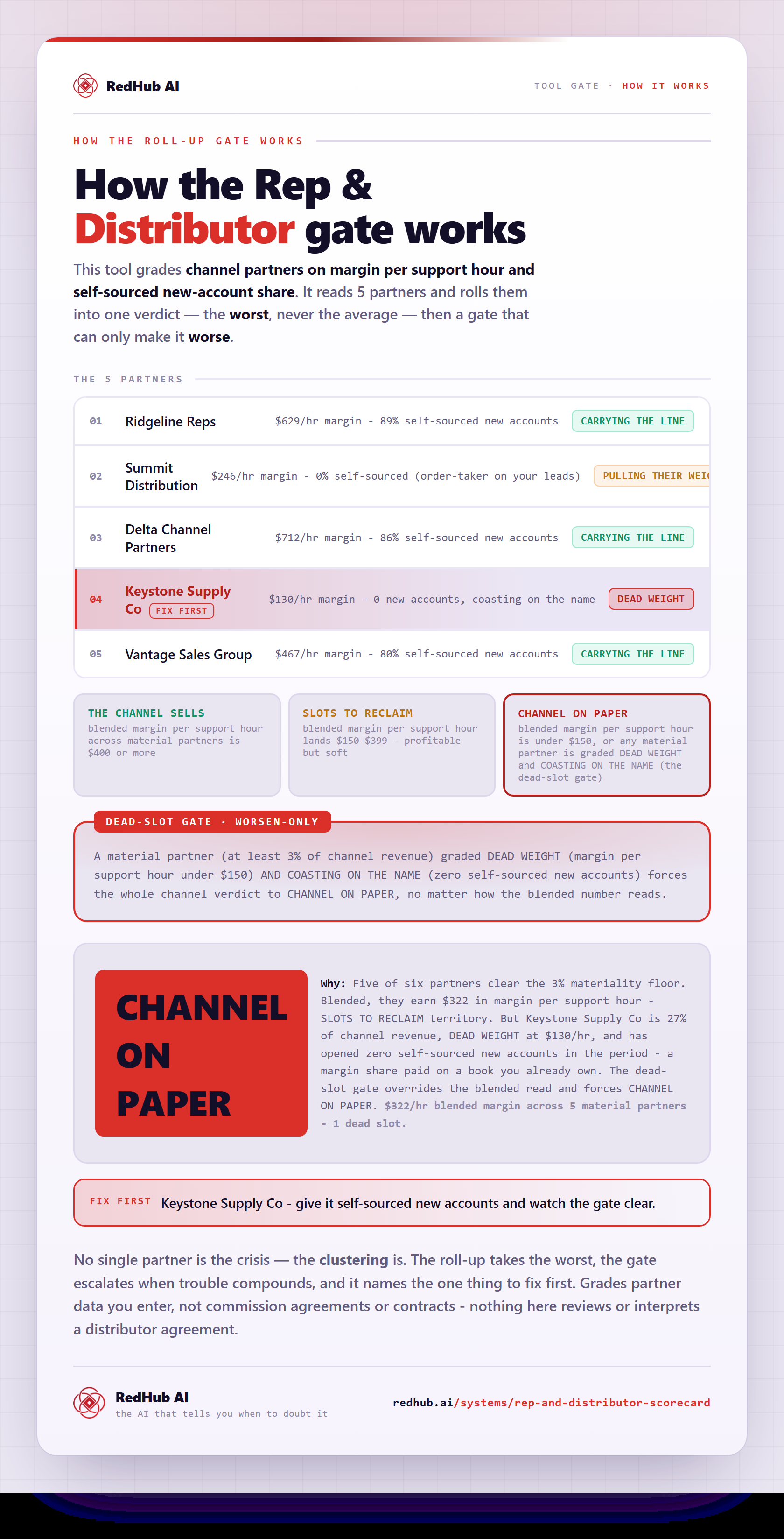
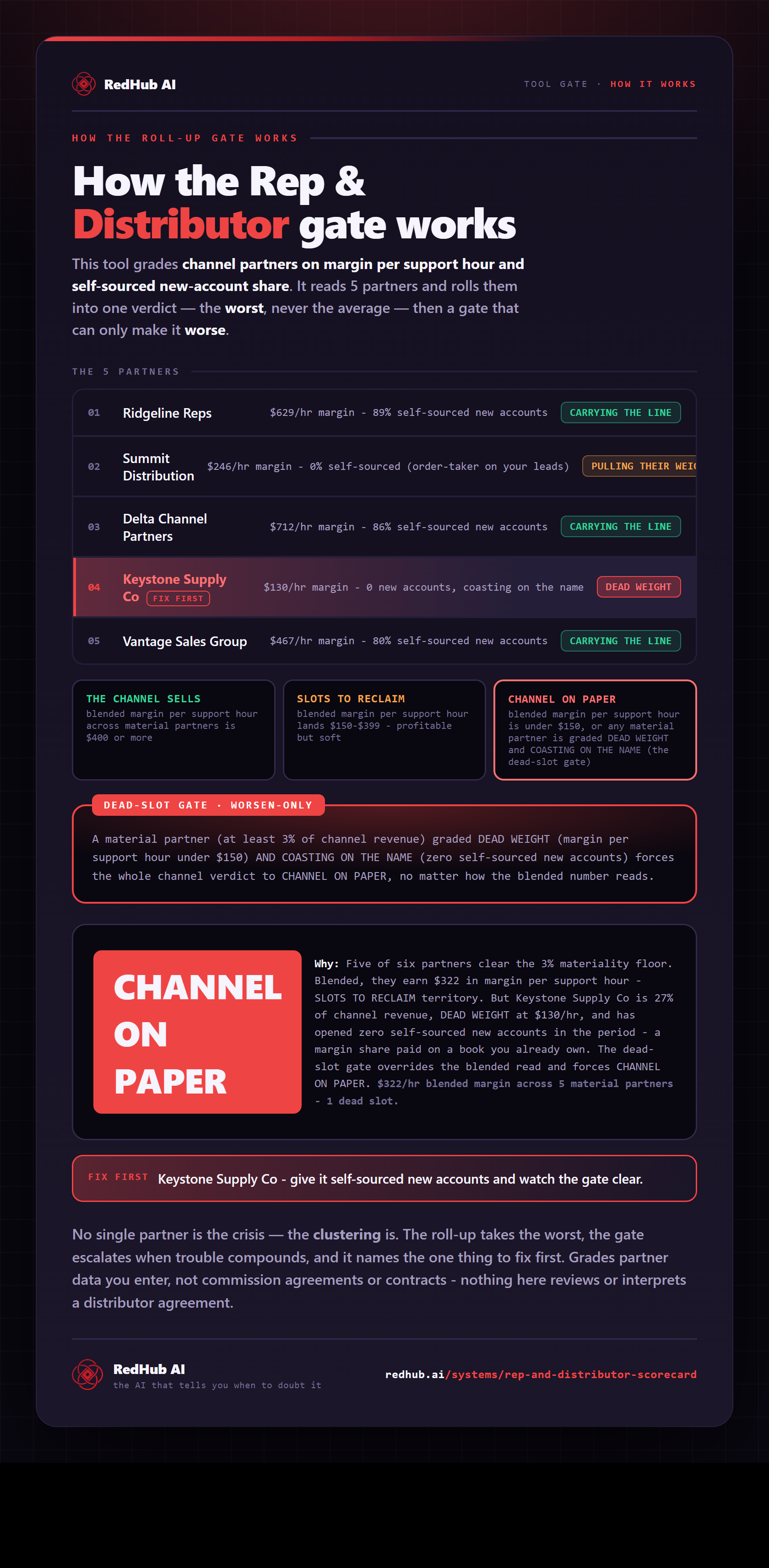
How the gate works, in one image
How the Rep & Distributor Scorecard rolls up channel partners and catches the dead slot a healthy blended margin hides — the same math the demo runs, as a diagram you can share or embed anywhere.
View & embed the full diagramA channel read you can run from your sales records.
The engine is zero-dependency Python — eight columns per partner, no dates, and it prints every partner’s two reads, the channel verdict, the gate, and, where a slot is short, the one to fix first. The workbook reproduces the identical math, and the demo above runs the same logic. This is the engine’s verbatim output on the shipped sample:
REP & DISTRIBUTOR SCORECARD - RDS-069
==============================================================================
Partners: 6   Scored (>= 3% of revenue): 5   Book: $4,495,000

PARTNER                 TYPE            MARGIN    $/HR  NEW  SELF  CONTRIBUTION         SELF-GEN             FLAG
Ridgeline Reps          REP           $264,000     629    9   89%  CARRYING THE LINE    SELLS FOR YOU
Summit Distribution     DISTRIBUTOR   $290,000     246    2    0%  PULLING THEIR WEIGHT ORDER-TAKER
Delta Channel Partners  REP           $213,500     712    7   86%  CARRYING THE LINE    SELLS FOR YOU
Keystone Supply Co      DISTRIBUTOR   $122,000     130    0     -  DEAD WEIGHT          COASTING ON THE NAME DEAD SLOT
Vantage Sales Group     REP            $84,000     467    5   80%  CARRYING THE LINE    SELLS FOR YOU
Anchor Industrial       DISTRIBUTOR    $19,000       -    -     -  NOT MATERIAL         NOT MATERIAL         below floor

Channel margin per support hour: $322 - SLOTS TO RECLAIM
GATE: Keystone Supply Co is dead weight AND opens no new accounts - you're paying a
margin share for a legacy annuity you already own. That's the slot to reclaim.

VERDICT: CHANNEL ON PAPER
Fix first: Keystone Supply Co
Built so the verdict can’t be negotiated.
Two reads, never blended
Contribution is what they net you per hour; self-generation is how much new business they win. They’re orthogonal — a rich legacy annuity and a low-margin growth investment are opposite situations a single partner score would collapse into one misleading number.
Priced by the hour you spend
Contribution is margin per support hour, not raw margin — because the partner you spend every Friday managing and the one who runs themselves are not equivalent at the same revenue. The cost side of the relationship finally shows up.
Grades a slot, not a person
It reads margin, hours, and accounts from closed records — no dates, no drift, and no judgment of anyone’s effort or worth. A partner below the materiality floor is shown but left out of the verdict; the DEAD SLOT gate names channel economics, not a firing.
A channel-economics read, not a performance review.
- A deterministic, offline read of eight columns per partner — engine, workbook, and demo produce the identical verdict from the identical records.
- The two-axis read a revenue ranking hides: what each partner nets you per hour, and how much new business they truly source.
- A review tool: the runbook turns each read into a specific conversation — grow the slot, restructure the support, or reclaim it.
- A performance review of a person. It grades a partner’s commercial contribution, and makes no employment or termination recommendation.
- A CRM or a commission engine. It reads a summary you can fill in twenty minutes; your systems hold the transactions.
- Legal advice. Confirm contract terms, notice periods, and territory rights with your own advisors before acting on any slot.
Scope note. This tool grades a channel partner’s commercial contribution from sales records you enter — it scores a slot’s economics, never a person’s worth, and it makes no employment, termination, or contract recommendation. It does not score or rank people; it is not for hiring, tenant, or credit screening. Confirm contract terms, notice periods, and territory rights with your own advisors before acting. Not legal advice.
Anyone paying a channel margin they can’t fully see.
Sales leaders whose partner ranking is really just a revenue ranking wearing a suit
Channel managers who suspect a big partner is coasting on house leads and legacy accounts
Owners deciding which reps to invest in, restructure, or let go before renewal season
Founders whose distributor takes a margin share for what looks a lot like order fulfillment
Anyone building a partner QBR who wants contribution and self-generation, not just top-line
Teams inheriting a channel and needing an honest read from the records they already have
The channel leg of the honesty stack.
Supplier Lead-Time Honesty Scorecard
$69The inbound mirror of this one: whether each supplier's quoted lead time is a number you can plan around.
Customer-Concentration Risk Gate
$99The risk beneath the channel: how exposed your revenue is if one account or partner walks.
Margin Leak Auditor
$79Where the margin actually goes once discounts, concessions, and channel cuts are counted honestly.
Straight answers, before you pay.
Two things a revenue ranking can't see. Contribution — what a partner nets you per hour you spend servicing them, on margin dollars divided by support hours: CARRYING THE LINE / PULLING THEIR WEIGHT / DEAD WEIGHT. And self-generation — how much of the new business they actually win, on partner-sourced new accounts as a share of all new accounts: SELLS FOR YOU / ORDER-TAKER / COASTING ON THE NAME. The two reads are independent and never blended, because 'expensive but growing' and 'cheap legacy annuity' are opposite situations that a single partner score would collapse.
Because revenue through a partner isn't the same as selling through one. A distributor can post your largest number while opening zero new accounts and running entirely on the house leads you hand them — that's an ORDER-TAKER at best, or COASTING ON THE NAME if they've stopped opening accounts at all. You're paying a channel margin for fulfillment you could run yourself. The scorecard separates the partners who go win business from the ones who process it.
The one combination worth acting on now: a partner that is both DEAD WEIGHT (nets you little per hour) and COASTING ON THE NAME (opens no new accounts) — pure cost against a legacy book you already own. Any such partner forces the channel verdict to CHANNEL ON PAPER, worsen-only, and it releases the moment they either start opening new accounts or lift their margin per hour. A partner who's dead weight but bringing lots of self-sourced new accounts is an investment, not a dead slot, and is deliberately not gated.
Coasting is about direction, not size. A partner with zero new accounts is living on the book they built years ago — the relationship is an annuity, not a growth engine. That can still be fine if the margin per hour is high (a rich legacy account you're glad to keep). It becomes a dead slot only when it's also dead weight. Size is handled separately: a partner below the materiality floor (default 3% of revenue) is shown but left out of the channel verdict, because it's too small to move it either way.
No. It grades a partner's commercial contribution from closed sales records — margin, hours, accounts. It says nothing about anyone's effort or worth, and it makes no employment or termination recommendation. It's a channel-economics read to inform a business conversation, not a performance review. Confirm contract terms and territory rights with your own advisors before acting.
No dates at all — it works on closed-period totals, so there's no evaluation date to pin and last year's verdict is the same verdict forever. And it's deterministic and offline: the same records produce the same verdict in the engine, the workbook, and this page's demo, byte for byte. Nothing is scored by AI and nothing leaves the sheet. Not legal advice.
Find the slot
you’re paying for twice.
One purchase, lifetime access, 12 months of updates. $69, once.
Grades a partner’s contribution, never a person. Confirm contract terms and territory rights with your own advisors. Not legal advice.
Sold by RedHub AI LLC · Secured by Stripe · redhub.ai