A quote is a numberyou plan around.
So the only question that matters is whether you can. Your ERP shows one blended on-time number per supplier — and it hides two different lies: the supplier who quietly pads every quote by a week, and the one who quotes short and misses. This scorecard reads your receiving history and grades both, separately, because they are two different problems and only one of them is a fiction you can’t plan around.
One on-time number. Two different lies.
Northgate’s median slip. It has never delivered late — because it pads every quote by nearly a week. You finance that week as buffer inventory and slower promises, and the ERP calls it your best supplier.
Coastal’s late share — chronically late, but its median slip is +1 day. Noisy, not biased: a scheduling problem you can buffer against, not a number that lies to you. The scorecard says so, and does not gate it.
Precision’s median slip, at 100% late. Chronically late and optimistic at once — it misses every date it promises and promises dates it can’t hit. That’s the one you can’t plan around. QUOTED FICTION.
Five suppliers, two reads each — live.
Two independent reads. Northgate never delivers late — and pads every quote by four to five days, a week of buffer you finance on every PO. Coastal is late 40% of the time but centered, so it’s a scheduling problem, not a fiction. Only Precision is both: chronically late and short-quoting. Pull its actuals in and watch the verdict fall.
Same math as the engine and the workbook — byte-for-byte. No dates anywhere: closed receipts are closed. Nothing here is scored by AI, nothing leaves this page, and the verdict will not soften because you wanted it to.
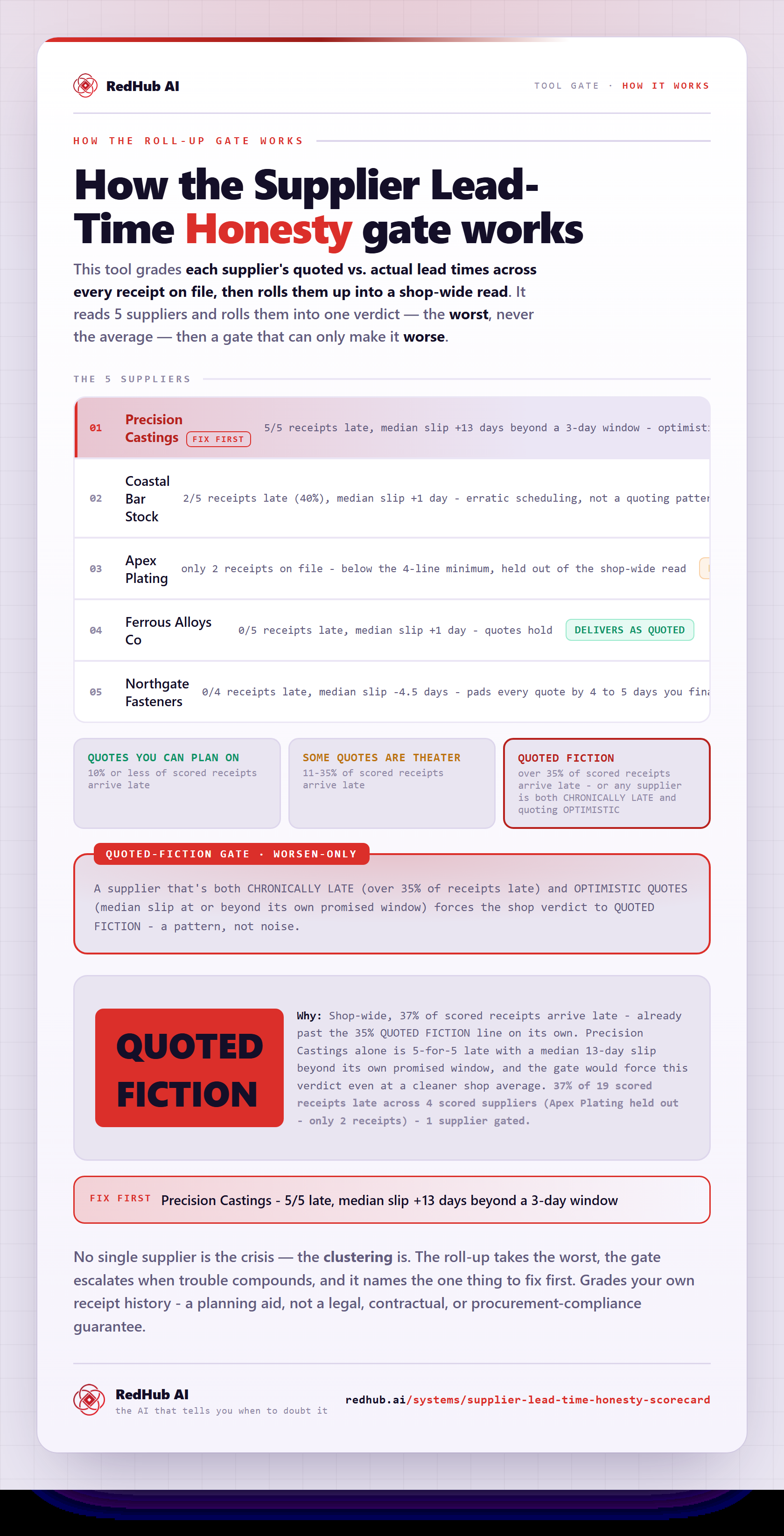
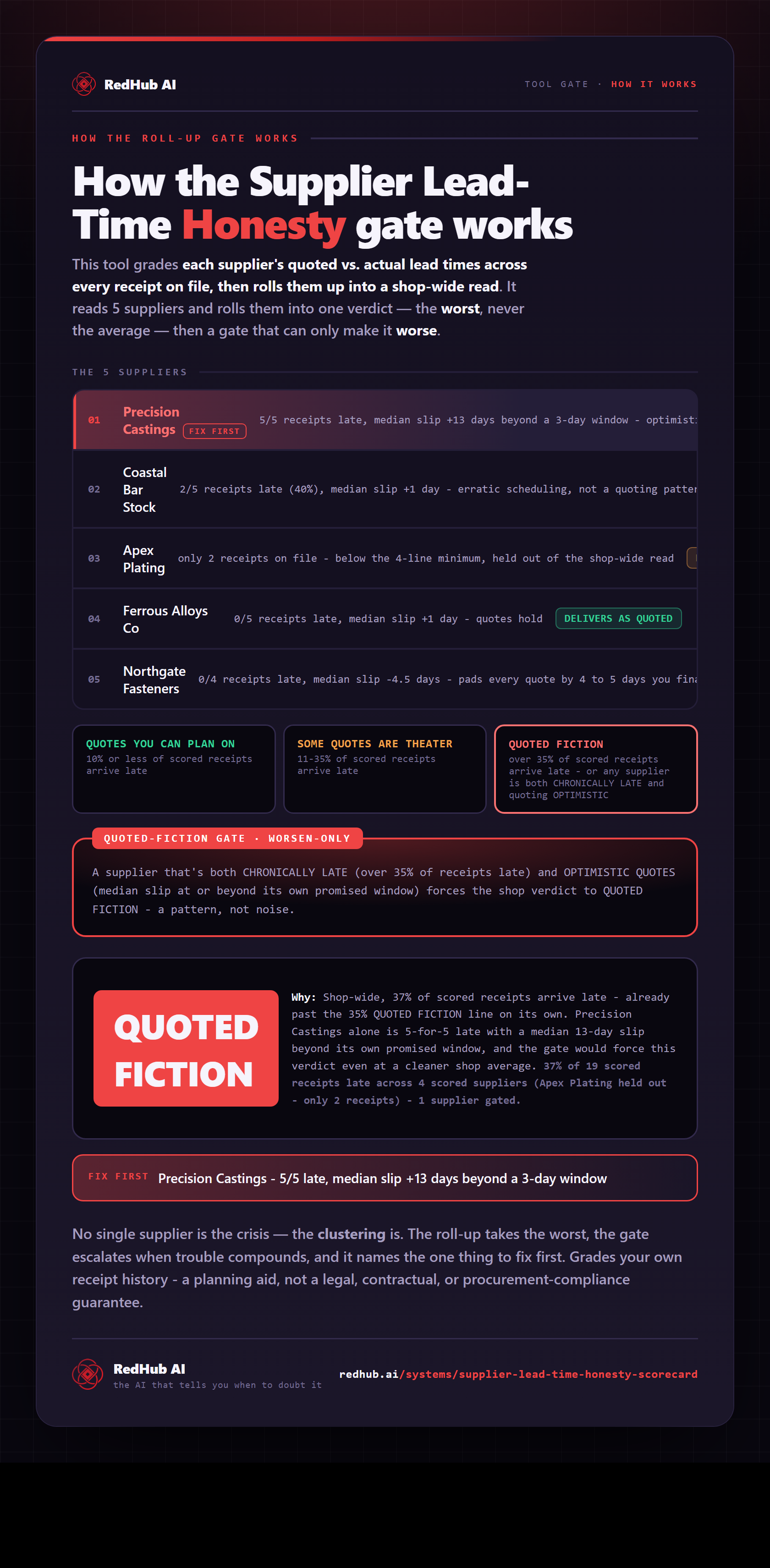
How the gate works, in one image
How the Supplier Lead-Time Honesty Scorecard rolls up quoted-vs-actual receipts and catches the supplier that's both chronically late and short-quoting — the same math the demo runs, as a diagram you can share or embed anywhere.
View & embed the full diagramA supplier read you can run from your receipts.
The engine is zero-dependency Python — five columns per receipt, no dates, and it prints every supplier’s two reads, the shop verdict, the gate, and, where a supplier is short, the one to fix first. The workbook reproduces the identical math, and the demo above runs the same logic. This is the engine’s verbatim output on the shipped sample:
SUPPLIER LEAD-TIME HONESTY SCORECARD - SLH-069
========================================================================
Receipt lines: 21   Suppliers: 5   Scored (>= 4 lines): 4

SUPPLIER               LINES  LATE  LATE%  MED SLIP  RELIABILITY         BIAS               FLAG
Ferrous Alloys Co          5     0     0%       +1d  DELIVERS AS QUOTED  QUOTES HOLD
Precision Castings         5     5   100%      +13d  CHRONICALLY LATE    OPTIMISTIC QUOTES  QUOTED FICTION
Northgate Fasteners        4     0     0%     -4.5d  DELIVERS AS QUOTED  PADS THE QUOTE
Coastal Bar Stock          5     2    40%       +1d  CHRONICALLY LATE    QUOTES HOLD
Apex Plating               2     1      -         -  NOT ENOUGH DATA     NOT ENOUGH DATA

Shop late share (scored lines): 37% - QUOTED FICTION
GATE: Precision Castings is chronically late AND quotes short - they miss the
dates they promise and promise dates they can't hit. You can't plan around this number.

VERDICT: QUOTED FICTION
Fix first: Precision Castings
Built so the verdict can’t be negotiated.
Two reads, never averaged
Reliability is how often they miss; bias is which way the quote leans. They’re orthogonal — reliable-but-padded and unreliable-but-centered are both real, and both invisible in a single blended on-time percentage. The scorecard refuses to blend them.
Padding is a cost, not a virtue
A supplier who sandbags a week onto every quote always looks on time — and you carry that week as inventory or lost responsiveness. PADS THE QUOTE names the quiet cost so you can negotiate it out instead of financing it forever.
No dates, no drift
It works entirely in lead-time days from closed receipts — there’s no evaluation date to pin and nothing reads today. Last quarter’s verdict is the same verdict forever, and a supplier below the minimum line count is left unscored, because two receipts are noise.
A quoting read, not a spend report.
- A deterministic, offline read of five columns per receipt — engine, workbook, and demo produce the identical verdict from the identical history.
- The two-axis read your ERP’s blended on-time number hides: reliability and bias, separately, per supplier.
- A negotiation tool: the runbook turns each read into a specific ask — tighten the quote, cut the padding, or requalify the source.
- A concentration or spend-risk tool. That grades how exposed you are if a supplier fails; this grades whether their quote is a number you can build a schedule on.
- A verdict on a person. It grades a supplier’s quoting record from receipts — not your buyers, and not a supplier’s character.
- A source of terms advice. Confirm switching costs and contract terms with your own advisors; this is a planning read, not procurement or legal advice.
Scope note. This tool grades a supplier’s lead-time quoting record from receipt history you enter — it scores a quoting record, never a person, and it contacts no supplier and values nothing. It is a planning read, not a statement of a supplier’s solvency or character. Confirm terms, switching costs, and sourcing decisions with your own advisors. Not procurement advice and not legal advice.
Anyone who schedules around a supplier’s promise.
Buyers walking into a lead-time negotiation who want the supplier's own record on the table
Planners who keep getting burned by the same supplier's optimistic quotes
Ops leads carrying weeks of buffer inventory they suspect is really supplier padding
Owners consolidating the supply base who need the honest performers separated from the theatrical ones
Quality or supply teams building a supplier scorecard that measures quoting, not just quality
Anyone inheriting a supplier base and needing an honest read from the receipt history they already have
The inbound leg of the honesty stack.
Order-Book Buildability Gate
$89The other end of the same material: whether the orders you booked can actually be built with what's arriving.
Promise-Date Integrity Tripwire
$89What you did with the dates you promised your own customers — the two-clock OTD audit downstream.
Supplier-Concentration Risk Gate
$99The structural risk beneath the quoting one: how exposed you are if a single supplier fails or changes terms.
Straight answers, before you pay.
For each supplier, two things your ERP's blended on-time number hides. Reliability — how often they miss, on the share of receipts later than your on-time window: DELIVERS AS QUOTED / QUIETLY LATE / CHRONICALLY LATE. And bias — which way the quote leans, on the median slip (actual minus quoted): QUOTES HOLD / PADS THE QUOTE / OPTIMISTIC QUOTES. The two reads are independent and never averaged, because a supplier can be reliable and biased, or unbiased and wildly unreliable.
Because you pay for it. A supplier who sandbags a week onto every lead time always looks on time — and you carry that week as buffer inventory, longer promises to your own customers, or lost responsiveness. It's a real cost, just a quieter one than a miss. The scorecard names it so you can negotiate the padding out instead of financing it forever.
The one combination you can't plan around: a supplier both CHRONICALLY LATE and OPTIMISTIC — they miss the dates they promise and promise dates they can't hit. Neither the quote nor the history tells you when the material actually lands. Any such supplier forces the shop verdict to QUOTED FICTION, worsen-only, and it releases the moment their record pulls back into either honest bias or acceptable reliability. A supplier who's chronically late but centered — noisy, not biased — is a scheduling problem, not a fiction, and is deliberately not gated.
Because a verdict on two receipts is noise, not a record. The default minimum is four lines (yours to change); a supplier below it is shown but marked NOT ENOUGH DATA and left out of the shop verdict. The point is an honest read, and two data points can't give you one.
No dates at all — it works entirely in lead-time days from your closed receipts, so there's no evaluation date to pin and last quarter's verdict is the same verdict forever. And it grades a supplier's quoting record, never a person: not your buyers, and not a named supplier's character. It's a read on a number, for planning.
A concentration tool grades your spend structure — how exposed you are if one supplier fails. This grades whether each supplier's quoted lead time is a number you can build a schedule on. It's deterministic and offline: the same receipt history produces the same verdict in the engine, the workbook, and this page's demo, byte for byte. Confirm terms and switching costs with your own advisors. Not procurement or legal advice.
Stop planning
around fiction.
One purchase, lifetime access, 12 months of updates. $69, once.
Grades a quoting record, never a person. Confirm terms and switching costs with your own advisors. Not procurement or legal advice.
Sold by RedHub AI LLC · Secured by Stripe · redhub.ai