On time — againstwhich promise?
Your ERP scores delivery against the promise date that has already been moved. Push a date out, hit the pushed date, and the order lands green. This tripwire scores every closed order against two clocks — the promise you gave first and the promise you gave last — and the spread between the two on-time rates is the measured size of the re-promising habit. Your customers never reset their clock. Now neither do you.
Your on-time number is a re-promised number.
What the dashboard says. The shipped 12-order sample hits 92% on-time — measured against the current promise, the one that has already been moved.
What the first promises say. Same orders, same ship dates — scored against the dates the customers actually planned around. The 17-point spread is the size of the lie.
Of the sample’s $159,600 in closed orders — 47% of the book by dollars — shipped later than first promised. Including a $64,000 key-account order moved three times.
Two clocks, one order book — live.
| Order | Key acct | First promise | Final promise | Shipped | Re-promised | Value |
|---|---|---|---|---|---|---|
| ORD-7101 | 2026-03-06 | 2026-03-06 | 0 | $8,400 | ||
| ORD-7104 | 2026-03-11 | 2026-03-11 | 0 | $5,200 | ||
| ORD-7112 | 2026-03-18 | 2026-03-18 | 0 | $22,000 | ||
| ORD-7118 | 2026-03-25 | 2026-03-25 | 0 | $3,900 | ||
| ORD-7123 | 2026-04-01 | 2026-04-01 | 0 | $6,100 | ||
| ORD-7127 | 2026-04-08 | 2026-04-08 | 0 | $4,700 | ||
| ORD-7133 | 2026-04-15 | 2026-04-15 | 0 | $9,800 | ||
| ORD-7136 | 2026-04-22 | 2026-04-22 | 0 | $18,500 | ||
| ORD-7139 | 2026-04-29 | 2026-04-29 | 0 | $5,600 | ||
| ORD-7141 | 2026-04-10 | 2026-05-08 | 3 | $64,000 | ||
| ORD-7146 | 2026-04-24 | 2026-05-15 | 1 | $7,300 | ||
| ORD-7150 | 2026-05-01 | 2026-05-12 | 1 | $4,100 |
$75,400 of $159,600 shipped later than first promised. Try it: drop ORD-7141’s re-promise count to 1 and the tripwire releases — the verdict falls back to what the numbers earn on their own.
Same math as the engine and the workbook — byte-for-byte. Nothing here is scored by AI, nothing leaves this page, and the verdict will not soften because you wanted it to.
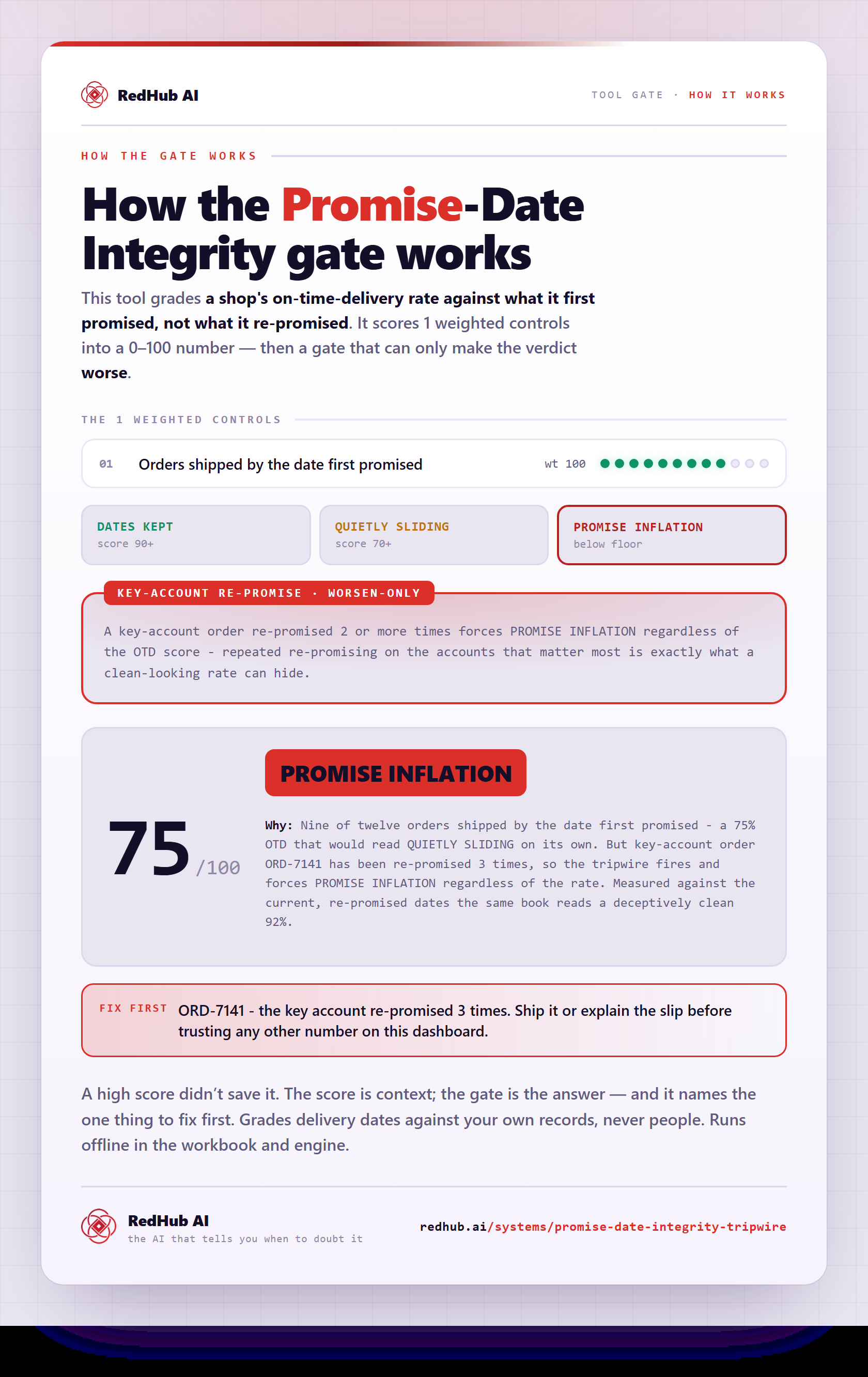
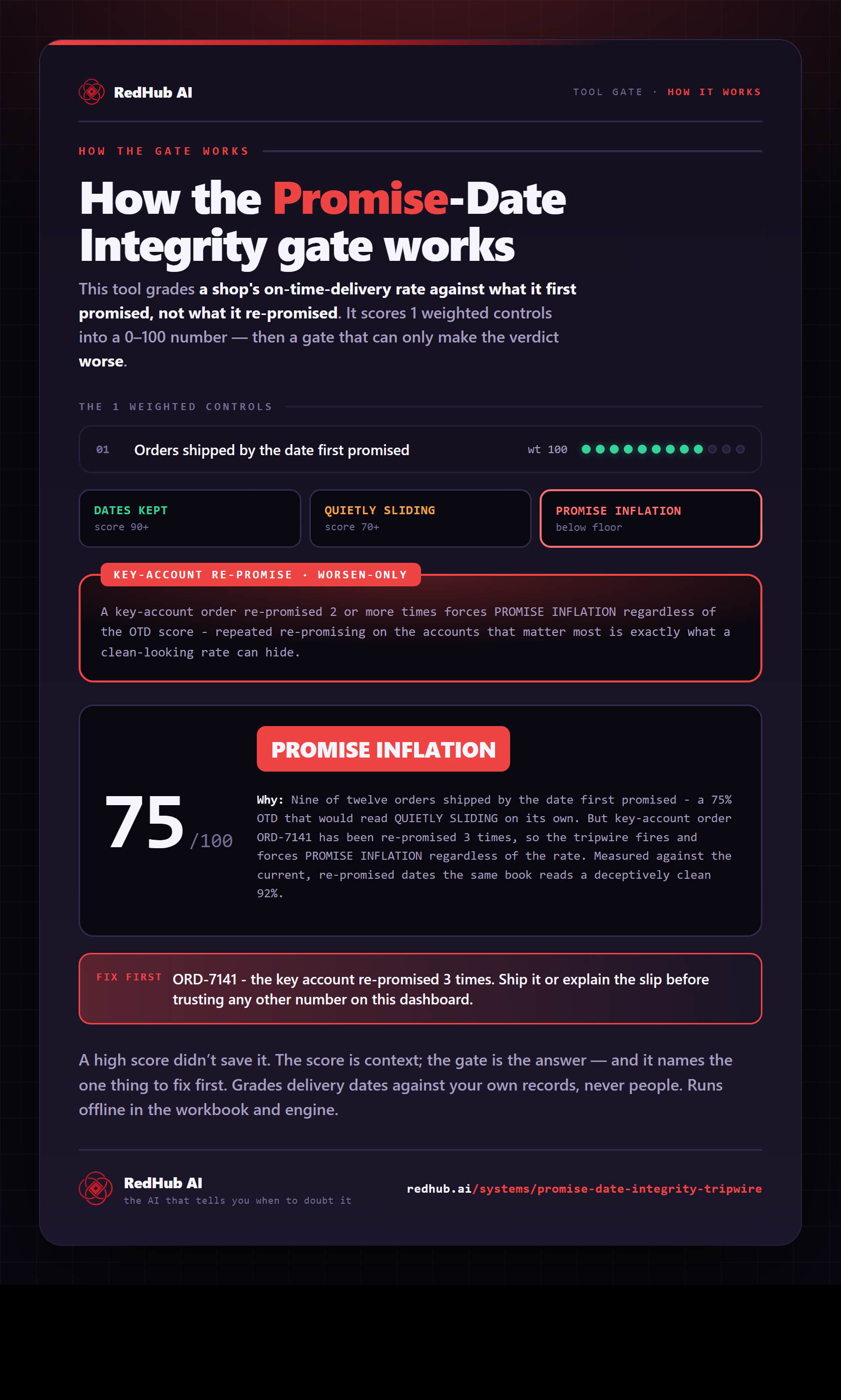
How the gate works, in one image
How the Promise-Date Integrity Tripwire grades on-time delivery against the date first promised and fires when a key account is quietly re-dated — the same math the demo runs, as a diagram you can share or embed anywhere.
View & embed the full diagramA verdict you can run, not a report you can argue with.
The engine is zero-dependency Python — point it at your closed-order CSV and it prints the two clocks, both reads, the tripwire, and, where an order is short, the one to fix first. The workbook reproduces every formula for the spreadsheet-native, and the demo above runs the identical math. Same rows in, same verdict out, on all three. This is the engine’s verbatim output on the shipped sample:
PROMISE-DATE INTEGRITY TRIPWIRE - PDI-089
========================================================
Closed orders read: 12

OTD vs CURRENT promise (the dashboard number): 92%
OTD vs ORIGINAL promise (the honest number):   75%
Spread (the size of the lie):                  17 pts

Delivery read:  QUIETLY SLIDING
Inflation read: MOVING THE GOALPOSTS
TRIPWIRE: key-account order ORD-7141 re-promised 3x - verdict forced to PROMISE INFLATION

VERDICT: PROMISE INFLATION
Fix first: ORD-7141
Shipped later than first promised: $75,400 of $159,600 (47.2% of the book)
Built so the verdict can’t be negotiated.
The two reads never average
A delivery rate and a candor rate measure different failures. DATES KEPT / QUIETLY SLIDING / PROMISE INFLATION rides the honest clock; TELLING IT STRAIGHT / MOVING THE GOALPOSTS / RE-PROMISED INTO GREEN rides the spread. You get both, side by side, unblended.
The gate is commercial, not statistical
A key-account order re-promised twice trips the verdict to PROMISE INFLATION whatever the rates say — that account has stopped planning around your dates, and no percentage can see it. Worsen-only: the gate can drag a verdict down, never lift one, and it releases the moment the condition clears.
No verdict on a coin-flip
Under five closed orders, the tripwire withholds the verdict instead of dressing noise up as a rate. And a row claiming zero re-promises with a moved promise date is refused, not quietly accepted — in the engine, the workbook, and the demo alike.
A tripwire for the habit, not a stick for the scheduler.
- A deterministic, offline read of your own closed orders — engine, workbook, and demo produce the identical verdict from the identical rows, every run.
- Two on-time rates from two clocks, a spread in points, a worsen-only key-account gate, and, where an order is short, one named order to fix first.
- A monthly discipline: the runbook installs the promise-setting rule, the re-promise protocol, and the key-account repair call.
- An ERP integration, a scheduler, or an AI that scores anything. It connects to nothing and reads nothing you don’t type in.
- A performance review. It grades an order book’s promise discipline — never a planner, a scheduler, or any person. Fix-first names an order, not a name.
- A prediction. Every input is a historical fact — an order that has shipped — which is why nothing in the tool ever reads today’s date.
Scope note. This tool grades an order book’s promise discipline from records you enter — it scores orders and habits, never people. Delivery commitments can carry contractual weight; what a promised date legally obligates you to is a question for your contracts and your counsel. Not contract or legal advice.
Anyone whose dates get quoted, moved, and remembered.
Job shops and make-to-order fabricators whose OTD report is green while key customers quietly requote elsewhere
Owners and GMs who suspect the on-time number but can't prove the re-promising underneath it
Ops and production managers who want the fix-first order named before the Monday meeting, not after the escalation
Sales and account managers doing damage control on accounts that have stopped believing the acknowledged date
Anyone installing a re-promise approval rule and needing the before/after measured on the same yardstick
Distributors and assemblers whose ERP overwrites the original promise the moment a date is moved
The delivery leg of the honesty desk.
PM Deferral & Pencil-Whip Tripwire
$89Why the dates slip: the maintenance that stayed green on the CMMS while the work never happened.
Cost-of-Poor-Quality Ledger
$99What the slips cost: price the scrap, rework, and warranty behind the missed dates and, where a cell is outside your tolerances, name the worst one.
Margin Leak Auditor
$79Where the expedites land: the freight, overtime, and concessions that rescue a late order eat the margin on it.
Straight answers, before you pay.
Two on-time-delivery rates computed from the same closed orders: OTD against the original promise date (the honest number) and OTD against the final promise date (the number your ERP dashboard shows). The spread between them, in points, is the measured size of the re-promising habit. The two reads sit side by side and are never averaged.
The customer accepted the new date; they didn't forget the first one. An order pushed from April 10 to May 8 and shipped May 6 is a green checkmark on the dashboard and a month late in the customer's planning. Scoring both clocks makes the gap a number instead of an argument.
A worsen-only override: any key-account order re-promised two or more times forces the verdict to PROMISE INFLATION, whatever both rates say. A book can post a strong honest OTD while the account that funds the quarter has been taught your dates are fiction — the rate can't see that, the gate exists to. It releases the moment the condition clears, and it never lifts a verdict.
One row per closed order: order ID, key-account flag, original promise date, final promise date, actual ship date, re-promise count, and order value. Most ERPs keep the current promise; the original lives in the order acknowledgment or the first confirmation email if your system overwrites it. Dates are entered as ISO text (YYYY-MM-DD), and the tool needs at least five closed orders before it will give a verdict.
No and no. It's deterministic and offline — a zero-dependency Python engine, a workbook that reproduces it formula for formula, and a demo that runs the same math. Same rows in, same verdict out, every time. It connects to nothing and reads nothing you don't type in.
It grades an order book's promise discipline — never a person. The fix-first line names an order to act on, not someone to blame. Delivery commitments can carry contractual weight, so questions about what a promise legally obligates you to belong with your contracts and your counsel; this is not contract or legal advice.
Your customers kept the first date.
Start scoring yourself on it.
One purchase, lifetime access, 12 months of updates. $89, once.
Grades the order book, never a person. Not contract or legal advice.
Sold by RedHub AI LLC · Secured by Stripe · redhub.ai