Your domain can score 76and still be bouncing.
Since 2024, Google, Yahoo, and Microsoft reject bulk mail that fails authentication — it never reaches the inbox or the spam folder. This gate grades every sending domain against those rules and returns one honest verdict each: ENFORCING, AT RISK, or FAILING. A structural gate fails any bulk sender whose mail is being rejected right now, no matter how good the rest looks.
A high score can hide the one fault that bounces every message.
Most deliverability checklists average everything into one number. That hides the faults that actually get mail rejected. A bulk sender with strong SPF, DKIM, clean unsubscribe and good spam numbers — but no DMARC record — looks healthy on a score and is being rejected at the SMTP level today. This gate refuses to let that pass.
Grade a domain. Watch the gate disagree with the score.
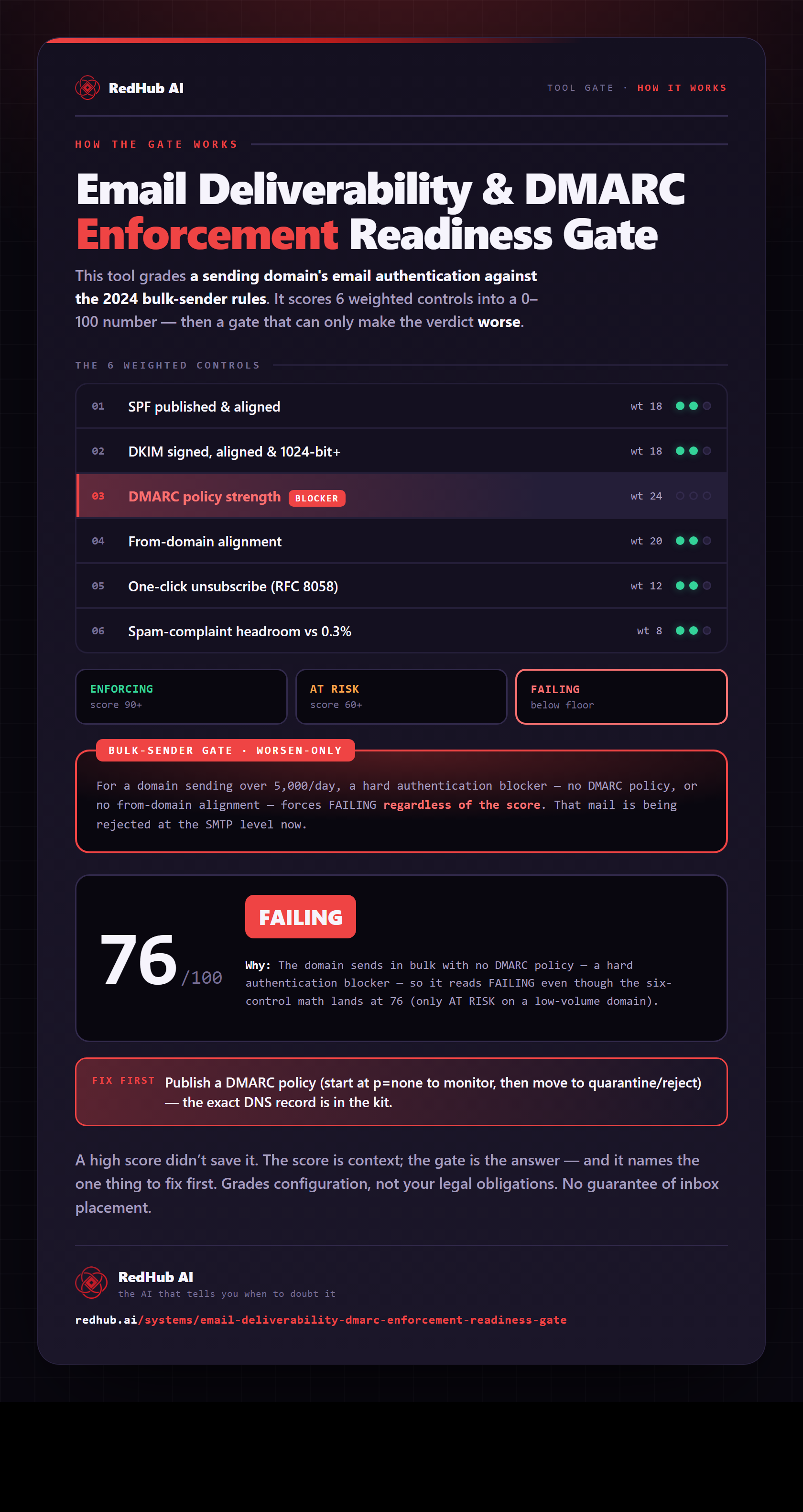
Bulk-sender gate: this domain sends over 5,000/day and has a hard authentication blocker (no DMARC, or no alignment) — its mail is being rejected at the SMTP level now. FAILING regardless of score.
Mark six controls
Same math as the workbook and the Python engine: six controls weighted to 100, ENFORCING at 90+, AT RISK at 60+, and a structural gate that forces FAILING for a bulk sender with no DMARC or no alignment — the exact gap that’s only AT RISK on a low-volume domain. It grades configuration, not your obligations. No guarantee of inbox placement.
This is the live engine. Grade every sending domain in one workbook + a runnable engine Catch the bulk domain that's bouncing before your next campaign Where a control is short, get the one fix-first per domain, with the exact DNS / ESP step
Get the kit — $79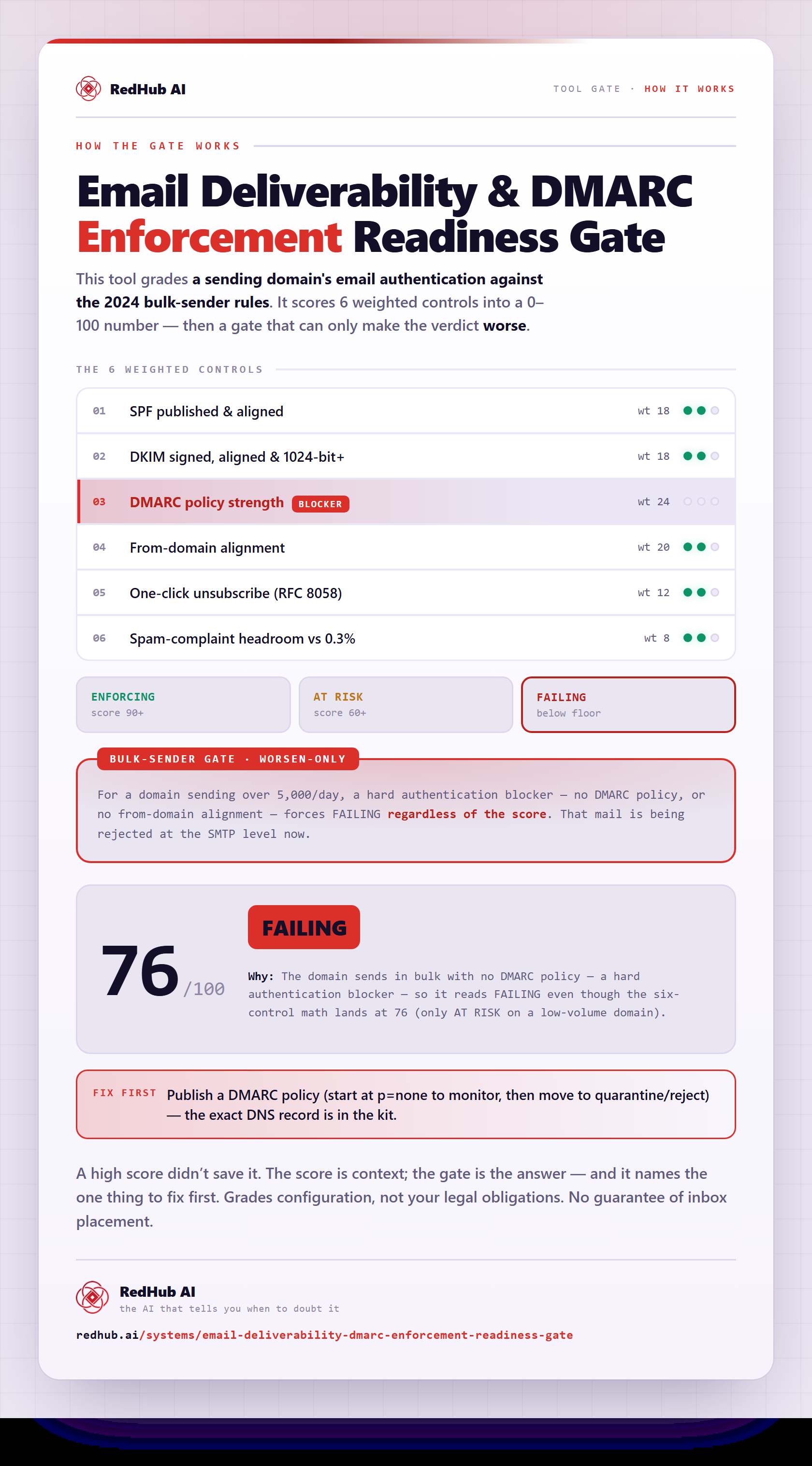
How the gate works, in one image
The six weighted authentication controls and the bulk-sender gate that forces FAILING when a high-volume domain has no DMARC or no alignment — the same math the demo runs, as a diagram you can share or embed anywhere.
View & embed the full diagramThe same verdict, offline, from your terminal.
The workbook and the Python engine share one config — same weights, same thresholds, same structural gate. Run it against the shipped seven-domain sample:
$ python3 engine/edr_engine.py engine/sample_domains.csv

Email Deliverability & DMARC Enforcement Readiness Gate
========================================================
Account posture: DELIVERY EXPOSED

mail.acmecorp.com  (bulk >5k/day, 42,000/day)
  score 76/100  ->  FAILING  [GATE: bulk auth blocker -> FAILING]
  fix first: DMARC policy strength

news.brightline.io  (bulk >5k/day, 180,000/day)
  score 64/100  ->  FAILING  [GATE: bulk auth blocker -> FAILING]
  fix first: From-domain alignment (SPF or DKIM passes & aligns)

shop.northwind.co  (bulk >5k/day, 9,500/day)
  score 90/100  ->  ENFORCING
  fix first: From-domain alignment (SPF or DKIM passes & aligns)

hello.tinybatch.com  (low-volume, 1,200/day)
  score 76/100  ->  AT RISK
  fix first: DMARC policy strength

go.summitpeak.org  (bulk >5k/day, 65,000/day)
  score 19/100  ->  FAILING  [GATE: bulk auth blocker -> FAILING]
  fix first: DMARC policy strength

list.evergreen.dev  (bulk >5k/day, 28,000/day)
  score 100/100  ->  ENFORCING

crm.harborlight.com  (low-volume, 3,100/day)
  score 50/100  ->  FAILING
  fix first: DMARC policy strength

Not legal, compliance, or deliverability-guarantee advice.
It is the readiness gate, not your DNS or your ESP.
Identical marks, 42k/day vs 1.2k/day (rows 1 and 4): the gate is the only difference between FAILING and AT RISK.
Six controls, weighted to 100, with one gate that overrides them all.
Authentication, weighted honestly
SPF, DKIM, DMARC policy, and From-alignment carry the weight, because they are what receivers reject on. Unsubscribe and spam headroom round it out.
A structural gate, not a curve
Bulk sender + no DMARC, or bulk sender + no alignment, forces FAILING. The gate does distinct work: the same gap on a low-volume domain is only AT RISK.
One fix-first per domain
Where a domain is short, the verdict names the single highest-leverage change. Clear the gate first, then raise the score — the runbook gives the exact DNS or ESP step.
A readiness gate. Not a sender, not a scanner, not a lawyer.
- A deterministic verdict per sending domain, from facts you supply.
- A way to find the one domain that is bouncing before a campaign goes out.
- A repeatable, defensible review you can run every quarter or before every launch.
- A DNS scanner or live monitor — you enter each domain’s facts; it doesn’t read them for you.
- A guarantee of inbox placement — authentication is the floor, not the ceiling.
- Legal or compliance advice — it grades configuration, not your obligations.
Not legal, compliance, or deliverability-guarantee advice. No tool guarantees inbox placement. It is the readiness gate, not your DNS or your ESP — verify your own settings and consult a qualified professional for compliance decisions.
Anyone responsible for whether the mail actually arrives.
Clear the domain, then send with confidence.
Brand-Voice Email & Newsletter Engine
Once the domain is clear, write mail that sounds like you and earns the click. $69.
ViewDatabase Reactivation Readiness Engine
The consent gate for waking up dormant leads before you send. $99.
ViewVoice & Likeness Compliance Gate
The pre-publish gate for marketing that uses AI voices and avatars. $99.
ViewWhat teams ask before they buy.
Because a score averages every control into one number, and that average hides the one fault receivers actually reject on. A bulk sender (over 5,000 messages a day to Gmail, Yahoo, or Outlook) with strong SPF, DKIM, a clean unsubscribe, and good spam numbers — but no DMARC record — can score in the 70s and still be rejected at the SMTP level on every send. This gate refuses to let that pass: a structural gate forces FAILING for any bulk sender with a hard authentication blocker (no DMARC, or From-alignment to neither SPF nor DKIM), no matter how high the score. The verdict is ENFORCING, AT RISK, or FAILING per domain, and where a domain is short it names the one fix to make first.
It clears the floor, but it scores AT RISK, not ENFORCING. The rules require a published DMARC record, and p=none (monitoring only) satisfies the letter of 'has a DMARC record' — so a bulk sender at p=none is not gate-failed. But p=none gives you reporting without enforcement: it doesn't actually stop spoofed mail from your domain. The gate weights DMARC policy strength heaviest of the six controls and treats p=none as partial credit, so a p=none domain lands in AT RISK and the fix-first points you toward p=quarantine or p=reject. Monitoring is the on-ramp; enforcement is the destination.
No, and any tool that claims to is lying. Authentication is the floor, not the ceiling. SPF, DKIM, DMARC, and alignment get your mail accepted instead of rejected at the server — but whether it then lands in the inbox versus the spam folder depends on sender reputation, engagement, content, and list hygiene, which no static check can promise. This gate grades the floor honestly: it tells you whether your domains are configured to be accepted, and names what's blocking them if they're not. It is the readiness gate, not your DNS, your ESP, or a guarantee of placement.
One verdict per sending domain — ENFORCING, AT RISK, or FAILING — plus, where a control is short, a single fix-first that names the highest-leverage one to change. You enter each domain's facts across six weighted controls (SPF, DKIM, DMARC policy, From-alignment, one-click unsubscribe, spam-complaint headroom) and its daily volume. A structural gate fails any bulk sender with a hard authentication blocker. An account rollup grades all your domains together as ALL ENFORCING, SOME AT RISK, or DELIVERY EXPOSED. It ships a workbook, a runnable Python engine that produces the identical verdict offline, two playbooks, and a seven-domain worked sample.
No connection, no scanning, nothing uploaded. You read each domain's settings with whatever you already use — your DNS provider, a DMARC checker, your ESP's authentication panel — and mark what you find. The gate then grades those marks deterministically, the same way every time, fully offline. That's deliberate: it makes the review repeatable and defensible, something you can run every quarter or before every campaign launch, without granting a tool access to your mail infrastructure.
Different layers of the same send. This gate owns the domain layer — whether your sending domains are authenticated and configured to be accepted at all. The Brand-Voice Email & Newsletter Engine owns the message layer — writing mail that sounds like you and earns the click once delivery is cleared. Order matters: a perfectly written newsletter from a FAILING domain never arrives. Clear the domain here first, then write with the Brand-Voice engine. They're siblings, not substitutes.
Find the domain that’s bouncing
before your next send does.
One purchase, lifetime access, 12 months of updates. $79, once.
Not legal, compliance, or deliverability-guarantee advice. No tool guarantees inbox placement. It is the readiness gate, not your DNS or your ESP — verify your own settings and consult a qualified professional for compliance decisions.
Sold by RedHub AI LLC · Secured by Stripe · redhub.ai