An impact assessmentgraded on its worst impact.
EU AI Act Art. 27 and ISO 42001 Annex A want an impact assessment for each AI system that touches people. Most are long documents that read well and quietly wave through one serious harm. This one rates each impact, reduces it by its mitigation, and refuses to call the assessment defensible while a single severe, unmitigated impact stands.
A working aid, not legal advice. This grades the impacts you enter from your own ratings — it is not the assessment of record, a fundamental-rights determination, a certification, or an audit. It does not discover impacts you didn’t list, decide what residual is lawful for your context, or score any person. Confirm your impact criteria and any FRIA/impact-assessment obligation with a qualified auditor or counsel.
A thorough write-up isn’t a defensible assessment.
the EU AI Act wants a fundamental-rights impact assessment for high-risk systems; ISO 42001 Annex A wants an AI impact assessment too.
the worked sample: an impact with a moderate-looking residual that still triggers the gate, because it is a severe irreversible harm to a vulnerable group.
an assessment is only as defensible as its single worst unmitigated impact — averages hide the one that matters.
The failure isn’t a missing section — it’s a serious harm that the document describes and then proceeds past. This builder scores each impact down to a residual and takes the worst one as the verdict, so a single severe, unmitigated impact can’t hide behind a well-written assessment.
Rate an impact. Watch the worst one set the verdict.
The assessment is only as defensible as its worst unmitigated residual impact. It grades the impacts you enter from your own ratings — it doesn’t discover impacts you didn’t list, decide what residual is lawful, or score any person. A working aid, not the assessment of record. Not legal advice.
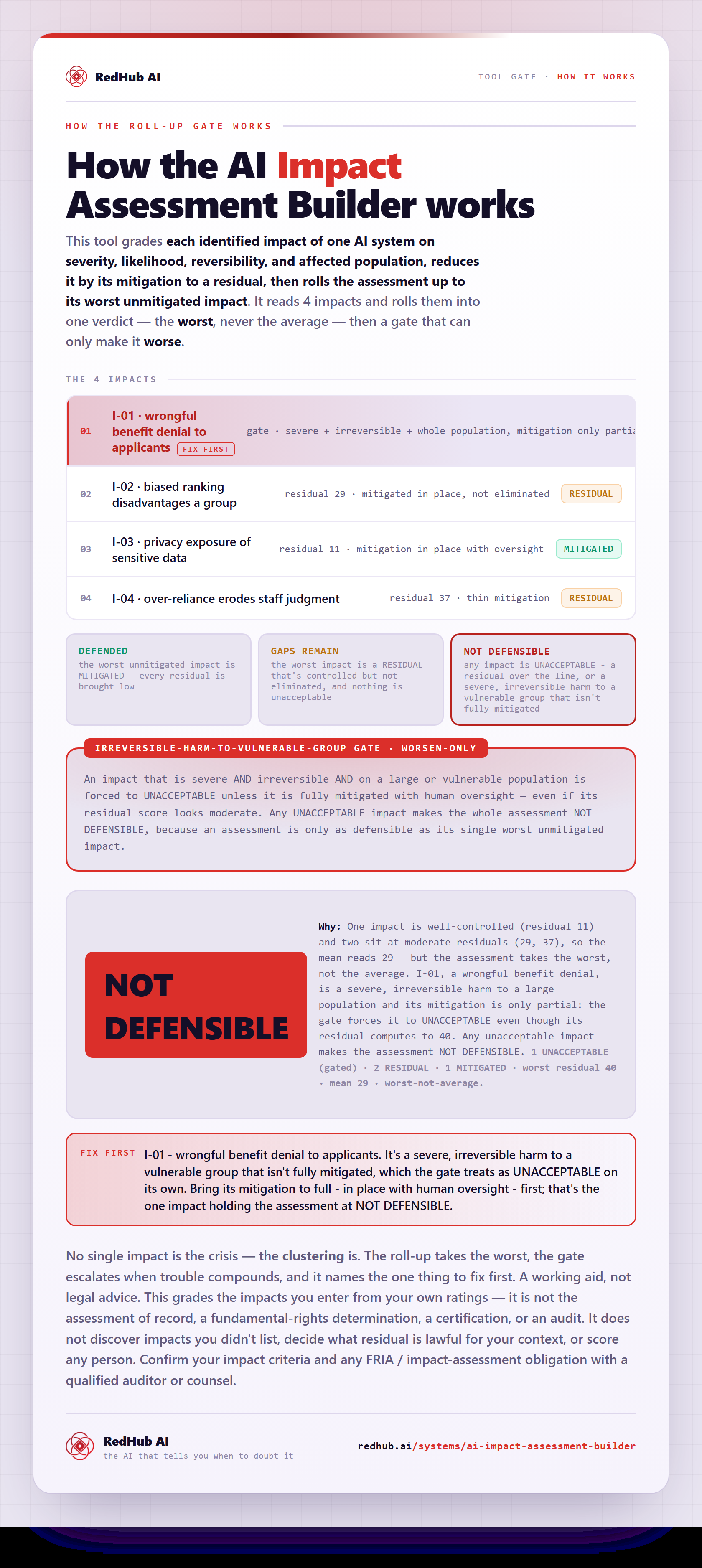
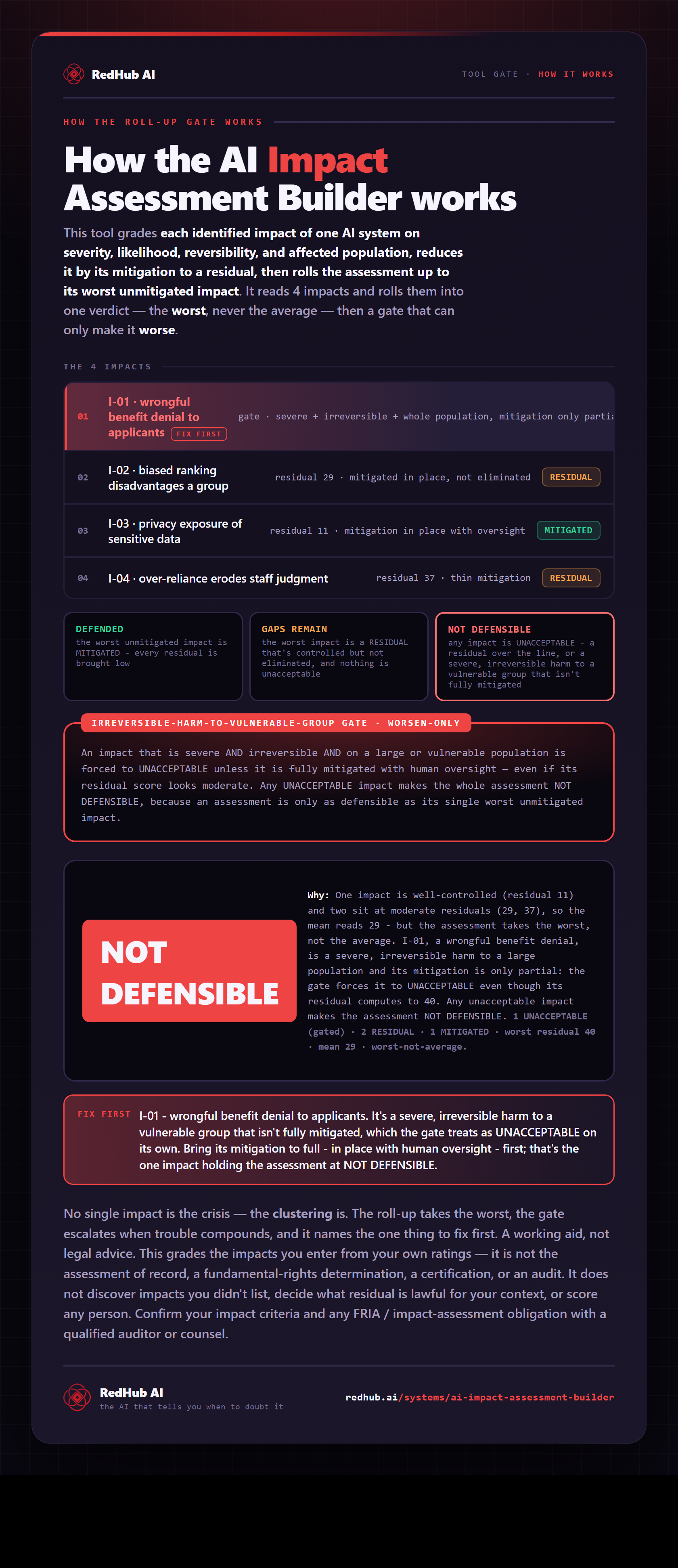
How the gate works, in one image
How the AI Impact Assessment Builder rolls impacts up to the worst and reads EVIDENCE GAPS PRESENT AS DESCRIBED when one residual stays unacceptable — the same math the demo runs, as a diagram you can share or embed anywhere.
View & embed the full diagramThe same verdict, reproducible from the command line.
A zero-dependency Python engine reproduces every number in the workbook and the demo. Point it at a CSV of your impacts and it returns each residual, the assessment verdict, and, where an impact is short, the one to fix first.
$ python3 engine.py sample.csv

==========================================================================
AI IMPACT ASSESSMENT — DEFENSIBILITY READ
==========================================================================
Assessment verdict: EVIDENCE GAPS PRESENT AS DESCRIBED [irreversible-vulnerable gate fired]
Worst residual impact (headline): 40/100   |   Mean residual (context only): 27/100
Mitigated: 2/6 in-scope impacts
--------------------------------------------------------------------------
Impact    Inh  Res  Verdict      S/L/R/P   Mit  Title
I-01       93   40  UNACCEPTABLE 3/2/3/3     2  Wrongful benefit denial to *GATE
         GATE: Severe, irreversible harm to a large/vulnerable population that is not fully mitigated with human oversight (mitigation < 3) — independently triggers the severe-impact gate because the entered ratings meet the stated gate conditions.
I-02       67   29  RESIDUAL     2/2/2/2     2  Biased ranking disadvantag
I-03       40   29  RESIDUAL     1/2/1/1     1  Minor UI confusion for som
I-04       72   11  MITIGATED    3/1/2/2     3  Privacy exposure of sensit
I-05       52   37  RESIDUAL     2/1/1/2     1  Over-reliance erodes staff
I-06       93   14  MITIGATED    3/2/3/3     3  Severe irreversible harm f
I-07      100  100  UNACCEPTABLE 3/3/3/3     0  Retired pilot scoring feat *GATE  (out of scope)
         GATE: Severe, irreversible harm to a large/vulnerable population that is not fully mitigated with human oversight (mitigation < 3) — independently triggers the severe-impact gate because the entered ratings meet the stated gate conditions.
--------------------------------------------------------------------------
FIX FIRST: I-01 (residual 40/100, UNACCEPTABLE) — Wrongful benefit denial to applicants
==========================================================================
A working aid for grading a single AI system's impact assessment, not the
assessment of record, a fundamental-rights determination, a certification, or
legal advice. It grades your identified impacts from your own ratings; it does
not discover impacts you didn't enter and scores no person.
Four dimensions, reduced by mitigation.
How badly an affected person could be harmed. 3 = severe, irreversible, or life-affecting.
How hard the harm is to undo if it occurs. 3 = irreversible.
How likely in normal operation. 3 = near-certain.
How many, and how vulnerable. 3 = a large or vulnerable group.
One mitigation rating per impact (0 none → 3 in place with human oversight & monitoring) reduces the residual: residual = inherent × (1 − mitigation/3 × 0.85). Full mitigation cuts a residual by 85% — but never to zero, because no control eliminates a severe impact entirely.
An impact that is severe AND irreversible AND on a large or vulnerable population is forced to UNACCEPTABLE unless it is fully mitigated with human oversight — even if its residual looks moderate. The sample’s I-01 computes a residual of 40 and still gates. Bring its mitigation to 3 to release it.
A pressure test for your assessment, not a verdict on your system.
- A builder that grades one system’s impact assessment on its worst unmitigated impact.
- A gate that catches a severe irreversible harm to a vulnerable group.
- A reproducible workbook + engine + demo, all giving the same verdict.
- The per-system artifact EU AI Act Art. 27 and ISO 42001 Annex A contemplate.
- Not the assessment of record, and it won’t discover impacts you don’t enter.
- Not a fundamental-rights determination or a ruling on what residual is lawful.
- Not a certification or an audit opinion.
- Not a tool that scores the system’s quality or any person, and not legal advice.
A working aid, not legal advice. This grades the impacts you enter from your own ratings — it is not the assessment of record, a fundamental-rights determination, a certification, or an audit. It does not discover impacts you didn’t list, decide what residual is lawful for your context, or score any person. Confirm your impact criteria and any FRIA/impact-assessment obligation with a qualified auditor or counsel.
Anyone who has to assess one AI system’s impact on people.
The assess → register → defend core.
The living register that tracks each risk. This builder defends each high-impact system the register flags. Run both.
Scores your whole AIMS and routes a Risk & Impact gap to exactly this pair — register plus impact assessment.
Publish the limitations you found here as a model or system card — graded so it informs the reader instead of over-claiming.
Straight answers before you buy.
A graded impact assessment for one AI system. You list the impacts the system could have on people and their rights; you rate each on severity, likelihood, reversibility, and the scale or vulnerability of the affected population, then rate its mitigation. The kit computes each impact's residual and returns MITIGATED / RESIDUAL / UNACCEPTABLE per impact and DEFENDED / GAPS REMAIN / EVIDENCE GAPS PRESENT AS DESCRIBED for the assessment. It is the per-system artifact EU AI Act Article 27 and ISO 42001 Annex A contemplate.
Because a defensible assessment is only as strong as its worst unmitigated impact. If a system causes one severe, unmitigated harm, the fact that ten other impacts are well-controlled does not make that harm acceptable. The kit takes the worst residual as the headline (MIN-as-headline) and reports the mean for context only. One UNACCEPTABLE impact makes the whole assessment read EVIDENCE GAPS PRESENT AS DESCRIBED.
Because of the irreversible-harm-to-vulnerable-group gate. An impact that is severe AND irreversible AND falls on a large or vulnerable population is forced to UNACCEPTABLE unless it is fully mitigated with human oversight — even if its computed residual lands in the moderate range. Partial mitigation of a severe, irreversible harm to a vulnerable group is not defensible. The sample's I-01 computes a residual of 40 and still gates for exactly that reason. Only full mitigation with oversight releases it.
Each impact carries one mitigation rating 0–3 that captures both the control and human oversight: 0 none, 1 named but unproven, 2 in place, 3 in place with human oversight and monitoring. Residual = inherent × (1 − mitigation/3 × 0.85). Full mitigation cuts the residual by 85% — but never to zero, because no control eliminates a severe impact entirely. That irreducible floor is deliberate: it stops a paper assessment from claiming a severe harm has been fully erased.
No. It is a working aid for building and grading an impact assessment — it structures and pressure-tests your thinking, but it is not the assessment of record, not a legal determination of fundamental-rights impact, and not a certification. It grades the impacts you enter from your own ratings; it does not discover impacts you didn't list or decide what residual is lawful for your context. Confirm any FRIA or impact-assessment obligation with a qualified auditor or counsel.
No. The quality of the assessment depends on the impacts you identify — the tool grades only what you enter, and it says so plainly. It is deterministic and offline: nothing uploads, no AI judges your system, and the same logic runs in the workbook, the engine, and the demo so every number is reproducible. It scores the assessment, not the system's quality and not any person.
Find the impact you can’t defend
before someone else does.
One purchase, lifetime access, 12 months of updates. $99, once.
A working aid, not legal advice. This grades the impacts you enter from your own ratings — it is not the assessment of record, a fundamental-rights determination, a certification, or an audit. It does not discover impacts you didn’t list, decide what residual is lawful for your context, or score any person. Confirm your impact criteria and any FRIA/impact-assessment obligation with a qualified auditor or counsel.
Sold by RedHub AI LLC · Secured by Stripe · redhub.ai