A model card that won’tpublish while it over-claims.
Model and system cards are how you tell readers what an AI system is for, where it fails, and how to reach a human. The dangerous card isn’t the thin one — it’s the polished one that claims a capability it can’t back. This builder scores completeness and refuses to call a card publishable while it asserts something its evidence doesn’t support.
The dangerous card is the one that over-claims.
the EU AI Act expects transparency and instructions for use; model-card norms expect intended use, limits, and evaluation disclosed.
the worked sample: a near-complete card, still unpublishable, because it claims performance its evidence doesn't back.
a card that makes no claim is graded on completeness alone; the gate fires only on a claim with nothing behind it.
A card that lists impressive capabilities and stays quiet on limits, or asserts fairness it never measured, misleads exactly the reader it’s meant to inform. This builder couples every claim to the evidence that must exist for it — and won’t pass a card that claims what it can’t show.
Mark the sections. Toggle a claim. Watch the gate.
A card is NOT PUBLISHABLE if it scores too low or makes a claim it can’t back. Silence isn’t dishonesty — a card that makes no claim is graded on completeness alone. It grades the card you write, not the model’s quality and not any person. A working aid, not a certification. Not legal advice.
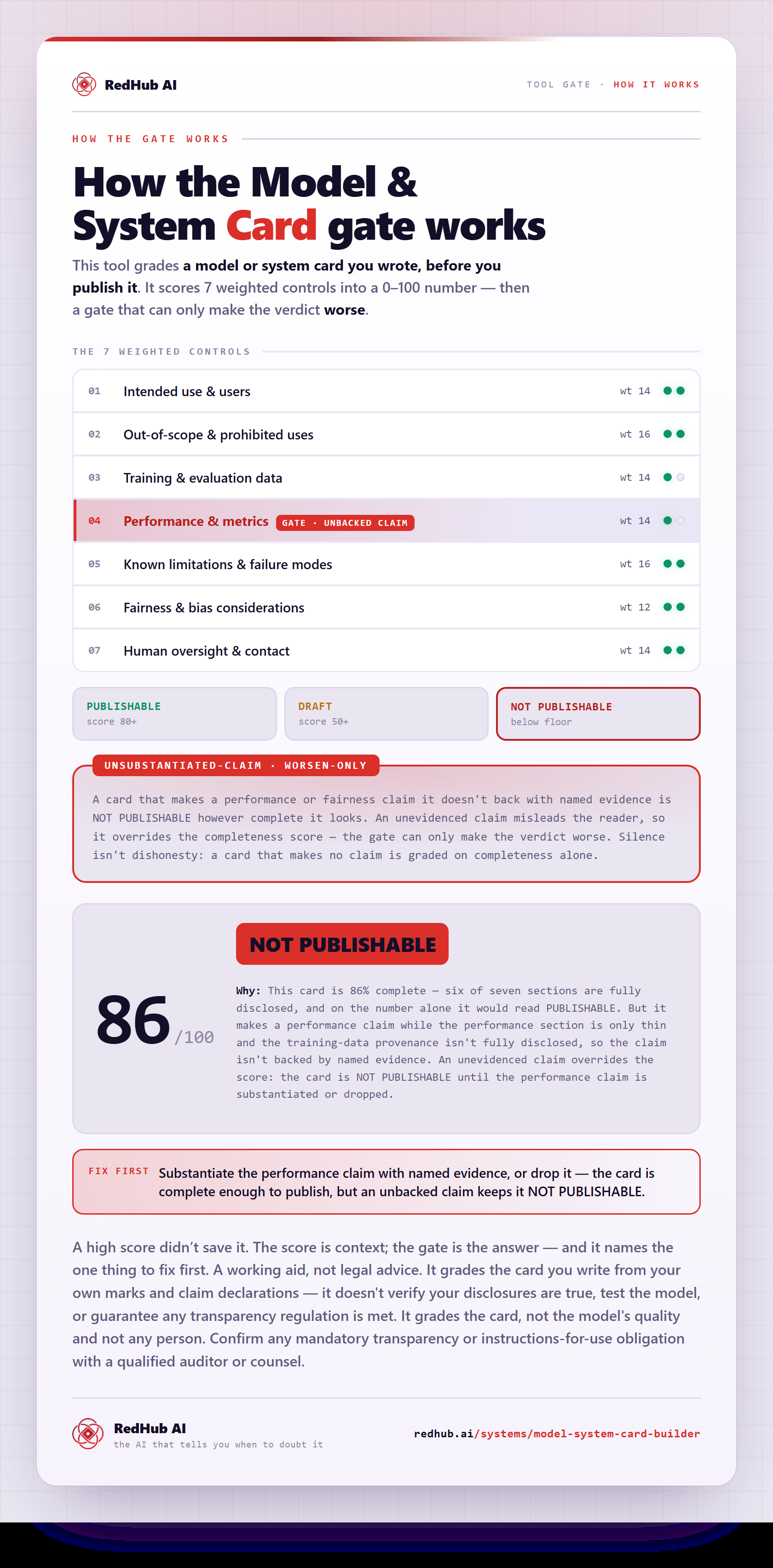
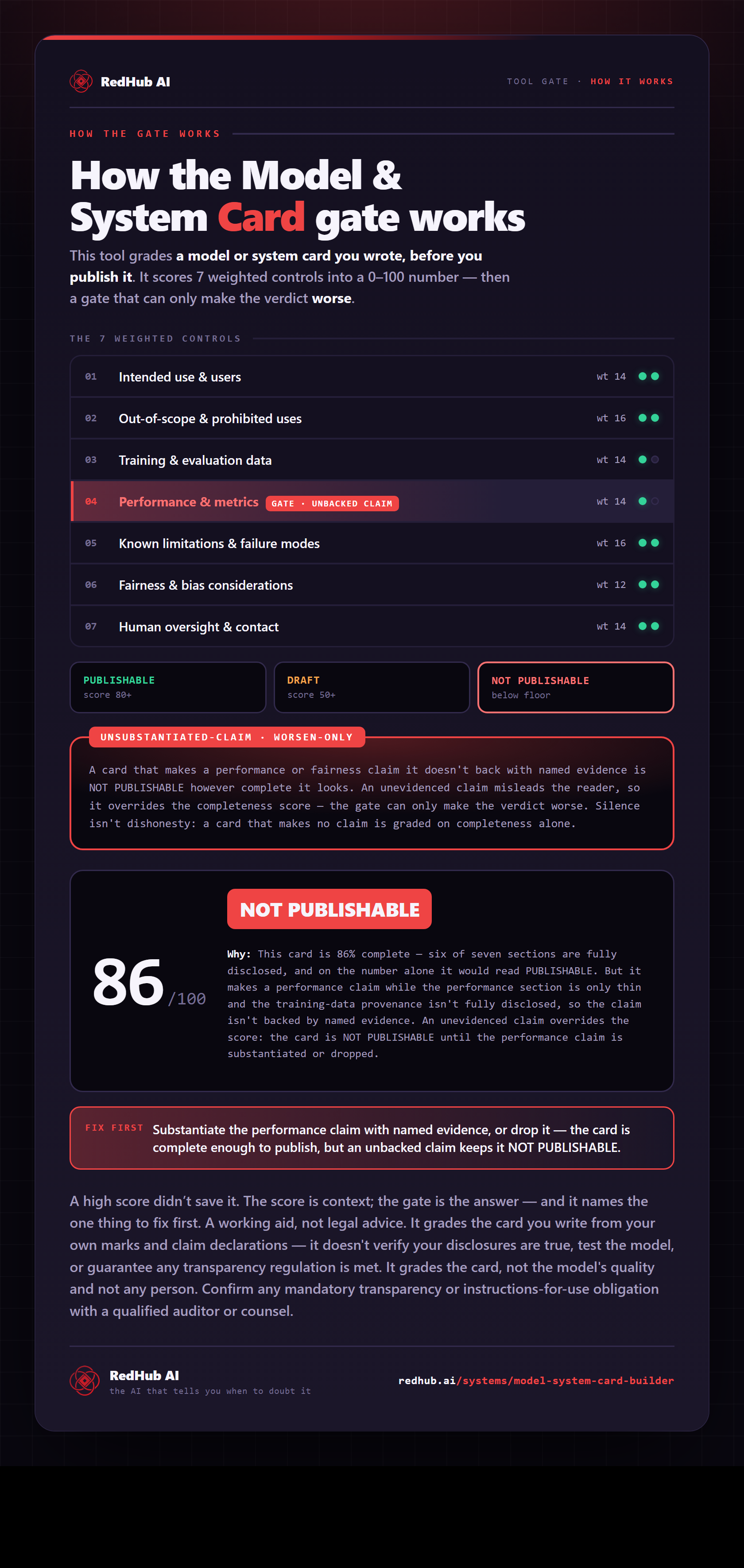
How the gate works, in one image
How the Model & System Card Builder scores a card's completeness and forces NOT PUBLISHABLE when a claim isn't backed by named evidence — the same math the demo runs, as a diagram you can share or embed anywhere.
View & embed the full diagramThe same verdict, reproducible from the command line.
A zero-dependency Python engine reproduces every number in the workbook and the demo. Point it at a CSV of your cards and it returns each section’s disclosure, the gate, and the card verdict.
$ python3 engine.py sample.csv

========================================================================
MODEL / SYSTEM CARD READ — Resume-ranking assistant card
========================================================================
Card verdict: NOT PUBLISHABLE [claim-vs-evidence gate fired]
Completeness score: 86/100  (base PUBLISHABLE)
Claims made: performance [UNEVIDENCED]
------------------------------------------------------------------------
Section                            Mark  Band       Wt
Intended use & users                  2  DISCLOSED  14
Out-of-scope & prohibited uses        2  DISCLOSED  16
Training & evaluation data            1  THIN       14
Performance & metrics                 1  THIN       14
Known limitations & failure modes     2  DISCLOSED  16
Fairness & bias considerations        2  DISCLOSED  12
Human oversight & contact             2  DISCLOSED  14
------------------------------------------------------------------------
FIX FIRST (claim): The card makes a performance claim it does not substantiate with named evaluation evidence. Substantiate it (fully disclose the performance evidence) or stop making the claim.
========================================================================
A working aid for drafting and grading a model/system card, not a
certification, an audit, or a guarantee a published card meets any
regulation. It grades the card from your own marks and claim
declarations; it does not verify your disclosures or test the model.
What a publishable card discloses.
What the system is NOT for. The disclosure that protects readers most.
Where it fails or degrades. The other reader-protecting disclosure.
What it's for, who should use it, in what context.
Where the data came from, its scope, and known gaps.
How it performs, on what metrics, measured on what set.
How humans stay in the loop and how to report a problem.
Known disparities across groups and what was checked.
If the card makes a performance claim the performance section doesn’t fully back with named evaluation data, or a fairness claim the fairness section doesn’t substantiate, the card is forced to NOT PUBLISHABLE regardless of score. The sample’s C-02 scores 86 and still fails. Substantiate the claim or drop it to release the gate — there is no third move.
A pressure test for your card, not a fact-checker.
- A builder that grades a card’s completeness and honesty.
- A gate that catches a claim the card can’t back.
- A reproducible workbook + engine + demo, all giving the same verdict.
- The card model-card norms and EU AI Act Art. 13 transparency contemplate.
- Not a writer — you bring the disclosures; it grades them.
- Not a fact-checker — it doesn’t verify your disclosures are true or test the model.
- Not a certification or a guarantee a card meets a specific regulation.
- Not a tool that scores the model’s quality or any person, and not legal advice.
A working aid, not legal advice. This grades the card you write from your own marks and claim declarations — it doesn’t verify your disclosures are true, test the model, or guarantee a published card meets any specific transparency regulation. It grades the card, not the model’s quality and not any person. Confirm any mandatory transparency or instructions-for-use obligation with a qualified auditor or counsel.
Anyone who has to publish a card for an AI system.
The internal assessment, the outward card.
Assess one system's impacts; this card publishes the limitations you found. The internal assessment, the outward card.
The living register that tracks each risk. The card is the public face of the same governance.
Scores your whole AIMS; documentation like model cards is part of what it looks for.
Straight answers before you buy.
A graded model or system card — the transparency document that tells readers what an AI system is for, how it performs, where it fails, and how to reach a human. You fill seven sections and mark how fully each is disclosed; the builder scores completeness (weighted to 100) and returns DISCLOSED / THIN / MISSING per section and PUBLISHABLE / DRAFT / NOT PUBLISHABLE for the card. It's the kind of card model-card norms and EU AI Act Article 13 transparency contemplate.
Because of the claim-vs-evidence gate. If the card makes a performance claim but the performance section isn't fully disclosed with named evaluation data — or makes a fairness claim the fairness section doesn't substantiate — the card is forced to NOT PUBLISHABLE no matter how complete it looks. A transparency document that asserts a capability it can't back misleads the very reader it's meant to inform. The sample's C-02 scores 86 and still fails for exactly that reason. Substantiate the claim or stop making it to release the gate.
Not necessarily — and this is the honest part. A card that makes no performance or fairness claim never trips the gate, however thin: silence is not dishonesty. A card that makes a bold claim with nothing behind it does trip it, however polished. The sample's C-03 is thin but honest and reads DRAFT; C-02 is far more complete but over-claims and reads NOT PUBLISHABLE. Claiming something you can't back is the failure, not leaving a section short.
Out-of-scope/prohibited uses and known limitations carry the most weight (16 each). They are the disclosures that stop a reader from misusing the system or trusting it where it fails — the reader-protecting heart of a card. Intended use, training/evaluation data, performance, and human oversight & contact follow at 14 each; fairness considerations at 12. Write the two reader-protecting sections before you polish anything else.
Neither. It structures and grades the card you write — it does not draft your disclosures for you, verify that what you wrote is accurate, or test the model. You declare your own section marks and whether the card makes a claim; the gate couples those declarations to the evidence that must exist. It grades the card, not the model's quality and not any person.
No. A high score means the card is complete and doesn't over-claim by this tool's measure — it is not a determination that your card meets any specific legal transparency obligation. Requirements vary by system, role, and jurisdiction, and they change. This is a working aid, not a certification or audit; confirm any mandatory transparency or instructions-for-use obligation with a qualified auditor or counsel.
Publish a card that informs —
and won’t over-claim.
One purchase, lifetime access, 12 months of updates. $69, once.
A working aid, not legal advice. This grades the card you write from your own marks and claim declarations — it doesn’t verify your disclosures are true, test the model, or guarantee a published card meets any specific transparency regulation. It grades the card, not the model’s quality and not any person. Confirm any mandatory transparency or instructions-for-use obligation with a qualified auditor or counsel.
Sold by RedHub AI LLC · Secured by Stripe · redhub.ai