Is your published contenta scaled-content penalty waiting to land?
Google's scaled-content-abuse enforcement targets pages built to rank with little value added — human-written or AI, it doesn't care. This gate grades what's already live on six signals and tells you which pages are exposed before the next enforcement cycle reaches you.
Enforcement turns on a page's weakest area — not its average.
organic traffic lost by sites hit in the scaled-content enforcement waves (as reported across SEO press)
signal that decides a page — one thin area sinks it, however strong the rest
effect — low-value pages drag the whole site's perceived quality
The policy doesn't prohibit AI — it targets thin content at scale, whoever produced it. The pages that survived shared one thing: demonstrable first-hand experience. This gate grades your live pages on the six signals that separate the survivors from the casualties.
A page can score a perfect 2 four times over — and still be EXPOSED.
Mark the six signals on a page below. The weakest one is the verdict. And if the page is mass-templated with no first-hand value, the gate forces EXPOSED no matter how the rest scores.
Page
/locations/plumber-springfield
Gate: this page is mass-templated and carries no first-hand value — the exact scaled-content casualty pattern. It's EXPOSED even though four of six signals are a perfect 2. Lift either gate signal off zero and it climbs out.
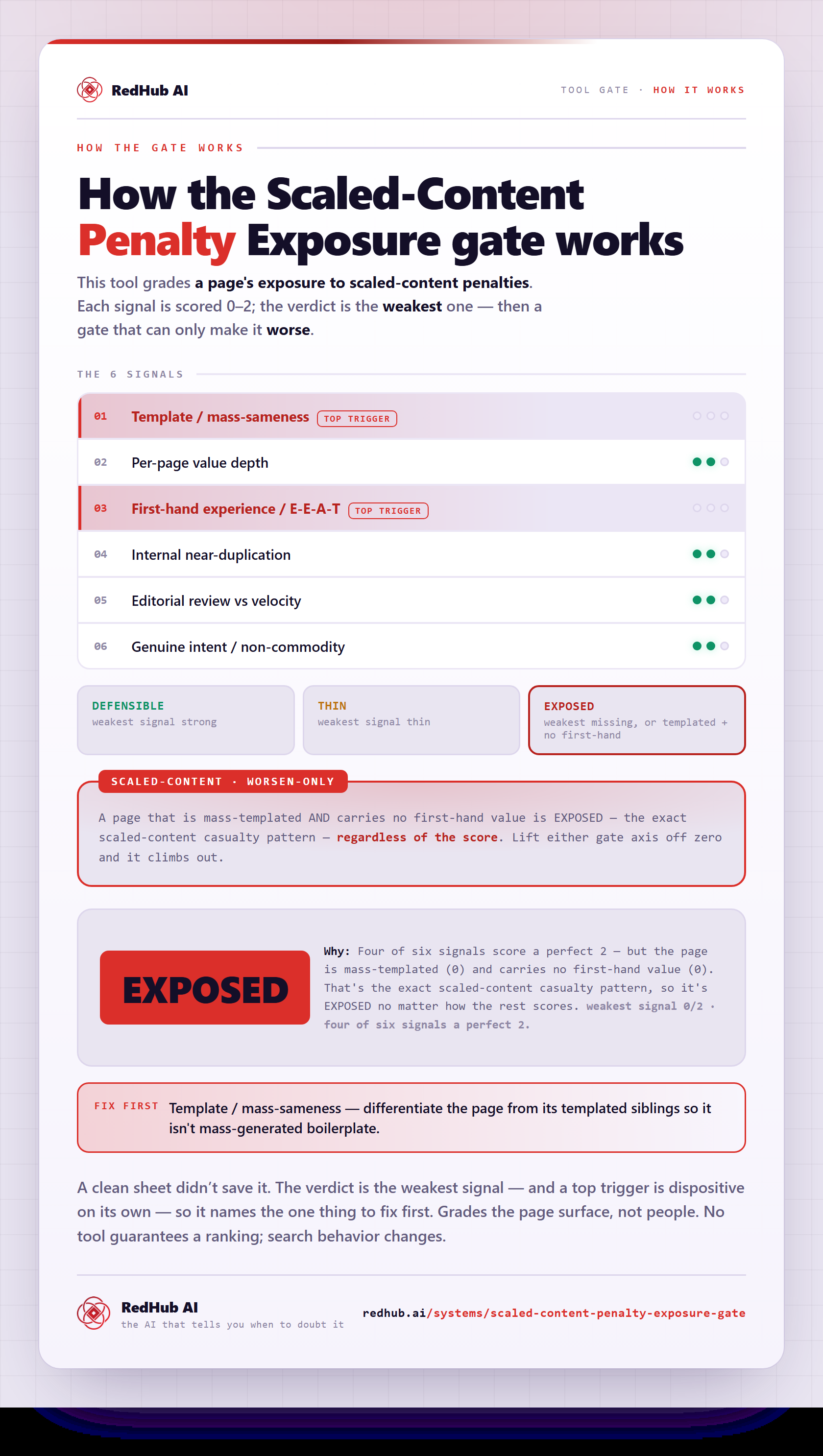
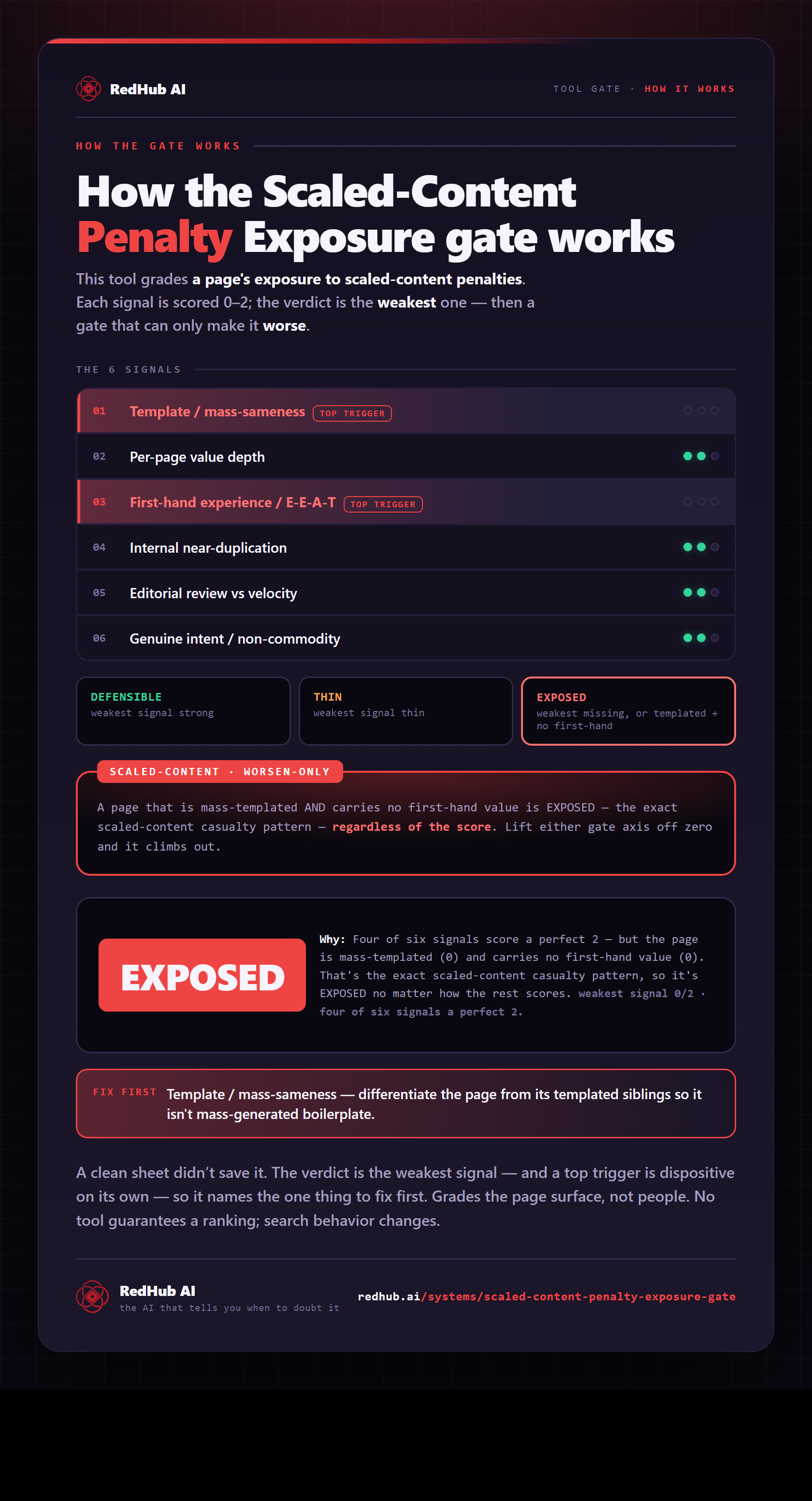
How the gate works, in one image
The six signals with the verdict set by the weakest, and the gate that forces EXPOSED when a page is mass-templated and carries no first-hand value — the same math the demo runs, as a diagram you can share or embed anywhere.
View & embed the full diagramThe same verdict from a script, a workbook, and the demo.
The zero-dependency Python engine grades an exported page audit and prints the per-page verdict, the gate, the fix-first signal where a signal is short, and the site rollup. Here it is run against the shipped sample — the workbook and the demo above reproduce these verdicts exactly.
Scaled-Content Penalty Exposure Gate  (SCP-079)
Evaluation date: 2026-06-26
================================================================

PAGE: /locations/plumber-springfield  ->  EXPOSED
  [GATE] mass-templated + no first-hand value -> EXPOSED
    Template / mass-sameness         0 (gate axis)
    Per-page value depth             2
    First-hand experience / E-E-A-T  0 (gate axis)
    Internal near-duplication        2
    Editorial review vs velocity     2
    Genuine intent / non-commodity   2
    min 0  | mean 1.33 (context only)
  Fix first: Template / mass-sameness

PAGE: /guides/sourdough-starter-from-scratch  ->  DEFENSIBLE
    Template / mass-sameness         2 (gate axis)
    Per-page value depth             2
    First-hand experience / E-E-A-T  2 (gate axis)
    Internal near-duplication        2
    Editorial review vs velocity     2
    Genuine intent / non-commodity   2
    min 2  | mean 2.00 (context only)

PAGE: /blog/best-crm-tools-2026  ->  THIN
    Template / mass-sameness         2 (gate axis)
    Per-page value depth             1
    First-hand experience / E-E-A-T  2 (gate axis)
    Internal near-duplication        2
    Editorial review vs velocity     2
    Genuine intent / non-commodity   2
    min 1  | mean 1.83 (context only)
  Fix first: Per-page value depth

PAGE: /services/ai-seo-audit  ->  THIN
    Template / mass-sameness         2 (gate axis)
    Per-page value depth             2
    First-hand experience / E-E-A-T  1 (gate axis)
    Internal near-duplication        2
    Editorial review vs velocity     1
    Genuine intent / non-commodity   2
    min 1  | mean 1.67 (context only)
  Fix first: First-hand experience / E-E-A-T

PAGE: /locations/plumber-shelbyville  ->  THIN
    Template / mass-sameness         1 (gate axis)
    Per-page value depth             2
    First-hand experience / E-E-A-T  2 (gate axis)
    Internal near-duplication        2
    Editorial review vs velocity     2
    Genuine intent / non-commodity   2
    min 1  | mean 1.83 (context only)
  Fix first: Template / mass-sameness

PAGE: /compare/tool-a-vs-tool-b  ->  EXPOSED
    Template / mass-sameness         1 (gate axis)
    Per-page value depth             1
    First-hand experience / E-E-A-T  1 (gate axis)
    Internal near-duplication        0
    Editorial review vs velocity     1
    Genuine intent / non-commodity   1
    min 0  | mean 0.83 (context only)
  Fix first: Internal near-duplication

================================================================
SITE: SITE EXPOSED   (2 of 6 pages EXPOSED, 33.3% exposure rate)
Penalty exposure is sitewide: the site is only as defensible as its weakest page.Three operating principles.
The weakest signal wins
MIN-as-headline: the lowest of the six signals is the diagnosis and the verdict. The mean is context only, because enforcement turns on the weakest area.
The casualty gate
Mass-templated + no first-hand value forces EXPOSED regardless of score — the exact survivor/ casualty split. Worsen-only; lift either axis and it releases.
Your marks, sitewide truth
The verdict comes from your own review. The site is only as defensible as its weakest page, and the exposure rate decides: fix the pages, or consolidate the cluster.
It grades penalty exposure on live pages — not voice, and not for Google.
It is
- A search-penalty exposure gate for already-published pages and clusters.
- A per-page verdict plus a site rollup and exposure rate you act on.
- A consolidate-or-fix decision aid grounded in the published signals.
It isn't
- A brand-voice or style checker — that's the Anti-Slop Content System.
- Affiliated with Google, a crawler, or a prediction of any specific ranking action.
- An assessment of people; it grades pages, with no guaranteed rankings.
A working aid for your own SEO review — not legal advice, not affiliated with Google, and not a guarantee of rankings or recovery. Re-audit as the policy and signals evolve.
Anyone sitting on content published at scale.
For
- SEOs and agencies auditing a programmatic or location-page footprint.
- Publishers and content teams who scaled AI output and want a risk read.
- Founders deciding whether to fix, consolidate, or retire a content cluster.
Not for
- Grading voice or style before publishing — use the Anti-Slop System.
- Measuring AI-answer citation — use the AEO Audit Kit.
- Anyone wanting a guaranteed ranking outcome; this grades exposure.
The content-defensibility shelf.
Anti-Slop Content System
The quality guardrail on the way in — grade style, voice, and AI tells before you publish, Publish / Revise / Rework.
AEO Citation Audit & Optimizer Kit
Once a page is defensible, grade whether AI answer engines actually cite it — the visibility side of the same library.
Content Refresh & Publishing Engine
After triage, run the refresh: decide which posts to update, consolidate, or retire, and stage the rewrite.
The questions SEOs actually ask before an enforcement cycle.
The Anti-Slop System is a quality guardrail on the way in — it grades style, voice, and AI tells with a Publish / Revise / Rework call so what you publish doesn't sound like everyone else's AI. This gate works on what's already live and grades a different thing: search-penalty exposure against Google's scaled-content-abuse signals. One protects your voice before publishing; this measures your risk on pages already out there.
Template/mass-sameness, per-page value depth, first-hand experience (E-E-A-T), internal near-duplication, editorial review vs publish velocity, and genuine intent vs commodity — each marked 0–2. The weakest signal is the diagnosis and the verdict because scaled-content enforcement turns on a page's weakest area, not its average: a page can score well on five signals and still be exposed on the sixth. The mean is shown only for context.
A page that is mass-templated and carries no first-hand value is EXPOSED regardless of how it scores elsewhere — that's the exact pattern the enforcement waves hit hardest. In the worked sample a location page scores a perfect 2 on four of six signals (mean 1.33) and is still EXPOSED, because it's a templated swap-fill with no demonstrable experience behind it. Lift either gate signal off zero and the page climbs out.
No. It's offline and self-contained. You mark each page from your own review and enter the marks; nothing is crawled, uploaded, or sent to Google. It is not affiliated with Google and predicts no specific ranking action — it grades exposure against the published signals so you can act before the next enforcement cycle.
The exposure rate — the share of pages that are EXPOSED — tells you which. A few exposed pages on an otherwise healthy site is a fix list, and the gate names the one signal to fix first on each. A high exposure rate across a templated cluster is a consolidation problem: improving each thin page individually rarely recovers, so the Remediation Runbook walks you through merging thin pages into comprehensive resources and redirecting the thin URLs.
A runnable zero-dependency Python engine that grades an exported page audit, a workbook that reproduces the same per-page verdict and site rollup cell-for-cell, two playbooks (an Exposure Audit Playbook and a Remediation Runbook), and a six-page worked sample. The engine, workbook, and on-page demo all produce identical verdicts. It grades pages, not people — a working aid, no guaranteed rankings, not affiliated with Google.
Find the exposed pages.
Before the next update does.
One purchase, lifetime access, 12 months of updates. $79, once.
A working aid, not legal advice and not affiliated with Google. No guaranteed rankings.
Sold by RedHub AI LLC · Secured by Stripe · redhub.ai