Eleven of fourteen sheets are clean.The set is still not measurable.
Every takeoff tool on the market will happily read a drawing set that cannot support a takeoff, and return quantities either way. This grades the set first. Six properties per sheet, six per set, and a headline that is the worse of the two reads and the worst single sheet — never the average, because a takeoff is only as good as the weakest drawing it reads.
The expensive failure is not a bad measurement. It is a good measurement of the wrong drawing.
Computer vision reads what it is given. It has no way to know the elevation sheet was rescaled when somebody printed it to PDF at half size, so it returns a confident quantity from a drawing whose scale is a guess.
Four or five addenda arrive, usually in the last seventy-two hours. Someone prices the change and nobody updates the set, so the superseded sheet sits in the project folder looking exactly as authoritative as it did before.
By the time the number is wrong in a way anyone can see, it has been in a bid, in a schedule of values, and in a conversation with an owner.
Twenty minutes at intake, on a set that will absorb twenty hours.
Clear the scale on A-201 and watch the verdict move.
Four sheets and the six set controls, running the same arithmetic the shipped engine runs. A-201 scores 83 and reads READABLE on its own — and it is the only reason the whole set is not measurable. That is the instrument in one screen.
scale not declared on 1 sheet(s): A-201
- Fix first
- A-201 · Scale declaration
- Holding the set back
- A-201, M-101
- Out of measurement scope
- A-601
Four sheets here; the shipped kit takes as many as your set has. The verdict is the worse of the set read and the worst single sheet — never the average — and the gate can only ever make it worse. Clear the scale on A-201 and watch a set that was NOT MEASURABLE become PARTIAL without a single other mark changing.
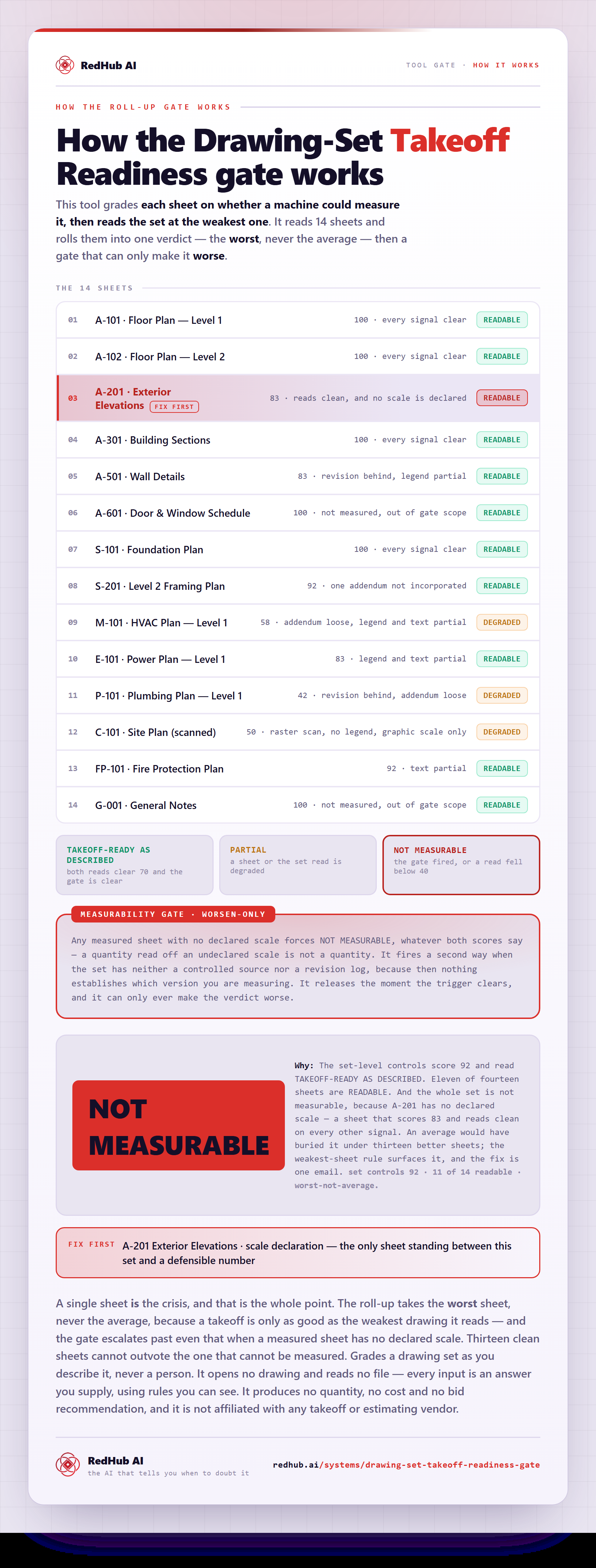
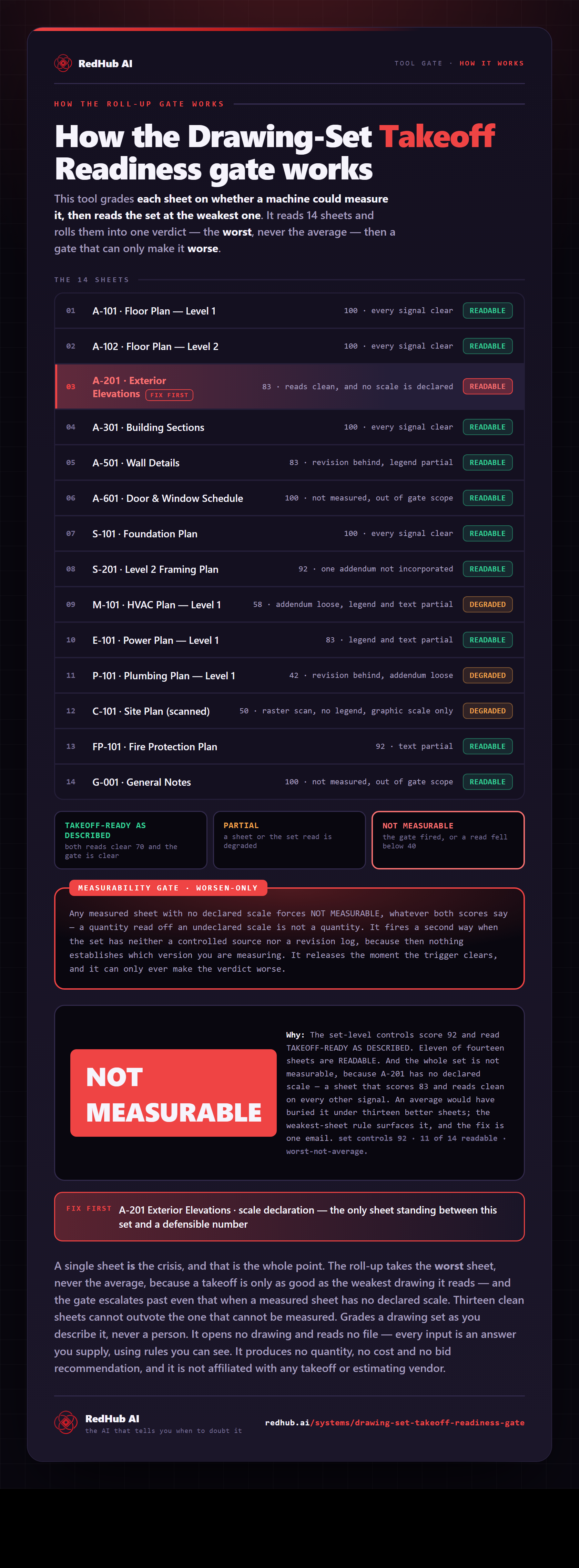
How the gate works, in one image
Fourteen sheets, the set read, and the measurability gate — one picture of why a set that scores 92 and reads eleven-of-fourteen readable still comes back NOT MEASURABLE.
View & embed the full diagramWhat it prints, on the 14-sheet example that ships with it.
Verbatim stdout, not a mock-up. Zero dependencies, Python 3.8+, fully offline.
DRAWING-SET TAKEOFF READINESS GATE — DTR-099
==============================================================================
A-101      Floor Plan - Level 1               100  READABLE
A-102      Floor Plan - Level 2               100  READABLE
A-201      Exterior Elevations                 83  READABLE  <- no scale declared
A-301      Building Sections                  100  READABLE
A-501      Wall Details                        83  READABLE
A-601      Door & Window Schedule             100  READABLE  (not measured)
S-101      Foundation Plan                    100  READABLE
S-201      Level 2 Framing Plan                92  READABLE
M-101      HVAC Plan - Level 1                 58  DEGRADED
E-101      Power Plan - Level 1                83  READABLE
P-101      Plumbing Plan - Level 1             42  DEGRADED
C-101      Site Plan (scanned)                 50  DEGRADED
FP-101     Fire Protection Plan                92  READABLE
G-001      General Notes                      100  READABLE  (not measured)
------------------------------------------------------------------------------
SET CONTROLS:  92  TAKEOFF-READY AS DESCRIBED
           Sheet index                2
           Revision log               2
           Addenda log                1
           Single controlled source   2
           Discipline coverage        2
           File integrity             2
------------------------------------------------------------------------------
SHEETS: 14 total   (READABLE 11 / DEGRADED 3 / UNREADABLE 0)   79% readable
Out of measurement scope: 2 sheet(s) — A-601, G-001   (scale gate covers the other 12)
GATE FIRED: scale not declared on 1 sheet(s): A-201
VERDICT: NOT MEASURABLE
Sheets holding the set back: A-201, M-101, P-101, C-101
Fix first: A-201 · Scale declaration
Read the last five lines together. The set-level controls score 92 and read TAKEOFF-READY AS DESCRIBED. Eleven of fourteen sheets are READABLE. And the verdict is NOT MEASURABLE, because one elevation sheet has no declared scale. An average would have buried that; the worse-of rule surfaces it, and the fix is one email.
Three rules the verdict is held to.
The headline is the worse of the set read and the worst single sheet. One sheet at an undeclared scale invalidates every quantity taken off it however clean the other forty are, so thirty-nine good sheets are never allowed to hide it.
The measurability gate forces NOT MEASURABLE regardless of both scores when any measured sheet has no declared scale, or when the set has neither a controlled source nor a revision log. It releases the moment the trigger clears. It never lifts a verdict, only holds one down.
Scale on a measured sheet, the revision log and the single controlled source cannot be marked not-applicable — the engine refuses the input rather than dropping it from the divisor and the gate at once. Sheets you legitimately never measure can be taken out of scope, and every run prints how many you took.
- Scale declaration
- A stated scale and a graphic scale bar. The bar is the one that matters — it is the only thing that survives a rescaled print.
- Revision currency
- The revision on the sheet matches the current issue, not the one you downloaded five weeks ago.
- Addenda incorporation
- The change is on the sheet, not living in a loose sketch you are expected to remember.
- Legend resolvability
- Every hatch and symbol on this sheet is defined by a legend that is present and consistent.
- Text legibility
- Selectable vector text, not a raster scan of a print.
- Sheet completeness
- Whole sheet, right way up, nothing clipped or missing.
- Sheet index
- The drawing list matches the sheets actually in the file.
- Revision log
- An issue history you can tie to a transmittal.
- Addenda log
- Every issued addendum accounted for, in order, with none skipped.
- Single controlled source
- One issued file, not an assembly of PDFs from three emails.
- Discipline coverage
- Every discipline your scope needs is present.
- File integrity
- No security lock; text and layers intact.
Clear about the lane. No inflated promises.
- A deterministic gate that grades a drawing set before anyone measures it.
- A named list of the sheets holding the set back, and, where a signal is short, the one thing to fix first.
- A dated record of what the set looked like on the day you priced it.
- A Python engine and an Excel workbook that agree, verified across 7,645 cases.
- Offline. Nothing is uploaded and nothing phones home.
- A scanner. It never opens your drawings — every input is an answer you supply.
- A takeoff, a quantity, or a cost estimate.
- A prediction that any takeoff tool will succeed on your set.
- Affiliated with, or a review of, any takeoff or estimating vendor.
- A bid recommendation, or legal or contractual advice.
On the verdict name: TAKEOFF-READY AS DESCRIBED says what it means. The verdict is a statement about the set as you described it in the file, and it is the kind of line that ends up in an email to a GC or an architect — where whoever reads it did not supply the inputs and should not have to guess.
The firm that owns the margin, not the seat that runs the takeoff.
- General contractors bidding from issued sets they did not produce.
- Subcontractors pricing a scope across drawings from several disciplines.
- Estimating teams adopting an AI takeoff tool and wanting a defensible intake step.
- Anyone who has priced a job off a superseded sheet and would rather not again.
- Measure anything, or check a quantity you already have.
- Tell you whether to bid the job.
- Read a PDF, a BIM model, or any file at all.
- Settle a scope dispute or advise on notice provisions in your contract.
The rest of the loop.
Runs before this one. It decides whether the job is worth pursuing at all; this decides whether the set it arrived with can be measured.
The other end of the same loop. This gate protects the number going out; that one tells you whether the numbers you sent ever matched what the work cost.
The same shape aimed at packets rather than drawings — is everything here before anyone starts work.
The questions estimators actually ask before they trust an intake step.
It is a $99 deterministic gate that grades a construction drawing set before anyone measures it, and returns TAKEOFF-READY AS DESCRIBED, PARTIAL, or NOT MEASURABLE. You mark six properties on each sheet and six on the set as a whole; it returns the verdict, the sheets holding the set back, and, where a signal is short, the one thing to fix first. It ships a zero-dependency Python engine, a live-formula Excel workbook, two playbooks and a worked 14-sheet example. It grades the set as you describe it — it never opens your drawings.
Because a takeoff is only as good as the weakest drawing it reads. One sheet at an undeclared scale invalidates every quantity derived from that sheet no matter how clean the other forty are, and an average would let thirty-nine good sheets hide it. In the worked example that ships with the kit, the set-level controls score 92 and read TAKEOFF-READY AS DESCRIBED, eleven of fourteen sheets are READABLE, and the verdict is still NOT MEASURABLE — because one elevation sheet that itself scores 83 has no declared scale. Averaging is exactly how that set gets measured anyway.
Those tools measure. This one decides whether measuring is safe yet, and it is not affiliated with any of them. An AI takeoff tool will return quantities from a set it should have refused, because it has no way to know an elevation was rescaled when someone printed it to PDF at half size. This runs before that tool does, on the same set, and tells you which sheets will produce numbers you cannot stand behind. It makes takeoff software more useful, not less — most sets come back PARTIAL, which means proceed and hand-check the flagged sheets.
The gate is worsen-only and dispositive: it forces NOT MEASURABLE regardless of both scores when any measured sheet has no declared scale, or when the set has neither a controlled source nor a revision log — meaning nothing establishes which version you are holding. A high score plus a fired gate is the most common and most useful result, because it says the set is nearly fine and names the two or three sheets standing between you and a defensible number. The gate releases the moment the trigger clears, and it can only ever make the verdict worse.
Not on the three that matter. Scale declared on a measured sheet, revision log present, and single controlled source cannot be marked not-applicable, and the engine refuses the input rather than quietly dropping it — because marking one N/A would remove it from the divisor and from the gate at the same time, which is how a gate gets waived into silence. Elsewhere a blank genuinely means not applicable and is renormalised out. A schedule or general-notes sheet you never measure can be marked measured = N, which takes it out of the scale gate, and every run prints how many sheets you took out of scope.
That the verdict is a statement about the set as you described it in the file, not about a set anyone inspected. Nothing is uploaded, nothing is scanned, and no drawing is opened — every input is an answer you supply about a set you are holding. The suffix travels with the verdict because the verdict travels: it is the kind of line that ends up in an email to a GC or an architect, and whoever reads it there did not supply the inputs and should not have to guess.
No, and it is checked rather than asserted. The workbook's formulas are read back out of the shipped .xlsx and compared against the engine across 7,645 cases with zero mismatches, including the tie-break that decides which single item is named as fix-first. There is one deliberate difference: a blank scale on a measured sheet is a state the engine refuses outright, and neither Excel nor a browser can refuse, so both treat it as missing and fire the gate. All three err in the same direction.
It is for the general contractor, subcontractor or estimating team that owns the margin on a bid — the firm, not the seat. It pays for itself the first time it stops a set from being measured twice. It is not for anyone who wants a quantity, a cost, or a bid recommendation; it produces none of those. It is not a scanner, not a takeoff, not an estimate, and not legal or contractual advice. If you want the commercial read on whether your bidding process learns from its own history, that is a different instrument.
Check the set.
Then measure it.
One purchase, lifetime access, 12 months of updates. $99, once.
Honest boundary: a document-readiness aid. It grades a drawing set as you describe it — it opens nothing, measures nothing, and is not affiliated with any takeoff vendor.
Sold by RedHub AI LLC · Secured by Stripe · redhub.ai