Your dashboard says thecall was resolved. Was it?
Voice agents log calls as successful that quoted a wrong balance, never handed off an angry caller, or ended politely with the goal unmet. This auditor grades a batch of your call transcripts, catches those calls, and where any call is short names the one to review first — with a trust gate that forces MISHANDLED on any fabricated fact or failed handoff, however polished the rest of the call.
The dashboard tracks whether the call ended — not whether it went well.
and wrong. A voice agent states a balance, a policy, or a price it could not know, in a natural voice a caller can't fact-check in real time. It's the failure mode QA teams rank most dangerous — and it logs as a normal call.
A frustrated caller needed a human and the agent looped, faked competence, or dead-ended. Every missed escalation is a task the AI couldn't finish — and a customer who remembers it.
unresolved. The call ended courteously with the caller's goal unmet. Containment counts it a win; the caller calls back. Transcript-only dashboards miss it because the words sound fine.
Six signals per call, a craft MIN, and a trust gate that outranks a clean score.
The trust gate is worsening this verdict. A trust signal (factual grounding or escalation correctness) at 1 caps a call to SOFT-HANDLED; at 0 it forces MISHANDLED — because a fabricated fact or a failed handoff makes a call harmful however polished. Craft alone would have read RESOLVED.
Same signals, weights, and two-layer gate as the workbook and the runnable engine — one scoring model, three surfaces. Deterministic and offline: it grades calls that already happened, connects to no live agent, and scores no people. Refresh resets the demo; the kit is yours to keep.
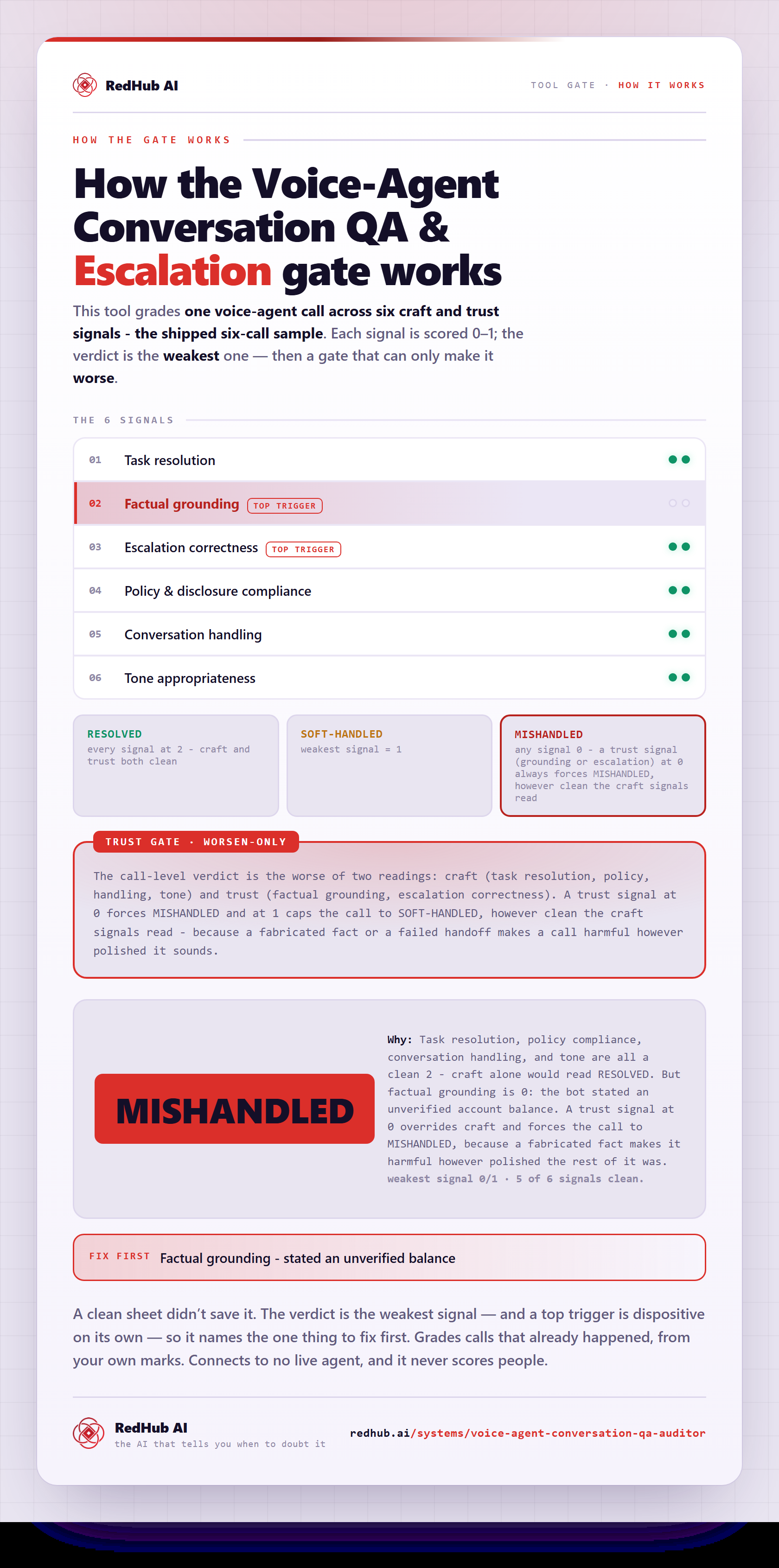
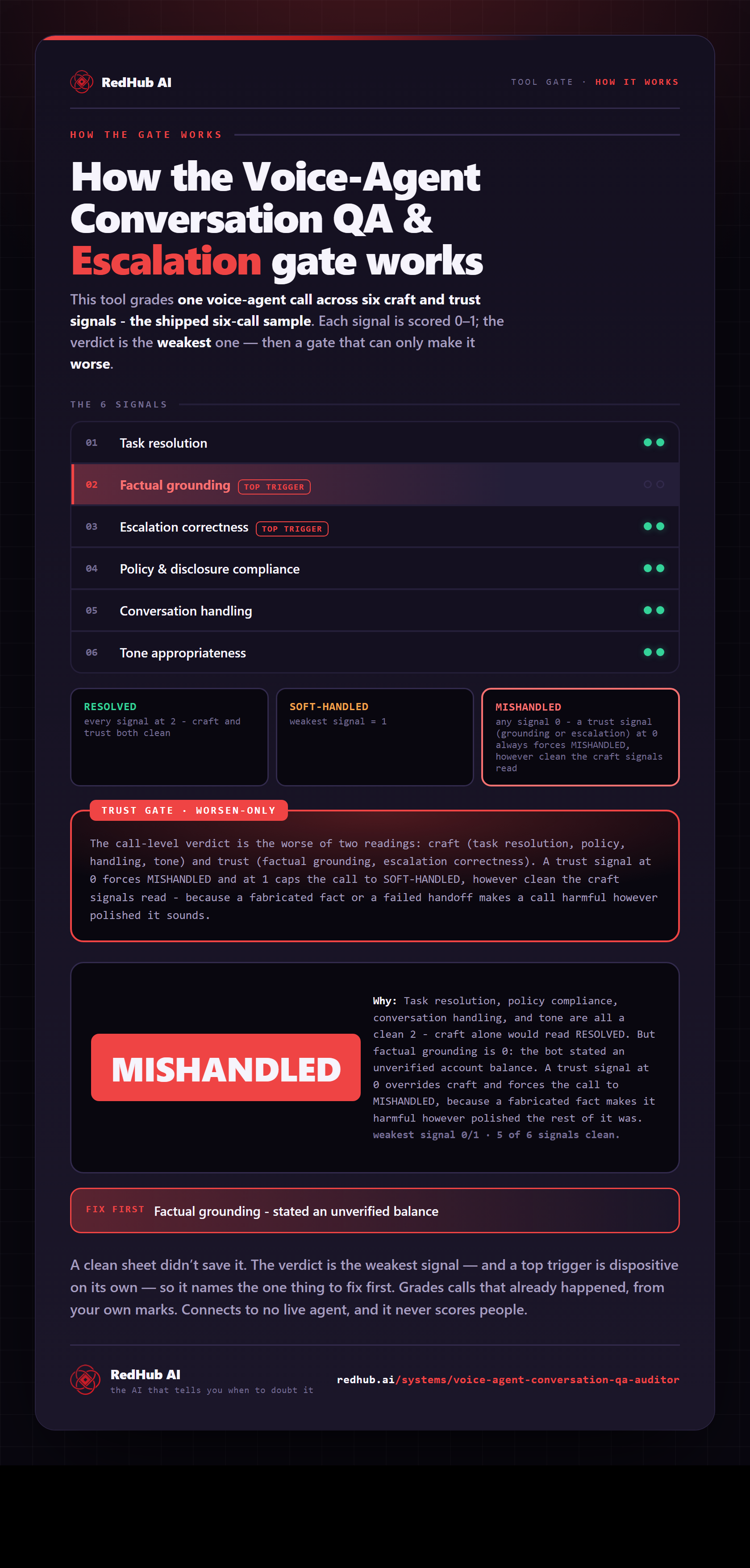
How the gate works, in one image
How the Voice-Agent Conversation QA Auditor grades a call's craft and trust separately and lets a bad trust signal override clean craft — the same math the demo runs, as a diagram you can share or embed anywhere.
View & embed the full diagramOne command grades the whole batch — this output is from the shipped sample, run and verified.
VOICE-AGENT CONVERSATION QA & ESCALATION AUDIT
==========================================================================
Signals (weights): Task resolution 22, Factual grounding 20, Escalation correctness 20, Policy & disclosure compliance 16, Conversation handling 12, Tone appropriateness 10
Verdict = craft MIN (task/policy/handling/tone), then worsened by
the trust gate: grounding or escalation at 1 caps to SOFT-HANDLED,
at 0 forces MISHANDLED.
--------------------------------------------------------------------------
CALL-1042     80  MISHANDLED    [TRUST GATE: forced]
    Balance inquiry - agent stated a specific balance it could not v
    fix first: Factual grounding
CALL-1043    100  RESOLVED
    Appointment reschedule - smooth, confirmed new time
CALL-1051     39  MISHANDLED
    Billing dispute - agent looped, never handed off the angry calle
    fix first: Escalation correctness
CALL-1067     79  MISHANDLED
    Order status - resolved but skipped identity verification step
    fix first: Policy & disclosure compliance
CALL-1078     62  MISHANDLED
    Return request - polite throughout but caller hung up unresolved
    fix first: Task resolution
CALL-1090     90  SOFT-HANDLED  [TRUST GATE: forced]
    Plan change - flawless handling but quoted an unverified promo r
    fix first: Factual grounding
--------------------------------------------------------------------------
BATCH VERDICT: MISHANDLING FOUND
Mishandle rate: 67% (4 of 6 calls MISHANDLED; 1 RESOLVED)
Review first: CALL-1051 -> Escalation correctness
==========================================================================
Deterministic and offline. Grades marks a human recorded from
transcripts of calls that already happened; connects to no live
agent, sends nothing, scores no people. Not legal advice.
Read CALL-1042: it scores 80 — and reads MISHANDLED anyway, because the trust gate caught a balance the agent couldn't verify. And CALL-1090 has flawless craft yet reads SOFT-HANDLED, because it quoted an unverified rate — the gate doing work a quality average would hide. Zero dependencies, Python 3.8+, fully offline; the workbook reproduces the same scoring cell by cell, and a 729-combination verifier ships in the zip that proves the trust gate changes the verdict on 83 of those combinations.
Two layers, each doing distinct work, and a verdict from your own confirmed marks.
The weakest of the four craft signals — task resolution, policy, conversation handling, tone — sets the base verdict, because one broken part of the interaction sinks the call however good the rest was.
The two trust signals — factual grounding and escalation correctness — then worsen that base. A 1 caps a call to SOFT-HANDLED even at perfect craft; a 0 forces MISHANDLED. Graduated, worsen-only, and it never lifts a verdict.
The four Claude Skills propose marks and cite the transcript turns; a human confirms every mark before the verdict stands. No hidden benchmark, no invented rate — the verdict comes from what the calls actually show.
The post-launch QA layer, not a live monitor and not another agent.
- A deterministic, offline QA read of a batch of call transcripts — per-call verdict, mishandle rate, and the one call to review first where any call is short.
- Four Claude Skills that read your transcripts, mark each call with cited evidence, draft the fix, and assemble the report — for you to confirm and act on.
- One scoring model on three surfaces — workbook, Python engine, and this page's demo — with a shipped verifier that proves they agree and that the trust gate earns its place.
- The measurement layer beside the AI Voice Agent Deployment Kit (build) and the AI Agent Go-Live Readiness Gate (pre-launch).
- Not a live monitor or a call simulator — it grades calls that already happened, connects to no live agent, and dials nothing.
- Not an auto-fixer. It drafts recommended changes — a prompt edit, a KB gap, an escalation rule — for a human to review and apply to their own agent.
- Not a scorer of people. It grades the AI agent's conversation, never the caller and never the human who takes a handoff.
- Not legal, safety, or compliance advice, and no resolution or containment outcome is guaranteed.
Anyone accountable for what a live voice agent says to customers.
Build it, clear it, then keep it honest — this is the third stage of a voice-agent lifecycle.
The build stage: production call flows plus a compliance layer for Vapi, Retell, ElevenLabs, and GHL.
ViewThe pre-launch stage: the operator's go/no-go on approval gates, logging, rollback, and escalation before you flip it live.
ViewThe liability lane: triage every customer-facing AI surface — including the voice bot — on exposure before the next answer goes out.
ViewDirect answers on scope, the trust gate, and the calls this catches.
No. It is deterministic and fully offline. You supply transcripts of calls that already happened; you (or the four Claude Skills) mark six 0/1/2 signals per call, and the engine returns the verdict. It connects to no live agent, dials nothing, and sends nothing.
Different stage. The Deployment Kit builds your call flows; the Go-Live Readiness Gate clears the guardrails before you launch; this auditor grades the calls once the agent is live. Build it, clear it, then keep it honest — three stages, three products.
Because the verdict isn't the weighted score — it's the trust gate. A call that stated a balance it couldn't verify (factual grounding 0) is forced to MISHANDLED however clean the rest was, because a confidently wrong fact erodes trust immediately. The shipped CALL-1042 sample scores 80 and reads MISHANDLED for exactly this reason.
A call that worked but isn't fully trustworthy. The graduated trust gate caps a call at SOFT-HANDLED when a trust signal is a 1 — an unverifiable claim, or a mistimed handoff that resolved anyway — even when every craft signal is a perfect 2. The sample's CALL-1090 has flawless craft but quoted an unverified promo rate, so it reads SOFT-HANDLED, not RESOLVED.
Yes — that is a core catch. Task resolution is marked 0 when the call ended with the caller's goal unmet however courteous the close, so the craft MIN drives it to MISHANDLED. A platform that logs the call as a success won't flag it; marking the transcript does.
Neither. It grades the AI agent's conversation from the transcript and drafts recommended fixes — a prompt change, a KB gap, an escalation rule — for a human to review and apply. It never edits your agent, and it scores no people: not the caller, not the human who takes a handoff. Verdicts come from your own confirmed marks. Not legal, safety, or compliance advice.
Find the calls your
dashboard is hiding.
One audit tells you which calls your agent actually mishandled — and, where any call is short, the one to fix first. One purchase, lifetime access, 12 months of updates. $129, once.
Sold by RedHub AI LLC · Secured by Stripe · redhub.ai