System · Build & Ship
A model does not knowit is filling a gap.It sounds the same either way.
Recalling a fact and inventing one come out in the same confident sentence, in the same register, with the same absence of hedging. This takes a finished deliverable apart fact by fact and says which ones a source actually supports, which ones follow by a rule you can state, and which ones simply appeared.
Deterministic and offline. Fetches nothing, verifies no source.
Grades the facts you record — never people.
Instant download. Python engine, workbook, two playbooks, worked trace.
01
Three states, and only one of them is free
Asserted costs you a reference. Derivable costs you a sentence saying how. Assumed costs nothing at all, which is exactly why it accumulates.
ASSERTED
A source says it, and you recorded where. A clause, a page, a ticket — something a colleague could open tomorrow without asking you.
DERIVABLE
No source says it, but a stated rule turns facts that are asserted into this one. Annual fee times term. Notice period counted back from term end.
ASSUMED
Neither. It arrived in the sentence from somewhere nobody can name, and it reads exactly as confidently as the other two.
02
The problem is never on the row you are reading
A fact can name its inputs, state its rule, and still be an assumption.
F-06
“Monthly run rate is 20,000 USD.” Derived from F-02, by dividing the annual fee by twelve. F-02 cites the order form. This holds: DERIVABLE.
F-05
“We are exposed for a further 36 months.” Derived from F-04, by a perfectly sensible rule. But nothing sourced F-04. This is an assumption with arithmetic on top: ASSUMED.
Both rows look identical. Neither review catches it.
Read F-05 on its own and there is nothing wrong: it names an input, it states a rule, the arithmetic is right. The failure is one row away, and it stays invisible to any check that reads a claim at a time. The trace follows every derivation back through its inputs, up to ten levels, and demotes the ones standing on nothing — then names the root, not the symptom, because fixing F-04 fixes F-05 for free.
03
Give one fact a source and watch what lifts
Source F-04 and F-05 rises with it. Nothing else on F-05’s row changes.
Two repairs, each fixing a root rather than a symptom:
Portfolio verdict
RESTS ON ASSUMPTION
1 grounded · 1 inferred · 2 resting on assumption, of 4. 50% of 12 material facts are asserted — context only. 2 fact(s) looked derived and were demoted. Fix first: Vendor risk memo — F-04.
Vendor risk memo
RESTS ON ASSUMPTION
6 material of 6 facts · 33% asserted
* F-01 Contract term is 36 months
ASSERTED
* F-02 Annual fee is 240,000 USD
ASSERTED
* F-03 Total committed spend is 720,000 USD
DERIVABLE
from F-01; F-02
* F-04 Vendor renews automatically unless cancelled
ASSUMED
* F-05 We are exposed for a further 36 months
ASSUMED
from F-04 — reads DERIVABLE on its own row
derived from an assumption: F-04
* F-06 Monthly run rate is 20,000 USD
DERIVABLE
from F-02
Renewal summary
RESTS ON ASSUMPTION
2 material of 3 facts · 50% asserted · 1 assumption(s) not material
* F-07 Notice period is 90 days
ASSERTED
* F-08 Latest cancellation date is 2027-06-30
ASSUMED
from F-20 — reads DERIVABLE on its own row
derived from a fact that is not in this trace: F-20
F-09 Relationship described as strategic
ASSUMED
Pricing note
INFERRED
2 material of 3 facts · 50% asserted · 1 assumption(s) not material
* F-10 List price is 18 USD per seat
ASSERTED
* F-11 Effective discount is 22 percent
DERIVABLE
from F-10
F-12 Pricing considered competitive
ASSUMED
Contact sheet
GROUNDED
2 material of 2 facts · 100% asserted
* F-13 Account manager is named in the MSA
ASSERTED
* F-14 Escalation contact is named in the MSA
ASSERTED
* marks a material fact; only those set a verdict. Same arithmetic as the shipped engine and workbook. It grades the facts you record, never people, and fetches nothing.
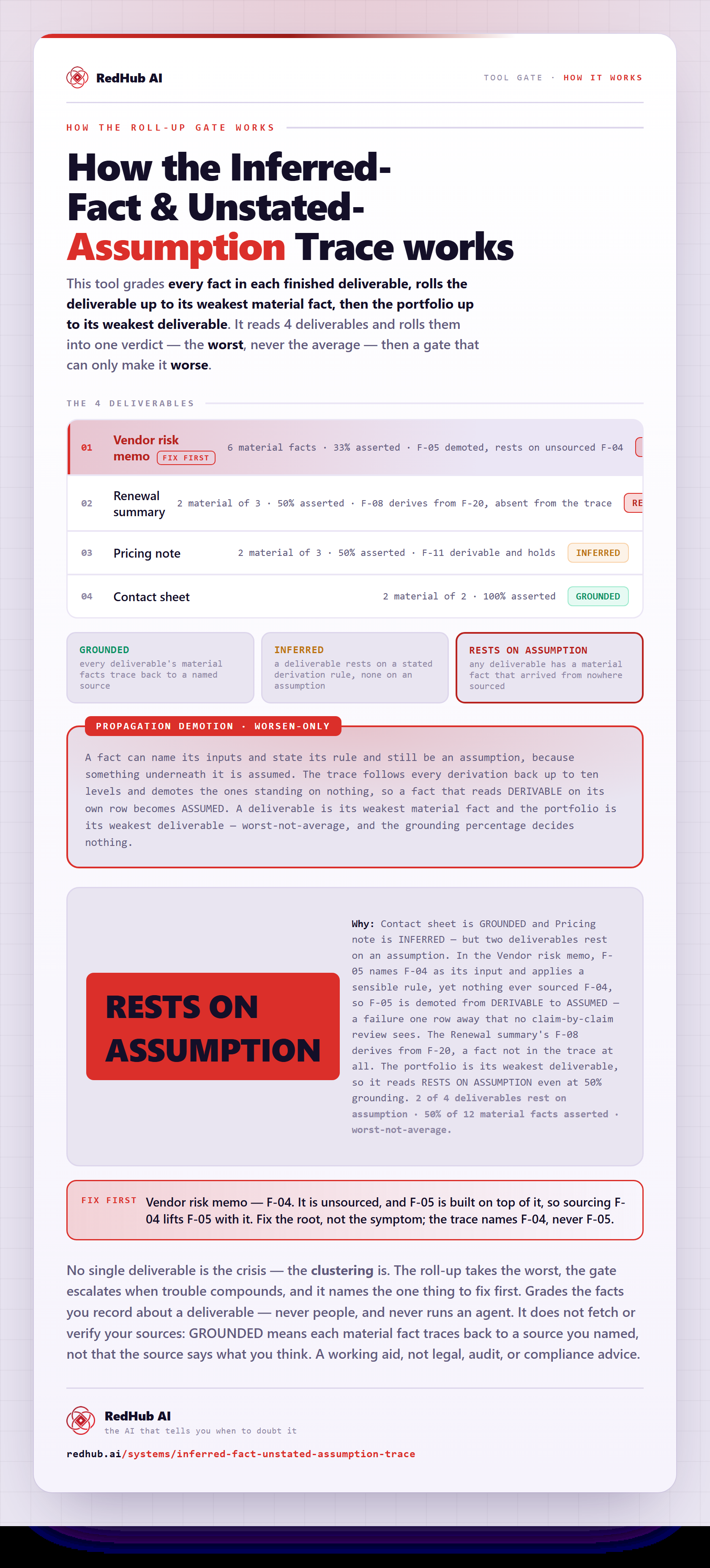
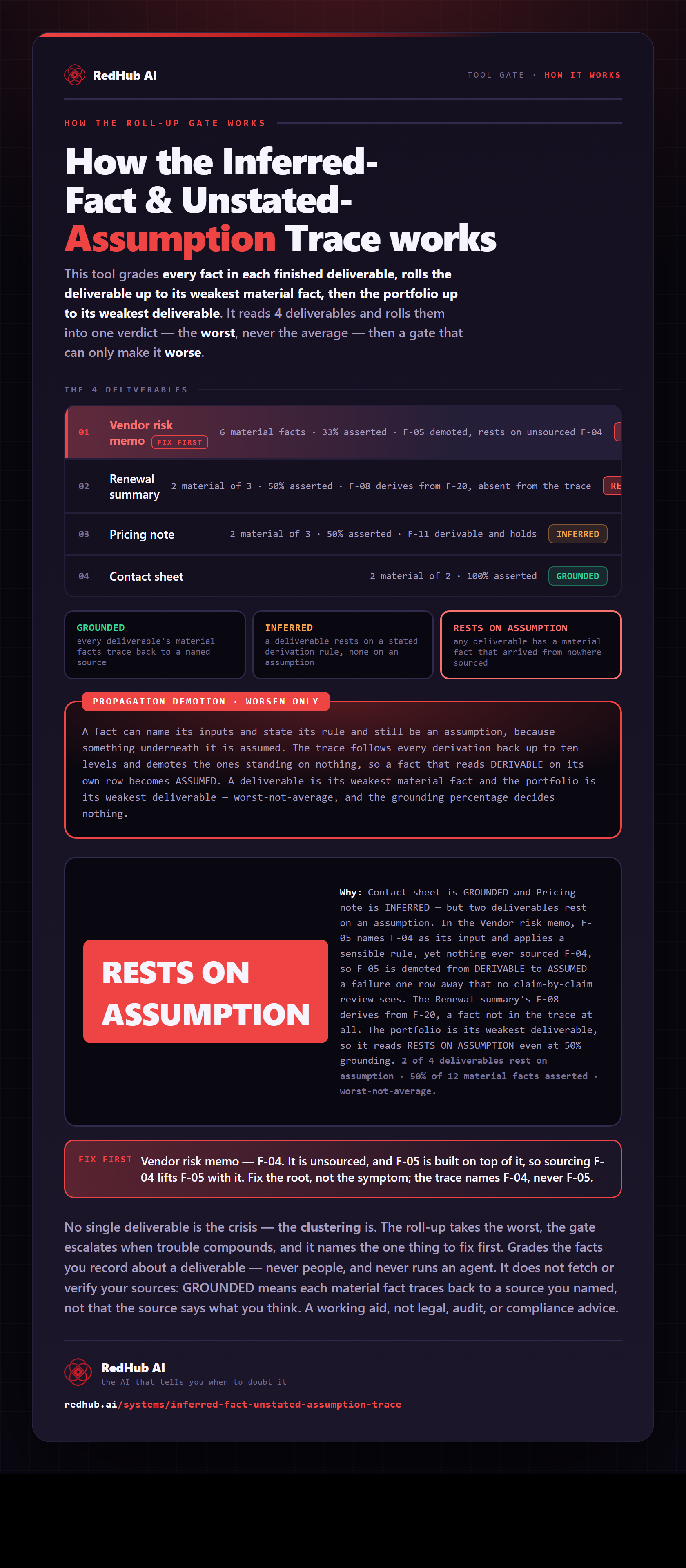
How the gate works, in one image
How the Inferred-Fact & Unstated-Assumption Trace rolls deliverables up to the weakest fact and reads RESTS ON ASSUMPTION when one assumption goes unsourced — the same math the demo runs, as a diagram you can share or embed anywhere.
View & embed the full diagram04
What the engine prints
This is the shipped engine’s complete output on the shipped trace.
INFERRED-FACT & UNSTATED-ASSUMPTION TRACE
==========================================================================

Vendor risk memo   RESTS ON ASSUMPTION
    6 material of 6 facts; 33% of the material ones are asserted
    * F-01    ASSERTED   Contract term is 36 months
    * F-02    ASSERTED   Annual fee is 240000 USD
    * F-03    DERIVABLE  Total committed spend is 720000 USD
          from F-01; F-02
    * F-04    ASSUMED    Vendor renews automatically unless cancelled
    * F-05    ASSUMED    We are exposed for a further 36 months
          from F-04
          [DEMOTED] reads DERIVABLE on its own line - derived from an assumption: F-04
          rests on F-04
    * F-06    DERIVABLE  Monthly run rate is 20000 USD
          from F-02
    fix first: F-04

Renewal summary   RESTS ON ASSUMPTION
    2 material of 3 facts; 50% of the material ones are asserted
    * F-07    ASSERTED   Notice period is 90 days
    * F-08    ASSUMED    Latest cancellation date is 2027-06-30
          from F-20
          [DEMOTED] reads DERIVABLE on its own line - derived from a fact that is not in this trace: F-20
      F-09    ASSUMED    Relationship described as strategic
    1 assumed fact(s) are not material and do not set this verdict
    fix first: F-08

Pricing note   INFERRED
    2 material of 3 facts; 50% of the material ones are asserted
    * F-10    ASSERTED   List price is 18 USD per seat
    * F-11    DERIVABLE  Effective discount is 22 percent
          from F-10
      F-12    ASSUMED    Pricing considered competitive
    1 assumed fact(s) are not material and do not set this verdict

Contact sheet   GROUNDED
    2 material of 2 facts; 100% of the material ones are asserted
    * F-13    ASSERTED   Account manager is named in the MSA
    * F-14    ASSERTED   Escalation contact is named in the MSA

--------------------------------------------------------------------------
PORTFOLIO VERDICT: RESTS ON ASSUMPTION
  1 grounded / 1 inferred / 2 resting on assumption  (of 4 deliverables)
  50% of 12 material facts are asserted  -- context only, it decides nothing
  2 fact(s) looked derived and were demoted; 2 assumption(s) are not material
  fix first: Vendor risk memo -- F-04

  * marks a material fact. Only material facts set a verdict.

Grades the facts you record. Not legal, audit, or compliance advice.
Vendor risk memo is the pair worth reading twice: F-05 and F-06 both derive from a single input by a stated rule, and one is demoted while the other holds, because F-04 was never sourced. Note also Renewal summary, where F-08 derives from F-20 — a fact that is not in this trace at all — and the portfolio grounding of 50% still reads RESTS ON ASSUMPTION off two deliverables, not the average.
05
What is inside
Six files, all editable, none requiring an account.
Trace engine
Zero-dependency Python. Resolves the derivation graph level by level, prints a state per fact, a verdict per deliverable, and a portfolio rollup. No network access of any kind.
Workbook that reproduces it
Three tabs and 219 live formulas, including ten hop columns that follow a derivation chain back the same way the engine does. No macros, no iterative calculation.
Fact-Extraction Playbook
How to pull the facts out of a finished deliverable without rewriting it, and how to decide what counts as material in under an hour.
Assumption Runbook
What each state means, why fix-first names a root rather than a symptom, and the three shapes an assumption usually takes in AI-assisted work.
Worked 14-fact trace
Four deliverables, including the pair that makes the point and a derivation pointing at a fact that is not there.
Editable config
The three state rules, the demotion reasons, and the derivation depth, in a JSON file you own.
06
Who it is for, and what it will not do
It is for whoever signs the thing, and gets asked where a number came from.
Built for
- Anyone shipping AI-assisted memos, reports, or proposals a client or a board will act on.
- Reviewers who can tell something is off but cannot point at the sentence.
- Teams who have already checked their citations and want to know about the claims that never had one.
It will not
- Fetch or open your sources. You record where a fact is asserted; it grades the structure, not the source.
- Tell you a cited source actually says what you claim. That is the Claim & Citation Gate’s question, not this one.
- Extract the facts for you. Pulling them out of the prose is an hour of work and the playbook shows how.
- Treat every assumption as a problem. Non-material ones are counted and left alone.
This System grades the facts you record about a deliverable. It is a working aid, not legal, audit, or compliance advice, and it is not a certification. It never scores, ranks, or assesses people. It does not fetch or verify your sources — GROUNDED means each material fact traces back to a source you named, not that the source says what you think it says.
07
What sits either side of it
The nearest neighbours ask a different question about the same page.
AI Deliverable Claim & Citation Defensibility Gate
$79
Whether the citations you have are present, reachable, and actually support the claim. This asks about the facts that have no citation at all.
AI Output Audit-Trail & Record-Keeping Kit
$79
Records who produced what, when, and with which model. This grades whether the content itself stands up.
Multi-Source Data Reconciliation Engine
$89
When the sources themselves disagree. Worth reaching for once a trace shows the asserted facts are the problem.
08
Questions people actually ask
Short answers first, with the caveat after it rather than in front of it.
Every fact in a finished deliverable, sorted into three states. ASSERTED means a source says it and you recorded where. DERIVABLE means no source says it, but a stated rule turns asserted facts into this one. ASSUMED means neither — it arrived from somewhere nobody can name. Deliverables read GROUNDED, INFERRED, or RESTS ON ASSUMPTION.
A fact can look perfectly derived on its own row — it names inputs, it states a rule — and still be an assumption, because something underneath it is assumed. The trace follows each derivation back through its inputs and demotes the ones resting on nothing. In the shipped example, F-05 and F-06 have identical shapes and get different states, because F-05 rests on an unsourced claim and F-06 does not. No row-by-row review catches that, since the problem is never on the row you are reading.
That Gate asks whether a claim's citation is present, reachable, and actually supports it — it catches fabricated and broken sources. This asks a different question: what about the facts with no citation at all? Are they legitimately derived from things that are sourced, or invented? One checks the citations you have; this checks the reasoning between them. They stack, and neither substitutes for the other.
Because an assumed adjective in a summary sentence is noise, and an assumed number a decision rests on is the thing you were looking for. Flagging both equally is how these reviews get ignored. Non-material assumptions are still classified and counted in their own line so you can see they were considered rather than quietly dropped — the shipped example has two.
Ten levels, and the workbook and the engine stop at exactly the same point rather than one of them guessing further than the other. A chain deeper than that reads ASSUMED with the reason stated. In practice a ten-deep derivation chain inside a single deliverable is itself a finding worth acting on. Derivation loops are detected and reported the same way.
No. It does not fetch anything, open anything, or verify that a cited source says what you claim — that is a separate question and a separate tool. It grades the structure of your reasoning from what you record, which is what makes it deterministic and reproducible, and is also the boundary of what it can tell you. It grades facts, never people, and is a working aid rather than legal, audit, or compliance advice.
Find the sentences nobody can source.
Three states, one graph, and the demotions that no claim-by-claim review can see. Deterministic, offline, and clear that traced to a source is not the same as true.
This System grades the facts you record about a deliverable. A working aid, not legal, audit, or compliance advice. It does not verify sources, and it never scores or ranks people.
Sold by RedHub AI LLC · Secured by Stripe · redhub.ai