Before it goes out the door,prove every claim survives scrutiny.
AI writes a clean board memo in minutes — and quietly cites sources that don't exist. This gate grades a finished deliverable claim by claim and returns DEFENSIBLE, VERIFY FIRST, or DO NOT SHIP. One load-bearing claim resting on an unreachable citation holds the whole thing, however polished the rest.
A deliverable can be 98% right and still be unsupported where the decision turns.
claims in one audited AI-assisted report that didn't check out — enough to make headlines, in a deliverable that read as finished.
is all it takes. A reader acts on a material number; if its source can't be opened, the whole document is on the line.
an AI fabrication often leaves on the surface. The author, title, and DOI look real until someone tries to open them.
An overall "looks good" read is exactly what fails here, because the failure is local: a single load-bearing claim with a broken citation. This gate forces you to look at every claim and won't let a high average paper over a gate-triggering one.
Grade a deliverable, claim by claim — and watch one bad citation hold the whole thing.
| Claim | Material | Citation present | Citation reachable | Source supports claim | Fabrication-free | Internal consistency | Score | Verdict |
|---|---|---|---|---|---|---|---|---|
| C01 | 100 | SUPPORTED | ||||||
| C02 | 100 | SUPPORTED | ||||||
| C03 | 60 | UNSUPPORTED ⛔ | ||||||
| C04 | 100 | SUPPORTED | ||||||
| C05 | 100 | SUPPORTED | ||||||
| C06 | 66 | UNSUPPORTED ⛔ | ||||||
| C07 | 100 | SUPPORTED | ||||||
| C08 | 100 | SUPPORTED | ||||||
| C09 | 76 | CHECK |
Each mark is 0/1/2. Materiality decides whether a defect holds the deliverable. The full kit ships this engine, a workbook that reproduces it, two playbooks, and a worked sample. A review aid for your own deliverables — it grades claims, never people. Not legal advice.
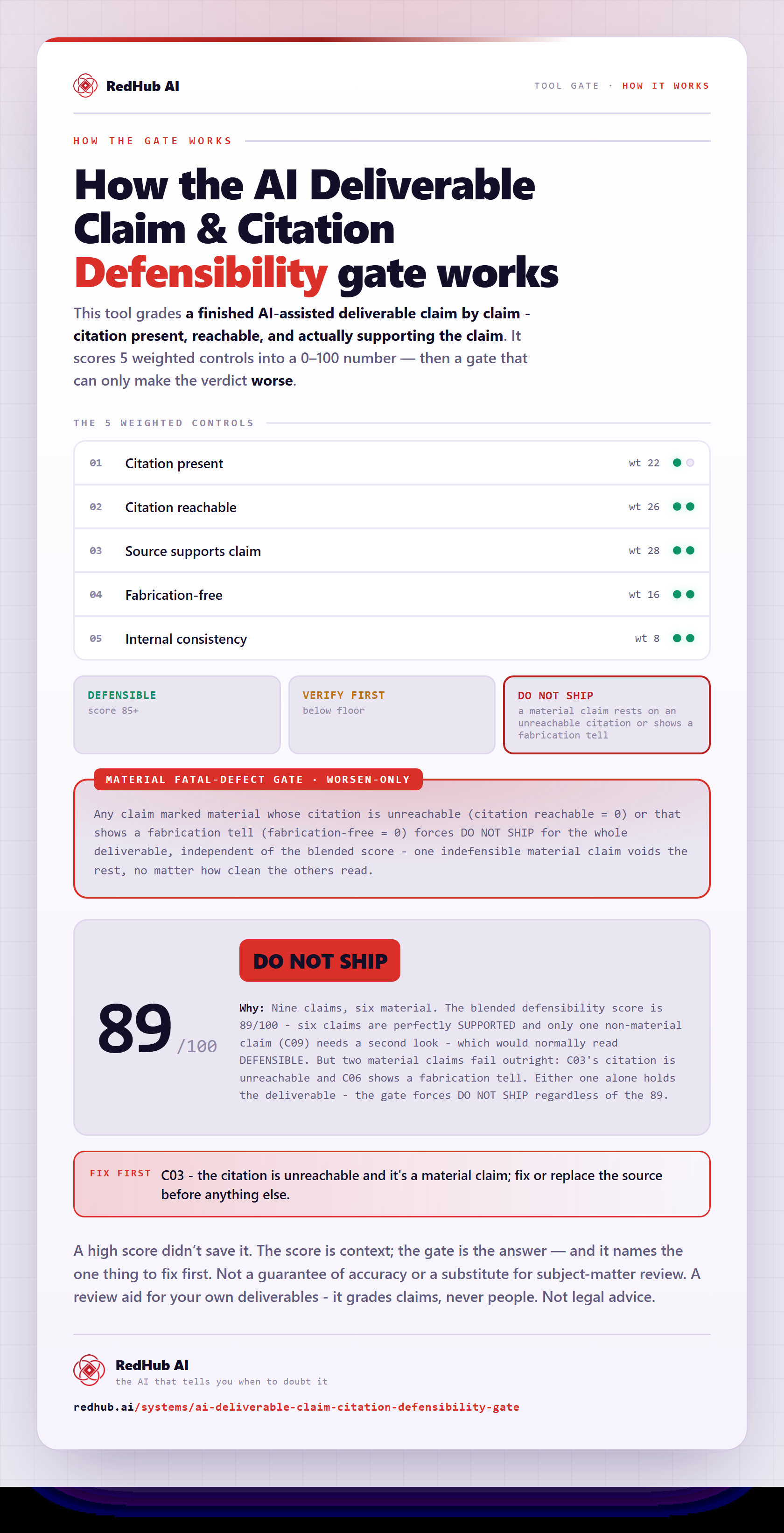
How the gate works, in one image
How the AI Deliverable Claim & Citation Defensibility Gate scores a deliverable's claims and forces DO NOT SHIP on one material claim that can't be cited — the same math the demo runs, as a diagram you can share or embed anywhere.
View & embed the full diagramBOARD-MEMO-Q3 score 89/100 [ DO NOT SHIP ]
claims: 9 (6 material) SUPPORTED 6 / CHECK 1 / UNSUPPORTED 2
GATE FIRED: a material claim has an unreachable or fabricated citation.
fix first: C03
*C01 100/100 SUPPORTED
*C02 100/100 SUPPORTED
*C03 60/100 UNSUPPORTED <- gate
C04 100/100 SUPPORTED
*C05 100/100 SUPPORTED
*C06 66/100 UNSUPPORTED <- gate
C07 100/100 SUPPORTED
*C08 100/100 SUPPORTED
C09 76/100 CHECK
* = material claim.The board memo scores 89/100 and still reads DO NOT SHIP: two of its material claims (C03, C06) rest on citations a reviewer can't open or that show fabrication tells. The score is context; the gate is the verdict.
One engine, one workbook, two playbooks, one worked sample.
A zero-dependency Python CLI: feed it a claims CSV and it returns per-claim SUPPORTED / CHECK / UNSUPPORTED, the deliverable verdict, the keystone gate, and, where a claim is short, the one to fix first. Runs anywhere Python does; nothing uploaded.
Start Here → Dashboard → Claim Grader. Enter the five marks per claim; the same score, the same gate, the same verdict — live formulas, weights summing to 100. Opens in Excel, Google Sheets, or Numbers.
How to pull every claim out of a deliverable, decide what's material, and mark each citation honestly — the reviewer discipline that makes two graders agree.
What to do with a DO NOT SHIP: re-source the claim, downgrade it to a hedge, or cut it — and how to re-grade once you have.
Three rules keep the verdict honest.
A material claim with an unreachable or fabricated citation forces DO NOT SHIP regardless of score. The gate does work the average can't: it finds the one gate-triggering claim a high score hides.
A defect on a claim a decision rests on holds the deliverable. The same defect on a throwaway aside is still flagged, but doesn't gate. You grade what matters, weighted by what's at stake.
No AI grades you, no benchmark is baked in. The engine applies the same scoring and the same gate every time, so the result is reproducible and defensible to whoever asks.
A claim-defensibility gate, not an automatic fact-checker.
- A deterministic, offline gate for finished AI-assisted deliverables — memos, case studies, proposals, reports.
- A claim-by-claim verdict with a keystone gate that catches the one bad citation a polished read misses.
- The substance companion to the Audit-Trail Kit (which records provenance) and the Anti-Slop System (which grades voice).
- Not an automatic fact-checker or AI detector — you do the reviewing and enter the marks; the engine applies the gate.
- Not a grader of people; it grades claims and citations in a document, never the author.
- Not a guarantee of accuracy or a substitute for subject-matter review. A review aid for your own deliverables; not legal advice.
Anyone who signs their name to AI-assisted work.
Build the defensible-AI stack.
Records who generated each output, with what tool, when, reviewed by whom. Keep the record; this gate defends the claims.
ViewGrades voice and style so AI work doesn't read like everyone else's. The quality layer; this is the substance layer.
ViewThe same keystone-gate idea, applied to a job application's verifiability instead of a deliverable's claims.
ViewAnswers before you buy.
Because the score is context and the keystone gate is the verdict. The AI Deliverable Claim & Citation Defensibility Gate grades every claim, but a single material claim resting on a citation a reviewer can't open — or one that shows fabrication tells — forces DO NOT SHIP no matter how high the overall average is. The shipped board-memo sample scores 89/100 and still reads DO NOT SHIP because two of its material claims (C03, C06) have a citation defect that triggers the evidence gate. A high average can't paper over one gate-triggering claim, and that's the point: the failure is local, so the gate makes you look at it.
You grade the deliverable claim by claim. For each claim you mark five 0/1/2 signals — citation present, citation reachable, source actually supports the claim, fabrication-free, internally consistent — and flag whether the claim is material (a reader acts on it). The engine turns those marks into a per-claim SUPPORTED / CHECK / UNSUPPORTED, a deliverable score, the keystone gate, and, where a claim is short, the one to fix first. You do the reviewing; the kit applies the same scoring and gate every time so two reviewers reach the same verdict.
An audit trail is a record; this is whether the work survives scrutiny. The AI Output Audit-Trail & Record-Keeping Kit records who generated each output, with what tool, when, and who reviewed it — provenance. This gate grades whether the claims inside the deliverable actually hold: is every cited source real, reachable, and supporting the claim it's attached to. You want both — the record that you reviewed, and the proof the claims are defensible. They're sold as companions for exactly that reason.
No. It never opens a URL, calls an API, or judges truth on its own — you read each claim, check each citation, and enter the marks; the engine applies the deterministic scoring and the keystone gate. That's deliberate: a reviewer deciding what's material and whether a source genuinely supports a claim is the judgment an automatic checker can't make. It's a review aid that makes your own check rigorous and repeatable, not a substitute for subject-matter review.
Neither. It grades claims and citations in a document, never the person who wrote it, and it runs entirely offline — the Python engine and the workbook both work on your machine with nothing uploaded, so a confidential memo or client proposal never leaves your control. The same logic runs three ways (engine, workbook, on-page demo) and is byte-exact across all three, so the verdict is reproducible and you can show your work to whoever asks.
You get a runnable zero-dependency Python defensibility engine, a workbook that reproduces it (Excel / Google Sheets / Numbers), a claim-review playbook, a fix-the-citation runbook, and a 9-claim worked sample — a one-time purchase with lifetime access and 12 months of updates. It's a review aid for your own AI-assisted deliverables; it grades claims, not people, and it is not legal advice or a guarantee of accuracy. Use it alongside, not instead of, subject-matter review.
Don't let one bad citation
sink the whole deliverable.
Grade it claim by claim before it ships. One purchase, lifetime access, 12 months of updates. $79, once.
Sold by RedHub AI LLC · Secured by Stripe · redhub.ai