Read what your rulesadmit from a visiting agent.
This grades agents that write and transact: book, buy, change, cancel. The AI Bot & Scraper Traffic Control Readiness Gate ($49) grades read traffic from crawlers and scrapers. Here you mark eight agent and action rows across five layers, and where a row is short, the rulebook names the row and the layer.
It reads your marks. It does not check a signature, test your site, or predict what any agent will do, and it is not legal, payment or security advice. A successfully verified signature provides technical evidence that the request was signed by a holder of the private key corresponding to the published key used in verification. It does not by itself establish who operates the agent, whether an end user approved the action, whether the site permits it, whether payment authority exists or whether the action succeeded.
UNVERIFIED MONEY PATH: A money-moving action is marked admitted while the identity layer is below this instrument’s verified mark. This result reflects only the user’s marks. RedHub did not inspect the agent, verify a signature, authorize a payment or determine whether the action was permitted.
“Holds as described” means the entered marks satisfy this product’s stated rulebook conditions. It is not a certification that the rules are lawful, complete, secure or technically enforced.
This self-assessment applies the stated rules to the user’s marks. RedHub did not visit the site, inspect traffic, verify a signature, identify an agent, validate user approval, interpret a contract, authorize a payment or confirm an outcome. The result is not legal, payment or security advice and does not determine whether any action is permitted or required.
A rule you have not written down is a rule an agent cannot read.
is not an approval. A successfully verified signature provides technical evidence that the request was signed by a holder of the private key corresponding to the published key used in verification. It does not by itself establish who operates the agent, whether an end user approved the action, whether the site permits it, whether payment authority exists or whether the action succeeded. Identity and Intent are separate layers here.
Browse and buy are different actions with different exposure. One policy for a whole agent hides the row that admits more than its layers support.
You mark what you do today, then the five layers. A row is a gap where today is more open than the layers support. That difference is the finding.
Mark eight rows. Each row reads ADMIT, REVIEW or REFUSE, and where one is short, the rulebook names it.
Customer-rights review: The automated cancellation request is refused. Confirm whether the customer retains an effective permitted cancellation path and whether any applicable law, contract, platform commitment or accessibility requirement affects that refusal. The rulebook does not make that determination.
Money gate tripped. A money-moving action is marked admitted while the identity layer is below this instrument’s verified mark. This result reflects only the user’s marks. RedHub did not inspect the agent, verify a signature, authorize a payment or determine whether the action was permitted.
Customer-rights review: Required — change or cancellation is refused
Customer shopping agent / cancel is marked refused. Refusal describes the site’s current handling of the automated request, but customer-rights review is not shown. This prevents RULEBOOK HOLDS AS DESCRIBED. Final result: UNVERIFIED MONEY PATH.
Layer Guide, section 1: Identity. It is in the download.
This self-assessment applies the stated rules to the user’s marks. RedHub did not visit the site, inspect traffic, verify a signature, identify an agent, validate user approval, interpret a contract, authorize a payment or confirm an outcome. The result is not legal, payment or security advice and does not determine whether any action is permitted or required.
A refusal mark describes the site’s current treatment of the automated request; it does not determine that refusing the request is lawful or appropriate. For an action that changes or cancels an existing customer order, booking, account, subscription or service, record whether the customer retains an effective permitted way to exercise any applicable change, cancellation, refund or accessibility right. Applicable requirements vary by transaction, contract, jurisdiction and customer relationship. This instrument does not determine what rights apply or whether another channel is sufficient. Obtain qualified advice before relying on refusal as the completed policy for a customer-rights action.
From your own marks · pinned to 2026-10-31 · no AI, no baked-in multiplier · it does not predict what any agent will do.
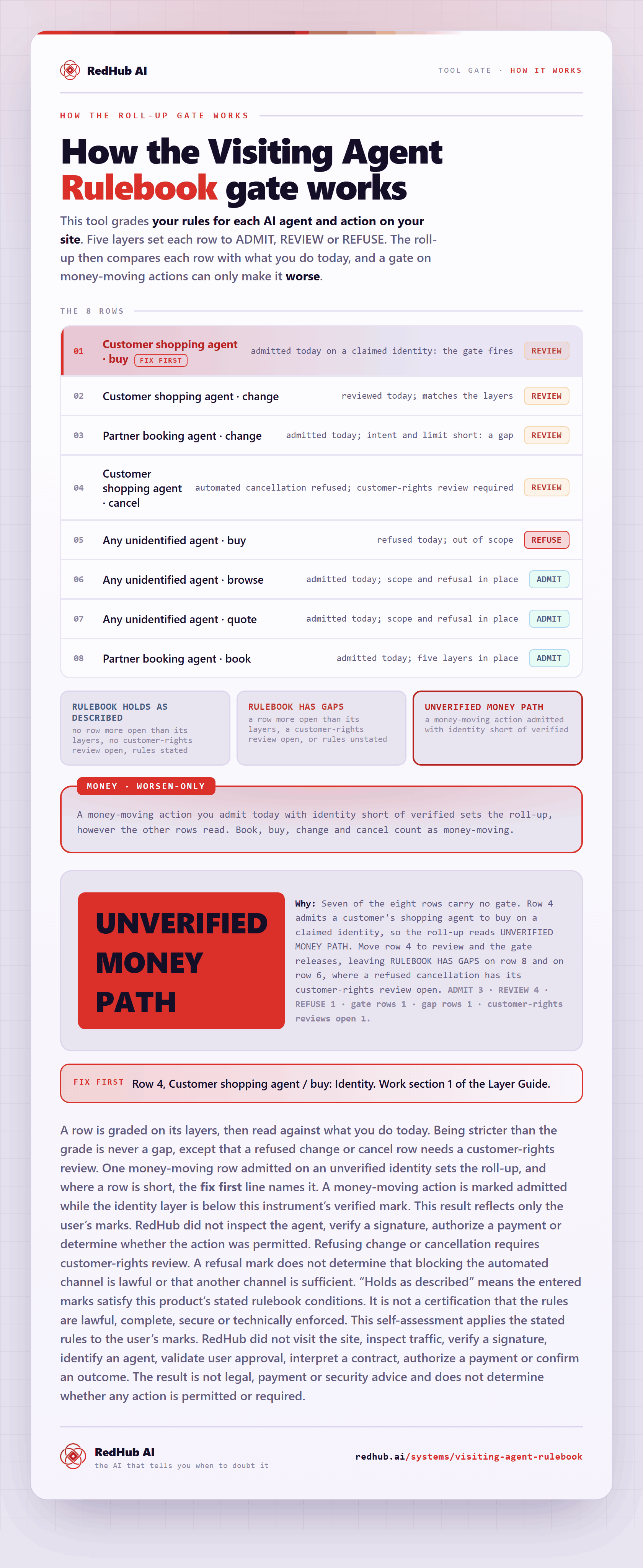
How the gate works, in one image
Agent by action rows graded across five layers, with the money gate and where a short row routes you.
View & embed the full diagramFive layers set the grade. The money gate can override the roll-up.
Each layer is marked 0, 1 or 2. A row is REFUSE where Scope is 0, or where the action moves money and Identity is 0. It is ADMIT where Scope and Refusal are 2 and, for money-moving actions (book, buy, change, cancel), Identity, Intent and Limit are 2 as well. Anything else is REVIEW. A refused change or cancel row displays REVIEW with a customer-rights review, which prevents RULEBOOK HOLDS AS DESCRIBED until the review is recorded. The money gate reports UNVERIFIED MONEY PATH where a money-moving action is admitted today with identity short of verified. A money-moving action is marked admitted while the identity layer is below this instrument’s verified mark. This result reflects only the user’s marks. RedHub did not inspect the agent, verify a signature, authorize a payment or determine whether the action was permitted. Here is the engine on the shipped sample:
A refusal mark describes the site’s current treatment of the automated request; it does not determine that refusing the request is lawful or appropriate. For an action that changes or cancels an existing customer order, booking, account, subscription or service, record whether the customer retains an effective permitted way to exercise any applicable change, cancellation, refund or accessibility right. Applicable requirements vary by transaction, contract, jurisdiction and customer relationship. This instrument does not determine what rights apply or whether another channel is sufficient. Obtain qualified advice before relying on refusal as the completed policy for a customer-rights action.
============================================================
VISITING AGENT RULEBOOK
============================================================

ROWS (agent / action / today -> what the layers support):
  1. Any unidentified agent / browse / admit -> ADMIT
  2. Any unidentified agent / quote / admit -> ADMIT
  3. Any unidentified agent / buy / refuse -> REFUSE
  4. Customer shopping agent / buy / admit -> REVIEW  <- GATE
  5. Customer shopping agent / change / review -> REVIEW
  6. Customer shopping agent / cancel / refuse -> REVIEW  <- CUSTOMER-RIGHTS REVIEW
     Customer-rights review: The automated cancellation request is
     refused. Confirm whether the customer retains an effective permitted
     cancellation path and whether any applicable law, contract, platform
     commitment or accessibility requirement affects that refusal. The
     rulebook does not make that determination.
  7. Partner booking agent / book / admit -> ADMIT
  8. Partner booking agent / change / admit -> REVIEW  <- GAP

  ADMIT 3 | REVIEW 4 | REFUSE 1
  Gate rows: 1 | Gap rows: 1 | Customer-rights reviews open: 1 | Rules published: 1 of 2
  Customer-rights review: Required — change or cancellation is refused

VERDICT: UNVERIFIED MONEY PATH
  money_gate TRIPPED:
  A money-moving action is marked admitted while the identity layer is
  below this instrument’s verified mark. This result reflects only the
  user’s marks. RedHub did not inspect the agent, verify a signature,
  authorize a payment or determine whether the action was permitted.
  Customer shopping agent / cancel is marked refused. Refusal describes
  the site’s current handling of the automated request, but
  customer-rights review is not shown. This prevents RULEBOOK HOLDS AS
  DESCRIBED. Final result: UNVERIFIED MONEY PATH.

FIX THIS FIRST:
  Row 4: Customer shopping agent / buy
  -> Layer Guide, section 1: Identity

This self-assessment applies the stated rules to the user’s marks. RedHub
did not visit the site, inspect traffic, verify a signature, identify an
agent, validate user approval, interpret a contract, authorize a payment
or confirm an outcome. The result is not legal, payment or security advice
and does not determine whether any action is permitted or required.

A refusal mark describes the site’s current treatment of the automated
request; it does not determine that refusing the request is lawful or
appropriate. For an action that changes or cancels an existing customer
order, booking, account, subscription or service, record whether the
customer retains an effective permitted way to exercise any applicable
change, cancellation, refund or accessibility right. Applicable
requirements vary by transaction, contract, jurisdiction and customer
relationship. This instrument does not determine what rights apply or
whether another channel is sufficient. Obtain qualified advice before
relying on refusal as the completed policy for a customer-rights action.

It does not predict what any agent will do.
============================================================Three operating principles keep the verdict honest.
The grade is your own marks made legible. No AI scoring, no baked-in estimate. The same arithmetic runs in the engine, the workbook, and this page.
The money gate reports that your marks show an admitted money action with identity short of verified. It does not stop any transaction. Your marks set it, and it is no conclusion about any payment. At RULEBOOK HOLDS AS DESCRIBED the rulebook names nothing to fix first.
It never visits your site, checks a signature, or contacts an agent. Where you have not checked a layer, mark it low. A layer you have not looked at is not a layer you can call verified.
- Visiting-Agent-Rulebook.xlsx
- engine/visiting_agent_rulebook.py
- engine/config.json
- engine/sample_rulebook.csv
- Layer-Guide.docx
- Reading-Your-Rulebook.docx
- README.md
- Welcome.pdf
- RedHub-LICENSE.txt
A grade of your own marks about your own rules, not a test of any agent.
- A row-by-row grader that, where a row is short, names the row and the layer.
- A grade of agents that write and transact. The AI Bot & Scraper Traffic Control Readiness Gate grades read traffic from crawlers and scrapers.
- Deterministic and offline, the same math in three places.
- A re-runnable check you repeat after you change a rule.
- A signature check, a site test, or a connection to any agent or platform.
- A prediction of what any agent will do.
- A statement of what you must permit or block, or that refusing a request is lawful. The marks are your own decisions.
- Legal, payment or security advice. It is operating hygiene.
Scope: grades marks you enter about your own rules. It checks no signature, tests no site, contacts no agent, and guarantees no agent behavior, and a limit you mark is not tested and may not prevent an unauthorized or duplicate action. As of October 31, 2026, Web Bot Auth (an IETF working-group draft), siteai.json (from the A2WF W3C Community Group) and /.well-known/agent-policy.json (a community draft) are drafts, and none is ratified. Not legal, payment or security advice.
Operators who want to see where their rules for visiting agents are thin.
Do you know which agent this is?
0 to 2: No way to tell / Claimed / Verified
Do you have a record of what the person approved?
0 to 2: No record / The agent says so / Recorded
Is this action inside what you allow this agent?
0 to 2: Undecided / Not written down / Written down
Is there a transaction limit?
0 to 2: No limit / Informal / Set and enforced
Is there a defined way to refuse?
0 to 2: No path / Case by case / Readable refusal
Grade the read side, the path, and the agents you run yourself.
AI Bot & Scraper Traffic Control Readiness Gate
The read side. Grades traffic from crawlers and scrapers, where this rulebook grades agents that write and transact.
Agent Purchase Relay
The path side. Grades five stages from discovery to a confirmed order, with Authorization as one of them. The rulebook goes row by row on that one.
Agent Action Admissibility Engine
For agents you run yourself. Grades whether an action your own agent is about to take is admissible, where this rulebook grades the agents that visit you.
Direct answers on the layers, the gate, and what the grade does not claim.
It grades your rules for AI agents that come to write and transact on your site, row by row as agent and action (browse, quote, book, buy, change, cancel). For each row you mark five layers 0 to 2: Identity, Intent, Scope, Limit and Refusal. It returns ADMIT, REVIEW or REFUSE per row and one roll-up verdict. It reads your marks. It does not check a signature, test your site, or predict what any agent will do.
They grade different traffic. The AI Bot & Scraper Traffic Control Readiness Gate ($49) grades read traffic from crawlers and scrapers. Visiting Agent Rulebook grades agents that write and transact: book, buy, change and cancel, plus browse and quote. If your question is who may fetch your pages, start with the gate. If it is what a visiting agent may do once it arrives, start here.
RULEBOOK HOLDS AS DESCRIBED means no row is more open today than its layers support, no customer-rights review is open and your rules are published. “Holds as described” means the entered marks satisfy this product’s stated rulebook conditions. It is not a certification that the rules are lawful, complete, secure or technically enforced. RULEBOOK HAS GAPS means at least one row is treated more openly than its layers support, a refused change or cancel row has its customer-rights review open, or your rules are stated nowhere an outsider can read. UNVERIFIED MONEY PATH applies however the other rows read. A money-moving action is marked admitted while the identity layer is below this instrument’s verified mark. This result reflects only the user’s marks. RedHub did not inspect the agent, verify a signature, authorize a payment or determine whether the action was permitted. This self-assessment applies the stated rules to the user’s marks. RedHub did not visit the site, inspect traffic, verify a signature, identify an agent, validate user approval, interpret a contract, authorize a payment or confirm an outcome. The result is not legal, payment or security advice and does not determine whether any action is permitted or required.
REFUSE when Scope is 0, or when the action moves money and Identity is 0. ADMIT when Scope and Refusal are 2 and, for a money-moving action, Identity, Intent and Limit are 2 as well. REVIEW is anything else. If the action is change or cancel and today is refuse, the row displays REVIEW with a customer-rights review, whatever its layers read. Book, buy, change and cancel count as money-moving. Browse and quote do not.
It fires when you admit a money-moving action today and Identity is below 2 (verified). The roll-up then reads UNVERIFIED MONEY PATH however the other rows read. A money-moving action is marked admitted while the identity layer is below this instrument’s verified mark. This result reflects only the user’s marks. RedHub did not inspect the agent, verify a signature, authorize a payment or determine whether the action was permitted. It does not stop any transaction.
Only where a row is short. Gate rows come first, then gap rows, then open customer-rights reviews, then publishing your rules if none are stated. It names a row and the matching section of the Layer Guide in the download. At RULEBOOK HOLDS AS DESCRIBED it names nothing, because no row is more open than its layers support and no customer-rights review is open.
No. A successfully verified signature provides technical evidence that the request was signed using the private key corresponding to the published key used in verification. End-user approval, site permission, payment authority and outcome verification are separate questions. The association between a key, URL and operator depends on the applicable registration, directory and verification process. That is why the rulebook keeps Identity and Intent as separate layers: Identity asks what you checked about the agent's key or credential, and Intent asks whether you have a record of what the person approved. Web Bot Auth, an IETF working-group draft as of October 31, 2026, concerns signing agent requests. The rulebook does not check a signature and does not treat that draft as ratified. Not legal, payment or security advice.
Yes, as a mark. The published-rules mark runs 0 (stated nowhere an outsider can read), 1 (in your terms or a policy page) or 2 (also in a machine-readable file). Candidates include siteai.json from the A2WF W3C Community Group and a /.well-known/agent-policy.json community draft. Both are drafts as of October 31, 2026, and neither is ratified. The rulebook grades whether you have published, not which format you chose. Check a draft's current status before you adopt it. Not legal, payment or security advice.
No. REFUSE describes the site’s current treatment of that automated request. It does not determine whether refusing the channel is lawful, whether the customer has an applicable change, cancellation, refund or accessibility right, or whether another channel is sufficient. A refused change or cancel action triggers customer-rights review in this instrument. A refusal mark describes the site’s current treatment of the automated request; it does not determine that refusing the request is lawful or appropriate. For an action that changes or cancels an existing customer order, booking, account, subscription or service, record whether the customer retains an effective permitted way to exercise any applicable change, cancellation, refund or accessibility right. Applicable requirements vary by transaction, contract, jurisdiction and customer relationship. This instrument does not determine what rights apply or whether another channel is sufficient. Obtain qualified advice before relying on refusal as the completed policy for a customer-rights action.
No. It reads marks you enter about your own rules. It promises no behavior by any agent or platform, it does not test your site, and it is not legal, payment or security advice. Where a row reads short, you know which layer to work on first.
A workbook (Visiting-Agent-Rulebook.xlsx), a runnable Python engine with its config and a worked sample, the Layer Guide and Reading-Your-Rulebook playbooks as .docx files, and a README. It is $79 once, with lifetime access and 12 months of updates. Refunds are 30 days. Questions go to support@redhub.ai.
Know what your rules admit.
Where a row is short, fix it first.
One purchase, lifetime access, 12 months of updates. Mark eight rows, read the verdict, re-run after you change a rule. $79, once. 30-day refund.
Grades your own marks about your own rules. Checks no signature, tests no site, contacts no agent. No agent behavior is guaranteed. Not legal, payment or security advice.
A paid RedHub product. Sold by RedHub AI LLC · Secured by Stripe · redhub.ai