You lost thirty bids last year.Do you know why?
On public work the answer is published. The tab lists every number, including yours, and it is the only competitive information anybody will ever hand you for free. Almost nobody reads them. The estimator moved to the next bid, the result was filed as a loss, and the reason is now unknowable.
The information is free, public and unread.
It goes in the log as a loss and the pipeline moves on. Nothing in that sequence requires anybody to ask where the number sat, and there is no moment at which not asking becomes visible.
In a win-rate report, losing by 0.8% and losing by 22% are the same row. One of them says your number was right and something else decided it. The other says you were never in the running, and they call for opposite responses.
A firm can read every tab, name every gap, and go on bidding the same owners, the same building types and the same competitors. The debrief is only real at the point where something about the next pursuit is different.
The worst-scoring bid on the board carries no gate.
Five closed bids running the same logic the shipped engine runs. BD-03 scores 17 and is not gated, because it was an 18.9% loss and this instrument lets blowouts go. BD-05 is gated on a margin that was never recorded, which counts as close — you cannot call a loss a blowout you never looked at.
BD-03 is the worst-scoring bid here and carries no gate. It was an 18.9% loss, and this instrument lets blowouts go on purpose.
Wide win, reported and never gated: BD-04 came in at or beyond 10% under the next bidder. That is a pricing question, and this grades whether you found out.
2 close bid(s) never debriefed: BD-02, BD-05 (1 of them with no recorded margin, which counts as close) — the one you nearly won is the one that had something to teach
- Fix first
- BD-05 — Position known
- Near misses nobody looked at
- BD-02, BD-05
One bid in five was debriefed and two close ones were not, so the gate is holding this at the floor. BD-05 is the interesting row: its margin was never recorded, which counts as close, because you cannot call a loss a blowout you never looked at. Press margin: ? on it and nothing improves — recording a number is not finding out what happened.
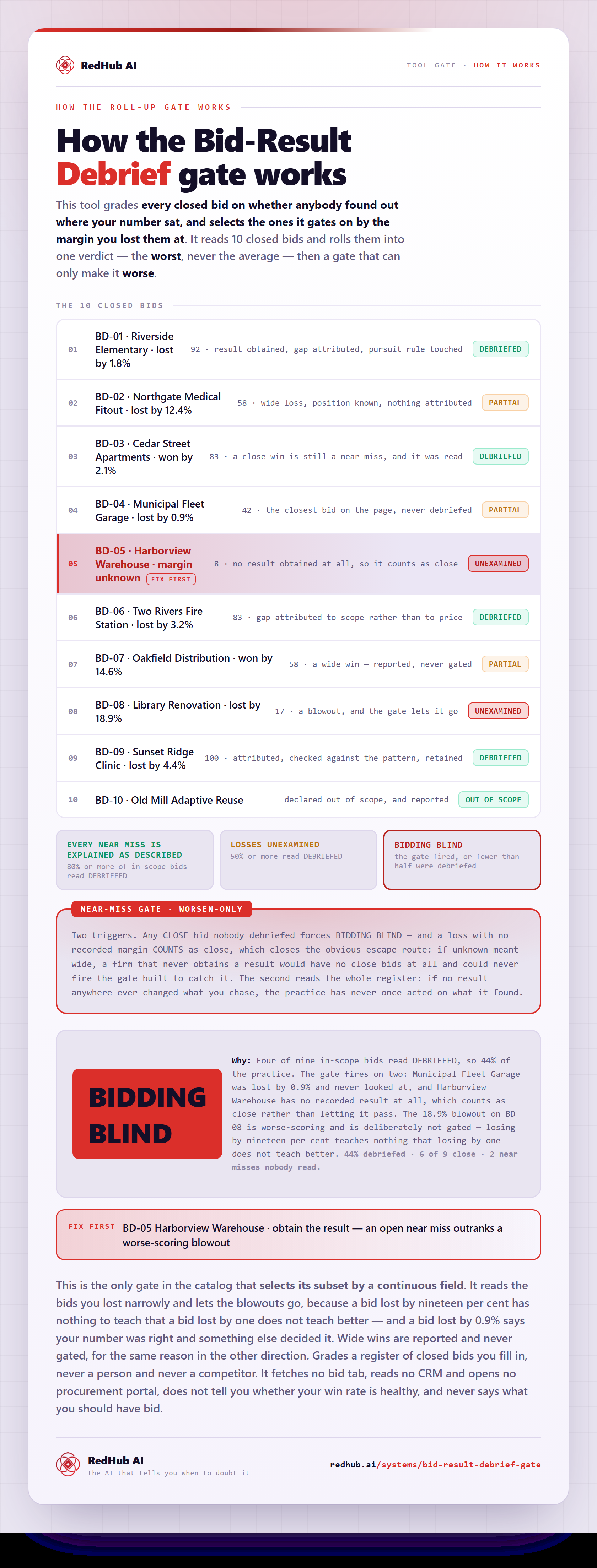
How the gate works, in one image
Ten closed bids, six signals each and a near-miss gate that picks its subset by losing margin - one picture of why a 0.9% loss is gated and an 18.9% blowout is deliberately let go.
View & embed the full diagramWhat it prints, on the 10-bid example that ships with it.
Verbatim stdout, not a mock-up. Zero dependencies, Python 3.8+, fully offline.
BID-RESULT DEBRIEF GATE - BRD-079
==============================================================================
BD-01   Riverside Elementary       LOST   1.8%  92  DEBRIEFED
BD-02   Northgate Medical Fitout   LOST  12.4%  58  PARTIAL
BD-03   Cedar Street Apartments    WON    2.1%  83  DEBRIEFED
BD-04   Municipal Fleet Garage     LOST   0.9%  42  PARTIAL  <- close, never debriefed
BD-05   Harborview Warehouse       LOST    ?     8  UNEXAMINED  <- close, never debriefed
BD-06   Two Rivers Fire Station    LOST   3.2%  83  DEBRIEFED
BD-07   Oakfield Distribution      WON   14.6%  58  PARTIAL
BD-08   Library Renovation         LOST  18.9%  17  UNEXAMINED
BD-09   Sunset Ridge Clinic        LOST   4.4% 100  DEBRIEFED
BD-10   Old Mill Adaptive Reuse    LOST    ?     -  OUT OF SCOPE
------------------------------------------------------------------------------
BIDS IN SCOPE: 9   (DEBRIEFED 4 / PARTIAL 3 / UNEXAMINED 2)   44% debriefed
Close bids: 6 of 9   Results that changed what you chase: 4
Out of scope: 1 bid(s) - BD-10
Wide wins (reported, never gated): BD-07 - at or beyond 10.0% under the next bidder
GATE FIRED: 2 close bid(s) never debriefed: BD-04, BD-05 (1 of them with no recorded margin, which counts as close) - the one you nearly won is the one that had something to teach
VERDICT: BIDDING BLIND
Near misses nobody looked at: BD-04, BD-05
Fix first: BD-05 - Position known
Four of nine bids were debriefed and four results changed what the firm chases, so the register-level trigger is clear. The gate still fires, on two close bids nobody looked at — one of them a 0.9% loss, the other a loss whose margin was never recorded. Note that the 18.9% loss scoring 17 does not appear in the gate line: it is the worst-marked bid in the register and it is not what is holding the verdict down.
Three rules the verdict is held to.
The gate reads the close bids and lets the blowouts go. Losing by 22% tells you almost nothing you did not suspect; losing by 0.8% says your number was right and something else decided it. This is the only RedHub gate that selects its subset by a continuous field rather than by a category, and it is the honest place to put the weight.
Not because it is probably close, but because the alternative is an escape hatch. If unknown meant wide, a firm that never obtains a result would have no close bids at all and could never fire the gate that exists to catch exactly that practice. On a win the rule reverses, because a job you took is not a near miss.
A condition on the whole register: if nothing you found out has ever moved what you chase, the verdict goes to the floor whatever the debriefed share says. It asks about action, not information — a firm can recalibrate its rates every quarter and go on bidding the same wrong owners forever.
- Result obtainedrequired
- A tab, an owner debrief, an award notice. Not 'we didn't get it'. Required.
- Position knownrequired
- The deciding number, your rank, the spread. Required, and what the whole exercise rests on.
- Gap attributed
- Scope carried, unit rates, markup, or a competitor's error. Not 'they were cheaper'.
- Checked against the pattern
- Compared with your other results on this building type, or against this competitor.
- Pursuit rule touched
- Something changed about what you chase — or a decision was recorded not to change it.
- Debrief retained
- The next estimator pricing this type would find it without asking anybody.
Clear about the lane. No inflated promises.
- A deterministic gate over a closed-bid register you maintain.
- A named list of the near misses nobody examined.
- A detector for a practice that reads every result and changes nothing.
- A reason to file the tab where the next estimator will find it.
- Offline. Nothing is uploaded and nothing phones home.
- A win-rate report, a forecast, or a hit-rate benchmark.
- A reader of bid tabs, your CRM or your estimate.
- A judgement on whether you should have bid.
- A claim about what your number should have been.
- A competitor-intelligence service.
On the verdict name: EVERY NEAR MISS IS EXPLAINED AS DESCRIBED is a statement about the register as you filled it in. Nobody read a bid tab.
The firm that writes far more bids than it wins.
- Contractors bidding public work, where the tab is published and unread.
- Firms that have narrowly lost the same building type more than once.
- Estimating teams where results are logged and never examined.
- Anybody whose pursuit list has not changed in three years.
- Fetch a bid tab or read a public procurement portal.
- Tell you whether your win rate is healthy.
- Say what you should have bid.
- Score a competitor, or a person.
What a debrief usually sends you back to.
The other half, on a register that does not overlap this one at all. That grades the jobs you built and whether their costs reached the next estimate; this grades the bids you lost.
Where a decomposed gap usually points. A loss attributed to 'scope carried' is a claim about your coverage, and this is the instrument that checks it before the next bid rather than after.
The other common answer to a lost bid. Soft money in the schedule is one of the few gap causes you control completely, and it is the one a debrief most often names.
The questions estimators actually ask before running this on their own bid history.
A verdict on your bidding practice: EVERY NEAR MISS IS EXPLAINED AS DESCRIBED, LOSSES UNEXAMINED, or BIDDING BLIND. Each closed bid is marked on six signals and reads DEBRIEFED, PARTIAL or UNEXAMINED, and the roll-up is the share that reached DEBRIEFED. A worsen-only near-miss gate forces the floor when any close bid was never debriefed, or when nothing in the whole register ever changed what you chase. Unless every near miss is already explained, it also names the one bid to look at first.
Because that is where the information is. Losing by 22% tells you almost nothing you did not already suspect; losing by 0.8% says your number was right and something else decided it, and that is the expensive thing not to have looked at. The gate lets blowouts go on purpose — the demo on this page has a bid that is the worst-scoring row on the board and carries no gate, because it was an 18.9% loss. No other RedHub gate selects its subset by a continuous field like this.
On a loss, an unrecorded margin counts as close. That is not severity, it is the closure of an escape hatch: if unknown meant wide, a firm that never obtains a result would have no close bids at all and could never fire the gate that exists to catch exactly that practice. You cannot call a loss a blowout you never looked at. On a win the rule is reversed, because a job you took is not a near miss.
Its register is jobs you built; this one's is bids you lost. Those populations do not overlap at all, which is a cleaner separation than most pairs get. That product asks whether what a job actually cost ever reached the basis that prices the next one. This asks whether you found out where your number sat against everybody else's, and whether it changed what you chase. A firm can close out every won job rigorously and never once request a bid tab, and a firm can study every tab it loses and never track a single actual.
No, and it deliberately never touches that. It says nothing about whether you win enough, whether you should have bid, or what your number should have been. A win far below the next bidder is reported because it is real and worth seeing, and it is not gated — that is a pricing question, and this instrument grades whether you found out, not whether you were right.
Less reliably than on public work, where tabs are published and the whole register can be filled in from documents that already exist. On private work the answer usually comes from asking, and the honest reading is that a firm which never asks scores badly here for a real reason. The signals are marked on what you actually obtained, not on what was theoretically obtainable, and a bid you genuinely could not get a result for still counts — because a practice that cannot find out is in the same position as one that does not try.
Because information that never changes anything is not a debrief, it is a filing habit. The second trigger asks whether the pursuit rule has ever moved on a result — not whether anything was learned, but whether anything changed. It is the same shape as the feedback gate's group trigger in the sibling product and deliberately a different subject: that one asks whether your estimating basis moved, this asks whether what you chase did. A firm can recalibrate its rates every quarter and go on bidding the same wrong owners forever.
A runnable Python engine and a live-formula .xlsx workbook that compute the same verdict from the same register, a debrief playbook and a bid-tab reading guide, a ten-bid worked sample, and the config that holds the close-margin threshold and every band so you can change them and see what moves. Offline, deterministic, no account and nothing uploaded.
The tab is public.
Somebody should read it.
One purchase, lifetime access, 12 months of updates. $79, once.
Honest boundary: a debrief aid. It grades a register you fill in — it fetches nothing, reads no tab, and never says what your number should have been.
Sold by RedHub AI LLC · Secured by Stripe · redhub.ai