Some of the numbers in that bidare placeholders with a dollar sign on them.
An allowance is a promise to price something later, and that is legitimate. What is not is an allowance nobody can convert: a round figure with no written scope, no stated basis, nobody's name on it and no date by which it has to become real. At that point it is not an allowance. It is the part of the bid you did not do.
Nobody audits the allowance schedule until the job is running.
Ninety thousand for landscape looks exactly like ninety thousand for a measured scope. On the schedule they are the same row, in the same column, in the same font. The difference only appears when somebody has to buy the work.
By the time a PM inherits the allowance, the assumptions behind it are unrecorded and the person who made them is on the next bid. Whatever it was supposed to cover is now whatever the client says it was supposed to cover.
Five tidy allowances and one enormous placeholder is 83% clean by line count and roughly 19% clean by value. Every instinct anyone has about this book counts rows, and the dollars are what you carry into the job.
Forty per cent clean by line. Twenty-six by dollars.
Five carried lines running the same logic the shipped engine runs, with both readings side by side so you can watch them disagree. Both triggers are firing. Give AL-05 a written scope and the first one releases while the verdict does not move, because the book is still 17% of the bid with under half its value defined.
1 line(s) with no written scope, carrying $85,000: AL-05 — nobody can convert a number when nothing says what it buys
the allowance book is 17% of the bid and only 26% of its value is defined — at or above 15% this is substantially an estimate of work nobody has priced
- Fix first
- AL-05 — Scope written down
- Nobody can convert
- AL-04, AL-05
Two of five lines are defined, which reads as 40% until you weigh the dollars and it becomes 26%. Both triggers are firing. Give AL-05 a written scope and the first one releases — and the verdict does not move, because the book is still 17% of the bid with under half its value defined. Clearing one trigger is not clearing the gate, which is the point.
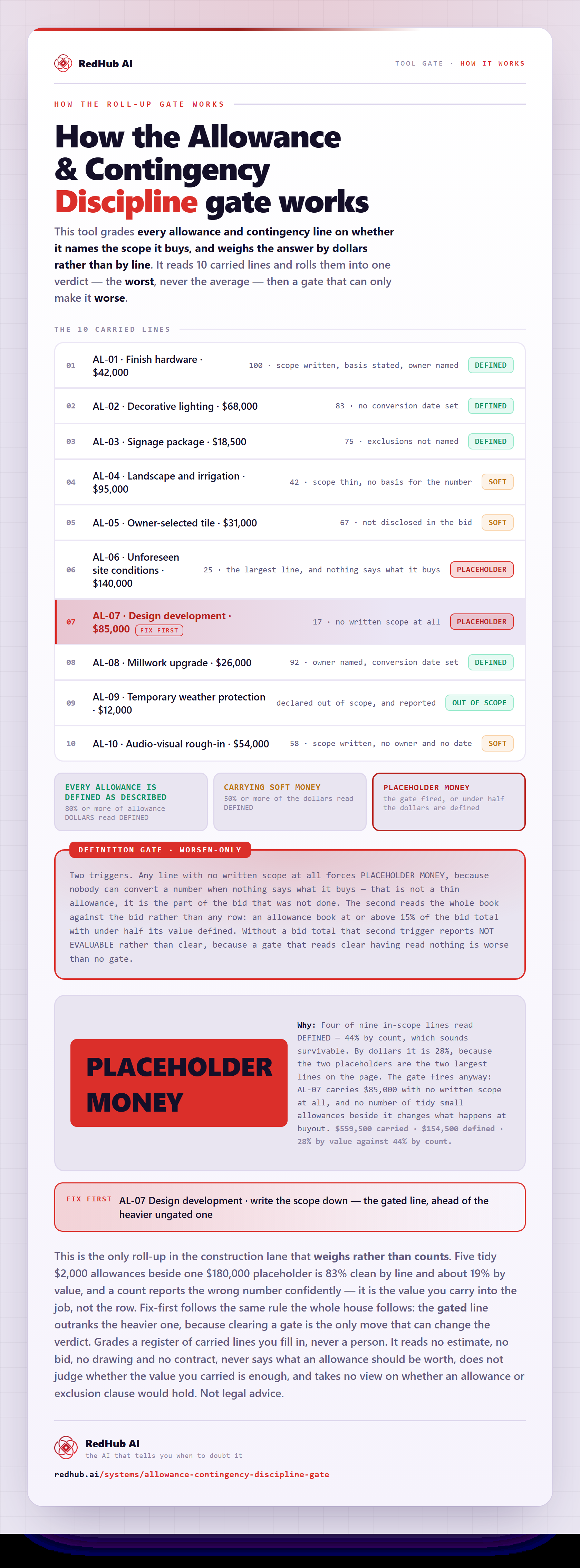
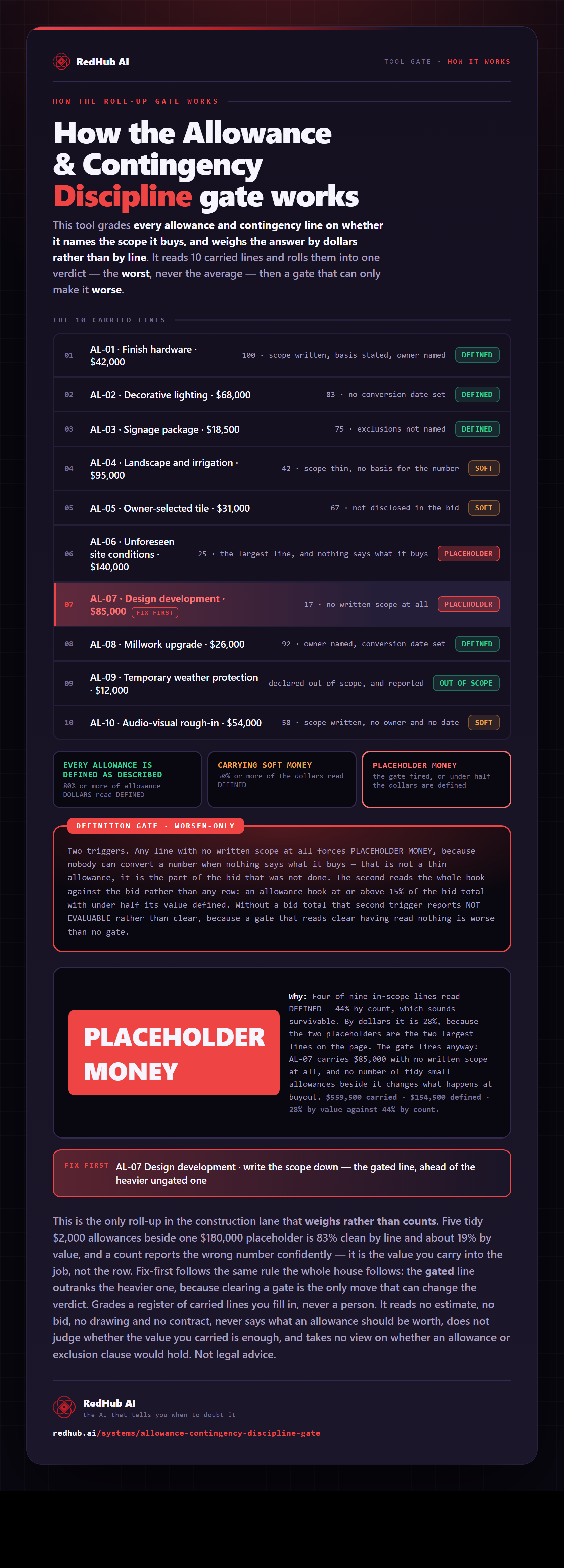
How the gate works, in one image
Ten carried lines, six signals each and a two-trigger definition gate - one picture of why a book that is 44% clean by row is 28% clean by the money you actually carry.
View & embed the full diagramWhat it prints, on the 10-line example that ships with it.
Verbatim stdout, not a mock-up. Zero dependencies, Python 3.8+, fully offline.
ALLOWANCE & CONTINGENCY DISCIPLINE GATE - ACD-079
==============================================================================
AL-01   Finish hardware              allowance       42,000 100  DEFINED
AL-02   Decorative lighting          allowance       68,000  83  DEFINED
AL-03   Signage package              allowance       18,500  75  DEFINED
AL-04   Landscape and irrigation     allowance       95,000  42  SOFT
AL-05   Owner-selected tile          allowance       31,000  67  SOFT
AL-06   Unforeseen site conditions   contingency    140,000  25  PLACEHOLDER
AL-07   Design development           contingency     85,000  17  PLACEHOLDER  <- no written scope
AL-08   Millwork upgrade             allowance       26,000  92  DEFINED
AL-09   Temporary weather protection allowance       12,000   -  OUT OF SCOPE
AL-10   Audio-visual rough-in        allowance       54,000  58  SOFT
------------------------------------------------------------------------------
LINES IN SCOPE: 9   (DEFINED 4 / SOFT 3 / PLACEHOLDER 2)
Carried: $559,500   Defined: $154,500   28% of allowance dollars defined
Allowance book as a share of the bid: 13%
Out of scope: 1 line(s) - AL-09
GATE FIRED: 1 line(s) with no written scope, carrying $85,000: AL-07 - nobody can convert a number when nothing says what it buys
VERDICT: PLACEHOLDER MONEY
Numbers nobody can convert: AL-06, AL-07
Fix first: AL-07 - Scope written down
Four of nine lines read DEFINED, which is 44% of the register and 28% of the money. One contingency has no written scope at all, and that single row forces the floor whatever the rest of the book scores. Note the line about the book as a share of the bid: at 13% it sits under the threshold, so the second trigger is reported and not fired. Run it without a bid total and that line says not evaluable rather than reading clear, which is a distinction the engine makes deliberately.
Three rules the verdict is held to.
The verdict is the share of allowance value reading DEFINED. This is the only roll-up in the RedHub construction lane that weighs rather than counts, and it is the whole product: an allowance's danger is proportional to its value and to nothing else, so a count reports the wrong number and reports it confidently.
A thin scope description somebody could argue with is a one, and a one can be improved. A zero is a number with nothing behind it, and nobody can convert it — not the estimator who carried it, not the PM who inherits it, not the sub eventually asked to price it. Only the zero forces the floor.
The second trigger measures the whole book against the bid, so without a bid total it cannot be read. The engine reports it as not evaluable rather than as clear. A gate that reads clear because it had nothing to read is worse than no gate, because it tells you something passed when nothing was checked.
- Scope written downrequired
- A written description of what this covers, specific enough that somebody could price it. Required, and the first gate trigger.
- Basis for the number stated
- A quantity times a rate, a budget quote, a prior job. Not a round figure somebody was comfortable with.
- Exclusions named
- It says what it does not cover. An allowance without an outer edge expands to fill whatever the client expected.
- Disclosed in the bidrequired
- Shown as an allowance at its value, rather than buried inside line items. Required.
- Owner named
- A named person converts it to a real price. A department is not a person.
- Conversion date set
- A date by which it has to become a real number, so it is a plan rather than a permanent condition.
Clear about the lane. No inflated promises.
- A deterministic gate over an allowance register you maintain.
- A value-weighted read, so the big soft number cannot hide behind small tidy ones.
- A named list of the lines nobody could convert, before you submit.
- A dated record of what each carried number was supposed to buy.
- Offline. Nothing is uploaded and nothing phones home.
- A price. It never says what an allowance should be.
- A judgement on whether the value you carried is enough.
- A reader of your estimate, your bid, your drawings or your contract.
- An opinion on whether an allowance or contingency clause would hold.
- Legal advice.
On the verdict name: EVERY ALLOWANCE IS DEFINED AS DESCRIBED is a statement about the register as you filled it in. Nobody read your estimate.
The estimator who signs the number, and the PM who inherits it.
- Contractors bidding design-development sets where selections are not made.
- Firms who have watched an allowance become an argument at buyout.
- Estimating teams where the person carrying the number is not the one converting it.
- Anyone whose contingency line has never been explained to anybody.
- Tell you what an allowance should be worth.
- Read your estimate or your bid documents.
- Decide whether an exclusion or an allowance clause would hold.
- Price the work you have not designed yet.
The rest of the bid.
Its natural pair, and neither contains the other. That one finds the divisions nobody carries and nothing excludes; this one finds the divisions where the number you did carry is a placeholder.
What happens after. An allowance that was never converted is the first thing a closeout comparison cannot explain, because nobody ever knew what it was supposed to buy.
Where soft money usually comes from. A sheet you could not measure becomes an allowance, and this is the point at which that decision either gets written down or disappears into a round number.
The questions estimators actually ask before running this on a live bid.
A verdict on your allowance book: EVERY ALLOWANCE IS DEFINED AS DESCRIBED, CARRYING SOFT MONEY, or PLACEHOLDER MONEY. Each carried line is marked on six signals and reads DEFINED, SOFT or PLACEHOLDER, and the roll-up is the share of allowance DOLLARS reading DEFINED rather than the share of lines. A worsen-only definition gate forces the floor when any line has no written scope, or when the book is at or above 15% of the bid with under half its value defined. It also names the one line to fix first where a line is short.
Because a count reports the wrong number and reports it confidently. Five tidy $2,000 allowances beside one $180,000 placeholder is 83% clean by line and about 19% clean by value, and it is the value you carry into the job. This is the only roll-up in the RedHub construction lane that weighs rather than counts, and the demo on this page shows both figures side by side so you can watch them disagree.
No, and the gate never says it is. An allowance is a legitimate way to price work that is not yet designed or selected. What this grades is whether each one is defined well enough for somebody to convert it later: a written scope, a stated basis, named exclusions, disclosure in the bid, an owner, and a date. An allowance with all six is a plan. One with none of them is the part of the bid you did not do, carried at a number chosen before anybody knew what the work was.
Because nobody can convert a number when nothing says what it buys — not the estimator who carried it, not the PM who inherits it, and not the sub eventually asked to price it. A weighted average handles that by diluting it against everything you did well, which is the arithmetic that lets a book look disciplined and not be. The gate fires on a mark of zero, not on a weak one: a thin description somebody could argue with can be improved, and nothing can be done with an absence.
The second trigger is reported as not evaluable rather than as clear, and the engine says so in its output. That distinction is deliberate. A gate that reads clear because it had nothing to read is worse than no gate, because it tells you something passed when nothing was checked. The first trigger and the value-weighted share work without a bid total.
That one asks whether every division is carried by somebody or excluded in writing. This asks whether the numbers you did carry are real. They come apart in both directions, which is the test: a bid where every division has a genuine sub quote can still carry $180,000 of finish allowances that say nothing about what is included, and a bid with two uncovered divisions can have three allowances each defined to the unit. They pair naturally and neither one contains the other.
No. It never says what an allowance should be, whether the value you carried is adequate, or whether an allowance or contingency clause in your contract would hold — that is fact-specific and not something a scorecard has any view on. It grades whether each carried number is defined well enough to be converted. Not legal advice.
A runnable Python engine and a live-formula .xlsx workbook that compute the same verdict from the same register, a definition playbook and an allowance-conversion playbook, a ten-line worked sample, and the config that holds every threshold so you can change them and see what moves. Offline, deterministic, no account and nothing uploaded.
Carry the allowance.
Just know what it buys.
One purchase, lifetime access, 12 months of updates. $79, once.
Honest boundary: a definition aid. It grades a register you fill in — it reads no estimate, sets no price, and takes no view on whether any clause in your contract would hold.
Sold by RedHub AI LLC · Secured by Stripe · redhub.ai