Everybody thinks somebodyhas Division 26.
The division nobody carried and nobody excluded is the classic margin killer, and it is almost never found before award. This grades the register instead of the bid. Every division lands in exactly one of six states, because a division is not seventy-three per cent covered — either somebody has it, or it is excluded in writing, or it is a gap.
A gap is not discovered before award. It is discovered when the job starts.
Somebody penciled a name against every division early on, because an empty cell is uncomfortable. Half of those names never sent a number, and the register has looked complete ever since.
The proposal excludes a division. The estimate has a sub assigned to it. Both are true statements about what you meant at different moments, and whichever one gets read first decides who pays.
Ninety-five per cent covered sounds like ninety-five per cent safe. It is not. The five per cent is the part with nobody on it, and it arrives as somebody else's change order.
Forty minutes, twice per bid. The second pass is the one that catches the expensive failures, and it is the one everybody skips.
Turn off one exclusion and watch $610,000 change state.
Ten divisions running the same logic the shipped engine runs. Division 26 opens by default: excluded in your own proposal and assigned to a subcontractor at the same time. Coverage reads 80% and the verdict is still UNCOVERED SCOPE.
excluded in writing and assigned to a carrier — two documents disagree
1 in-scope division(s) uncovered: 10
1 in-scope division(s) assumed: 26
- Fix first
- 26 Electrical — ASSUMED, $610,000
- Out of scope
- none
Division 26 is open by default. It is excluded in your own proposal and assigned to a subcontractor — two of your documents disagreeing about $610,000. Turn off the exclusion and watch it become OWNED; take away the carrier instead and it becomes a clean EXCLUDED. Both are answers. Shipping both documents is not.
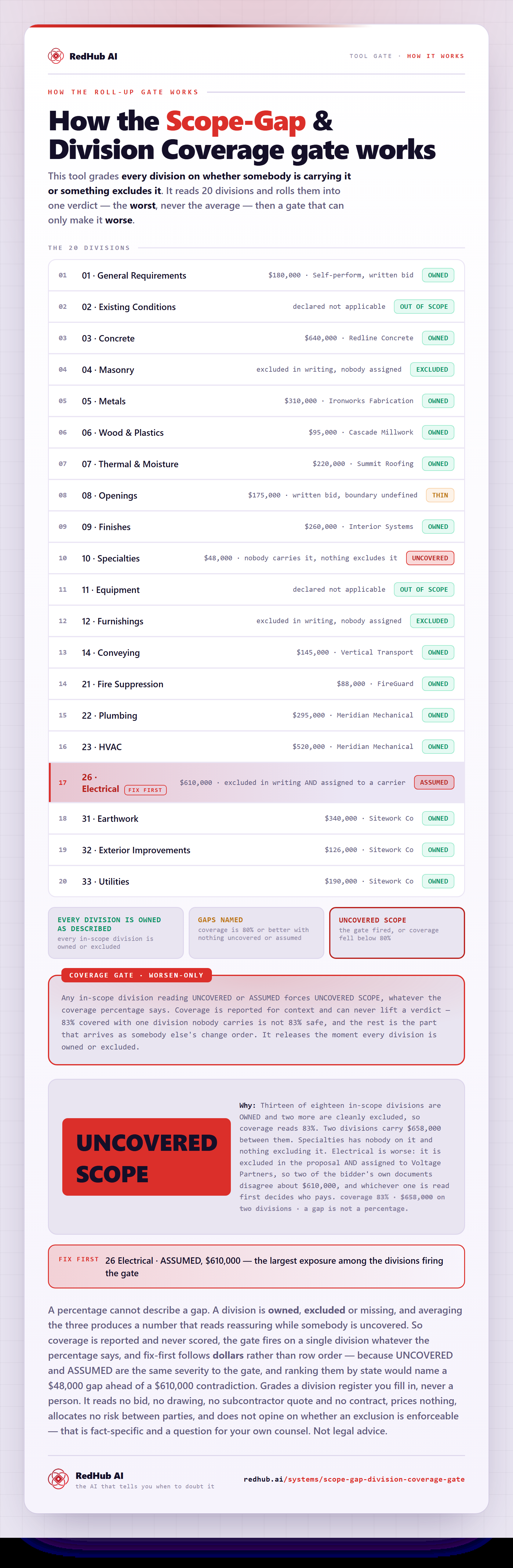
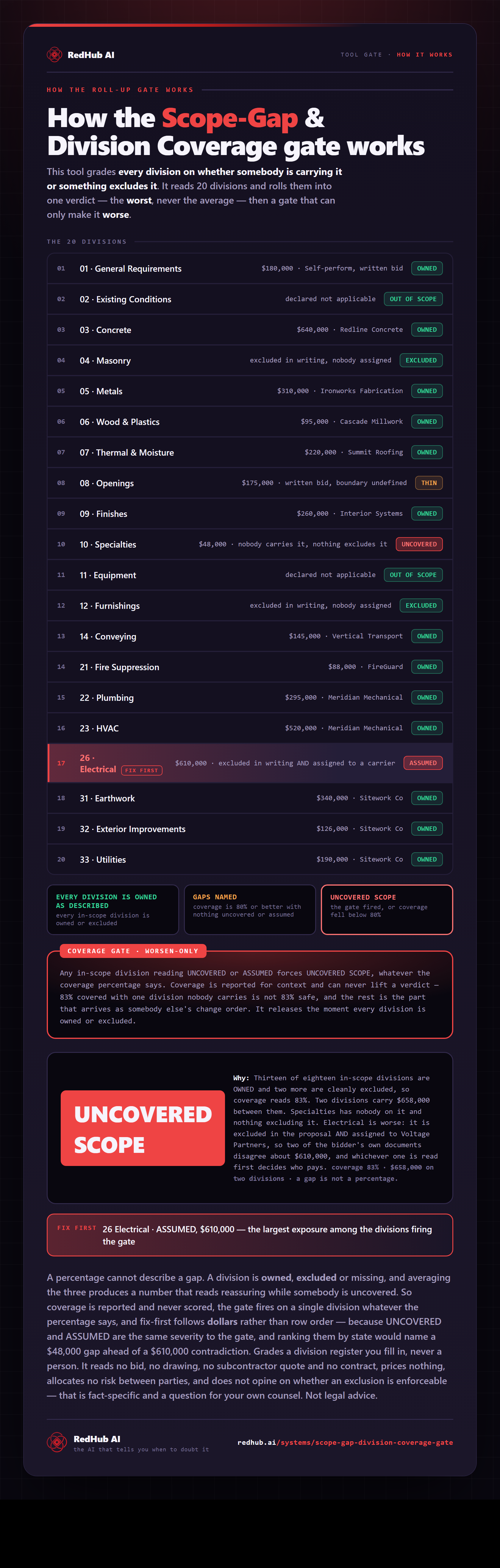
How the gate works, in one image
Twenty divisions, six states and the coverage gate — one picture of why a register reading 83% coverage still comes back UNCOVERED SCOPE with $658,000 on two rows.
View & embed the full diagramWhat it prints, on the 20-division example that ships with it.
Verbatim stdout, not a mock-up. Zero dependencies, Python 3.8+, fully offline.
SCOPE-GAP & DIVISION COVERAGE GATE — SGC-099
==============================================================================
01      General Requirements           $    180,000  OWNED
02      Existing Conditions                          OUT OF SCOPE
03      Concrete                       $    640,000  OWNED
04      Masonry                                      EXCLUDED
05      Metals                         $    310,000  OWNED
06      Wood & Plastics                $     95,000  OWNED
07      Thermal & Moisture             $    220,000  OWNED
08      Openings                       $    175,000  THIN
        Glass & Door Co — written bid with an undefined boundary
09      Finishes                       $    260,000  OWNED
10      Specialties                    $     48,000  UNCOVERED
        no carrier named and no written exclusion
11      Equipment                                    OUT OF SCOPE
12      Furnishings                                  EXCLUDED
14      Conveying                      $    145,000  OWNED
21      Fire Suppression               $     88,000  OWNED
22      Plumbing                       $    295,000  OWNED
23      HVAC                           $    520,000  OWNED
26      Electrical                     $    610,000  ASSUMED
        excluded in writing and assigned to a carrier — two documents disagree
31      Earthwork                      $    340,000  OWNED
32      Exterior Improvements          $    126,000  OWNED
33      Utilities                      $    190,000  OWNED
------------------------------------------------------------------------------
IN SCOPE: 18   (OWNED 13 / EXCLUDED 2 / THIN 1 / ASSUMED 1 / UNCOVERED 1)
Out of scope: 2 division(s) — 02, 11
Coverage: 83%   (reported for context — it never lifts the verdict)
GATE FIRED: 1 in-scope division(s) uncovered: 10
GATE FIRED: 1 in-scope division(s) assumed: 26
VERDICT: UNCOVERED SCOPE
Value sitting on gaps: $658,000
Fix first: 26 Electrical — ASSUMED, $610,000
Thirteen of eighteen in-scope divisions are OWNED and coverage reads 83%. Two divisions hold $658,000, and the larger of them is Electrical — excluded in the proposal and assigned to Voltage Partners at the same time. Fix-first names it ahead of the smaller uncovered division, because both fire the gate equally and dollars are the only honest tiebreak between them.
Three rules the verdict is held to.
Not a score. Either somebody is carrying it with a number behind them, or it is excluded in writing, or it is a gap — and the three have different fixes, which a percentage would hide.
It appears on the Dashboard for context and it cannot lift a verdict. Any division reading UNCOVERED or ASSUMED forces UNCOVERED SCOPE whatever the percentage says. The gate releases the moment every division is owned or excluded.
UNCOVERED and ASSUMED fire the gate equally, so ranking them by state would be arbitrary — and would name a $48,000 gap ahead of a $610,000 contradiction. The largest exposure among the divisions firing the gate goes first.
- OWNED
- A named carrier, a written bid, and a boundary somebody wrote down.
- EXCLUDED
- Excluded in writing, in your own proposal, with nobody assigned to it.
- THIN
- A carrier with only a verbal or budget number, or a written bid whose boundary lives in a conversation.
- ASSUMED
- A name with no bid behind it at all — or a division your proposal excludes while a sub is assigned to it.
- UNCOVERED
- Nobody carries it and nothing excludes it. The one that shows up after award.
- OUT OF SCOPE
- You declared it does not apply. Out of the divisor, and reported on every run.
Clear about the lane. No inflated promises.
- A deterministic gate over a division register you maintain.
- A named list of the gaps, in dollar order, before you submit.
- A detector for the case where your proposal and your estimate disagree.
- A dated record of what you believed you were carrying.
- Offline. Nothing is uploaded and nothing phones home.
- A bid, an estimate, or a price. It costs nothing out.
- A reader of your proposal, drawings, quotes or contracts.
- A risk allocation between you and anyone else.
- An opinion on whether an exclusion you wrote is enforceable.
- Legal advice.
On the verdict name: EVERY DIVISION IS OWNED AS DESCRIBED says what it means. The verdict is a statement about the register as you filled it in, and it is the kind of line that travels — to a partner, a bond agent, an owner — where whoever reads it did not supply the inputs.
The estimator who owns the bid, with the person who writes the proposal in the room.
- General contractors assembling a bid from many subcontractors.
- Subcontractors whose scope spans more than one division.
- Estimating teams where the proposal and the estimate are written by two people.
- Anyone who has found a division after award and would rather not again.
- Tell you what a division should cost.
- Decide whether to bid the job.
- Draft your exclusions, though the included guide covers how to write them clearly.
- Resolve a dispute, or say who is right about scope.
The rest of the bid.
Runs earlier on the same bid. It asks whether the drawings can be measured at all; this asks whether anyone is carrying what they show.
Runs before both. It decides whether the job is worth pursuing; these two protect the number once you have decided it is.
The other end of the loop. This gate closes gaps before the bid; that one tells you whether the bids you sent ever matched what the work cost.
The questions estimators actually ask before a bid goes out.
It is a $99 deterministic gate that grades a bid's division register before the bid goes out, and returns EVERY DIVISION IS OWNED AS DESCRIBED, GAPS NAMED, or UNCOVERED SCOPE. You list every division your scope touches and declare four facts about each — who is carrying it, whether it is excluded in writing, whether a bid arrived, and whether the scope boundary is defined — plus your own estimated value. It returns the verdict, the divisions holding it back, the dollars sitting on them, and the one to fix first. It ships a zero-dependency Python engine, a live-formula Excel workbook, two playbooks and a worked 20-division example.
Because a division is not 73% covered. Either somebody is carrying it, or it is excluded in writing, or it is a gap — and the three are not points on a scale, they are different situations with different fixes. A score would average a division nobody has against nine that are fine and return a number that reads reassuring. The six states are OWNED, EXCLUDED, THIN, ASSUMED, UNCOVERED and OUT OF SCOPE, and every division lands in exactly one.
Because coverage is reported, not scored, and it can never lift a verdict. The coverage gate is worsen-only and dispositive: any in-scope division reading UNCOVERED or ASSUMED forces UNCOVERED SCOPE whatever the percentage says. Eighty per cent coverage with one uncovered division is not eighty per cent safe — the twenty per cent is the part that shows up after award, and it shows up as somebody else's change order. The gate releases the moment every division is owned or excluded.
ASSUMED is a gap you think is filled. It fires two ways because both cost the same thing. The first is a carrier penciled in with no bid of any kind behind them — a name that makes the register look complete while nothing is actually committed. The second is a division your own proposal excludes while a subcontractor is assigned to it, which means two of your documents disagree about who has the work; whichever one gets read first decides who pays. In the worked example that second case is $610,000 of electrical, and it is the largest single exposure in the file.
Because UNCOVERED and ASSUMED are the same severity to the gate — both fire it — so ranking one above the other would be arbitrary, and it produces a worse answer. State-first ordering would name a $48,000 division nobody carries ahead of a $610,000 division your own documents contradict each other about. Dollars are the honest tiebreak between two equally dispositive findings. THIN is a genuinely lower tier because it does not fire the gate, so it only surfaces when nothing above it exists.
You can, and the Dashboard reports how many you did, on every run, in plain sight. That is the design: a waiver you cannot see is a waiver you can abuse. A blank in-scope answer counts as in-scope rather than out, so a missing answer can never quietly remove a division from the divisor or the gate. Taking a division out of scope is a legitimate thing to do when it genuinely does not apply to the project — it is only a problem when nobody can tell you did it.
No, and it deliberately never will. Whether an exclusion binds anyone turns on the contract you are actually in, how it was incorporated, and the law of the place you are in — it is fact-specific and it is a question for your own counsel. This is not legal advice. What the kit does address is clarity, which is the part you control: the included Scope Exclusion Writing Guide covers the four ways an exclusion fails to say what you meant, and the gate flags the case where an exclusion and an assignment contradict each other.
It is for the general contractor or subcontractor who owns the margin on a bid, and it is meant to be run twice — once when the bid opens to build the worklist, once the day before you submit with the person who writes the proposal in the room. It is not for anyone who wants a price, an estimate, or a bid recommendation; it produces none of those. It reads no bid, no drawing, no subcontractor quote and no contract, allocates no risk between parties, and grades only the register you fill in.
Find the gap now.
Not after award.
One purchase, lifetime access, 12 months of updates. $99, once.
Honest boundary: a scope-coverage aid. It grades a register you fill in — it reads no bid or contract, prices nothing, allocates no risk, and is not legal advice.
Sold by RedHub AI LLC · Secured by Stripe · redhub.ai