The gun fires whenthe posting goes live.
A strong proposal in the first 30 minutes sees a 28–35% response rate; the same proposal at three hours sees 4–9%. But speed without preparation is just fast spam. The Bid Sprint Drill scores whether you've done the prep that lets you deploy — not rush — when a good posting lands.
Most freelancers hear the gun and start preparing.
proposals in the first 30 minutes get more genuine attention than the 82 that follow them combined. The early queue is where decisions are made.
to build one reusable archetype file. The freelancers who win the window made that investment before the posting ever appeared.
is what speed is worth without a staged asset. A fast, generic proposal arrives early and says nothing — the exact failure the window punishes.
Score your prep. Read the verdict.
Every mark is yours; the score is your own. Grades bid-readiness, not any person, and guarantees no response rate.
Six readiness controls across the book's three phases — Build, Monitor, Sprint — each scored missing, stale, or ready. The score sets the band, but two assets are load-bearing: the archetype file and the proof stack.
Miss either one and the verdict is NOT SPRINT-READY no matter how fast you are — because speed without a staged asset just means sending something weak quickly. The sample shows exactly that: a freelancer who can fire a proposal inside the peak 20-minute window but never built the archetype file. Fast, and not ready.
Where a control is short, the Drill names the one to fix first, with its phase — so you know whether the gap is in what you built, how you watch, or how fast you deploy.
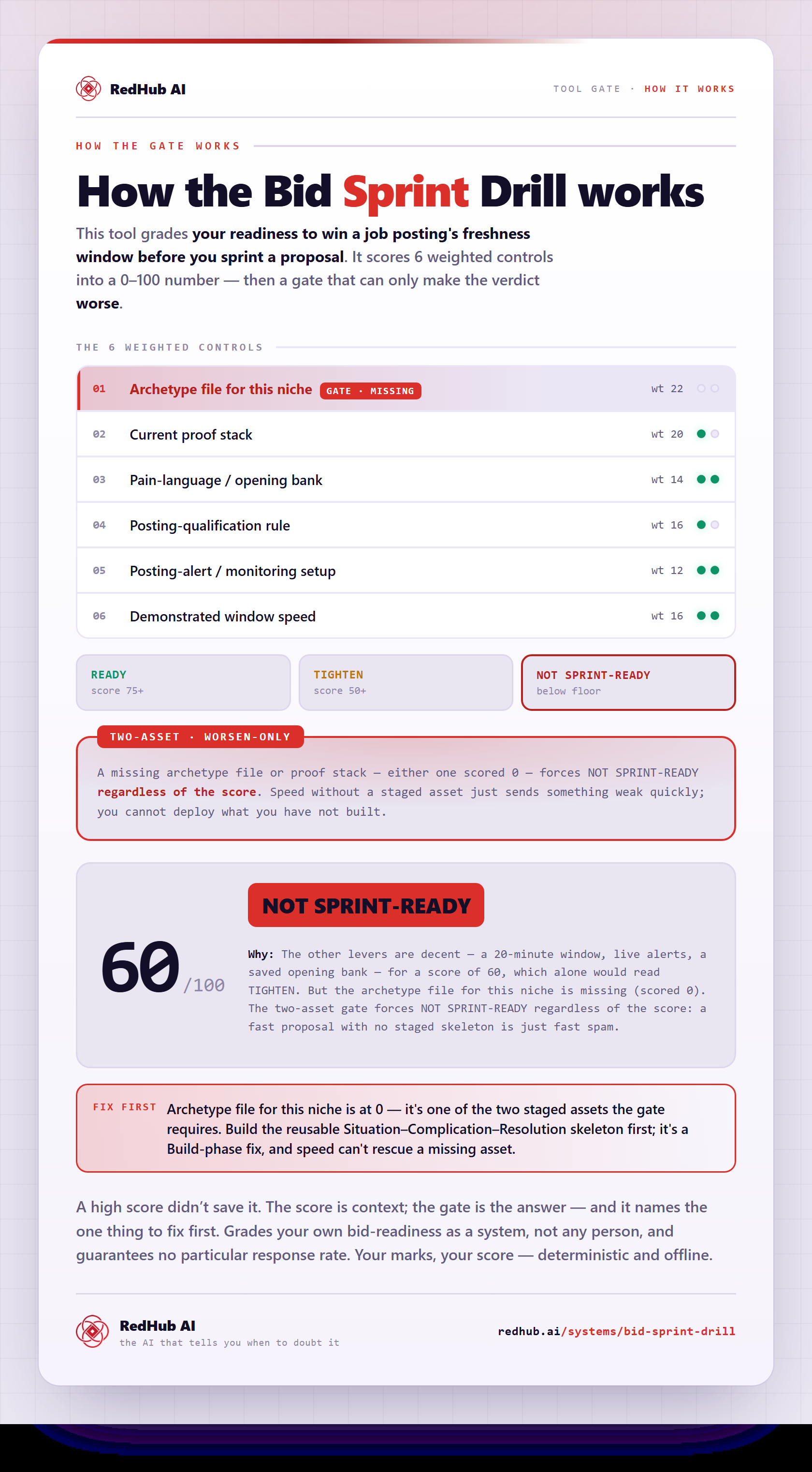
How the gate works, in one image
How the Bid Sprint Drill scores bid readiness and forces NOT SPRINT-READY when the reusable archetype file is missing — the same math the demo runs, as a diagram you can share or embed anywhere.
View & embed the full diagramThe same verdict, offline and runnable.
The zero-dependency Python engine scores one profile or a whole portfolio of niches from a CSV and produces the identical verdict to the demo and the workbook — verified across the full input space. Here it grades the "fast but unprepared" profile:
BID SPRINT DRILL
============================================================
  Archetype file for this niche    0/2 (trigger)
  Current proof stack              1/2 (trigger)
  Refined pain-language / opening bank 2/2
  Posting-qualification rule       1/2
  Posting-alert / monitoring setup 2/2
  Demonstrated window speed        2/2  -> 0-30 min (peak)
------------------------------------------------------------
  Score                            60/100
  VERDICT                          NOT SPRINT-READY
  Gate                             missing archetype_file -> NOT SPRINT-READY
  Fix first                        Archetype file for this niche (Build phase)
Three rules the Drill never breaks.
A missing archetype file or proof stack forces NOT SPRINT-READY from any score. The book is explicit: speed without quality is spam, and the Drill refuses to call that ready.
The two-asset gate can pull a verdict down to NOT SPRINT-READY but never lifts one up. A strong score is never manufactured — it is earned mark by mark.
Window speed is scored against the book's published Freshness Window Benchmark, and every other mark is yours. No invented lift, no response rate promised, no person scored.
A readiness check, not a stopwatch.
- The book's Build/Monitor/Sprint system as a pre-week readiness check.
- A gate that insists on the staged assets before it credits speed.
- A fix-first pointer to the single highest-leverage gap.
- A portfolio tool — score every niche profile from one CSV.
- A timer or alarm — it grades preparation, not the act of submitting fast.
- A scorer of people — it grades your own readiness as a system.
- A guarantee of any response rate or win.
- A replacement for Chapter Seven; it is the companion to it.
Scope. The Drill grades your own bid-readiness as a system from the marks you enter; it does not score, rank, or assess any person, guarantees no response rate, and is not legal, financial, or career advice.
For the freelancer who wants to deploy, not rush.
- Freelancers and independents who bid on a stream of postings and feel they're always late.
- Readers of The AI Proposal System building the Bid Sprint system from Chapter Seven.
- Anyone who suspects their problem is preparation, not typing speed.
- —Not a substitute for actually building the archetype files — it tells you to, it doesn't write them.
- —Not for scoring or ranking people — it grades a readiness posture.
- —Not a promise of a response rate; the window is an advantage, not a guarantee.
Build the assets the Drill checks for.
Build the proof stack and competitor-aware approach the archetype file depends on.
Sharpen the posting-qualification rule — sprint only on budget-aligned work.
When the bid is a formal enterprise RFP rather than a freelance posting.
Answers before you ask.
It is a deterministic readiness check for the freshness window from The AI Proposal System. Early proposals win — a strong proposal in the first 30 minutes of a posting sees a 28–35% response rate, the same proposal at three hours sees 4–9%. The Drill scores whether you are prepared to win that window: it grades six readiness controls across the book's Build, Monitor, and Sprint phases and returns READY, TIGHTEN, or NOT SPRINT-READY.
Because the book's whole argument is that speed without preparation is just fast spam. The freelancers who win the window prepared before the gun fired — they built a reusable archetype file and a current proof stack, then deployed. So if either of those two load-bearing assets is missing, the verdict is NOT SPRINT-READY no matter how high the score. You cannot deploy what you have not built.
You enter your honest typical time, in minutes, from seeing a qualifying posting to a sent proposal. The Drill converts it to a mark against the book's Freshness Window Benchmark: inside 60 minutes is ready, 60–180 minutes is stale, and past 180 minutes is missing. Speed is one weighted control among six — it can move you from READY to TIGHTEN, but it cannot rescue a missing asset.
Each control is scored 0 (missing), 1 (stale or partial), or 2 (ready and fresh), weighted to 100. READY is 75–100, TIGHTEN is 50–74, NOT SPRINT-READY is 0–49 — and the two-asset gate can force NOT SPRINT-READY from any score. Where a control is short the Drill also names the one to fix first: the lowest mark, breaking ties toward the load-bearing assets.
Yes, where a control is short. The fix-first control names the single highest-leverage gap, with its phase. A missing archetype file or proof stack is a Build-phase fix — the six-hour-per-file investment the book describes. A weak qualification rule or alert is a Monitor-phase fix. A slow window is a Sprint-phase fix. You work that one, then re-run the Drill.
No — it is the companion to Chapter Seven. The book explains why the window exists and how to build the Bid Sprint system; the Drill turns that into a readiness check you run before a busy bidding week. It grades your own preparation as a system, not any person, and it guarantees no particular response rate — it is not legal, financial, or career advice.
Prepare before the gun.
Deploy after it.
One purchase, lifetime access, 12 months of updates. $69, once.
Scope. The Drill grades your own bid-readiness as a system from the marks you enter; it does not score, rank, or assess any person, guarantees no response rate, and is not legal, financial, or career advice.
Sold by RedHub AI LLC · Secured by Stripe · redhub.ai