Cleared to use it?Allowed to own it?
AI makes a track or a voice in seconds — but a free-tier track in a paid ad, a prompt-only song you want to register, or a soundalike of a real artist each carry a different rights problem. Know which one, before you publish or sell.
A CLEAR TO USE / HUMAN-AUTHORSHIP NEEDED / RELICENSE verdict per asset and a GO / REVIEW / HOLD gate for the whole library — with the exact fix.
“It’s royalty-free” is not the same as “you’re cleared.”
AI music tools made a track free and instant — and quietly moved the hard part to rights. The license you hold depends on the plan you generated under and whether it was active at the time; ownership depends on human authorship; and imitating a real artist is a different problem entirely from either.
These are separate questions that look identical until something goes wrong: a strike, a takedown, an un-registrable catalog, a right-of-publicity claim. The gate runs before you publish or sell, so each asset gets the right answer to the right question.
A plan can grant you the right to use a track and still leave you unable to register or license it out — because purely AI output generally isn't copyrightable in the US without human authorship.
The most common mistake: a free-tier generation dropped into monetized content or a paid ad. Free tiers usually grant no commercial rights — so the use is unlicensed, and the fix is to recreate it under a commercial plan.
'In the style of <famous artist>' is the highest-risk move — right-of-publicity and infringement exposure a generation license never covers. It's the heart of the AI-music lawsuits and label deals.
Reduces copyright / right-of-publicity / platform-ToS risk; it does not eliminate it. Not legal advice.
Configure one asset and watch the verdict resolve.
This is the same logic that ships in the Python engine and the workbook — running in your browser on a single asset. Load a preset, change the plan, the use, or the authorship, and see the verdict and the references to check. Nothing is sent and nothing is stored.
- You're using this commercially but don't hold commercial rights to the output. Recreate it under a plan that grants commercial rights (active at generation time), or license it properly.
References to check with counsel
- Tool commercial-rights tiers (Suno, ElevenLabs)
Download and back up the master and stems — AI models get deprecated and un-backed-up assets can become unrecoverable.
Not legal advice. A triage aid — verdicts come from the inputs above, not from any one platform's current terms. Confirm high-risk uses with counsel.
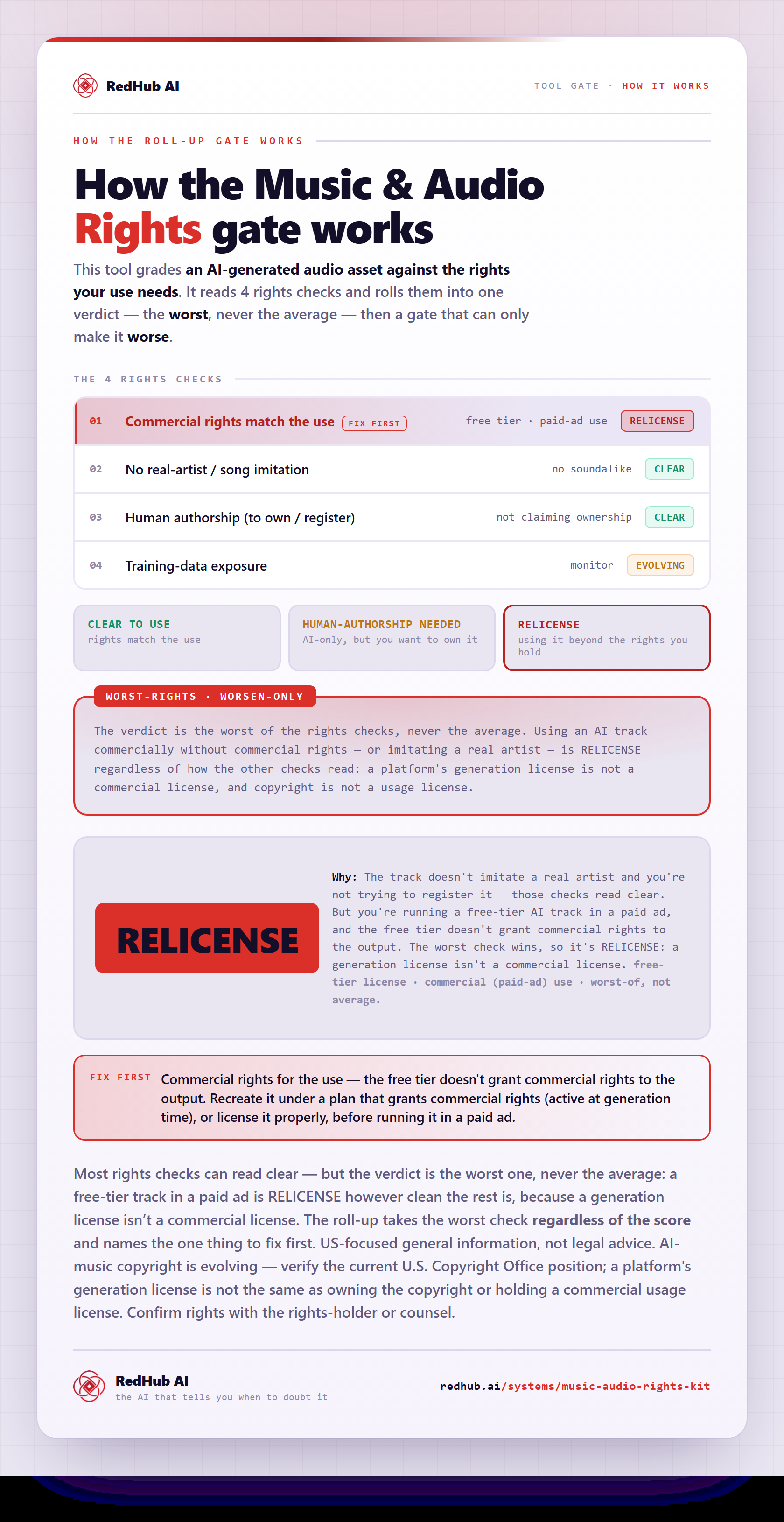
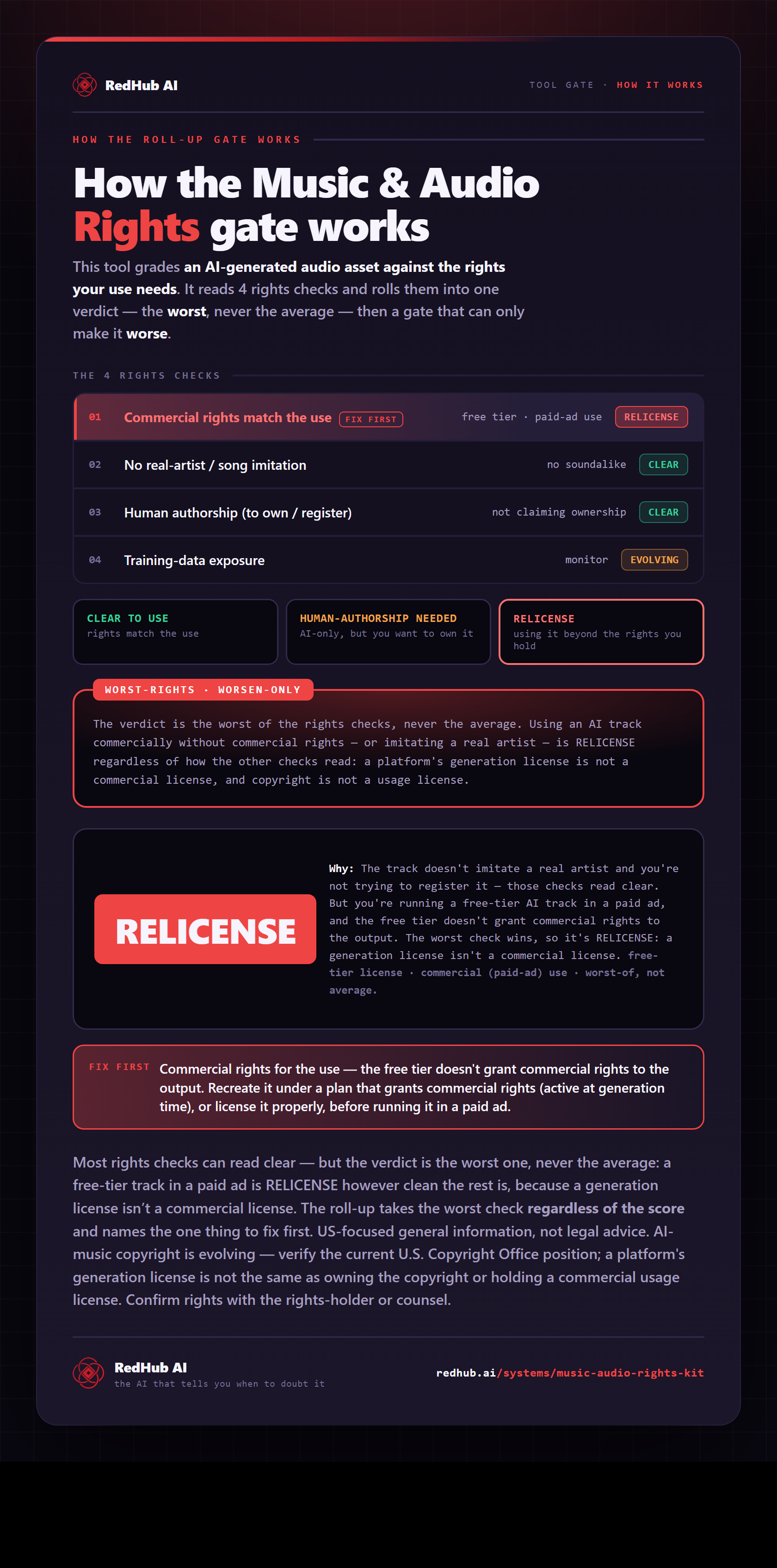
How the gate works, in one image
Each rights check rolled up to the worst and the gate that forces RELICENSE on commercial use without commercial rights — the same logic the demo runs, as a diagram you can share or embed anywhere. US-focused general information, not legal advice; AI-music copyright is evolving.
View & embed the full diagramThe engine actually runs. Here’s real output.
This is the included music_audio_rights_engine.py run against the 7-asset sample library — not a screenshot of a promise. Three cleared, one needs authorship to own, three need relicensing — so the library is held until they’re cleared.
$ python3 music_audio_rights_engine.py --in sample/sample-tracks.csv --as-of=2026-06-18

========================================================================
AI MUSIC & AUDIO RIGHTS KIT
As-of: 2026-06-18   ·   Assets reviewed: 7
========================================================================

[CLEAR TO USE]  Channel intro music (Suno Pro instrumental)
  risk: LOW
  note: Clear to use for the inputs given. Re-check if the plan, the asset, or the intended use changes.

[CLEAR TO USE]  Podcast narration (ElevenLabs Creator)
  risk: LOW
  note: Clear to use for the inputs given. Re-check if the plan, the asset, or the intended use changes.

[RELICENSE]  Paid client ad background track (Suno free tier)
  risk: HIGH
  action: You're using this commercially but don't hold commercial rights to the output. Recreate it under a plan that grants commercial rights (active at generation time), or license it properly.
  references (for counsel review, not legal advice):
    - Tool commercial-rights tiers (Suno, ElevenLabs) [in effect]
  note: Download and back up the master and stems — AI models get deprecated and un-backed-up assets can become unrecoverable.

[CLEAR TO USE]  Song licensed to other creators (Suno Pro · own lyrics)
  risk: LOW
  note: Clear to use for the inputs given. Re-check if the plan, the asset, or the intended use changes.

[HUMAN-AUTHORSHIP NEEDED]  Instrumental to register and own (Suno Pro · prompt-only)
  risk: MEDIUM
  action: Purely AI-generated output generally isn't protected by copyright in the US. To register, enforce, or license it out, add meaningful human authorship (original lyrics, performance, substantial editing/arrangement) and document it.
  references (for counsel review, not legal advice):
    - US Copyright Office — human-authorship requirement [in effect]

[RELICENSE]  Soundalike vocal in the style of a famous artist
  risk: HIGH
  action: This imitates an identifiable artist's voice or an existing song. Imitation of a real artist carries right-of-publicity and infringement exposure that a generation license does not cover. Clear rights with the rights-holder or change it.
  references (for counsel review, not legal advice):
    - Right of publicity / artist voice & likeness [in effect]
    - AI-music training-data litigation & label licensing [evolving as of 2026-06-18]

[RELICENSE]  Cloned voice of a former teammate (no release)
  risk: HIGH
  action: Uses a real person's voice without confirmed consent. Get a signed release dated before use (see the Voice & Likeness Compliance Gate) before publishing.
  references (for counsel review, not legal advice):
    - Voice consent (see Voice & Likeness Compliance Gate) [in effect]

========================================================================
LIBRARY GATE: HOLD
  CLEAR TO USE: 3   HUMAN-AUTHORSHIP NEEDED: 1   RELICENSE: 3
  Don't ship the library: at least one asset needs its rights cleared.
  Not legal advice. Verify tool terms, dated specifics, and high-risk uses with counsel.
========================================================================

$ echo $?
0
Reads a CSV of your own audio library, annotates each framework as in-effect / upcoming / evolving as of the --as-of date, and prints a per-asset verdict plus the library gate. --json for tooling. The engine, the workbook, and the demo above share one logic and are verified to agree on all 7 sample assets.
Three questions, kept separate — and answered from structure.
Verdicts come from each asset’s rights structure, not from any one platform’s current terms — so they don’t rot when a tool changes its plans. Three principles hold the line:
Use and own are different rights
A license to use is not the right to register, enforce, or license out. Ownership in the US needs human authorship — so a prompt-only track can be cleared to use and still need authorship before you can own it.
Commercial rights are plan-gated
Whether you can use output commercially depends on the plan you generated it under, active at that time. Free-tier output in monetized or paid content is unlicensed — the fix is to recreate it under a commercial plan, not to add a disclosure.
Imitation isn't a license problem
Imitating a real artist's voice or an existing song is a right-of-publicity and infringement question a generation license never covers. It's the highest-risk move, flagged RELICENSE — describe a sound by mood and genre instead.
The dated references (tool commercial-rights tiers, the US Copyright Office human-authorship requirement, right of publicity, the AI-music training-data litigation & label-licensing landscape) are surfaced for triage and counsel review only — the engine marks each as in-effect, upcoming, or evolving as of your evaluation date and never presents them as legal conclusions. This reduces legal and platform risk; it is not legal advice. Confirm tool terms and high-risk uses with qualified counsel.
The rights layer — it pairs with the consent layer.
This kit answers “am I allowed to use and own this audio?” When a real person’s voice is cloned, that’s a consent question — it flags it and hands you to the Voice & Likeness Compliance Gate. Two layers, one clean publish.
- ·Commercial-license fit for the plan you generated under
- ·Human authorship for ownership / registration
- ·Soundalike / existing-song infringement exposure
- ·The backup that doubles as your rights proof
- ·Consent dated before use for a real voice/likeness
- ·Conspicuous AI + paid-partnership disclosure
- ·Synthetic-performer and fake-testimonial rules
- ·The pre-publish CONTACT / SUPPRESS gate
List each audio asset's rights structure — tool plan, human authorship, intended use, whether it imitates a real artist or uses a real voice.
Each asset gets CLEAR TO USE / HUMAN-AUTHORSHIP NEEDED / RELICENSE; the whole library gets GO / REVIEW / HOLD. One RELICENSE holds the ship.
Recreate free-tier tracks under a commercial plan, add human authorship where you need to own, change soundalikes, clear voice consent — then re-gate.
Download the master and stems and store them with your plan, date, and prompt — your backup and your rights proof in one step.
Clear about the lane. No inflated promises.
- The rights engine (Python) — A runnable tool that reads a CSV of your audio assets and returns the per-asset verdict and the library gate. Standard library only; runs offline, no API key. --as-of pins the framework annotations; --json for tooling.
- The workbook — The identical logic as a live spreadsheet — Start Here, a Rights Gate tab with dropdowns and per-asset verdicts, and a Dashboard library rollup. No setup; opens in Excel, Sheets, or Numbers.
- Music & Audio Rights Playbook — How the engine decides, the use-vs-own distinction, tool commercial-rights tiers, the human-authorship requirement, and a dated framework reference surfaced for counsel review.
- Brand Sound Prompts & Disclosure — Prompt patterns that describe a sound by mood/genre/instrumentation (not 'in the style of <artist>'), disclosure language, and a rights-proof checklist — plus a 7-asset sample library spanning every verdict.
- Not legal advice — it reduces copyright / right-of-publicity / ToS risk; it doesn't eliminate it. Confirm tool terms and high-risk uses with counsel.
- Not a music tool — it gates rights; it doesn't generate tracks, voices, or stems. Pair it with Suno / ElevenLabs / Udio.
- Not a single tool's terms — verdicts come from the rights structure, so they stay useful when a platform changes its plans; always re-verify your tool's current terms.
- No consent/disclosure engine — a cloned real voice is flagged and handed to the Voice & Likeness Compliance Gate, which owns that layer.
- No SaaS, no monthly fee, no telemetry — your asset data never leaves your environment.
Anyone publishing or selling AI-generated audio.
Creators & podcasters
If you use AI music, intros, or synthetic narration in monetized content, the gate tells you which tracks are cleared, which need authorship to own, and which to recreate under a commercial plan.
Agencies & brand teams
Free-tier audio in a client's paid ad is the classic exposure. Gate every track before it ships, and keep the backup that proves the rights if anyone asks.
Musicians & sync sellers
If you want to register, enforce, or license AI-assisted work, the human-authorship gate tells you exactly what to add before it's ownable — and flags the soundalikes that aren't.
Voice & Likeness Compliance Gate
The consent & disclosure layer — when a real voice or likeness appears, this rights kit hands you here for the dated-before-use consent and the conspicuous-disclosure gate.
YouTube Packaging & Retention Engine
Once the audio is cleared, the packaging layer: significance-tested thumbnails and a retention-gated SHIP / TIGHTEN / REWORK verdict per video.
Distinctive AI Visuals Kit
On-brand AI imagery without the templated look — the visual half of a creative stack whose audio you've already cleared here.
The questions creators actually ask before they publish AI audio.
No. The kit helps you triage what to clear or verify before you publish or sell AI-generated audio, and points you to the dated specifics that matter. It doesn't replace a lawyer, and the law and platform terms here move quickly — confirm anything high-stakes with qualified counsel.
It depends on the plan you generated it under, and whether that plan was active at the time. Free tiers generally grant no commercial rights; paid tiers do, for outputs made while subscribed. The engine flags a free-tier track used commercially as RELICENSE and tells you to recreate it under a commercial plan. Always verify your tool's current terms.
Using means you hold the license for your purpose. Owning means you can register, enforce, or license it out — which in the US requires human authorship. A prompt-only track can be CLEAR TO USE yet still HUMAN-AUTHORSHIP NEEDED if you want to own it. Add original lyrics, a performance, or substantial editing and document it.
That's the highest-risk move. A soundalike vocal or an imitation of a specific song carries right-of-publicity and copyright exposure a generation license doesn't cover — it's the heart of the AI-music lawsuits and label licensing deals. The engine flags it as RELICENSE. Describe the sound you want by mood, genre, and instrumentation instead.
They're complementary. This kit is about rights to use and own AI music and audio. When a cloned real voice appears, it flags the consent issue and points you to the Voice & Likeness Compliance Gate, which handles consent and disclosure structure in full.
AI models get deprecated and libraries get reorganized, so a track you can't regenerate and didn't download can disappear. For anything you publish or sell, the kit reminds you to download the master and stems and store them alongside your plan, date, and prompt — which is also your rights proof.
Clear the rights before you publish.
The engine, the workbook, both playbooks, and the sample library — one purchase, yours to run on every track, voice, and audio asset. Know what’s cleared, what needs authorship to own, and what to relicense, before it ships.
Not legal advice. Verify tool terms, dated specifics, and any high-risk use with qualified counsel.
Sold by RedHub AI LLC · Secured by Stripe · redhub.ai