The gauge that sinks youis green on the chart.
Your wall chart tracks one fact: the calendar. This check tracks two — where every gauge sits against a pinned evaluation date, and what its last calibration actually found. A gauge that failed as-found accepted parts out of tolerance for its entire prior interval; unless someone assessed that product impact, every one of those acceptances is suspect, and no amount of being in-cal today fixes it.
The wall chart answers the wrong question.
How far past due PIN-330 is — still in service, still accepting parts. One overdue gauge in a ten-gauge fleet is 10%: RUNNING ON GRACE, and never CALIBRATION CURRENT.
TRQ-077’s calendar status today — green on every chart. It also failed as-found in March, and no product-impact assessment exists. Every torque it approved for six months is suspect. The calendar can’t see it.
The pinned evaluation date. The verdict on a dated fleet snapshot is the same verdict forever — no TODAY(), no drift, an auditable monthly read instead of a sheet that changes its answer every time it’s opened.
Eleven gauges, one green liability — live.
| Gauge | Service | Last cal | Interval (d) | Due | Status | As-found | Impact assessed |
|---|---|---|---|---|---|---|---|
| CAL-101 | 2026-05-10 | 2026-08-08 | IN CAL | ||||
| MIC-204 | 2026-04-21 | 2026-07-20 | IN CAL | ||||
| CMM-001 | 2026-01-15 | 2026-07-14 | DUE | ||||
| PIN-330 | 2026-02-20 | 2026-05-21 | OVERDUE 41d | ||||
| HGT-118 | 2026-06-05 | 2026-07-05 | DUE | ||||
| TRQ-077 | 2026-03-12 | 2026-09-08 | IN CAL | ||||
| CAL-102 | 2026-05-28 | 2026-08-26 | IN CAL | ||||
| BOR-450 | 2025-11-02 | 2026-11-02 | IN CAL | ||||
| THR-221 | 2026-04-18 | 2026-07-17 | IN CAL | ||||
| DEP-060 | 2026-06-20 | 2027-06-20 | IN CAL | ||||
| SUR-512 | 2026-06-01 | 2026-07-31 | IN CAL |
Try it: mark TRQ-077’s impact assessment done and the gate releases — the verdict falls to RUNNING ON GRACE and fix-first moves to PIN-330, the gauge 41 days over. TRQ-077 is IN CAL on the calendar. That’s the point.
Same math as the engine and the workbook — byte-for-byte, evaluation date pinned identically in all three. Nothing here is scored by AI, nothing leaves this page, and the verdict will not soften because you wanted it to.
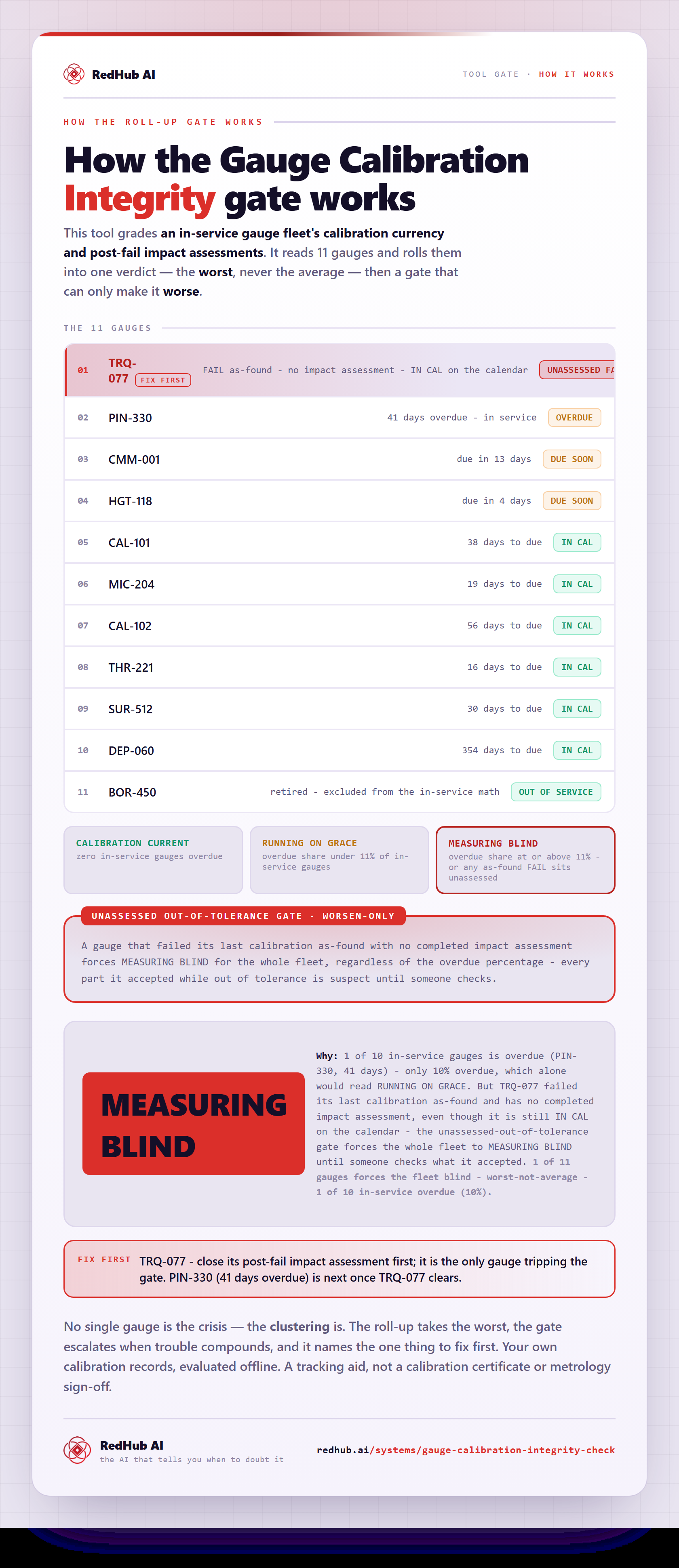
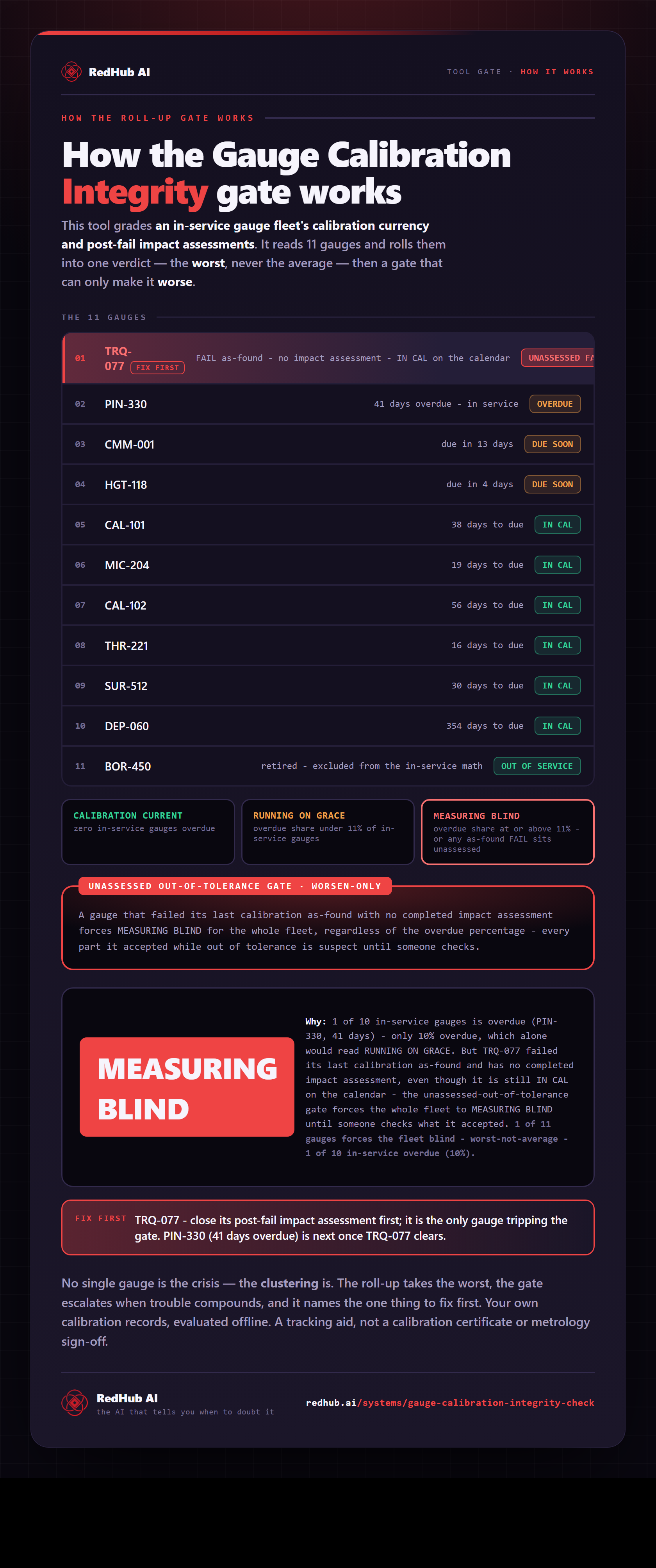
How the gate works, in one image
How the Gauge Calibration Integrity Check rolls an eleven-gauge fleet into one verdict and forces MEASURING BLIND on an unassessed out-of-tolerance gauge — the same math the demo runs, as a diagram you can share or embed anywhere.
View & embed the full diagramA fleet read you can run, not a chart you can admire.
The engine is zero-dependency Python — six columns per gauge, a pinned --as-of date, and it prints every gauge’s status, the fleet share, the gate, and, where a gauge is short, the one to fix first. The workbook reproduces the identical math with the same pinned date in a yellow cell, and the demo above runs the same logic. This is the engine’s verbatim output on the shipped sample:
GAUGE CALIBRATION INTEGRITY CHECK - GCA-079
================================================================
Evaluation date: 2026-07-01   Gauges read: 11   In service: 10

GAUGE    SVC  LAST CAL    DUE         STATUS   AS-FOUND  FLAG
CAL-101  yes  2026-05-10  2026-08-08  IN CAL   PASS
MIC-204  yes  2026-04-21  2026-07-20  IN CAL   PASS
CMM-001  yes  2026-01-15  2026-07-14  DUE      ADJUSTED
PIN-330  yes  2026-02-20  2026-05-21  OVERDUE  PASS      overdue 41d in service
HGT-118  yes  2026-06-05  2026-07-05  DUE      PASS
TRQ-077  yes  2026-03-12  2026-09-08  IN CAL   FAIL      UNASSESSED OUT-OF-TOLERANCE
CAL-102  yes  2026-05-28  2026-08-26  IN CAL   PASS
BOR-450  no   2025-11-02  2026-11-02  IN CAL   PASS
THR-221  yes  2026-04-18  2026-07-17  IN CAL   PASS
DEP-060  yes  2026-06-20  2027-06-20  IN CAL   PASS
SUR-512  yes  2026-06-01  2026-07-31  IN CAL   PASS

Overdue in service: 1 of 10 (10%) - RUNNING ON GRACE
Due within 14 days: 2
GATE: TRQ-077 failed its last calibration as-found and no product-impact
assessment exists - every part it accepted in the prior interval is suspect.

VERDICT: MEASURING BLIND
Fix first: TRQ-077
Built so the verdict can’t be negotiated.
A count before a percentage
One overdue gauge in service is never CALIBRATION CURRENT — the zero condition is checked as a count, so a 250-gauge fleet can’t round its one overdue gauge into a clean bill of health.
The gate cares about product
An as-found FAIL means the gauge was wrong for its whole prior interval — retired or not, those parts shipped. Without an impact assessment the verdict is MEASURING BLIND whatever the calendar says. Worsen-only: the gate never lifts a verdict, and it releases the moment the assessment exists.
Pinned, never drifting
The evaluation date is set explicitly in all three layers — engine flag, workbook cell, demo constant. Nothing reads today’s date, so last month’s verdict is auditable and this month’s is a deliberate re-run, not a sheet quietly changing its mind.
An integrity read, not a scheduling app.
- A deterministic, offline read of six columns per gauge against a pinned date — engine, workbook, and demo produce the identical verdict from the identical ledger.
- The layer your calibration software doesn’t ship: the overdue-in-service share, the unassessed-FAIL taint, and, where a gauge is short, one named gauge to fix first.
- A monthly discipline: the runbook installs the as-found capture at every cal, the impact-assessment rule, and the grace-period cleanup.
- Calibration software or a cal lab. It schedules nothing and measures nothing — it grades the ledger your existing system exports.
- A technician review. It grades a fleet’s calibration integrity — never the person who ran the cals or the one who fell behind.
- A compliance determination. Calibration requirements can be contractual or regulatory; your documented QMS procedures and customer requirements override this tool — full stop.
Scope note. This tool grades a gauge fleet’s calibration integrity from a ledger you enter — it scores gauges and fleets, never people, and it schedules nothing. Calibration requirements can be contractual or regulatory; your documented QMS procedures and customer requirements override this tool. Not a compliance determination, not certification of any standard, and not legal advice.
Anyone whose acceptances depend on a wall chart.
Quality managers whose calibration report is a due-date list with no as-found column
Cal coordinators running a fleet on grace and needing the overdue exposure named before the auditor names it
Job-shop owners who found one out-of-tolerance gauge and now wonder what else has been accepting parts blind
Quality engineers who need the product-impact question — not just the reschedule — forced when a cal comes back FAIL
Teams preparing for an audit who want the fleet read demonstrated from their own ledger first
Shops inheriting a gauge crib and needing an honest day-one snapshot at a pinned date
The measurement leg of the quality desk.
Cost-of-Poor-Quality Ledger
$99What a blind acceptance costs when it comes back: scrap, rework, and warranty, priced from your own numbers.
PM Deferral & Pencil-Whip Tripwire
$89The same integrity audit pointed at maintenance — the PMs marked done that never happened.
OEE Honesty Grader
$99Whether the quality rate in your OEE is even real — measured parts are only as honest as the gauges that passed them.
Straight answers, before you pay.
Two facts per gauge: where it sits on the calendar against a pinned evaluation date (IN CAL / DUE / OVERDUE), and what its last calibration found before adjustment (PASS / ADJUSTED / FAIL). The fleet verdict rides the overdue-in-service share — CALIBRATION CURRENT / RUNNING ON GRACE / MEASURING BLIND — and one overdue gauge in service is never CURRENT, whatever the percentage rounds to.
The wall chart tracks the calendar; the gate tracks the product. A gauge that failed as-found at its last calibration was accepting parts out of tolerance for its entire prior interval — and unless a product-impact assessment exists, every one of those acceptances is suspect. Any unassessed FAIL forces MEASURING BLIND regardless of the calendar, in service or retired, because the suspect parts already shipped. It releases the moment the assessment exists, and it never lifts a verdict.
So the verdict on a dated fleet snapshot is the same verdict forever. A sheet that drifts with TODAY() gives you a different answer every time you open it, which makes the monthly read unauditable. You set the date once per run — in the engine with --as-of, in the workbook's yellow cell, and the site demo pins the same date — and re-run monthly with a new one.
Six columns: gauge ID, in-service flag, last calibration date, calibration interval in days, the as-found result of the last cal (before adjustment), and whether a product-impact assessment exists for a FAIL. Any calibration-tracking spreadsheet or software exports these; a wall chart and a stack of cal certs provide them in an hour.
No. Calibration software schedules and records; the cal lab measures. Neither one will tell you that a gauge green on the calendar is the one poisoning your acceptances, or that your fleet is running on grace. This is the integrity read on top: export the ledger, run the check, act on fix-first where a gauge is short — in your existing system.
No and no. It's deterministic and offline — the same ledger and the same evaluation date produce the same verdict in the engine, the workbook, and this page's demo, byte for byte. It grades a fleet's calibration integrity, never a technician. Calibration requirements can be contractual or regulatory; your documented QMS procedures and customer requirements override this tool. Not certification and not legal advice.
The chart says in-cal.
Ask what the last cal found.
One purchase, lifetime access, 12 months of updates. $79, once.
Grades the fleet, never a technician. QMS procedures and customer requirements override this tool. Not certification or legal advice.
Sold by RedHub AI LLC · Secured by Stripe · redhub.ai