Is this safe to handa colleague?
AI drafts look finished. Then a colleague spends two hours chasing the source that won't open and the number that traces to nothing. This gate catches both before the handoff — mark six signals, and the verdict is the weakest one, with a dispositive rule that an unreachable source or an untraced figure is DO NOT HAND OFF however polished the rest reads.
"Workslop" spreads at the handoff.
is what the failure needs: one passes on polished AI work, the next spends hours verifying and redoing it. The cost lands on the receiver, off the sender's books.
is all it takes. A colleague acts on a number; if its source can't be opened, the polished draft was confidently wrong the whole time.
an AI-assisted draft leaves on the surface. It reads finished — the gap only shows when someone downstream tries to trace it.
An overall "looks good" read is exactly what fails here, because the failure is local: one hollow signal in an otherwise clean deliverable. This gate forces you to look at each signal and won't let a strong average paper over a broken source.
Grade one deliverable — and watch one unreachable source hold the whole handoff.
Each mark is 0/1/2. The verdict is the weakest of the six, not the average. The two verifiability signals (sources reachable, figures traced) also arm a gate: below full, they force DO NOT HAND OFF. The full kit ships this engine, a workbook that reproduces it, two playbooks, and a 6-deliverable sample. It scores the deliverable, never the person. Not legal advice.
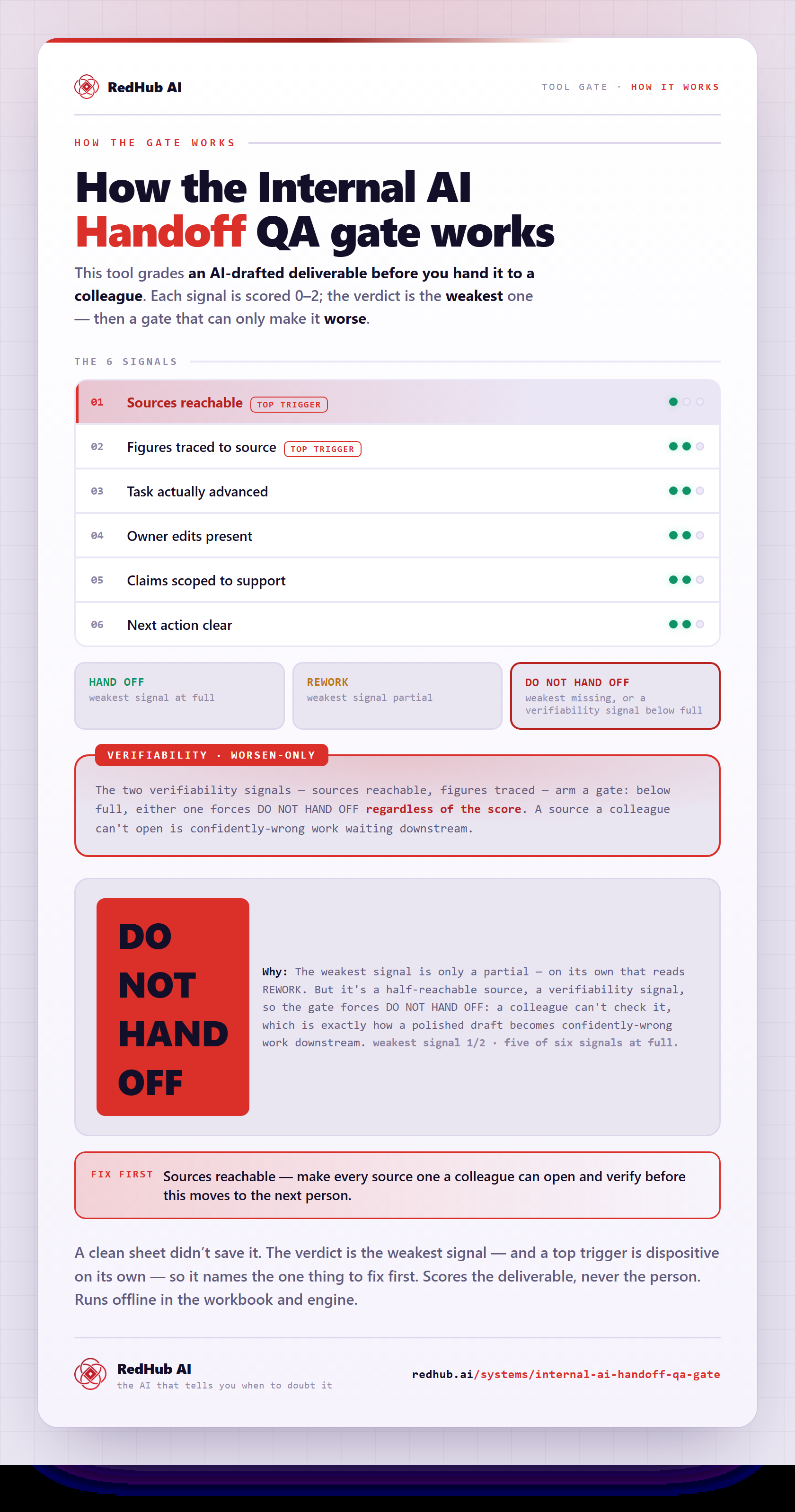
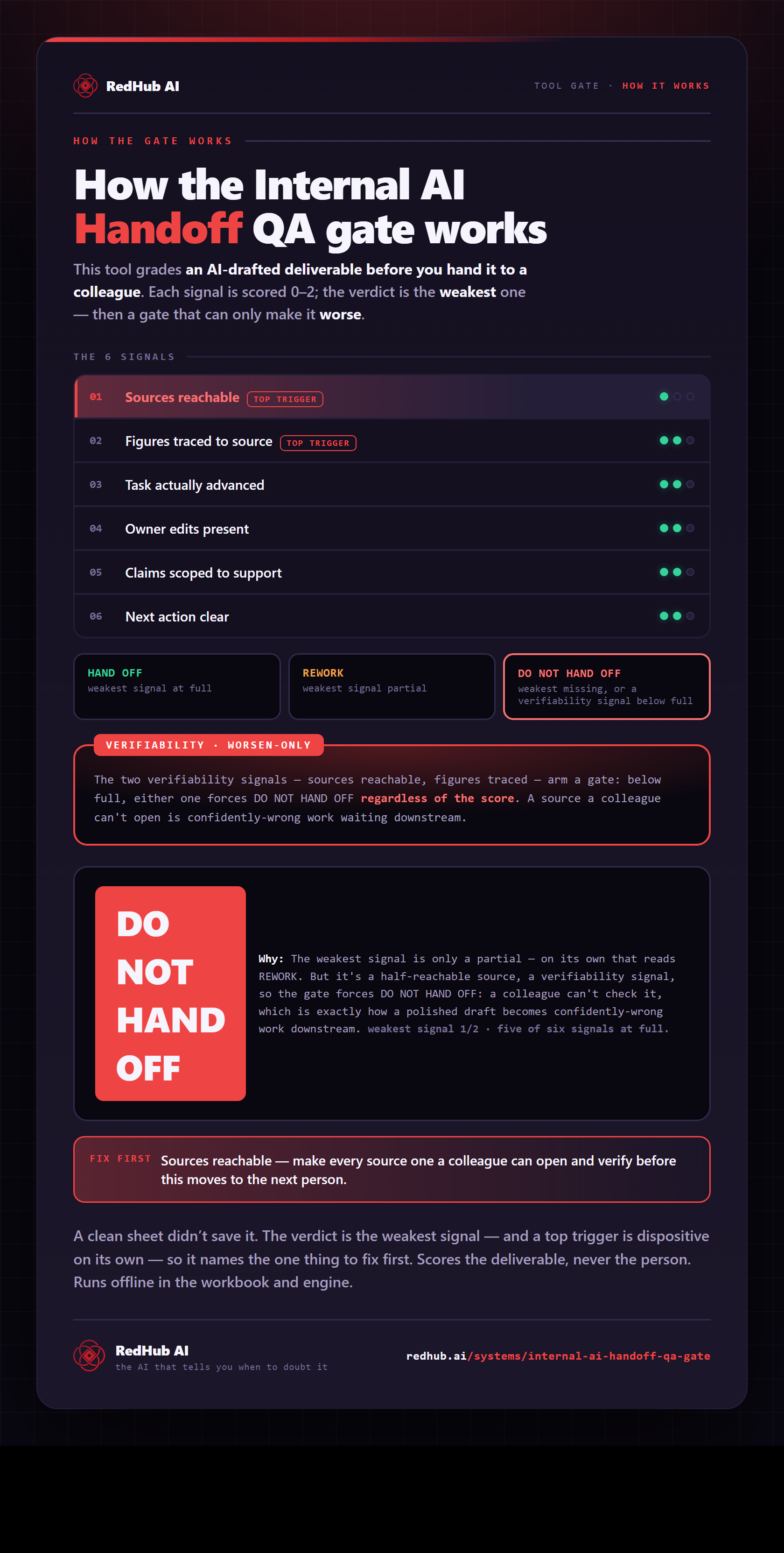
How the gate works, in one image
The six signals with the verdict set by the weakest, and the verifiability gate that forces DO NOT HAND OFF when a source is below full — the same math the demo runs, as a diagram you can share or embed anywhere.
View & embed the full diagram------------------------------------------------------------------------ INTERNAL AI HANDOFF QA GATE Is this AI-assisted deliverable safe to pass to a colleague? ------------------------------------------------------------------------ DELIVERABLE WEAK MEAN VERDICT GATE ------------------------------------------------------------------------ Q3 board summary 2 100% HAND OFF Competitor pricing brief 1 92% DO NOT HAND OFF FIRED Market-size memo 1 75% DO NOT HAND OFF FIRED Onboarding checklist 1 75% REWORK Vendor comparison 0 75% DO NOT HAND OFF FIRED Weekly metrics roundup 1 50% DO NOT HAND OFF FIRED ------------------------------------------------------------------------ Batch: HOLD — DO NOT HAND OFF ------------------------------------------------------------------------ Competitor pricing brief: fix first — Sources reachable Market-size memo: fix first — Figures traced to source Onboarding checklist: fix first — Task actually advanced Vendor comparison: fix first — Sources reachable Weekly metrics roundup: fix first — Sources reachable ------------------------------------------------------------------------ Verdict is the weakest signal; the mean is context only. The gate forces DO NOT HAND OFF when a source is unreachable or a figure is untraced. Deterministic, offline; it scores the deliverable, not people. ------------------------------------------------------------------------
The competitor brief scores 92% on the mean and still reads DO NOT HAND OFF: its weakest signal alone would only be REWORK, but that weak mark is a half-reachable source, so the gate is dispositive. The mean is context; the weakest signal and the gate are the verdict.
One engine, one workbook, two playbooks, one worked sample.
A zero-dependency Python CLI: feed it a deliverables CSV and it returns each item's weakest-signal verdict, the mean for context, the gate, and the one signal to fix first — plus a batch rollup across a stack of handoffs. Runs anywhere Python does; nothing uploaded.
Start Here → Handoff Scorecard → Dashboard. Enter the six marks per deliverable; the same verdict, the same gate, the same batch rollup — live formulas that reproduce the engine exactly. Opens in Excel, Google Sheets, or Numbers.
How to mark a deliverable honestly and read the verdict — what a 0, 1, or 2 means for each signal, so two reviewers reach the same call instead of arguing about vibes.
What to do with each verdict: how to close an unreachable source, trace a floating figure, or send it back — and how to re-score once you have.
Three rules keep the verdict honest.
Not the average. A handoff fails at its weakest point, so the verdict is the lowest of the six marks — one hollow part sinks it, and the mean is shown for context only.
An unreachable source or an untraced figure forces DO NOT HAND OFF even when the weakest signal would only read REWORK. Verifiability isn't just one mark among six — it's what makes a polished draft wrong downstream.
No AI grades the work, no benchmark is baked in. The engine applies the same weakest-signal rule and the same gate every time, so the result is reproducible and you can show your work.
A pre-handoff QA gate, not a grader of people.
- A deterministic, offline gate for AI-assisted internal deliverables — memos, analyses, summaries, briefs — before they move to a colleague.
- A weakest-signal verdict with a dispositive verifiability gate that catches the one unreachable source a polished read misses.
- The internal, peer-to-peer companion to the Claim Defensibility Gate (external deliverables) and the Output Risk Triage (customer-facing surfaces).
- Not a grader of people. It scores the deliverable, never the author, and is not for any hiring, performance, or employment decision.
- Not an automatic fact-checker or AI detector — you read the deliverable and enter the marks; the engine applies the verdict and the gate.
- Not a guarantee of quality or a substitute for subject-matter review. A review aid for your own internal work; not legal advice.
Scope. This grades a deliverable's quality, not any person. It does not screen, score, or rank individuals and is not for any hiring, performance, or employment decision. It is a review aid, not legal advice.
Teams passing AI-assisted work between people.
Build the accountable-AI stack.
Grades a finished external deliverable claim by claim before it ships to a client. This one gates the internal handoff before it does.
ViewScores live customer-facing AI surfaces on liability exposure. The public lane; this is the internal, peer-to-peer one.
ViewRecords who generated each output, with what tool, when, reviewed by whom. Keep the record; this gate keeps the handoff honest.
ViewThe questions teams actually ask before handing off AI-assisted work.
It's ready when its weakest signal is a full 2 and both verifiability checks are clear. The Internal AI Handoff QA Gate has you mark six 0/1/2 signals — sources reachable, figures traced, task actually advanced, owner edits present, claims scoped to support, next action clear — and takes the weakest one as the verdict: HAND OFF, REWORK, or DO NOT HAND OFF. One hollow part sinks the handoff, so a memo that's polished everywhere but rests on a source a colleague can't open is not ready, no matter how finished it reads.
Because a handoff fails at its weakest point, not its average one. A deliverable that scores 92% on the mean can still be a DO NOT HAND OFF if a single verifiability signal is broken — the shipped competitor-brief sample does exactly that. Averaging would let five strong signals hide one gate-triggering gap, which is the precise failure the gate exists to catch. The mean is shown for context only; it never sets the verdict.
The gate fires when a verifiability signal — sources reachable or figures traced — is below full, and it worsens the verdict to DO NOT HAND OFF. That's distinct from the weakest-signal headline: a deliverable whose weakest signal is a 1 reads REWORK on its own, but if that 1 is a half-reachable source, the gate forces DO NOT HAND OFF. An unreachable source or an untraced number is what turns a polished draft into work that's confidently wrong downstream, so it's treated as dispositive, not just one weak mark among six.
Same discipline, different lane. The AI Deliverable Claim & Citation Defensibility Gate grades a finished external deliverable claim by claim before it ships to a client or the public; the Customer-Facing AI Output Risk Triage scores live customer-facing surfaces like support bots. This one is the internal, peer-to-peer lane — the moment an AI-assisted memo or analysis moves to a colleague, which is where 'workslop' quietly spreads and costs the receiver hours of verifying and redoing. Use the one that matches where the work is going; many teams run all three.
No. It scores the deliverable, never the author, and it is not for any hiring, performance, or employment decision — that exclusion is load-bearing. It's a review aid that makes a pre-handoff check rigorous and repeatable; a colleague reads the six signals and enters the marks, and the engine applies the same deterministic verdict and gate every time. If it were ever repurposed to evaluate employees it would become a different, regulated thing, which is exactly why the scope line stays on the page, in the workbook, and in the runbook.
You get a runnable zero-dependency Python engine, a workbook that reproduces it exactly (Excel / Google Sheets / Numbers), a reviewer playbook and a fix-it runbook, and a 6-deliverable worked sample — a one-time purchase with lifetime access and 12 months of updates. It runs entirely offline, so a confidential internal memo never leaves your machine, and the same logic runs three ways (engine, workbook, on-page demo), byte-exact across all three. It's a review aid for your own deliverables; it is not legal advice.
Catch the workslop
before it reaches the next desk.
Gate every AI-assisted handoff on six signals before it moves. One purchase, lifetime access, 12 months of updates. $79, once.
Scope. This grades a deliverable's quality, not any person. It does not screen, score, or rank individuals and is not for any hiring, performance, or employment decision. It is a review aid, not legal advice.
Sold by RedHub AI LLC · Secured by Stripe · redhub.ai