When a shopper asks an AI,is your product invisible?
AI shopping reads your structured feed, not your homepage. One missing GTIN, one stale price, one schema that disagrees with the feed — and the AI recommends your competitor instead. This kit grades each product or local listing on six surfacing dimensions and returns one verdict: CITED, PARTIAL, or INVISIBLE — headlined by the weakest dimension, with a hard stop on contradictions.
The AI never sees your homepage. It reads your feed.
A scoring checklist that averages everything hides the one dimension that makes a product invisible. This kit refuses to average: your weakest dimension is the verdict, and an active contradiction is a hard INVISIBLE — so you see the real reason a product can’t surface, not a comforting blended number.
Mark six dimensions. Watch the weakest one become the verdict.
Consistency gate: schema contradicts feed — forced INVISIBLE regardless of the weakest mark. A contradiction makes the AI deprioritize both sides; that's worse than a gap.
Tap a dimension to cycle its mark (missing → thin → strong). Toggle a NAP conflict for a local listing. The verdict is the weakest dimension — unless a contradiction gates it.
Schema vs feed consistency
Same logic as the workbook and the Python gate: the verdict is your weakest of six surfacing dimensions, and an active contradiction — schema that disagrees with the feed, or a conflicting NAP — is a hard INVISIBLE. It grades the product surface, not people. Placements are earned, not bought; no tool guarantees a citation.
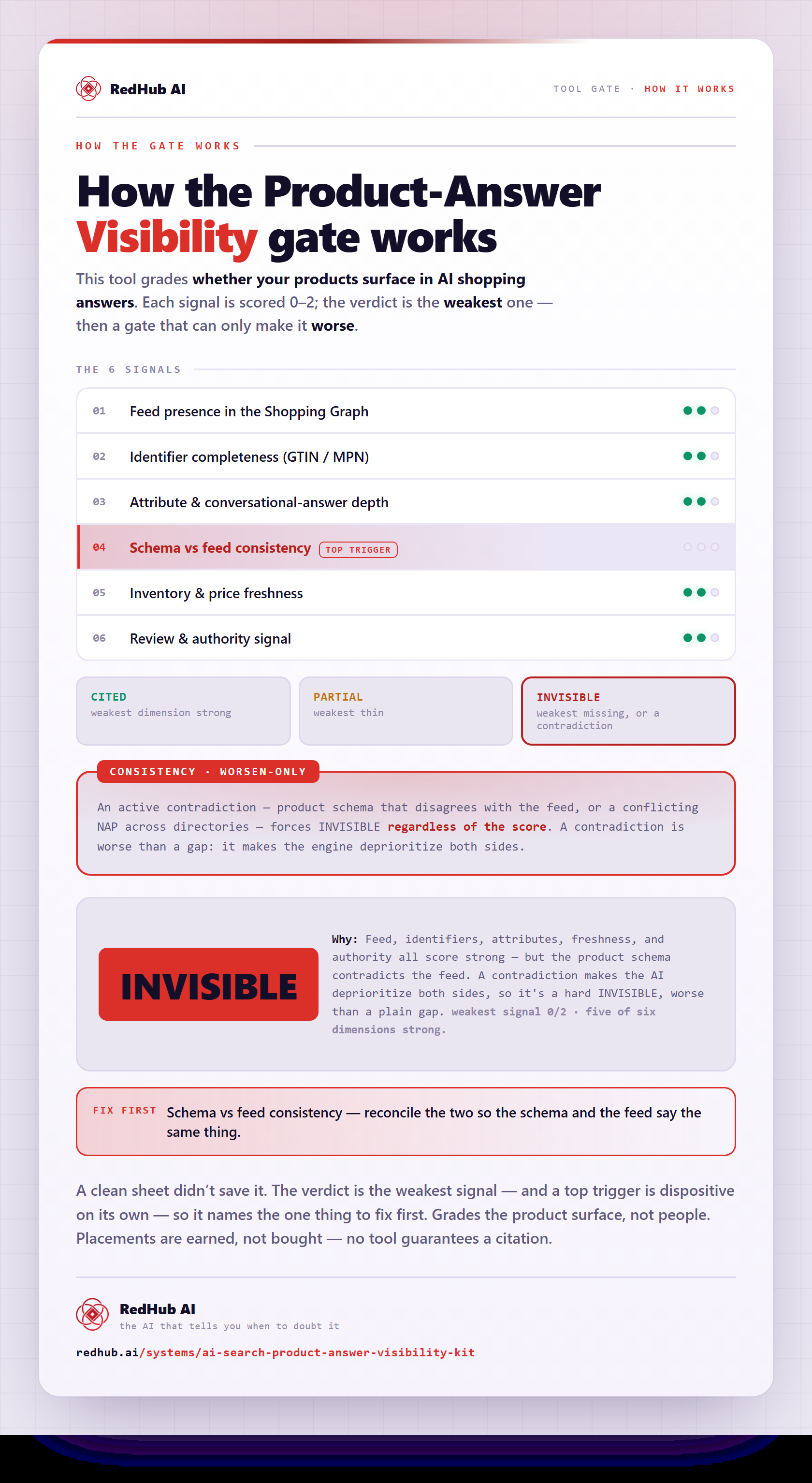
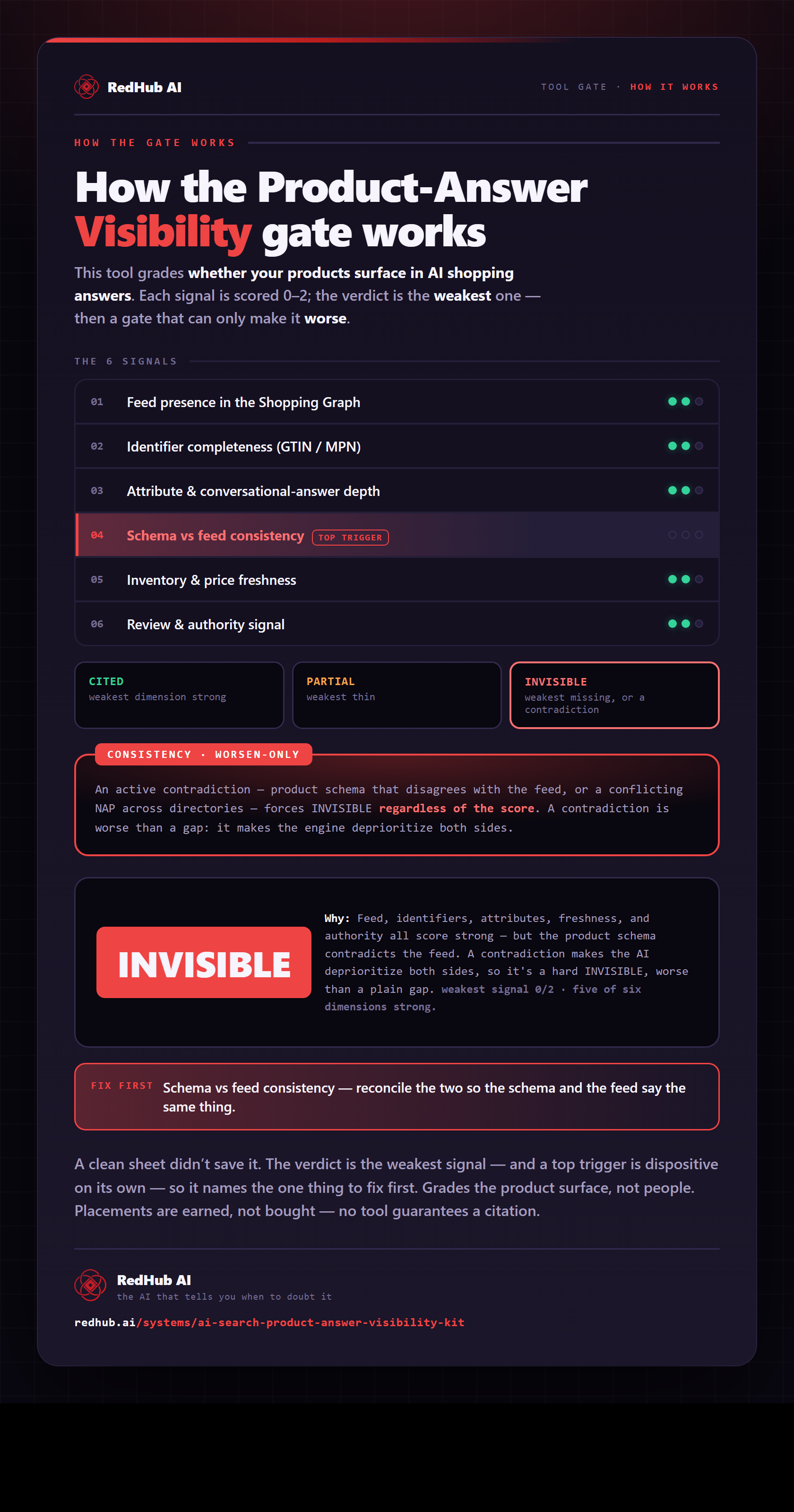
How the gate works, in one image
The six surfacing dimensions with the verdict set by the weakest, and the consistency gate that forces INVISIBLE when schema contradicts the feed — the same math the demo runs, as a diagram you can share or embed anywhere.
View & embed the full diagramThe same verdict, offline, from your terminal.
The workbook and the Python engine share one config — same dimensions, same weakest-link rule, same consistency gate. Run it against the shipped sample:
$ python3 engine/apv_engine.py engine/sample_items.csv

AI Search & Product-Answer Visibility Kit
============================================
Catalog: HIDDEN INVENTORY

Trail Runner Pro shoe (no GTIN)
  weakest: Identifier completeness (GTIN/MPN or verified place) (mark 0)  ->  INVISIBLE
  fix first: Identifier completeness (GTIN/MPN or verified place)

Hydration Vest 2L (fully optimized)
  weakest: Feed presence in the Shopping Graph (mark 2)  ->  CITED

Cast-Iron Skillet 12in (schema conflict)
  weakest: Schema vs feed consistency (mark 0)  ->  INVISIBLE   [GATE: schema contradicts feed -> INVISIBLE]
  fix first: Schema vs feed consistency

Bamboo Cutting Board (thin attributes)
  weakest: Attribute & conversational-answer depth (mark 1)  ->  PARTIAL
  fix first: Attribute & conversational-answer depth

Downtown Bike Shop (NAP mismatch)
  weakest: Review & authority signal (mark 1)  ->  INVISIBLE   [GATE: conflicting NAP across directories -> INVISIBLE]
  fix first: NAP consistency across directories

Vintage Denim Jacket (no feed)
  weakest: Feed presence in the Shopping Graph (mark 0)  ->  INVISIBLE
  fix first: Feed presence in the Shopping Graph

Local Coffee Roaster (solid local)
  weakest: Attribute & conversational-answer depth (mark 1)  ->  PARTIAL
  fix first: Attribute & conversational-answer depth

AI shopping placements are earned, not bought; no tool guarantees a citation.
It grades your readiness to surface, it does not place you.
The shoe sinks on its weakest dimension; the bike shop sinks on the gate, not its score.
Six dimensions, a weakest-link headline, and a contradiction gate.
Weakest dimension wins
The verdict is your lowest mark, named — because one missing GTIN or empty feed sinks the item regardless of everything else. That's how AI shopping actually fails.
A contradiction is worse than a gap
Schema that disagrees with the feed, or NAP that conflicts across directories, forces INVISIBLE — because the AI deprioritizes both sides, not just one.
One fix-first per item
Where a dimension is short, the verdict names the single one to fix first, and the runbook gives the exact feed, schema, or identifier move to make.
A readiness gate. Not a feed connector, not a placement guarantee.
- A deterministic, per-item verdict on readiness to surface in AI shopping and the local pack.
- A way to find the one dimension making a product invisible, named and prioritized.
- A repeatable audit you can run across a catalog and re-run as the surfaces evolve.
- A feed connector — you mark each dimension; it doesn’t read your Merchant Center for you.
- A guarantee of placement — AI shopping slots are earned through accurate data, not bought.
- A people-scoring tool — it grades products and businesses, not anyone’s reputation.
AI shopping and answer placements are earned, not bought — no tool guarantees a citation or carousel slot, and the mechanics of these surfaces change. Re-audit periodically. Not legal advice.
Anyone whose products need to be found by an AI.
Surface the product, cite the brand, earn the reviews.
AEO Citation Audit & Optimizer Kit
The other half: whether AI engines cite your brand in answer text. $79.
ViewEcommerce Skills Pack
Run the store behind the feed — listings, merchandising, operations. $89.
ViewAI Reputation & Reviews Engine
Build the review-authority signal one of these six dimensions grades. $99.
ViewWhat teams ask before they buy.
Almost always because of one dimension, not an overall weakness — and this kit names which one. AI shopping reads your structured feed, so a single broken signal sinks the item: no feed at all means no Shopping Graph entry; a missing or wrong GTIN drops you out of the competitive cluster; sparse attributes leave the AI unable to answer buyer questions. The kit grades six surfacing dimensions and the weakest one is the verdict, so you see the real reason instead of a comforting blended score. And if your data actively contradicts itself, that's worse than a gap — see the consistency gate below.
Through the structured-feed layer, not your homepage copy. AI shopping reads the Shopping Graph — tens of billions of listings populated from Merchant Center (or local) feeds plus Schema.org markup on your pages. The AI matches a shopper's question to items in that graph, so being present and accurate in the feed, carrying correct identifiers, and having page schema that agrees with the feed is the entry ticket. This kit grades exactly those signals — feed presence, identifiers, attribute depth, schema consistency, freshness, and review authority.
No — and any tool that promises a guaranteed citation or carousel slot is selling something it can't deliver. Organic AI-shopping and answer placements are earned through accurate, complete, consistent data, not bid on. This kit is honest about that: it grades your readiness to surface, it doesn't place you, and it makes no guarantee. What it does is find and prioritize the specific data fixes that make a product eligible to be recommended.
The gate forces an INVISIBLE verdict when your data actively contradicts itself — page schema that disagrees with the feed (a different price, availability, or rating), or a name/address/phone that conflicts across directories. A gap (a missing field) just leaves you out of one comparison; a contradiction makes the AI distrust and deprioritize both sides, which is worse. So a contradiction is a hard stop regardless of how strong the other dimensions are — in the worked sample, a local business with decent signals still goes INVISIBLE on a NAP conflict, and the fix-first is to reconcile the NAP.
Different layer of the same goal. The AEO Citation Audit & Optimizer Kit and GEO work grade whether AI engines cite your brand in answer text — the editorial layer. This grades the product surface: whether your items are eligible to appear in AI-shopping panels, product carousels, and the local pack — the structured-feed layer. A brand can be well-cited in answers and still have invisible products, or vice versa. Run both: surface the product with this, earn the brand citation with the AEO kit.
No connection — you mark each dimension yourself from your Merchant Center, feed, and pages, and it grades deterministically offline. You get a visibility scorecard workbook (.xlsx), a runnable Python gate that shares the workbook's config, a Visibility Audit Playbook and a Surfacing Fix Runbook (both .docx), and a 7-item worked sample. Run it across a catalog, fix the named dimension per item, and re-audit as the surfaces evolve. It grades products and businesses, not people; placements are earned, not bought.
Find the dimension that’s
hiding your product from the AI.
One purchase, lifetime access, 12 months of updates. $89, once.
AI shopping placements are earned, not bought — no tool guarantees a citation. It grades your readiness to surface, it does not place you.
Sold by RedHub AI LLC · Secured by Stripe · redhub.ai