The renewal you missdissolves the company.
Most states send no reminder, and a single missed annual report escalates quietly: late fee, then loss of good standing, then administrative dissolution — and reinstatement runs three to ten times a timely filing. This watchtower reads every entity and license from your own confirmed dates, tells you what’s current, due soon, past due, or blocked, and, where an obligation needs working, names the one to fix first.
A silent failure with disproportionate consequences.
Several states — Florida among them — send no renewal notice at all. Many owners find out they were dissolved months after it happened.
what reinstatement typically costs versus a timely filing — plus back fees, and in some states you can lose your business name to a competitor.
dissolve the entity and the licenses under it can't be renewed, and foreign registrations in other states can be revoked automatically.
The obligation you miss isn’t always the one with the nearest date — it’s the entity whose lapse takes the licenses under it down with it. This reads every renewal from your own confirmed dates and names that one first.
Edit a due date and watch the cascade decide.
The Florida contractor license is 149 days from its own renewal — and still reads BLOCKED, because the Florida LLC underneath it is past due with name-loss on the line. Bring that entity current and the license goes back to reading by its own clock.
Edit any due date and watch the read change. Urgency is the headline; severity says how bad; a license reads BLOCKED when the entity underneath it has gone into dissolution territory — its own date can’t save it. The evaluation date is pinned, never live. Grades obligations, not people. Not legal advice — confirm every date and consequence with your state.
How the gate works, in one image
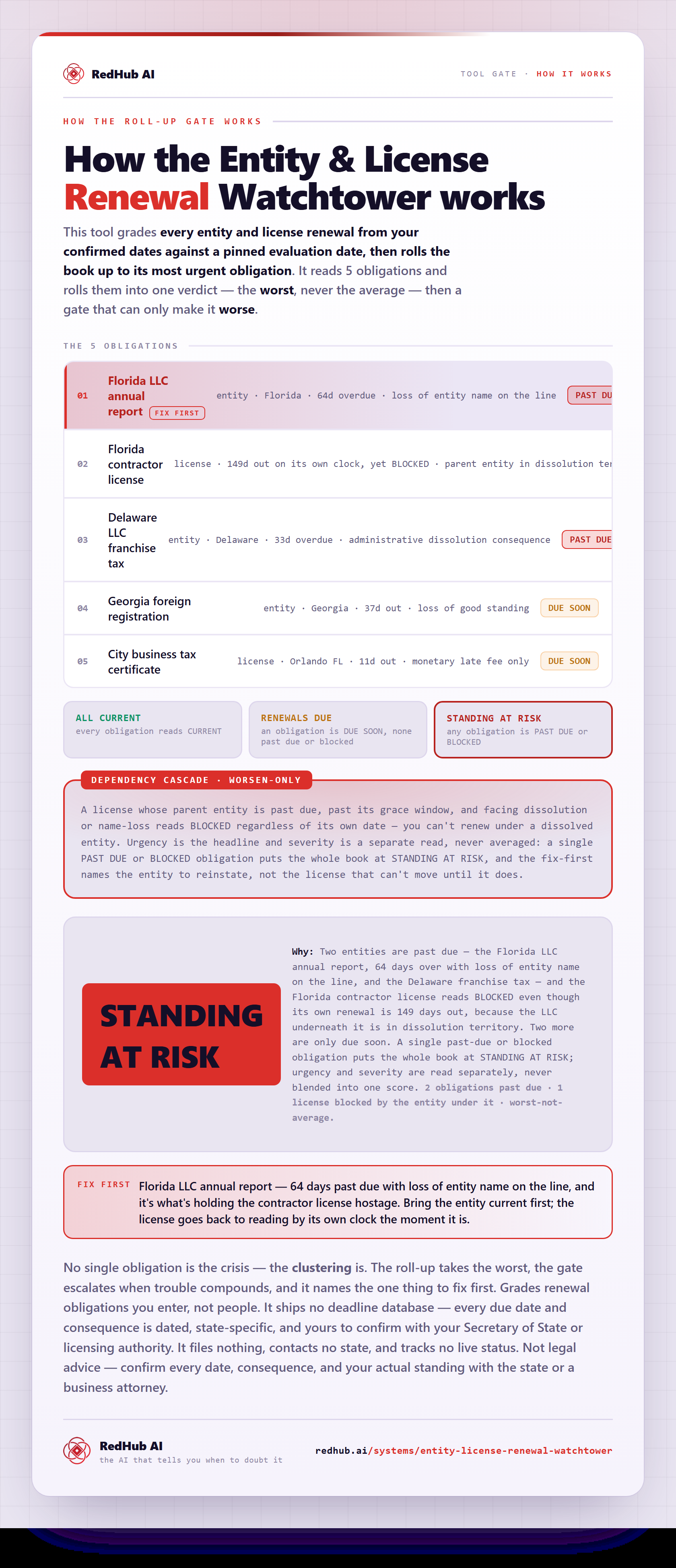
How the Entity & License Renewal Watchtower rolls renewals up to the most urgent and reads STANDING AT RISK when one obligation is past due — the same math the demo runs, as a diagram you can share or embed anywhere.
View & embed the full diagramOne command, every obligation you carry, an honest read.
The shipped five-obligation sample, run verbatim. Two entities past due, one license blocked by the entity above it, two more due soon — and, where anything needs working, the one thing to work first.
ENTITY & LICENSE RENEWAL WATCHTOWER -- as of 2026-07-04
(DUE SOON window: 45 days. Dates & consequences are buyer-confirmed.)
==========================================================================
[PAST DUE ] Florida LLC annual report
    entity · Florida · due 2026-05-01 (64d overdue)
    if missed: Loss of entity name to the public
--------------------------------------------------------------------------
[ BLOCKED ] Florida contractor license
    license · Florida DBPR · due 2026-11-30 (149d out)
    if missed: License / permit lapses, cannot operate
    >> BLOCKED: parent entity 'Florida LLC annual report' is in dissolution territory -- fix it first
--------------------------------------------------------------------------
[PAST DUE ] Delaware LLC franchise tax
    entity · Delaware · due 2026-06-01 (33d overdue)
    if missed: Administrative dissolution / revocation of authority
--------------------------------------------------------------------------
[DUE SOON ] Georgia foreign registration
    entity · Georgia · due 2026-08-10 (37d out)
    if missed: Loss of good standing (blocks financing / contracts / banking)
--------------------------------------------------------------------------
[DUE SOON ] City business tax certificate
    license · Orlando, FL · due 2026-07-15 (11d out)
    if missed: Monetary late fee only
--------------------------------------------------------------------------
THE BOOK: STANDING AT RISK   (worst consequence in play: Loss of entity name to the public)
Work first: Florida LLC annual reportOne clock for the headline. A cascade for what’s dispositive.
Time-to-deadline from each confirmed date against a pinned evaluation date: CURRENT, DUE SOON, or PAST DUE. The clock is the product.
The confirmed consequence if missed, from a flat late fee up to dissolution or name loss. It never averages into the urgency verdict.
A license whose parent entity is dissolution-bound reads BLOCKED regardless of its own date — because you can't renew under a dissolved entity.
No deadline database and no live clock — you confirm the dates, the evaluation date is fixed, so the read never silently drifts month to month.
Each obligation reads CURRENT, DUE SOON, or PAST DUE from its confirmed date against a pinned evaluation date — never a live one, so nothing drifts between runs.
What actually happens if you miss it — a flat late fee, or dissolution. A past-due late fee and a past-due dissolution are different problems, and the tool keeps them apart.
A license whose parent entity is dissolution-bound reads BLOCKED regardless of its own date. Fix the entity first; the tool names it as the work-first obligation.
A triage read, not a filing service.
- A monthly triage read of every entity and license renewal you carry.
- A dependency map that flags the licenses an entity lapse will take down.
- Built to stay correct as the rules change — you confirm the dates, not a database.
- Offline — engine, workbook, and demo agree to the day.
- Not a registered-agent or filing service — it files and sends nothing.
- Not a live status tracker — you bring the confirmed dates from the state.
- Not legal advice, or a guarantee against a lapse or an enforcement action.
- Not a deadline database — it ships no state figures, so it can’t go stale.
Not legal advice. This grades renewal obligations you enter, not people. It ships no deadline database — every due date and consequence is dated, state-specific, and yours to confirm against your Secretary of State or licensing authority. It files nothing, contacts no state, and tracks no live status. Confirm every date, every consequence, and your actual standing with the state or a business attorney.
Owners who’ve outgrown a calendar reminder.
One survival risk desk for the whole business.
The revenue-side risk on the same desk — how exposed you are if your biggest customer walks.
ViewThe supply-side twin — one supplier's share of spend, contracted or not, before it becomes a crisis.
ViewThe people-dependency risk — what breaks if one irreplaceable person is suddenly gone.
ViewThe questions owners actually ask before they buy.
No. It's the triage layer, not a registered-agent service. It computes where every obligation stands from the dates and consequences you enter, tells you what's current, due soon, past due, or blocked, and, where an obligation needs working, names what to fix first — but it files nothing, contacts no state, and tracks no live status. Its distinct value over a filing service is the honest read those dashboards don't give you: which of your obligations are existential versus annoying, and which licenses will structurally lapse because the entity they hang on is about to be dissolved.
Because a built-in deadline table would rot. Renewal dates, late fees, grace periods, and dissolution timelines are dated, state-specific, and change — Florida charges an immediate $400 the day after May 1 and releases your name after 12 months; Georgia dissolves after July 1; Delaware gives you two-plus years; Texas can revoke after 120 days. A shipped database would quietly go wrong. Instead you confirm each obligation's own due date and consequence from your Secretary of State or licensing authority, and the tool computes from exactly what you enter. That's the same honesty rule the rest of the catalog follows: it never invents a number you'd act on.
Because most licenses hang on an underlying entity — a contractor or professional license is issued to your LLC or corporation. If that entity is administratively dissolved, the licensing authority won't renew the license under it; you have to reinstate the entity first. So when a license's parent entity is past due, past its grace window, and facing dissolution or name-loss, the license reads BLOCKED regardless of its own date. The shipped sample shows a Florida contractor license 149 days from its own renewal reading BLOCKED, because the Florida LLC underneath it is 64 days past due. Fix the entity and the license goes back to reading by its own clock.
Urgency is when — the headline, from the due date versus the evaluation date: current, due soon, or past due. Severity is how bad — the consequence you confirm if it's missed, from a flat late fee up to loss of good standing, a lapsed license, name loss, or administrative dissolution. They're deliberately kept separate and never averaged, because a low-severity item due tomorrow and an existential item due in forty days are different problems, and a single blended score would bury which is which.
It's aimed squarely at the owner who's outgrown a spreadsheet but isn't paying a compliance service per entity — say three to fifteen obligations across a couple of states. If you have one LLC in one state, a calendar reminder is probably enough. The moment you add a foreign registration, a couple of licenses, or a second entity, the interactions start to matter: separate dates in each state, and licenses that can be taken down by an entity lapse you didn't notice. That's the mess this untangles.
The evaluation date is pinned rather than live so the workbook, engine, and demo always agree on the same reading — you set it to the day you run the review. The obligations themselves are yours to keep current: run it monthly, re-confirm any date that's changed, and the read updates. A mistyped or blank date is flagged as INVALID DATE rather than silently misread, so a bad entry can't quietly show you as current when you're not.
Catch the lapse before
the state does.
One purchase, lifetime access, runs on your own dates offline. $79, once.
Not legal advice. This grades renewal obligations you enter, not people. It ships no deadline database — every due date and consequence is dated, state-specific, and yours to confirm against your Secretary of State or licensing authority. It files nothing, contacts no state, and tracks no live status. Confirm every date, every consequence, and your actual standing with the state or a business attorney.
Sold by RedHub AI LLC · Secured by Stripe · redhub.ai