Measure your marketing honestly —even the parts AI made invisible.
Vanity metrics and over-attribution flatter you into bad decisions, and buyers now research you inside AI tools that leave no trail. A 50% lift on 8 conversions isn’t a result — it’s noise.
This kit gives you the few metrics that matter, the methods to track the dark funnel, and the discipline to report results you can defend — including a tool that tells you when a number isn’t reportable yet.
Measurement is where marketing earns or loses trust.
And right now it’s broken. Most marketers can’t confidently tie performance to channels, platform-attributed conversions add up to more than the business actually did, and a growing share of the buyer journey happens inside AI tools you can’t pixel.
The fix isn’t another dashboard — it’s a discipline that’s honest about what the numbers can and can’t say.
Impressions and likes feel like progress but rarely move revenue. They make a report look busy and a decision look justified — neither is true.
Summed platform conversions exceed reality — most teams can't untangle each channel's true impact, so credit gets double-claimed.
Buyers ask AI about you before they ever visit; analytics logs it as 'direct' or nothing at all. A growing share of the journey is invisible.
Before you report a win, check it.
Enter the basics and get an honest verdict — the same thresholds the kit’s evaluator uses and the same three bands as the Rigor Scorecard. A thin sample or a missing baseline gets caught here, not in the boardroom.
Verdict
Report with caveats
- •Small sample (n=45) — treat as directional, not conclusive.
Correlation isn’t causation — a controlled holdout is the only way to claim a cause.
Report results you can defend.
The kit adds the CLEAR framework, a KPI tracker, a channel ROI workbook, honest report templates, and a tool that lints your claims for over-reach.
Get the AI Marketing Measurement Kit — $99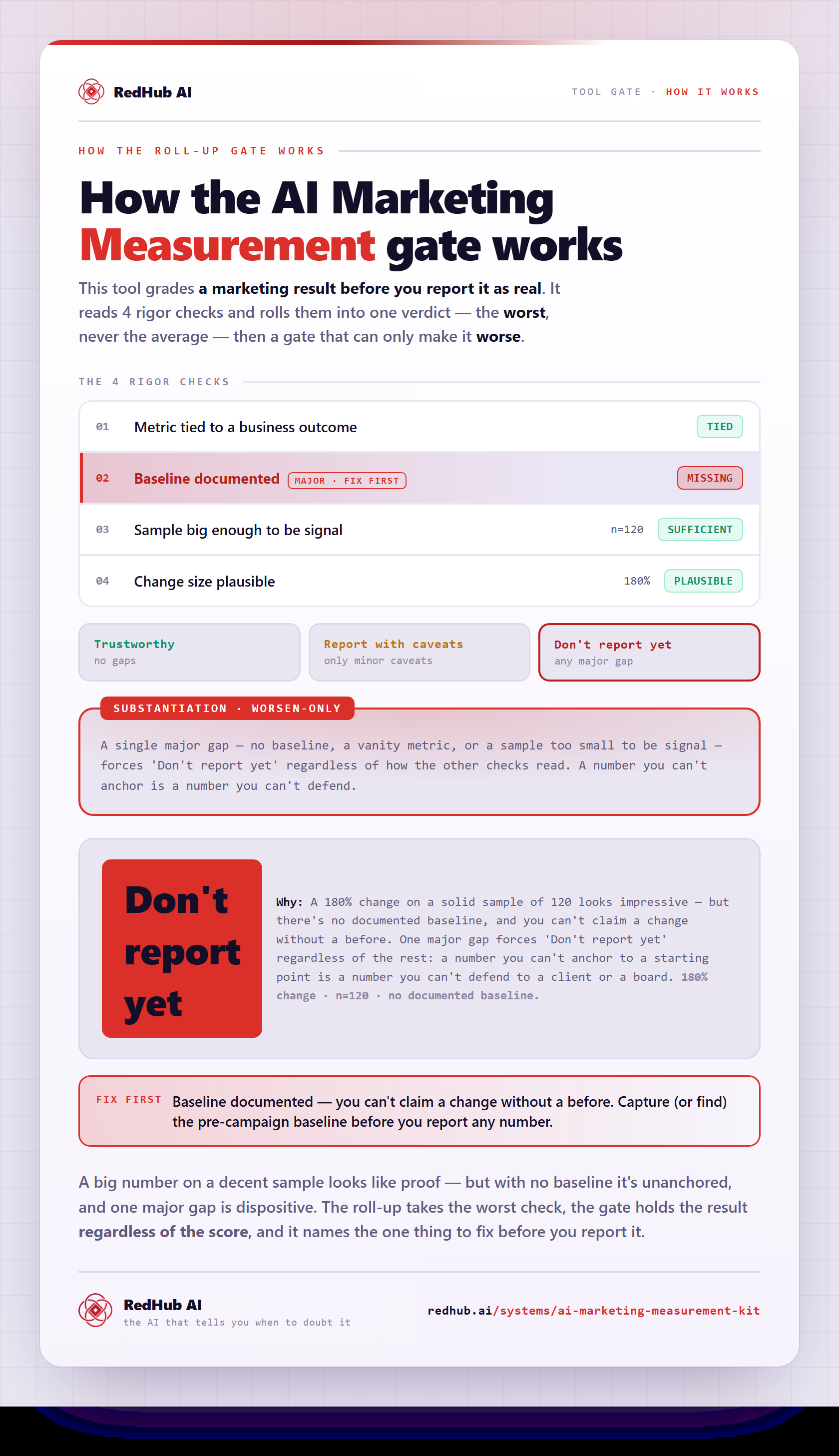
How the gate works, in one image
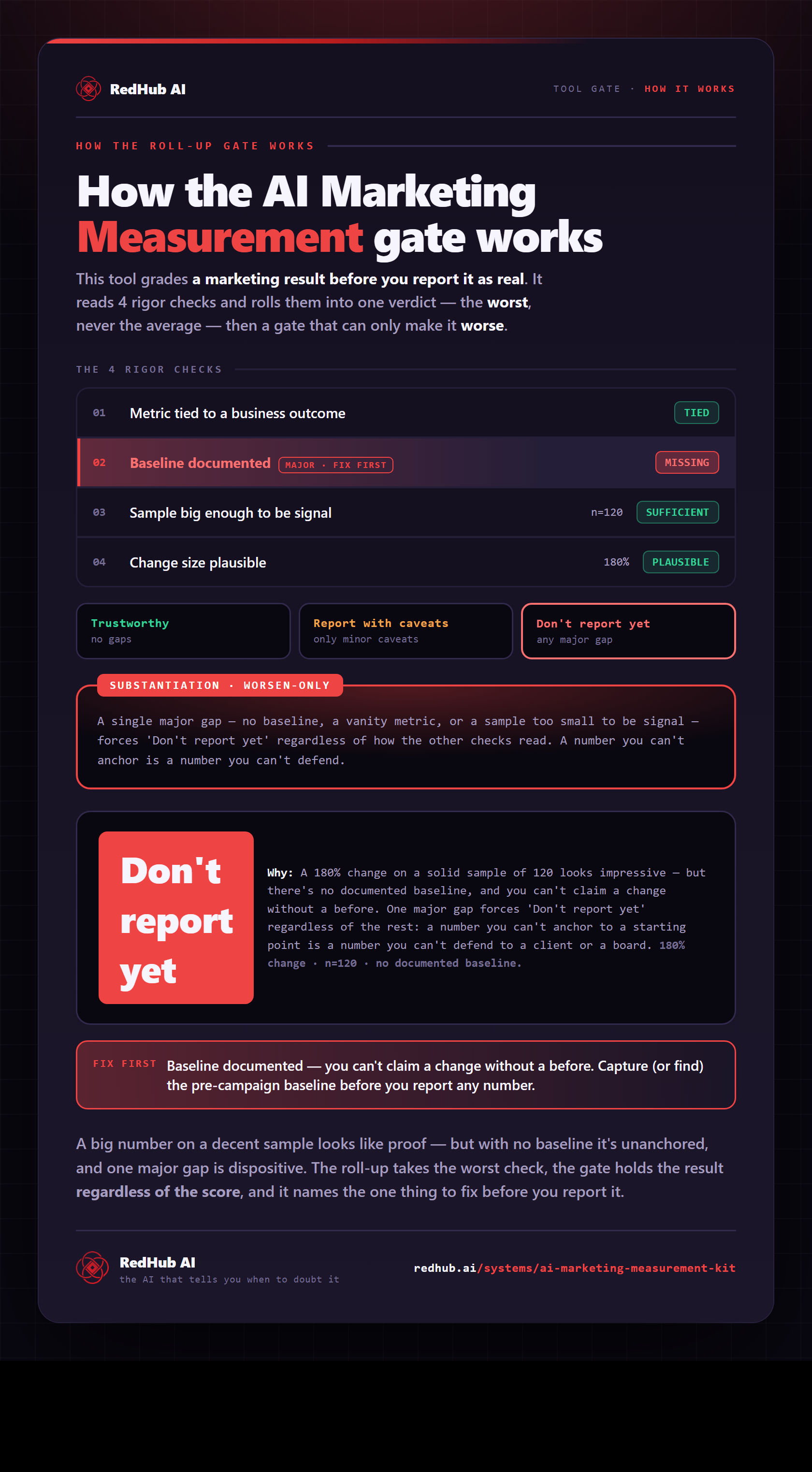
Four rigor checks rolled up to the worst and the substantiation gate that holds a result on one major gap — a 180% change can't be reported with no baseline to anchor it. The same math the demo runs, as a diagram you can share or embed anywhere.
View & embed the full diagramCLEAR: five checks that keep a result honest.
Run any number through all five before you believe it — or report it. It’s the spine of the playbook, the Rigor Scorecard, and the evaluator.
C — Connect to a goal
Every metric ties to revenue, pipeline, or retention. If it doesn't change a decision, it's vanity.
L — Lock a baseline
You can't measure lift without a before. Capture the prior period and the normal range first.
E — Evidence over anecdote
Enough data to mean something — and remember correlation is not causation.
A — Attribute honestly
Use self-reported attribution, signal correlation, and incrementality. Don't just sum platform credit.
R — Report with confidence
State what you know, what you don't, and the decision. No false precision.
Track the channels you can’t pixel.
You can’t measure a conversation inside ChatGPT directly. You estimate its influence honestly — and say that’s what you’re doing.
An open 'how did you hear about us?' field catches the dark funnel that analytics misses entirely.
Branded search, direct traffic, and mentions rising together is evidence of influence, even without a pixel.
A controlled holdout is the closest thing to a real causal read — the only way to claim a cause.
Whether AI cites you and describes you correctly — a leading indicator of dark-funnel health.
A playbook, a field guide, a workbook, and runnable tools.
Why measurement is broken, the CLEAR framework, the few metrics that matter, how to track the AI era honestly, and the reporting spine.
The metric taxonomy (matters vs vanity), attribution models in plain English, the measurement red flags + fixes, and dark-funnel methods.
A KPI tracker, a result Rigor Scorecard (Trustworthy / report with caveats / don't report yet), a channel ROI table (CAC, ROAS, conversion), and a dashboard.
Honest monthly-report and result-claim templates, a self-reported attribution question bank, a UTM cheat sheet, and an AI-search tracking checklist.
Computes CAC/ROAS/conversion/lift and flags thin samples, missing baselines, and implausible jumps; lints written claims for over-reach. Zero dependencies.
Editable sanity thresholds — sample sizes and implausible-result flags — so the rails match your own business, not someone's blog benchmark.
A methodology — not a guarantee, and not financial advice.
This is the discipline that makes a number defensible. It’s explicit about its own limits:
- Influence, not causation
Indirect methods estimate influence; they don't prove it. Confirm a cause with a controlled holdout.
- Use your own baselines
Benchmarks vary enormously by industry and channel — measure against your own history, not a blog number.
- 'Don't report yet' is a feature
The tools will hold a result when the sample is thin or the baseline is missing. That's the point, not a bug.
- Not financial advice
Measurement supports decisions; it doesn't guarantee outcomes. Treat the kit as a method, not a promise of results.
Marketers who’d rather be right than impressive.
In-house leads and agencies who report to people who ask hard questions, founders who want to know which channel actually works, and anyone tired of dashboards nobody trusts. No analyst required — the runnable tools are optional and the rest is no-code.
AEO Citation Audit Kit
$79The AI-visibility leg of measurement. This kit measures whether your marketing works; the AEO Audit Kit measures whether AI engines cite you at all — one of the leading indicators of dark-funnel health you'll be tracking here.
AI Brand Misinformation Watch
$99Visibility is only half the dark-funnel picture — accuracy is the other. Audit what AI actually says about your brand and correct what's wrong, so the impressions you're measuring aren't being undercut by a wrong price or a competitor mix-up.
Anti-Slop Content System
$79Make the content; then measure whether it worked. The Anti-Slop System keeps AI-assisted copy from reading generic; this kit tells you honestly whether it moved a number worth reporting. Production on one side, accountability on the other.
The questions marketing leads actually ask.
A framework, a workbook, and tools to measure AI-era marketing honestly. It includes a strategy playbook (the CLEAR framework), a field guide to metrics and attribution, a measurement workbook (KPI tracker + result rigor scorecard + channel ROI), a reporting pack of honest templates, and a runnable result evaluator and claim linter.
Five checks that keep a result honest: Connect to a goal, Lock a baseline, Evidence over anecdote, Attribute honestly, and Report with confidence. You run any result through all five before you believe it — or report it.
You measure their influence indirectly and say so: self-reported attribution (an open 'how did you hear about us?' field), signal correlation (branded search, direct traffic, and mentions moving together), and incrementality testing (controlled holdouts). The kit also tracks AI visibility and accuracy as a leading indicator of dark-funnel health.
AI makes reporting faster and pattern-finding broader, but it hasn't repealed baselines, sample size, or causation — and it hasn't fixed over-attribution. Most marketers still struggle to determine each channel's true impact. This kit is the discipline that AI tools don't give you on their own.
The AEO Citation Audit Kit measures whether AI cites you. This measures your whole marketing program honestly, with AI visibility as one leading indicator among several. Use them together — be visible in AI answers, and measure whether your marketing actually works.
No. The workbook and templates are no-code, and the result evaluator and claim linter (measure.py) are optional with zero dependencies. The point is sound judgment, not heavy tooling.
A Measurement Playbook, a Field Guide, the Marketing Measurement Workbook (Excel), a Reporting Pack, measure.py, and an editable thresholds config.
Stop reporting numbers you can’t defend.
Measure what matters, track the dark funnel, and report with honest confidence. The CLEAR framework, a KPI tracker, a rigor scorecard, and a tool that tells you when to hold. One-time $99, yours to keep.
Sold by RedHub AI LLC · Secured by Stripe · A methodology, not financial advice · estimates influence, not causation · redhub.ai