Your dialer says 4:30pm.Your contact hears 7:30pm — or 11pm.
An outbound queue is built in your timezone, but the calling window belongs to the person you’re calling. This checker resolves every queued call into the called party’s local time and flags the ones that would fire outside their permitted window — before the batch goes out.
Not legal advice. This tool renders a calling-window compliance read you act on, mapped to the federal 8am–9pm baseline as a default. It maintains no authoritative list of state calling-time laws, guarantees no current-law status, and grades queued calls, not people. The current federal window, its exemptions, and every state and local calling-time rule are legal questions — confirm them, and your editable overlay values, with counsel.
The queue looks fine in your timezone. That’s the trap.
The state overlay catching a call the federal window would clear.
The queue is built in the operator’s timezone; the window is the recipient’s. The tool resolves each called party’s local time and checks it against the effective window. It grades calls, not people. Not legal advice.
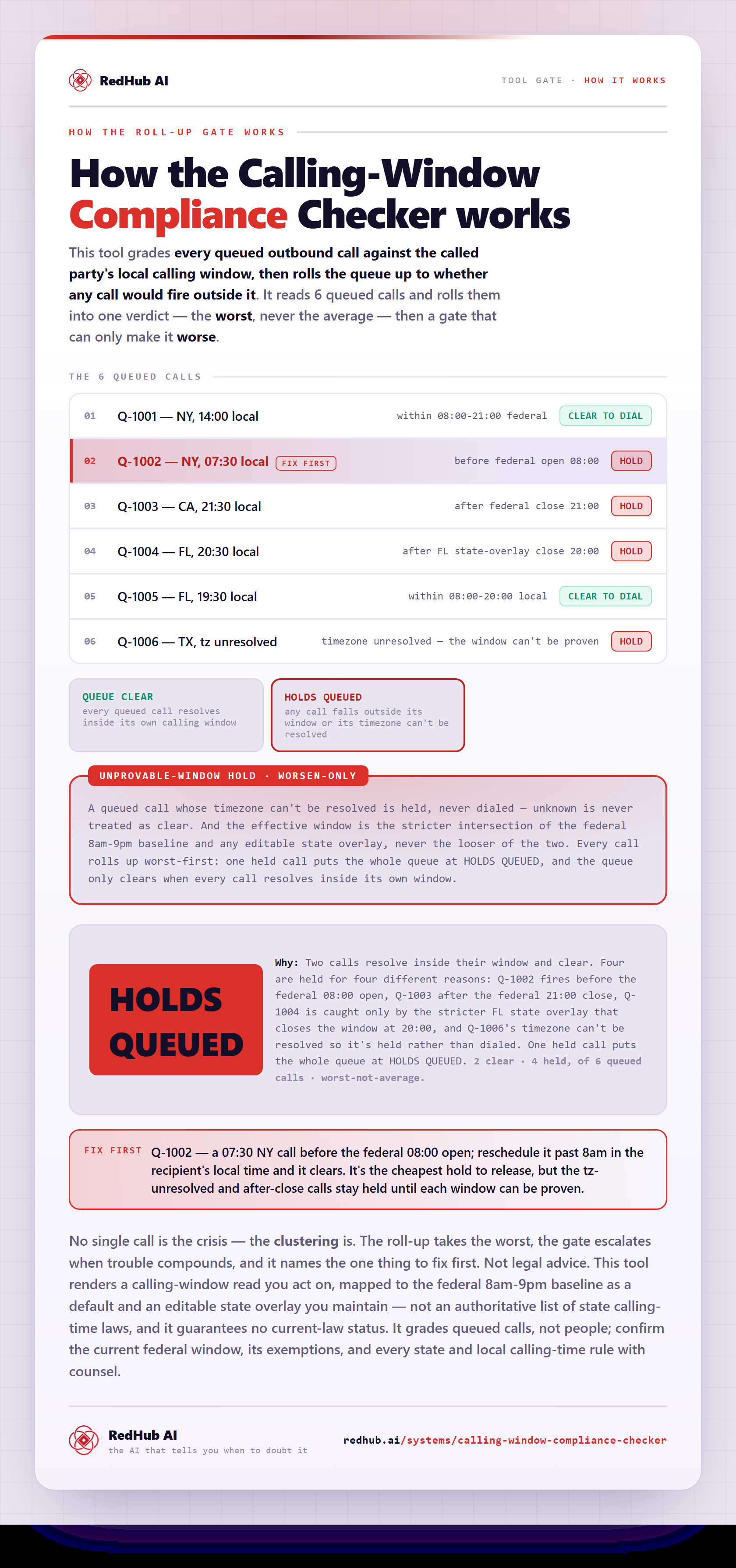
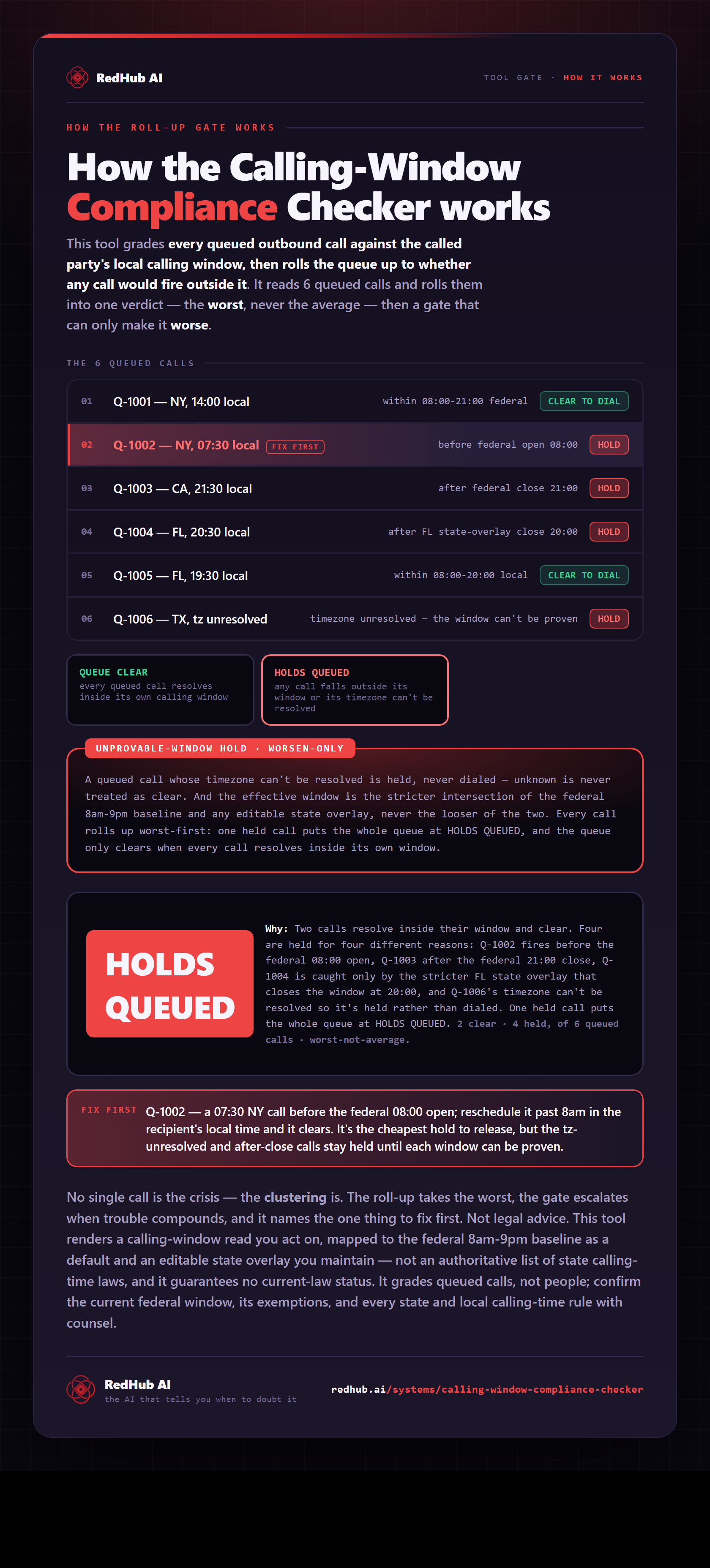
How the gate works, in one image
How the Calling-Window Compliance Checker rolls a call queue up to its worst and reads HOLDS QUEUED when one call falls outside the window — the same math the demo runs, as a diagram you can share or embed anywhere.
View & embed the full diagramFeed it your queue. Get a per-row verdict.
A zero-dependency Python tool (stdlib timezone math) resolves each called party’s local time and checks it against the effective window. Here is its actual output on the shipped six-call sample — two clear, four held, for four different reasons:
CALLING-WINDOW COMPLIANCE CHECKER
============================================================
Federal baseline 08:00-21:00 local to the called party.
State overlays are editable planning references, not a legal register.

PER QUEUED CALL
------------------------------------------------------------
Q-1001    NY CLEAR TO DIAL 2026-07-15 14:00
    within 08:00-21:00 local
Q-1002    NY HOLD          2026-07-15 07:30
    before open (08:00, federal)
Q-1003    CA HOLD          2026-07-15 21:30
    after close (21:00, federal)
Q-1004    FL HOLD          2026-07-15 20:30
    after close (20:00, state overlay (FL))
Q-1005    FL CLEAR TO DIAL 2026-07-15 19:30
    within 08:00-20:00 local
Q-1006    TX HOLD          (tz unresolved)
    timezone unresolved

QUEUE ROLLUP
------------------------------------------------------------
Queued calls ............. 6
Clear to dial ............ 2
Held ..................... 4
Fix first ................ Q-1002

VERDICT: HOLDS QUEUED

Grades queued calls against the called party's local calling window.
State overlays are editable planning references, not a legal register.
It grades calls, not people. Confirm all rules with counsel. Not legal advice.Three rules the checker holds to.
The window is the recipient's, not yours
The queue is built in the operator's timezone, but the calling window belongs to the called party. The tool resolves each recipient's local time at the scheduled fire moment with deterministic, DST-correct math — the flip an outbound queue silently gets wrong.
Stricter of federal and state — never looser
The federal 8am–9pm baseline is the default; a state overlay can only narrow it. The effective window is the intersection — the stricter open and the stricter close. Overlays are an editable planning reference you maintain, not a legal register.
If you can't prove the window, hold
A row whose timezone can't be resolved — a multi-zone state with no explicit timezone — is held, not dialed. Unknown is never treated as clear. When the local time can't be proven, the honest and safe verdict is HOLD.
A pre-flight check. Not a dialer, not a legal register.
- A per-row CLEAR TO DIAL / HOLD read on your queue export.
- Deterministic, DST-correct timezone resolution of the recipient’s local time.
- An editable stricter-state overlay intersected with the federal baseline.
- A hold on any row whose timezone can’t be proven.
- A dialer — it reads your queue and dials, blocks, and reschedules nothing.
- An authoritative or maintained list of state calling-time laws.
- A guarantee of the current federal window or its exemptions.
- A judge of people — it grades queued calls, never a person.
Not legal advice. This tool renders a calling-window compliance read you act on, mapped to the federal 8am–9pm baseline as a default. It maintains no authoritative list of state calling-time laws, guarantees no current-law status, and grades queued calls, not people. The current federal window, its exemptions, and every state and local calling-time rule are legal questions — confirm them, and your editable overlay values, with counsel.
Anyone whose queue crosses time zones.
The two halves of outbound-call eligibility.
Answers whether you may call this person at all. This answers whether you may call them right now — the two halves of outbound eligibility.
ViewReconciles what the agent promised on a call against your calendar. Same call operation, the reconciliation side.
ViewPurges call data past its retention window. The disposal end of the same call-data trail.
ViewThe parts worth pinning down before you buy.
Catch the after-hours call
before it dials.
Resolve every queued call into the recipient’s local time and flag the ones outside their window — before the batch fires. One purchase, lifetime access, 12 months of updates. $69, once.
Grades queued calls, not people. State overlays are editable planning references, not a legal register. Not legal advice — confirm all calling-time rules with counsel.
Sold by RedHub AI LLC · Secured by Stripe · redhub.ai