Your ChatGPT ad is approved.Why is it not serving?
The most common failure on ChatGPT Ads is silent: the ad passes review, then never delivers because the landing page blocks OpenAI's crawler. This kit grades a proposed ad and its page on six readiness dimensions and returns one verdict — READY TO SERVE, TIGHTEN, or WON'T SERVE — before you spend.
A brand-new ad surface with a spec that punishes guesswork.
Block OAI-AdsBot with a robots.txt, WAF, or CDN rule and your ad passes review, then quietly never delivers. The platform's most common silent failure.
The title and copy character limits are openly disputed — sources cite 40/150, 50/100, 50/80. Hard-code the wrong one and your creative truncates or rejects.
Six fields, one image, one sentence that has to read like a recommendation, not a billboard — and an offer in an allowed category. Miss any and you don't serve.
Score an ad. Watch a 76 still read WON'T SERVE.
The character limits aren't baked in — you enter what your live OpenAI ad builder shows, because the public figures disagree. The two gates worsen only; nothing is uploaded.
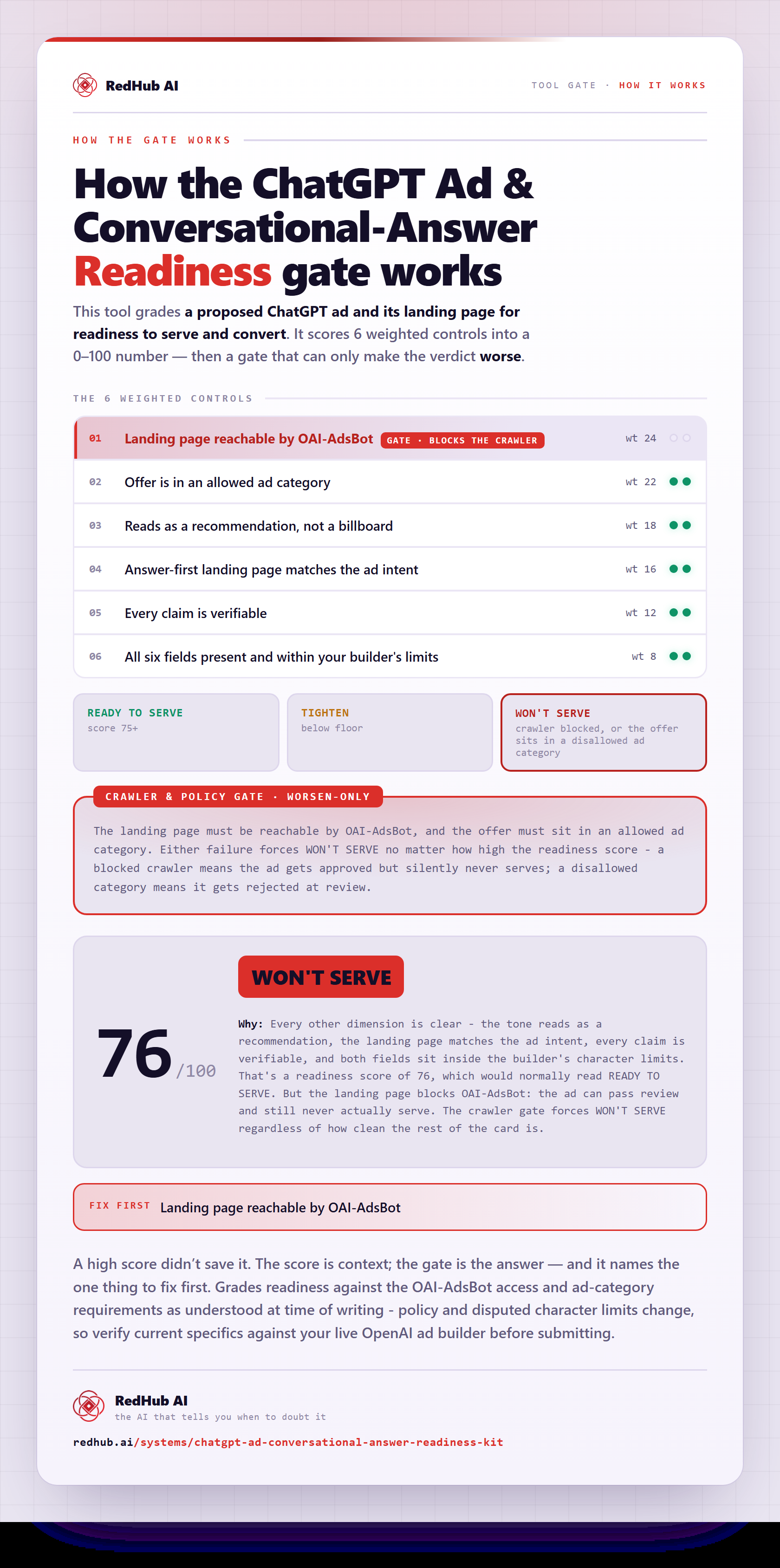
How the gate works, in one image
How the ChatGPT Ad & Conversational-Answer Readiness Kit scores an ad's readiness and gates on crawler access and ad-category policy — the same math the demo runs, as a diagram you can share or embed anywhere.
View & embed the full diagramOne command grades your whole ad batch.
The zero-dependency Python engine reads your ads and returns the readiness, the verdict, and, where a signal is short, the one thing to fix first — the same logic the workbook and the demo run. Verbatim output on the shipped 6-ad sample:
$ python3 cga_engine.py sample_ads.csv
==================================================================
  CHATGPT AD & CONVERSATIONAL-ANSWER READINESS KIT
==================================================================

  Project-management tool (blocked crawler)
    readiness : 76/100
    verdict   : WON'T SERVE  [gate: OAI-AdsBot blocked]
    fix first : Landing page reachable by OAI-AdsBot

  Indie budgeting app
    readiness : 100/100
    verdict   : READY TO SERVE

  Local HVAC repair service
    readiness : 79/100
    verdict   : READY TO SERVE
    fix first : Reads as a recommendation, not a billboard

  Crypto trading signals offer
    readiness : 56/100  (over builder limit)
    verdict   : WON'T SERVE  [gate: disallowed category]
    fix first : Offer is in an allowed ad category

  Boutique travel agency
    readiness : 86/100  (over builder limit)
    verdict   : TIGHTEN
    fix first : All six fields present and within your builder's limits

  DTC skincare brand
    readiness : 74/100
    verdict   : TIGHTEN
    fix first : Offer is in an allowed ad category

------------------------------------------------------------------
  PORTFOLIO : PULL FIRST   (READY 2 / TIGHTEN 2 / WON'T SERVE 2)
  mean readiness : 78.5 (context only)
  work first: Crypto trading signals offer
------------------------------------------------------------------Three principles keep the verdict honest.
The disputed character limit is the one thing you supply, from your live ad builder. The kit validates against your count, so it can't date-rot when OpenAI changes it.
A blocked crawler or a disallowed category forces WON'T SERVE no matter how good the card is. The gates worsen only — they hold an ad back, never promote it.
Every verdict comes from your own marks and your own numbers. No baked-in benchmark, no scraping, nothing uploaded, nothing submitted.
A pre-flight readiness gate for paid ChatGPT ads.
- A readiness gate for a proposed ChatGPT ad + its landing page, run before you spend.
- A check against the stable spec: six fields, crawler access, allowed category, conversational tone.
- A batch grader — score every proposed ad, get the one to fix first where a signal is short.
- Not an organic-visibility tool (that's the AEO Kit and GEO Playbook).
- Not connected to OpenAI — it submits nothing and runs no campaign.
- Not a guarantee of approval, delivery, or results, and it scores no person.
A readiness aid, not advice. ChatGPT Ads specs and policies change — always verify against OpenAI's live ad builder and current ad policy before you submit. Label paid placements clearly and substantiate every claim (an FTC expectation). It grades the ad and the page, not a person, and is not legal advice.
The person spending real money on a surface that's still being built.
Earn the answer. Then pay for the card.
Diagnose whether AI answer engines cite your brand organically — the free lane next to this paid one.
The treatment to the audit's diagnosis: get cited across ChatGPT, Perplexity, AI Overviews, Gemini.
Grade whether a product or local business surfaces in AI shopping panels and the local pack.
The questions buyers ask first.
There isn't a settled public number — and that's exactly why this kit never hard-codes one. Sources openly disagree (40/150, 50/100, 50/80), so the only ceiling that matters is whatever your live OpenAI ad builder shows you right now. The ChatGPT Ad & Conversational-Answer Readiness Kit asks you to enter your builder's headline and copy limits and validates your draft against those. If your title or copy is over the limit you supply, the creative dimension is forced to MISSING — because an over-limit asset truncates or gets rejected at submission.
The most common cause is a blocked crawler: if your landing page disallows OpenAI's OAI-AdsBot via robots.txt, a WAF, or a CDN rule, the ad can pass review and then silently never deliver. That's the kit's first hard gate — a blocked OAI-AdsBot forces WON'T SERVE no matter how strong the card is, and names it as the fix-first. Allowing OAI-AdsBot is OpenAI's stated requirement for ads to serve, so this is the first thing to check when an approved ad shows zero impressions.
Each ad is marked MISSING / PARTIAL / CLEAR on six readiness dimensions weighted to 100: crawler access (24, gate), allowed ad category (22, gate), conversational tone (18), answer-first landing match (16), claim verifiability (12), and creative completeness within your builder's limits (8). WON'T SERVE fires when either gate trips — the page blocks OAI-AdsBot, or the offer is in a disallowed category. READY TO SERVE needs no gate, a readiness of 75 or higher, and nothing MISSING. TIGHTEN is everything in between — it can serve, but something should be fixed first.
Score a whole batch of proposed ads and the kit rolls them into one program verdict — ALL READY (every ad is READY TO SERVE), SOME TO TIGHTEN (no WON'T SERVE, at least one TIGHTEN), or PULL FIRST (at least one WON'T SERVE) — and, where an ad is short, names the single one to work first (worst verdict, then lowest readiness). The mean readiness is shown as context only; it never decides anything, because an average can hide a won't-serve ad inside an otherwise healthy batch.
No. It's a pre-flight readiness aid that grades the ad and the landing page you describe from your own marks and your own builder numbers, entirely offline. It submits nothing, runs no campaign, and uploads nothing. Once an ad clears the gate, the organic side is a separate job: the AEO Citation Audit Kit and GEO / AI Visibility Playbook work on whether AI answer engines cite you for free, next to the paid card.
Neither. ChatGPT Ads specs and policies change fast, so always verify against OpenAI's live ad builder and current ad policy before you submit, and re-check the disallowed-category list (it can expand). Label paid placements clearly and substantiate every claim — an FTC expectation for native advertising. The kit grades the ad asset and the page, not a person, and it's not legal advice or a guarantee of approval, delivery, or results. The deterministic Python engine, the workbook, and the on-page demo all run the same logic, so the verdict is auditable rather than a black box.
Don't pay for an ad
that quietly never runs.
Grade the card and the page, catch the blocked crawler, get the verdict — before you spend. One purchase, lifetime access, 12 months of updates. $79, once.
A readiness aid, not advice. ChatGPT Ads specs and policies change — always verify against OpenAI's live ad builder and current ad policy before you submit. Label paid placements clearly and substantiate every claim (an FTC expectation). It grades the ad and the page, not a person, and is not legal advice.
Sold by RedHub AI LLC · Secured by Stripe · redhub.ai