Your attribution number is onlyas good as it can reconcile.
A deterministic grader that checks whether an attribution report is trustworthy enough to put in front of a CFO. It reconciles every deal's credit to 100%, verifies the model is declared and version-pinned, and floors any report you can't reconcile — no matter how polished — to BLACK BOX. It grades a report's integrity, not its accuracy.
Three tools, three attribution numbers, zero trust.
Different attribution tools produce different numbers on the same data — probabilistic models shift when the training data does.
is what a single double-counted deal quietly sums to when a webinar rule and a last-touch rule both claim full credit.
is the only credit total a CFO can sign off on. Anything else is a dashboard estimate wearing a suit.
Attribution is where probabilistic AI does the most organizational damage: when marketing, sales, and finance each cite a different number, cross-functional trust collapses. The fix isn't a better model — it's making attribution a math problem you can reconcile, version, and defend. This tool grades whether yours is.
Watch a well-documented report fail.
The Q1 board deck scores in the LEAKY band on documentation — and reads BLACK BOX, because one deal's credit sums to 115%. Switch to the fixed twin and it releases. Switch to the vendor export and a different trigger fires: a touchpoint that got credit but named no rule.
This report scores in the LEAKY band on documentation — and still reads BLACK BOX. A number you can't reconcile is a dashboard estimate, not a calculation.
Deterministic · all-historical inputs, no evaluation date · grades a report's integrity, not its accuracy · scores no person
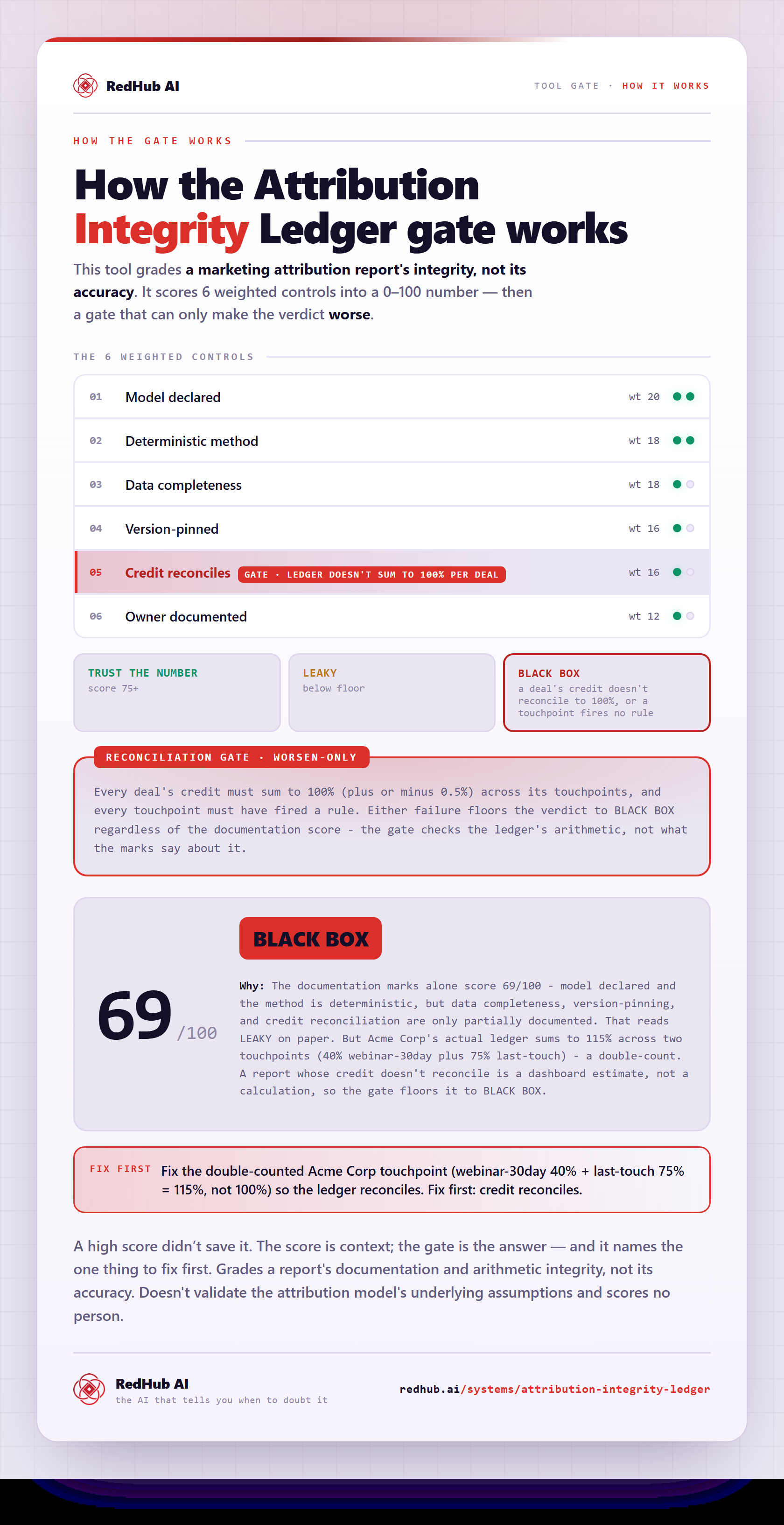
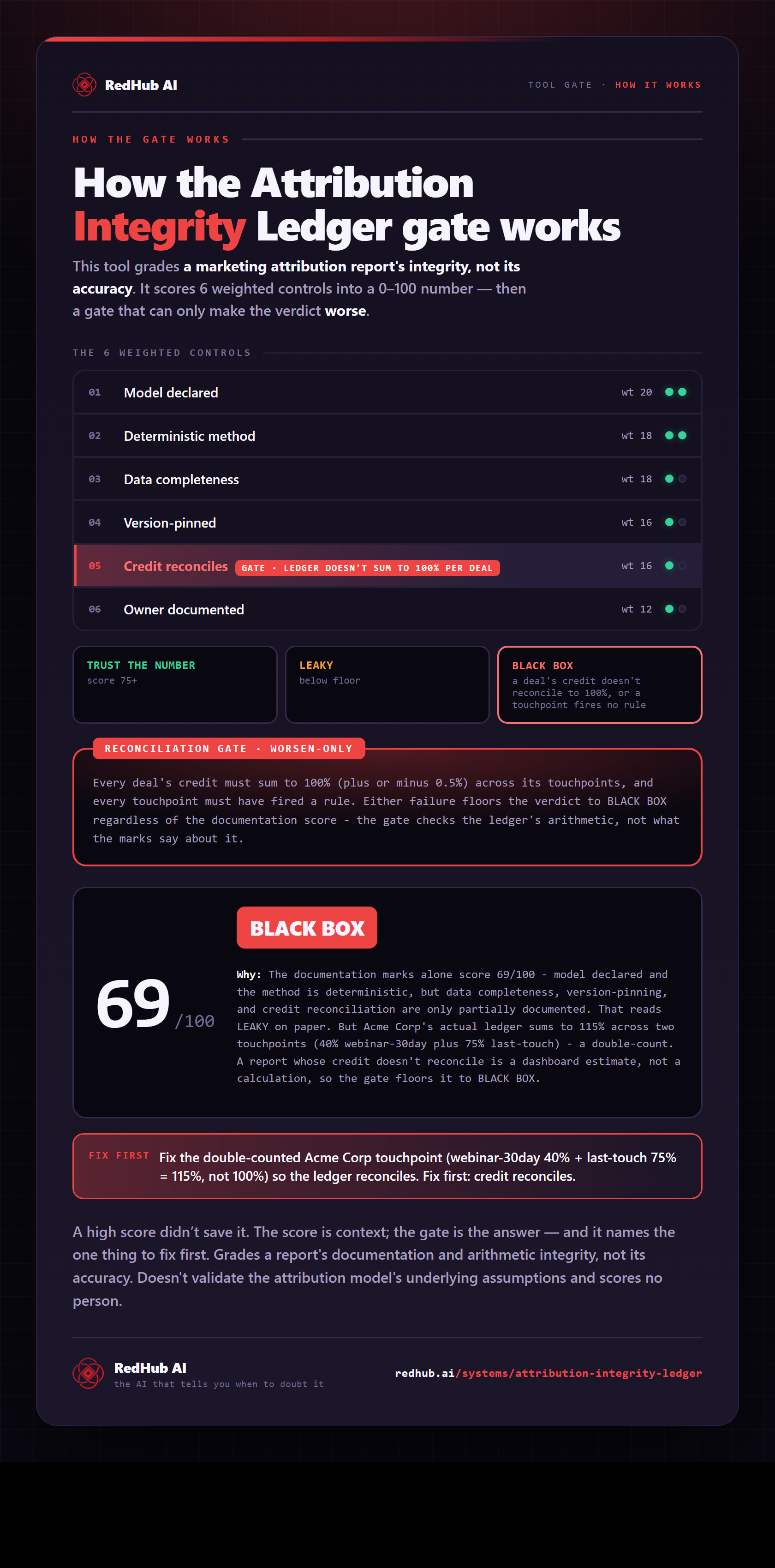
How the gate works, in one image
How the Attribution Integrity Ledger scores a report's documentation and reconciles its per-deal credit to 100% before trusting the number — the same math the demo runs, as a diagram you can share or embed anywhere.
View & embed the full diagramOne command grades a whole portfolio of reports.
Point the zero-dependency Python engine at two CSVs — an integrity scorecard and a credit ledger. It scores each report, reconciles every deal, floors the ones that don't close, and rolls the portfolio up to its worst report. Verbatim output on the shipped sample:
ATTRIBUTION INTEGRITY LEDGER
====================================================================

Q1 Board Deck - Pipeline Attribution  —  integrity 69/100  →  BLACK BOX  «GATE: won't reconcile»
    model 2 · method 2 · data 1 · version 1 · reconcile 1 · owner 1   (marks 0-2)
    ✗ Acme Corp: credit sums to 115.0% of pipeline value (target 100%)
    → Floored to BLACK BOX: a number you can't reconcile is a dashboard estimate, not a calculation.
    Fix first: credit reconciles

Q1 Board Deck (twin: double-count fixed)  —  integrity 69/100  →  LEAKY
    model 2 · method 2 · data 1 · version 1 · reconcile 1 · owner 1   (marks 0-2)
    Fix first: credit reconciles

Q2 Vendor Dashboard Export  —  integrity 43/100  →  BLACK BOX  «GATE: won't reconcile»
    model 2 · method 0 · data 1 · version 1 · reconcile 0 · owner 1   (marks 0-2)
    ✗ Cirrus Mfg: touchpoint 'Organic Blog' fired no rule — orphaned revenue
    → Floored to BLACK BOX: a number you can't reconcile is a dashboard estimate, not a calculation.
    Fix first: credit reconciles

Q3 Marketing MTA Report  —  integrity 100/100  →  TRUST THE NUMBER AS DESCRIBED
    model 2 · method 2 · data 2 · version 2 · reconcile 2 · owner 2   (marks 0-2)
    Nothing to fix — clean on every dimension.

Q4 CMO Channel Rollup  —  integrity 50/100  →  LEAKY
    model 1 · method 1 · data 1 · version 1 · reconcile 1 · owner 1   (marks 0-2)
    Fix first: credit reconciles

====================================================================
PORTFOLIO ROLLUP:  DASHBOARD FICTION   (worst report: Q1 Board Deck - Pipeline Attribution — BLACK BOX)
This tool grades an attribution report's integrity, not its accuracy, and scores no person.Three rules the whole tool obeys.
The credit must close
Every deal's assigned credit sums to 100% of its pipeline value, and every touchpoint fires a rule. A double-count, a gap, or orphaned revenue is the difference between a calculation and an estimate.
Integrity, not accuracy
It grades whether a report is reproducible and reconciled — not whether the weights are 'true.' The credit model is your business's judgment; this tool proves you applied it consistently and can defend it.
Reproducible by construction
All inputs are historical, so there's no evaluation date to drift. The same ledger graded a year from now returns the same verdict — the guarantee a CFO actually needs.
It reconciles the number. It doesn't bless the number.
- A deterministic grader you run on your own attribution ledger, offline.
- A per-report verdict, a reconciliation gate, and a worst-first portfolio rollup.
- A check that credit closes to 100% and every touchpoint fires a rule.
- Reproducible: engine, workbook, and demo compute identical results.
- Not a claim your credit weights are “true” — those are your judgment.
- Not an attribution engine that assigns credit — it grades the credit you assigned.
- Not a live integration — it reads a ledger you export, nothing streaming.
- Not a person scorer — it grades a reporting artifact, never an individual.
A reporting-integrity aid. It grades whether an attribution report is reconciled and reproducible from data you supply; it makes no claim about the objective accuracy of your credit model, moves no money, and scores no person. Not financial, accounting, or attribution-methodology advice.
Anyone who has to defend the number.
- RevOps who own the attribution setup and get asked “where did this number come from?”
- CMOs presenting channel ROI to a board that expects it to reconcile.
- Finance partners who need marketing's numbers to survive scrutiny.
- Consultants auditing a client's attribution before they build on top of it.
Build the reporting desk around it.
The honest-measurement methodology upstream — is the metric even worth attributing?
ViewThe same reconcile-the-real-number discipline, applied to what defects actually cost.
ViewGrades the leads feeding the pipeline this report attributes revenue across.
ViewThe things people ask first.
No — it grades whether the attribution report you already produce is trustworthy enough to put in front of a CFO. You bring your credit ledger (which touchpoints got what percentage of each deal, and the rule that assigned it) and your integrity marks; the tool checks that the math closes and the setup is reproducible. It works whether your attribution comes from HubSpot, Salesforce, a vendor MTA tool, or a spreadsheet.
It is the spine of the tool and the reason it is more than a documentation checklist. Any report containing a deal whose assigned credit does not sum to 100% of its pipeline value — a double-count or a gap — or a touchpoint that fired no rule (orphaned revenue), is floored to BLACK BOX no matter how well-documented the rest of the setup is. In the worked sample a report scores 69 (LEAKY band) and still reads BLACK BOX because one deal's credit sums to 115%; fix that single double-count and the identical twin releases to LEAKY. A number you can't reconcile is a dashboard estimate wearing a suit.
Exactly right, and the tool is explicit about it. Deterministic attribution is reproducible and auditable, but the credit weights themselves — 'give the webinar 40%' — are your business's judgment, not a truth the math discovers. This tool grades a report's integrity, not its accuracy: is the model declared, are the rules deterministic, does the credit reconcile, is it version-pinned. It tells you whether you can defend the number in front of a board, not whether the number is objectively true. That honesty is the point — a tool that claimed to reveal 'real' attribution would be doing the same over-claiming as the black-box models.
Because attribution is where probabilistic AI does the most organizational damage: different tools produce different numbers, and cross-functional trust collapses when marketing, sales, and finance each cite a different attribution figure. The failure isn't usually the model — it's an unreconciled ledger, an undeclared credit rule, or a vendor default nobody version-pinned. This tool finds those and, where a signal is short, names the one to fix first, and rolls a portfolio of reports up to its worst one, because a single unreconcilable report poisons the whole board deck.
No — and that is deliberate. Every input is historical: closed deals and the credit already assigned to them. Because nothing depends on 'today,' there is no evaluation-date cell to pin and no way for a saved file to drift. The same report graded a month from now against the same ledger returns the same verdict, which is the reproducibility guarantee the whole tool is built on.
A runnable zero-dependency Python engine that grades a portfolio of reports from two CSVs (an integrity scorecard and a credit ledger), an Excel workbook that reproduces every score and the reconciliation gate exactly, an Attribution Integrity Playbook and a Reconciliation Runbook, and a worked five-report sample. The engine, the workbook, and the on-page demo all compute identical results — verified cell-by-cell, including the tolerance knife-edge, before it shipped.
Stop defending numbers
you can't reconcile.
One purchase, lifetime access, 12 months of updates. $89, once.
Sold by RedHub AI LLC · Secured by Stripe · redhub.ai