RFP & Proposal Response Engine
$99
Six Claude skills that run the full RFP response the Shipley way — shred, bid-decide, build the compliance matrix, theme, draft — plus a runnable verifier that catches the missed requirement before you submit.
See all
27 items
You lose most of the bids you write, and on public work the reason is published in a bid tab almost nobody reads. This grades whether you ever found out where your number sat. Six signals per closed bid (result obtained, position known, gap attributed to scope / rates / markup rather than "they were cheaper", checked against your pattern, pursuit rule touched, debrief retained) read DEBRIEFED / PARTIAL / UNEXAMINED, and the practice verdict is the share that reached DEBRIEFED. A worsen-only near-miss gate forces BIDDING BLIND two ways: any CLOSE bid nobody debriefed — the only RedHub gate that selects its subset by a continuous field, because losing by 22% teaches you almost nothing and losing by 0.8% says your number was right and something else decided it — or, reading the whole register, nothing that ever changed what you chase. A loss with no recorded margin counts as CLOSE, which closes the escape hatch: you cannot call a loss a blowout you never looked at. Wide wins are reported and never gated. Runnable Python engine + live-formula workbook, verified in lockstep across 6,564 parity cases. It fetches no bid tab, reads no CRM, and never says whether your win rate is good or what your number should have been.
Measure the drift between what you quoted and what closed jobs actually cost — per work type, per component — then see the dollars of open quotes still priced on estimates your own data has disproven. DO NOT SEND AS PRICED until it's repriced or recalibrated.
Score every closed order against two clocks — the promise you gave first and the promise you gave last. The spread is the measured size of the re-promising habit, and a key-account order re-promised twice trips the verdict to PROMISE INFLATION. Deterministic, offline, $89.
Computed lead = backlog hours ÷ demonstrated weekly hours — per work center, from your own actuals. Confront every quoted lead with it, and let a DIVERGING QUEUE gate force LEAD-TIME FICTION on any center booking more than it burns. Deterministic, offline, $79.
Two independent reads per channel partner from your closed sales records: contribution (margin per support hour) and self-generation (share of new business they actually win). CARRYING THE LINE / PULLING THEIR WEIGHT / DEAD WEIGHT, and SELLS FOR YOU / ORDER-TAKER / COASTING ON THE NAME — with a DEAD SLOT gate. Deterministic, offline, no dates, $69.
A deterministic, offline grader that reads each open deal as a physical system — momentum, friction, decay — and scores it 0–100 on five weighted signals from your own numbers (stakeholder coverage, response-latency trend, stage age vs. your own median, days since last touch, activity direction), banded ACCELERATING / STALLING / DEAD WEIGHT. Its spine is a dispositive worsen-only ghost-deal gate: a deal that is single-threaded AND has outlived its stage (age past 1.5× your median) is floored to DEAD WEIGHT no matter how many points it scored, releasing the moment either clears — a 57 in the STALLING band reads DEAD WEIGHT while its two-threaded twin releases. Every verdict ends with the single cheapest move that changes it, and the pipeline rolls up worst-first. Runnable Python engine + workbook + Deal Momentum Playbook + Momentum Recovery Runbook + a seven-deal sample. Gong and Clari show what is happening; this prescribes what to do — no forecast, no probability, no black box. Grades a deal's momentum, never a person.
The MCP-driven workflow that grades a live sales pipeline so the forecast is honest. Four Claude Skills read your open deals from HubSpot or GoHighLevel, score whether each is truly committed (Commit / Best-case / At risk / Slipping), and draft the deal-review brief and rescue nudges — with a commit gate that refuses to count a deal with no next step, a dead close date, or gone silent as committed forecast, however large. It reads and drafts; you update the CRM and send. Forecast hygiene, not financial advice.
Your AI VP of Sales — the Executive Suite's revenue inspector. Reads your CRM and grades every open deal on qualification, not the stage or amount a rep entered: Commit / Best case / At risk / Not real, with a pipeline verdict of Healthy / Thin / Exposed against quota and the one deal to work first where anything needs working. The anti-happy-ears core is a disqualifier gate — a deal missing an engaged economic buyer or a concrete next step is AT RISK no matter its stage or size. Read-only: it grades and delivers the review; you work the deals. Feeds The Forecast Floor and the OCE Monday report. Not financial advice.
Five field-ready battlecards from your real intel — competitor, objection handling, discovery, talk track, persona. Accurate, honest, never invents competitor facts. Prompt, skill, or Project.
Score one freelance proposal before you send it — the five-criterion rubric from The AI Proposal System (Brooks), turned into a deterministic pre-send checkpoint. Mark opening, proof, approach, CTA, and bot-risk 1–5 for a score out of 25 and the book's verdict (SUBMIT / REVISE / DO NOT SEND / START OVER), with two worsen-only gates: a sub-3 criterion floors to REVISE, a bot-risk mark of 4–5 floors to DO NOT SEND — so a 22/25 can still read DO NOT SEND. The verdict is the book's, from your own marks; no hidden benchmark. Runnable engine + workbook + scoring & fix-it playbooks. The book's companion; grades the proposal, never a person.
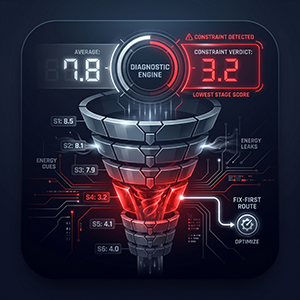
Enter your own 30-day proposal numbers and find the one stage that's costing you the work — the seven-metric dashboard and six-stage funnel map from The AI Proposal System (Brooks), turned into a monthly instrument. The Map scores three funnel stages against the book's niche benchmarks and, where a stage is leaking, names the constraint — the earliest stage below healthy, not the lowest score, because an upstream leak starves everything below it — then routes you to the drop that fixes it. Verdict HEALTHY / LEAKING / BLEEDING, set by the constraint stage, never the average, with a broken-stage gate that forces BLEEDING when a stage is non-functional. Runnable engine + workbook + diagnosis & constraint playbooks. The monthly companion to the per-proposal Quality Probe; grades the funnel, never a person.
Score whether you're ready to win the freshness window — the Build / Monitor / Sprint readiness system from Chapter 7 of The AI Proposal System (Brooks), as a pre-week check. Mark six readiness controls 0/1/2 (weighted to 100) and enter your typical minutes-to-send; the Drill maps speed via the book's Freshness Window Benchmark and returns READY / TIGHTEN / NOT SPRINT-READY plus, where a control is short, the one to fix first. A two-asset gate forces NOT SPRINT-READY when the archetype file or proof stack is missing — speed without a staged asset is just fast spam — so you can score 78 and still read NOT SPRINT-READY. Runnable engine + workbook + readiness & build-phase playbooks. The third companion to the per-proposal Quality Probe and the monthly Funnel Map; grades readiness, never a person, guarantees no response rate.
The checkout-stage grader below the page-level conversion tools. Score a cart/checkout flow on seven friction signals (total-cost transparency, guest checkout, length, trust, payment options, mobile, delivery clarity), each marked 0-2, and get SMOOTH / LEAKING / HEMORRHAGING per flow from the weakest signal, a gate on total cost and guest checkout, a portfolio rollup, and, where a signal is short, the fix to make first. Runnable engine + workbook + playbooks. Grades a flow you describe; no store connection, scores no people.
The anchor of the lead-gen line — grade your whole lead funnel and find the one stage choking it. A runnable Python engine + a workbook score six stages (capture, speed-to-lead, qualification, definition & handoff, nurture, source ROI) 0–100 and report the constraint — the lowest-scoring stage, not the average, because a funnel flows only as fast as its tightest stage — then, where a stage is short, route you to the exact RedHub drop that fixes it. Returns FLOWING / LEAKING / CLOGGED, with a broken-stage gate that forces CLOGGED if any stage is effectively dead. Run it first to learn which drop to buy. Grades your funnel, not people. Not legal advice.
Your prospects don’t vanish — they leak at one stage. A deterministic diagnostic for the sales / consultation funnel: enter the real head count at each stage (inquiry → discovery booked → held → qualified → presented → client) and it computes the actual conversion at every step, marks each ON TARGET / LEAKING / SEVERE against your own editable target, and, where a stage is leaking, names the constraint — the EARLIEST severe leak, because an upstream leak starves every stage downstream (so the show-up step, not the numerically-worse close, is the fix). A dead-stage gate forces HEMORRHAGING when a step passes nobody. Funnel verdict FLOWING / LEAKING / HEMORRHAGING plus a dollar estimate of closing the constraint to target from your own client value — no invented lift. Runnable Python engine + workbook + measurement & leak-fix playbooks + a worked sample. Grades a funnel, never people. Not financial advice.
Score every inbound lead and work the right ones first. A runnable Python engine + a workbook grade each lead PURSUE NOW / NURTURE / DISQUALIFY on five weighted signals (fit, intent, timeline, authority, recency) from your own marks — with a hard gate that holds back a great-looking lead that has no budget or no timeline. Priority, not permission; the verdict comes from your marks, no multiplier.
The MCP-driven workflow that turns new inbound leads into drafted meeting invites. Four Claude Skills read new leads from your HubSpot or GoHighLevel CRM and Gmail, score each (BOOK NOW / NURTURE / DECLINE) on the same five-signal model as the Inbound Lead Qualification Engine, and draft a first-touch reply proposing real open times read from your own Google Calendar — with a meeting-readiness gate that holds back any lead with no budget or no timeline, then assemble one prioritized contact queue and a speed-to-lead tracker. It reads and drafts only; it never sends, books, holds a slot, edits a record, or deletes — you send and book. Bring your own Calendar + CRM + Gmail MCP; not legal advice.
Five Claude skills for margin defense + a runnable auditor that sweeps your deal book for realized (pocket) margin below floor — names the deals losing money behind your blended average. Discount guard, quote review, cost-change impact, leak diagnosis. Defends the price; doesn't set it.
Find a current, sourced price with live web search, draft a defensible quote with its reasoning shown, and grade it before it reaches a buyer — QUOTE-READY / SHORE UP / DON'T QUOTE, with a two-trigger gate that forces DON'T QUOTE on any fabricated benchmark or below-margin-floor price. You supply cost and floor; it invents no number. Grades a quote, not a person; not financial advice.