The Complete Skills Library
All nine Claude Skills Packs
Every Claude Skills Pack — Solo Founder through Agency & Studio Operations, 55 skills across nine packs. The widest coverage at the deepest discount: $479 versus $781 bought separately.

All nine Claude Skills Packs
Every Claude Skills Pack — Solo Founder through Agency & Studio Operations, 55 skills across nine packs. The widest coverage at the deepest discount: $479 versus $781 bought separately.
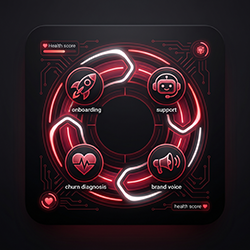
A bundle groups RedHub tools that genuinely work together — the whole Claude Skills Library, a developer suite, or a focused stack for retention, sales, governance, or the back office — and prices the set below the sum of its parts. Twenty-six bundles across seven outcome families, each saving up to 39% versus buying its products separately, every one held to the same honest RedHub standard. Buy the bundle when two or more of its tools fit; every product is also sold on its own page.
9 Skills Packs · 55 skills
Every Claude Skills Pack RedHub has shipped, in one library — the widest coverage at the deepest discount, for teams standardizing Claude across every function.
3 Codex packs · 18 skills
The three Codex packs — Migration & Refactor, Code-Review & PR-Hygiene, and the Technical Documentation Engine — with three runnable CI gates. Fix old code, guard new code, document all of it.
4 LLM dev tools + playbook
The four-tool LLM dev-tools stack — RAG Retrieval Grader, Prompt Regression Lab, Prompt Injection Red Team Kit, and Agent Reliability Harness — one CI-ready tool for each way AI breaks, with a pipeline playbook that runs them as one gate.
3 tools
Keep production AI agents reliable across the whole loop: evaluate the release at the trajectory level, catch the compounding quiet failures and drift in production, and close every incident on a postmortem that won't clear with an open critical fix. The operations sibling to the dev-CI Reliability Bundle.
4 gates
The four attack surfaces of an AI agent, one gate each: what you install (MCP/skill trust), what it reads (prompt injection), what it remembers (context poisoning), and what it can reach (non-human identity). Secure the agent before you ship it.
3 tools
Get AI spend and reliability under control: forecast the budget blowout, reclaim the unused seats inside the tools you keep, and catch the multi-step agents quietly failing end-to-end. Cheaper and reliable, not cheaper and broken.
2 tools + playbook
Workslop has a cost and a cause. The Workslop Cost & Verification-Tax Calculator prices the hours a team spends verifying and redoing hollow AI output; the Internal AI Handoff QA Gate catches that work before it moves. A 90-day playbook runs them together so you diagnose the cost, fix the handoff, and prove the drop in dollars.
3 Systems + rollup
Three ways to stop an AI agent, at the three moments it can do damage — the tool contract (the door), the action check (the ledger), and the failure path (the catch) — plus a chain rollup that names the weakest layer. They fail independently, so building one is not being covered.
3 Systems + rollup
One survey asks what you declared; two sweeps go and measure it. The rollup pairs each claim with its measurement and returns CONFIRMED / KNOWN GAP / OVERSTATED — because every model assessment is a self-assessment, and the marks come back better than the data would.
10 Systems + rollup
The whole line — ten deterministic checks from whether your domain is written down to what the next change will break quietly — plus a lane rollup that names the worst finding and the next thing to run. Built to be useful from the first check, not after all ten: a check you haven't run is not a check that passed.
3 kits + playbook
Policy → People → Proof: the AI Acceptable Use Policy Builder, the AI Literacy & Workforce Training Kit, and the EU AI Act Readiness Kit — three governance tools run as one program with a 90-day playbook.
4 tools
Prove how your AI is governed across four kinds of evidence: connector access (auditor), output records (audit-trail kit), disclosure (synthetic-content readiness), and data flows (vendor register). Answer with documents, not adjectives. A working aid, not legal advice.
4 tools
The four ways a data file lies, each caught: schema & quality (CSV gate), cross-source agreement (reconciliation), formula integrity (spreadsheet auditor), and PII safety (structured-data scanner). Grade the file before you trust the number.
3 kits + playbook
The honest back office: the AI Support Deflection Kit (escalate), the AI Document Extraction Kit (flag), and the Finance & Reporting Automation Kit (reconcile) — one rule across inquiries, paperwork, and the books. Don't guess, surface it.
2 tools
Verify what an application claims — the document, never the candidate: a whole-application fabrication-risk triage plus a per-claim verification checklist. Every verdict routes to verification, never a reject. A working aid, not legal advice.
2 kits + playbook
The audit-and-fix loop: the AEO Citation Audit & Optimizer Kit (diagnose where you stand in AI answers) plus the GEO / AI Visibility Playbook (fix it), with a 90-day loop playbook. Measure it, improve it, prove it.
4 tools
Battlecards, the fractional-exec pack, the Brand Voice Engine, and meeting intelligence — the whole selling motion from call to close.
4 tools
Onboarding sequences, support & success skills, a churn autopsy kit, and the Brand Voice Engine — the whole retention lifecycle, in one voice.
5 tools + playbook
Everything in the Customer Retention Bundle — onboarding, support, churn autopsy, brand voice — plus the AI Acceptable Use Policy Builder to govern the AI doing the work, with a 90-day playbook. The retention bundle, plus governance.
2 tools
Build support deflection the honest way, then prove it's real: the AI Support Deflection Kit stands up deflection that always offers a person, and the Honesty Grader audits whether the 'deflected' bucket is genuine resolution or hidden demand. Build it, then prove it — a number you can defend.
2 tools + playbook
Two jobs that pull opposite ways: lower your network ratio to keep the merchant account, and win the disputes in front of you. Fighting disputes never lowers a counted chargeback. The Chargeback Threshold & MID-Survival Gate reads whether you're over the line; the Chargeback-Proof Order Evidence Kit tells you which disputes to fight; a 90-day playbook connects them — your ratio band sets your representment posture.
10 instruments
All ten instruments in the distribution lane, plus the rollup none of them can do alone: it reads all ten answers together, names the earliest blocked stage, and marks every problem above it as real but not yet next. Six can report a problem and exactly one is worth touching.
4 tools + playbook
Four systems that read one plant from four angles — OEE honesty, PM execution, cost of poor quality, and critical-spares stockout risk. A deferred PM becomes a failure, the failure becomes cost, and a missing spare decides repair vs. outage. A 90-day playbook runs them worst-first as one quarterly reliability rhythm.
4 tools + playbook
A quote is four promises — worth chasing, priced right, lead time that holds, buildable once won. Four gates check each link in the order a quote travels: RFQ triage, cost calibration, backlog reality, order buildability. Each catches the failure the next stage would inherit.
3 gates + playbook
An auditor doesn't check whether you have a quality system — they check whether it's telling the truth. Three gates catch the three places it quietly isn't: a CAPA that recurs, an unassessed gauge, a change that never propagated. One pre-audit sweep.
2 tools + playbook
Every relationship you depend on has a number attached, and both sides lie the same two ways. Grade both sides of the handshake — supplier lead-time honesty and channel-partner contribution — each split into a reliability read and a bias read that never get averaged.
10 tools + playbook
The whole AI-voice-agent lifecycle under one honest standard: build, prove, and test the agent, run the live calls, and cover every call-data compliance exposure. All ten Voice Desk Systems, priced below sum-of-parts, plus the connective Voice Desk Playbook.
3 tools + playbook
A voice-agent guardrail can fail in three places — it was never there, it got edited out in the console, or a release quietly changed the behavior around it. Lint the prompt, prove the live version matches the one you approved, and catch a behavior regression each release.
3 tools + playbook
Every call leaves a trail carrying three risks: you called someone you shouldn't have, you're holding a card number read aloud, or you're sitting on data you should have deleted. Keep suppressed numbers out of dialing, redact spoken PII from transcripts, and purge data past its retention window.
4 tools + playbook
Every outbound call carries four compliance exposures that bite at different moments — wrong number, wrong time, kept PII, over-retained data. Two eligibility gates before the batch dials, two data-handling checks after — the regulated exposures covered first.
3 kits
The browser line and the ownership check — two halves of one door, plus the line's map. A server-side decision that never asks whose record still lets the request through, and a perfect ownership check on a browser-side decision is a lock on a door you can walk around.
3 kits
Your tables' shape, the rules on them, and what you hold about people — read in dependency order, because a rule about who may read a row needs an owner column to compare against. A clean rules verdict on a model that can't hold a rule is locked against nothing.
3 kits
Your order flow, plus whether that grade described anything — the right world, the right keys. A clean path measured against a sandbox on an account shared with production is not a smaller pass; it is not a pass.
10 kits
All ten kits — the front door, the data layer, the money path, and whether you can get back and explain what you built. The whole path from a working prototype to something you can charge for, at the lowest per-kit price.
Prices are one-time, with lifetime access and 12 months of updates. Every product inside a bundle is also sold on its own page.
The bundles aren’t random collections that share a cart. Each one solves a specific job, and the tools inside compound on each other.
Each bundle solves one job — standardize Claude across every function, keep customers, or win deals — so the tools inside actually compound instead of just sharing a checkout.
A bundle is the complete individual products together. You get every prompt, skill, template, and guide, plus 12 months of updates — just at a set price.
Every tool in every bundle holds the RedHub standard: it works to a senior bar and checks its own work — rather than producing confident output and hoping it's right.
Twenty-six, grouped above into seven families — skills & developer suites; reliability, cost & security; governance & accountability; back office & data integrity; winning & keeping customers; manufacturing & operations; and voice desk & call-data compliance. Each one is listed with its price and exactly what's inside, saves over buying its products separately, and includes 12 months of updates.
Retain & Govern is the superset. The Customer Retention Bundle ($225) is the four-tool retention lifecycle — onboarding, support & success, churn autopsy, and brand voice. The Retain & Govern Bundle ($269) is all four of those plus the AI Acceptable Use Policy Builder and a 90-day playbook. Buy the Retention Bundle if you just want the retention tools; buy Retain & Govern if you also want a written AI policy governing the tools that serve your customers. They share four products, so you'd never buy both — pick the one that matches whether you need the governance layer.
The Complete Skills Library is $479 versus $781 for the nine packs individually — about 39% off the line. The Dev Team Suite is $219 versus $277 for its three Codex packs — about 21% off. Each mini-bundle is $225 versus $286 for its four tools individually — about 21% off, roughly the price of the Brand Voice Engine that's included in both mini-bundles.
Yes. Every bundle contains the full, individual products exactly as sold on their own pages — nothing is trimmed for the bundle. You get each product's complete prompts, skills, templates, and guides, plus its updates.
Yes. The Brand Voice Engine appears in both mini-bundles, and the Customer Support & Success Skills Pack and the Fractional Executive Skills Pack each appear in both a mini-bundle and the Complete Skills Library. Bundles are curated by outcome, so a versatile tool can belong to more than one — you only pay once per bundle you buy. If you buy both mini-bundles, the Brand Voice Engine is counted once; we don't double-charge for shared products across bundles.
Buy the single product if only one fits how you work — every product stands alone. Buy the bundle when two or more of its tools are relevant, because that's the point where the discount makes taking the set the obvious move. The bundles are designed so the included tools genuinely work together, not just share a checkout.
Yes. Bundles are collections of tools and skills you run inside Claude; they do not include or resell a Claude subscription. A paid Claude plan is where they work best, especially for installing skills and using a Claude Project as your source of truth.
Every product in every bundle ships with 12 months of updates. When any individual product gets a refresh — new prompts, new skills, new templates — bundle buyers receive it automatically. The bundles also auto-include any new product that gets added to an existing bundle's lineup during the 12-month window.
The whole Skills Library, or a focused stack for retention or sales — each priced below the sum of its parts, each built to one honest standard.
Sold by RedHub AI LLC · Secured by Stripe · redhub.ai