Tool Gate · How it works
How the Founder Time-Leverage Audit gate works
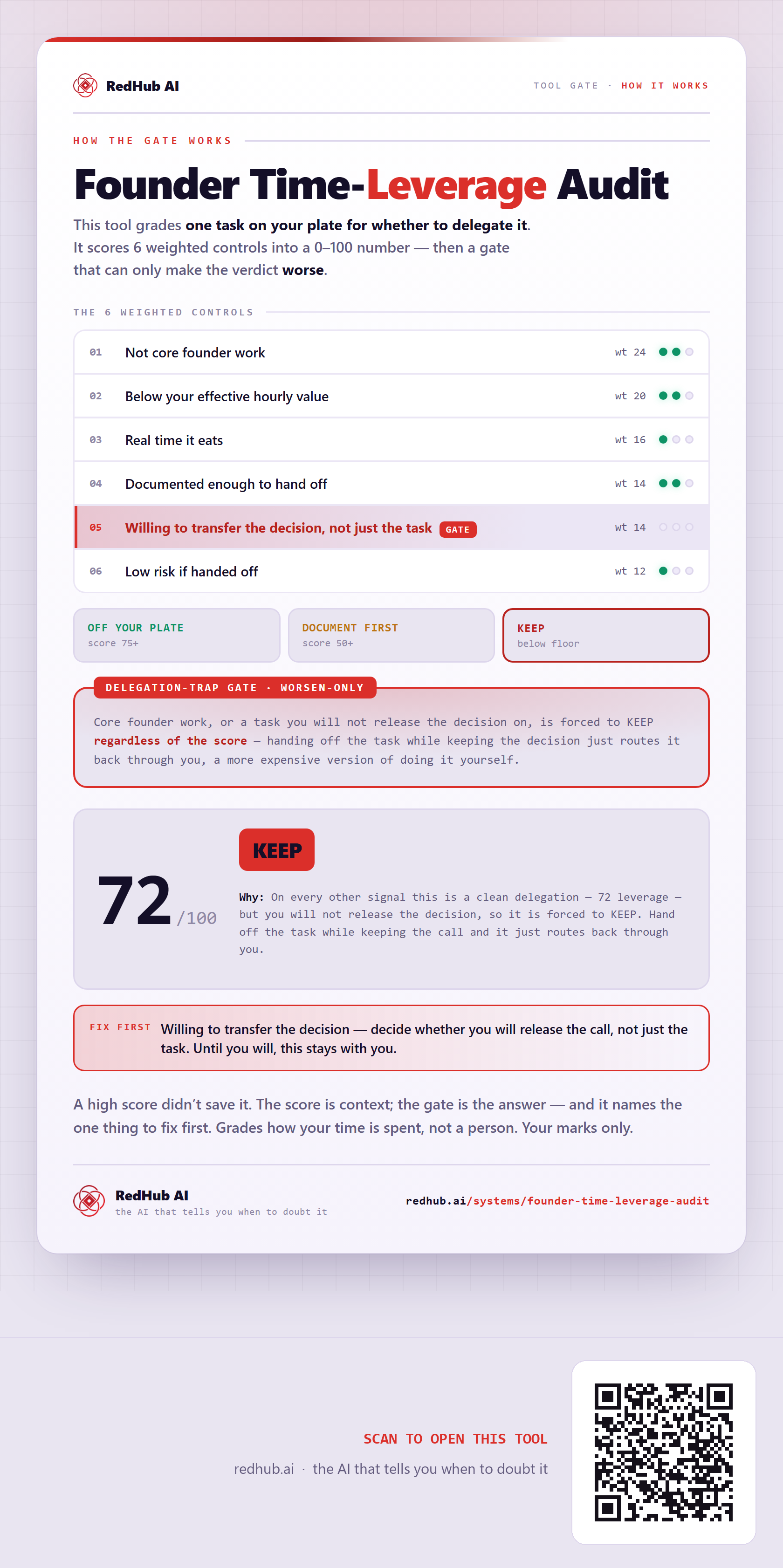
How the Founder Time-Leverage Audit grades a task: six weighted signals and a delegation-trap gate where core founder work — or a task you won't release the decision on — is forced to KEEP, which is how a 72 leverage score still stays on your plate.
How the gate works
This tool grades one task on your plate for whether to delegate it. Each control is marked from your own evidence and weighted into a 0–100 score — and then the score is run past a gate that can only make the verdict worse.
The 6 weighted controls
| Signal | Weight |
|---|---|
| Not core founder work | 24 |
| Below your effective hourly value | 20 |
| Real time it eats | 16 |
| Documented enough to hand off | 14 |
| Willing to transfer the decision, not just the task | 14 |
| Low risk if handed off | 12 |
| Total | 100 |
The verdict bands
Core founder work, or a task you will not release the decision on, is forced to KEEP regardless of the score — handing off the task while keeping the decision just routes it back through you, a more expensive version of doing it yourself.
In the worked sample it scores 72 out of 100 and still reads KEEP — On every other signal this is a clean delegation — 72 leverage — but you will not release the decision, so it is forced to KEEP. Hand off the task while keeping the call and it just routes back through you. Marked fix first on this sample: Willing to transfer the decision — decide whether you will release the call, not just the task. Until you will, this stays with you..
Common questions
Can something score well on the Founder Time-Leverage Audit and still fail?
Yes. The weighted score is run past a worsen-only gate — the Delegation-trap gate — that can only make the verdict worse. In the worked sample it scores 72 out of 100 and still reads KEEP, because on every other signal this is a clean delegation — 72 leverage — but you will not release the decision, so it is forced to KEEP. Hand off the task while keeping the call and it just routes back through you.
What is a worsen-only gate?
A dispositive rule that can only lower a verdict, never raise it. One fatal flaw overrides an otherwise-good score, because a single disqualifying gap shouldn't hide behind a high average. Where something is short, the fix-first row names it — here, "Willing to transfer the decision — decide whether you will release the call, not just the task. Until you will, this stays with you.".
Grades how your time is spent, not a person. Your marks only.
Embed this diagram
Free to share and embed with attribution (CC BY 4.0) — keep the link to redhub.ai.
Interactive — renders the live diagram
<iframe src="https://redhub.ai/visuals/tool/founder-time-leverage-audit.html" title="How the Founder Time-Leverage Audit gate works — RedHub AI" width="760" height="1555" loading="lazy" style="border:0;width:100%;max-width:760px"></iframe>
<p style="font:14px/1.5 system-ui,sans-serif"><a href="https://redhub.ai/visuals/tool/founder-time-leverage-audit">How the Founder Time-Leverage Audit gate works</a> — by <a href="https://redhub.ai">RedHub AI</a>, the AI that tells you when to doubt it.</p>
Image + link — a static picture for any blog
<a href="https://redhub.ai/visuals/tool/founder-time-leverage-audit"><img src="https://redhub.ai/visuals/tool/founder-time-leverage-audit-share.png" alt="Diagram of the Founder Time-Leverage Audit: six weighted signals, a delegation-trap gate, and a sample scoring 72 that still reads KEEP." width="760" loading="lazy" style="max-width:100%;height:auto;border-radius:16px"></a>
<p style="font:14px/1.5 system-ui,sans-serif"><a href="https://redhub.ai">RedHub AI</a> — the AI that tells you when to doubt it.</p>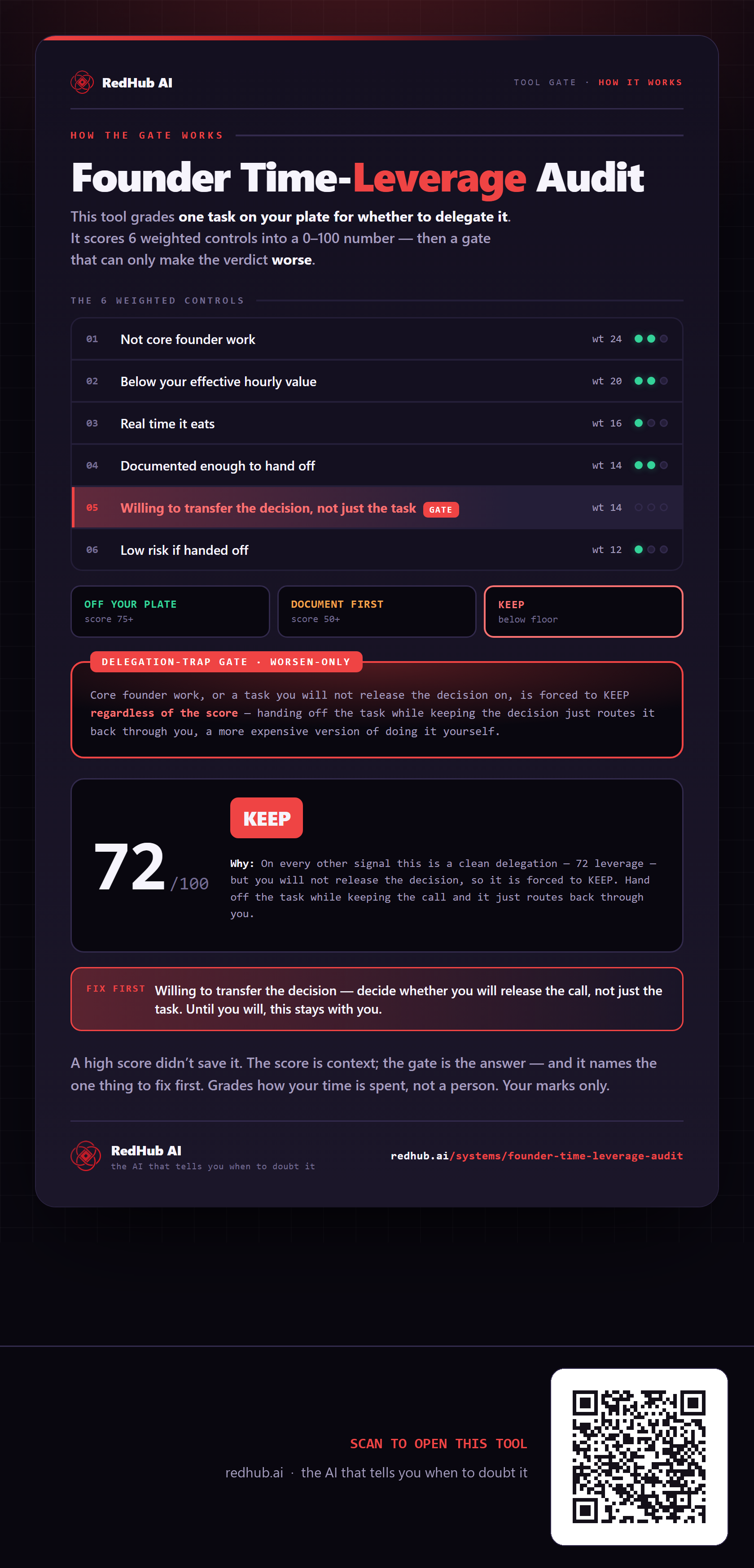
This is how Founder Time-Leverage Audit works. More diagrams in the Visual Field Guide.