Tool Gate · How it works
How the Application-Fabrication Risk gate works
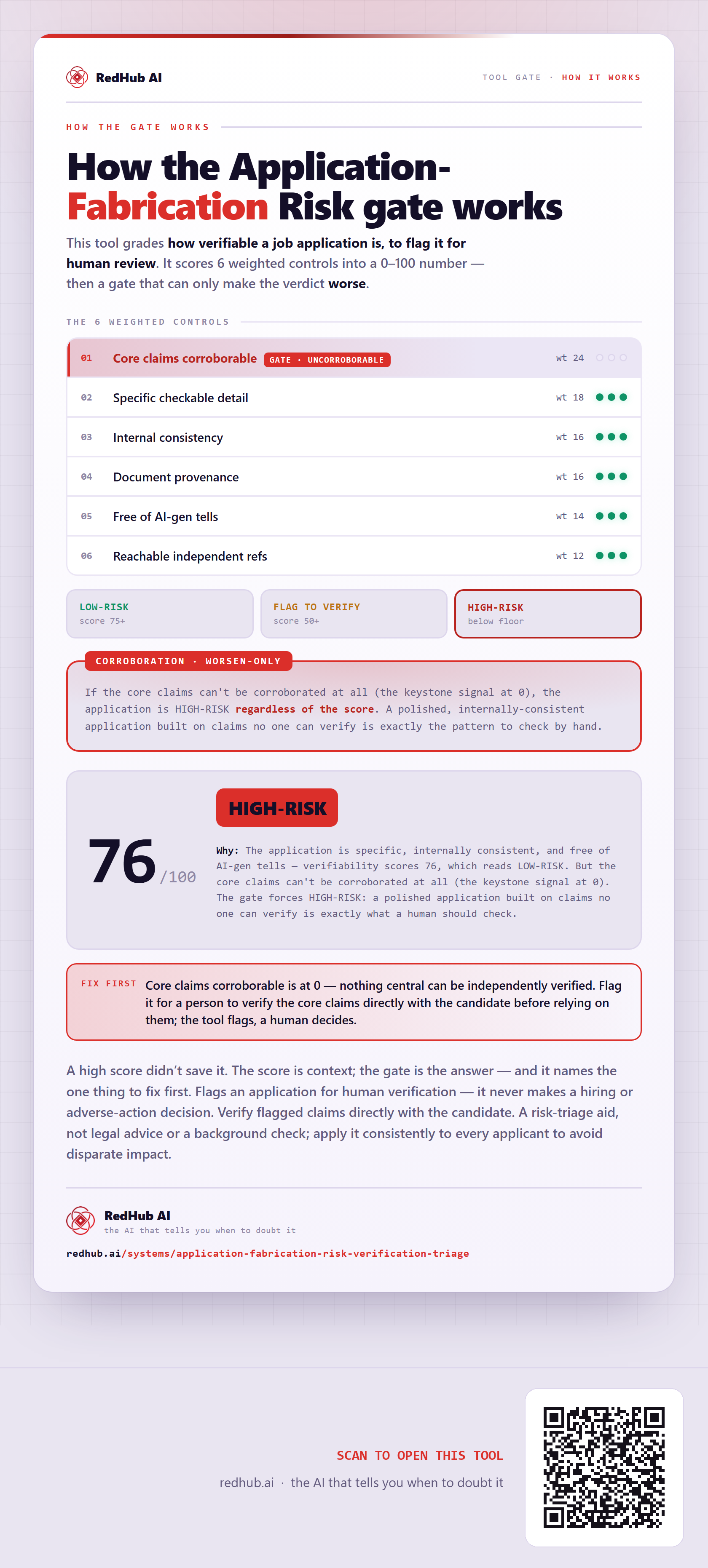
How the Application-Fabrication Risk gate flags a job application for human verification: six signals weighted into a 0–100 verifiability score, with a corroboration gate where a mark of 0 on Core claims corroborable (no independent source identified for the core claims) forces HIGH VERIFICATION NEED, whatever the score — which is how an application scoring 76 is still flagged. It flags; a human decides.
How the gate works
This tool grades how verifiable a job application is, to flag it for human review. Each control is marked from your own evidence and weighted into a 0–100 score — and then the score is run past a gate that can only make the verdict worse.
The 6 weighted controls
| Signal | Weight |
|---|---|
| Core claims corroborable | 24 |
| Specific checkable detail | 18 |
| Internal consistency | 16 |
| Document provenance | 16 |
| Material claims supported by independently verifiable evidence | 14 |
| Reachable independent refs | 12 |
| Total | 100 |
The verdict bands
A mark of 0 on Core claims corroborable (no independent source identified for the core claims) forces HIGH VERIFICATION NEED, whatever the score.
In the worked sample it scores 76 out of 100 and still reads HIGH VERIFICATION NEED — The other five signals are at the top mark — verifiability scores 76, which is in the VERIFICATION EVIDENCE STRONG AS DESCRIBED band. But Core claims corroborable is marked 0 (no independent source identified for the core claims). The gate forces HIGH VERIFICATION NEED, whatever the score. Verify first on this sample: Core claims corroborable is at 0 — no independent source is identified for the core claims. Flag it for a person to verify the core claims directly with the candidate before relying on them; the tool flags, a human decides.
Common questions
Can something score well on the Application-Fabrication Risk gate and still fail?
Yes. The weighted score is run past a worsen-only gate — the Corroboration — that can only make the verdict worse. In the worked sample it scores 76 out of 100 and still reads HIGH VERIFICATION NEED, because the other five signals are at the top mark — verifiability scores 76, which is in the VERIFICATION EVIDENCE STRONG AS DESCRIBED band. But Core claims corroborable is marked 0 (no independent source identified for the core claims). The gate forces HIGH VERIFICATION NEED, whatever the score.
What is a worsen-only gate?
A rule that can only lower a verdict, never raise it. One gate-triggering gap overrides an otherwise-good score, because a single gate-triggering gap shouldn't hide behind a high average. Where something is short, the verify first row names it — here, "Core claims corroborable is at 0 — no independent source is identified for the core claims. Flag it for a person to verify the core claims directly with the candidate before relying on them; the tool flags, a human decides.".
This result is about document verifiability and cannot be used as a reject instruction. This instrument supports human verification review; it does not make or recommend an employment decision. It does not determine whether this tool or the surrounding workflow is an automated employment decision tool or other regulated selection procedure. Assess applicability under the jurisdictions and roles involved. Flags an application for human verification — it never makes a hiring or adverse-action decision. Verify flagged claims directly with the candidate. A risk-triage aid, not legal advice or a background check. This instrument records whether a documented, job-related verification process is applied consistently. It does not determine whether the process causes or avoids disparate impact.
Embed this diagram
Free to share and embed with attribution (CC BY 4.0) — keep the link to redhub.ai.
Interactive — renders the live diagram
<iframe src="https://redhub.ai/visuals/tool/application-fabrication-risk-verification-triage.html" title="How the Application-Fabrication Risk gate works — RedHub AI" width="760" height="1824" loading="lazy" style="border:0;width:100%;max-width:760px"></iframe>
<p style="font:14px/1.5 system-ui,sans-serif"><a href="https://redhub.ai/visuals/tool/application-fabrication-risk-verification-triage">How the Application-Fabrication Risk gate works</a> — by <a href="https://redhub.ai">RedHub AI</a>, the AI that tells you when to doubt it.</p>
Image + link — a static picture for any blog
<a href="https://redhub.ai/visuals/tool/application-fabrication-risk-verification-triage"><img src="https://redhub.ai/visuals/tool/application-fabrication-risk-verification-triage-share.png" alt="Diagram of the Application-Fabrication Risk gate: six weighted signals, a corroboration gate, and an application scoring 76 returned as HIGH VERIFICATION NEED because Core claims corroborable is marked 0." width="760" loading="lazy" style="max-width:100%;height:auto;border-radius:16px"></a>
<p style="font:14px/1.5 system-ui,sans-serif"><a href="https://redhub.ai">RedHub AI</a> — the AI that tells you when to doubt it.</p>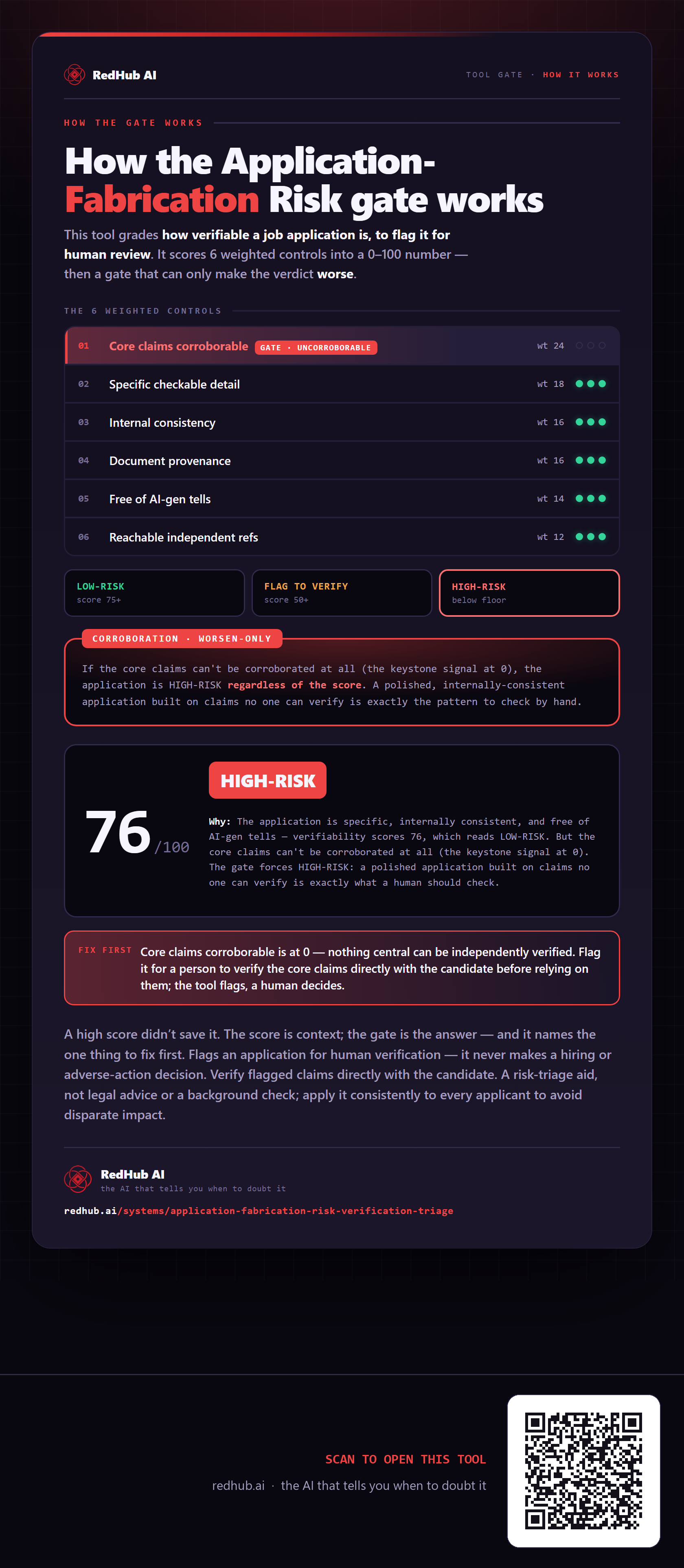
This is how Application-Fabrication Risk & Verification Triage works. More diagrams in the Visual Field Guide.