Tool Gate · How it works
How the AI Agent Go-Live Readiness Gate gate works
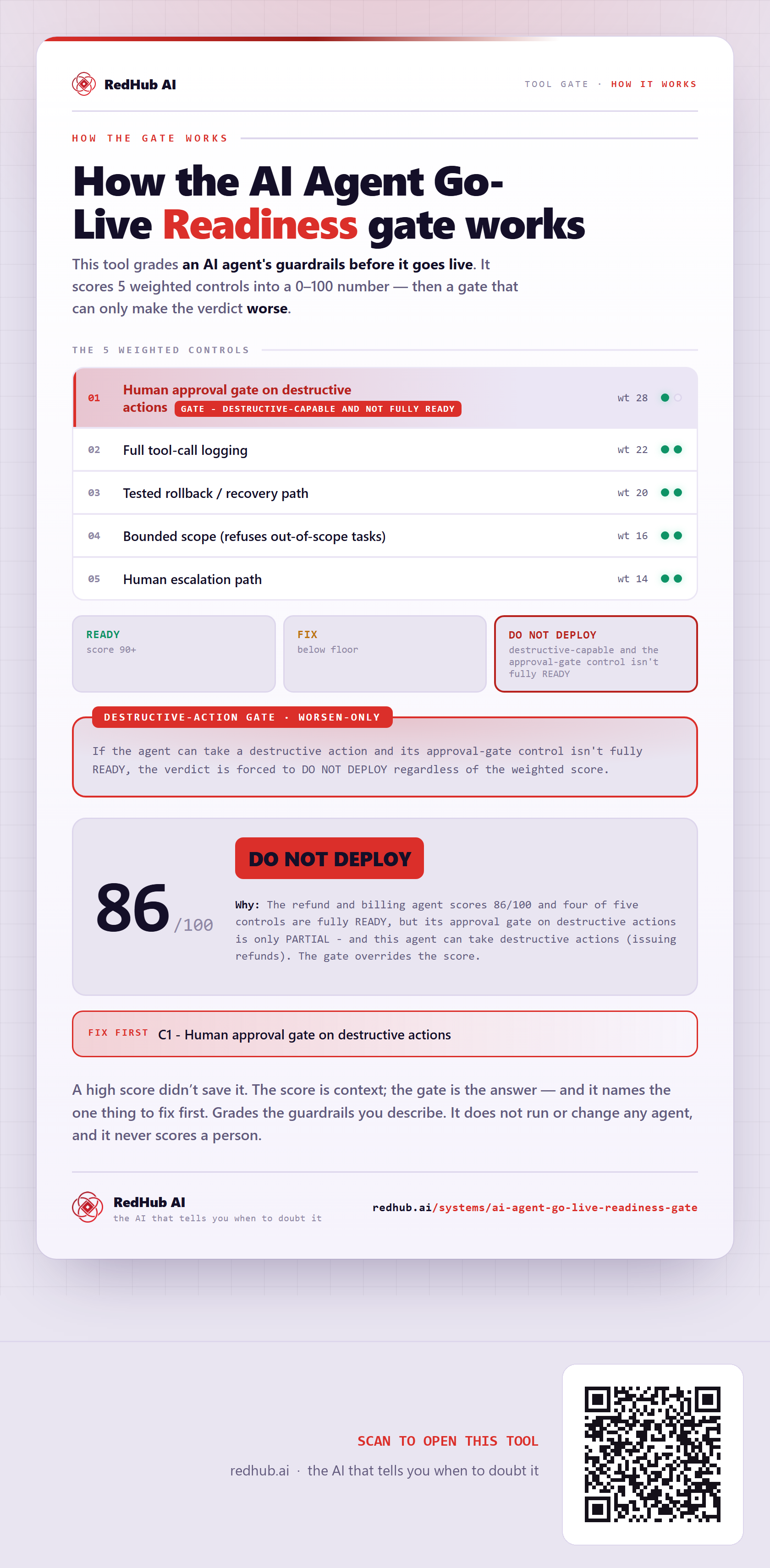
How the AI Agent Go-Live Readiness Gate scores 5 guardrail controls to 100: a destructive-action gate forces DO NOT DEPLOY when a refund-capable agent's approval gate is only partial — which is how the sample scores 86, with 4 of 5 controls fully ready, and still reads DO NOT DEPLOY.
How the gate works
This tool grades an AI agent's guardrails before it goes live. Each control is marked from your own evidence and weighted into a 0–100 score — and then the score is run past a gate that can only make the verdict worse.
The 5 weighted controls
| Signal | Weight |
|---|---|
| Human approval gate on destructive actions | 28 |
| Full tool-call logging | 22 |
| Tested rollback / recovery path | 20 |
| Bounded scope (refuses out-of-scope tasks) | 16 |
| Human escalation path | 14 |
| Total | 100 |
The verdict bands
If the agent can take a destructive action and its approval-gate control isn't fully READY, the verdict is forced to DO NOT DEPLOY regardless of the weighted score.
In the worked sample it scores 86 out of 100 and still reads DO NOT DEPLOY — The refund and billing agent scores 86/100 and four of five controls are fully READY, but its approval gate on destructive actions is only PARTIAL - and this agent can take destructive actions (issuing refunds). The gate overrides the score. Marked fix first on this sample: C1 - Human approval gate on destructive actions.
Common questions
Can something score well on the How the AI Agent Go-Live Readiness gate works and still fail?
Yes. The weighted score is run past a worsen-only gate — the Destructive-action gate — that can only make the verdict worse. In the worked sample it scores 86 out of 100 and still reads DO NOT DEPLOY, because the refund and billing agent scores 86/100 and four of five controls are fully READY, but its approval gate on destructive actions is only PARTIAL - and this agent can take destructive actions (issuing refunds). The gate overrides the score.
What is a worsen-only gate?
A dispositive rule that can only lower a verdict, never raise it. One fatal flaw overrides an otherwise-good score, because a single disqualifying gap shouldn't hide behind a high average. Where something is short, the fix-first row names it — here, "C1 - Human approval gate on destructive actions".
Grades the guardrails you describe. It does not run or change any agent, and it never scores a person.
Embed this diagram
Free to share and embed with attribution (CC BY 4.0) — keep the link to redhub.ai.
Interactive — renders the live diagram
<iframe src="https://redhub.ai/visuals/tool/ai-agent-go-live-readiness-gate.html" title="How the AI Agent Go-Live Readiness Gate gate works — RedHub AI" width="760" height="1593" loading="lazy" style="border:0;width:100%;max-width:760px"></iframe>
<p style="font:14px/1.5 system-ui,sans-serif"><a href="https://redhub.ai/visuals/tool/ai-agent-go-live-readiness-gate">How the AI Agent Go-Live Readiness Gate gate works</a> — by <a href="https://redhub.ai">RedHub AI</a>, the AI that tells you when to doubt it.</p>
Image + link — a static picture for any blog
<a href="https://redhub.ai/visuals/tool/ai-agent-go-live-readiness-gate"><img src="https://redhub.ai/visuals/tool/ai-agent-go-live-readiness-gate-share.png" alt="Diagram of the AI Agent Go-Live Readiness Gate: five guardrail controls and an 86/100 readiness score forced to DO NOT DEPLOY by a destructive-action gate on a partial approval gate." width="760" loading="lazy" style="max-width:100%;height:auto;border-radius:16px"></a>
<p style="font:14px/1.5 system-ui,sans-serif"><a href="https://redhub.ai">RedHub AI</a> — the AI that tells you when to doubt it.</p>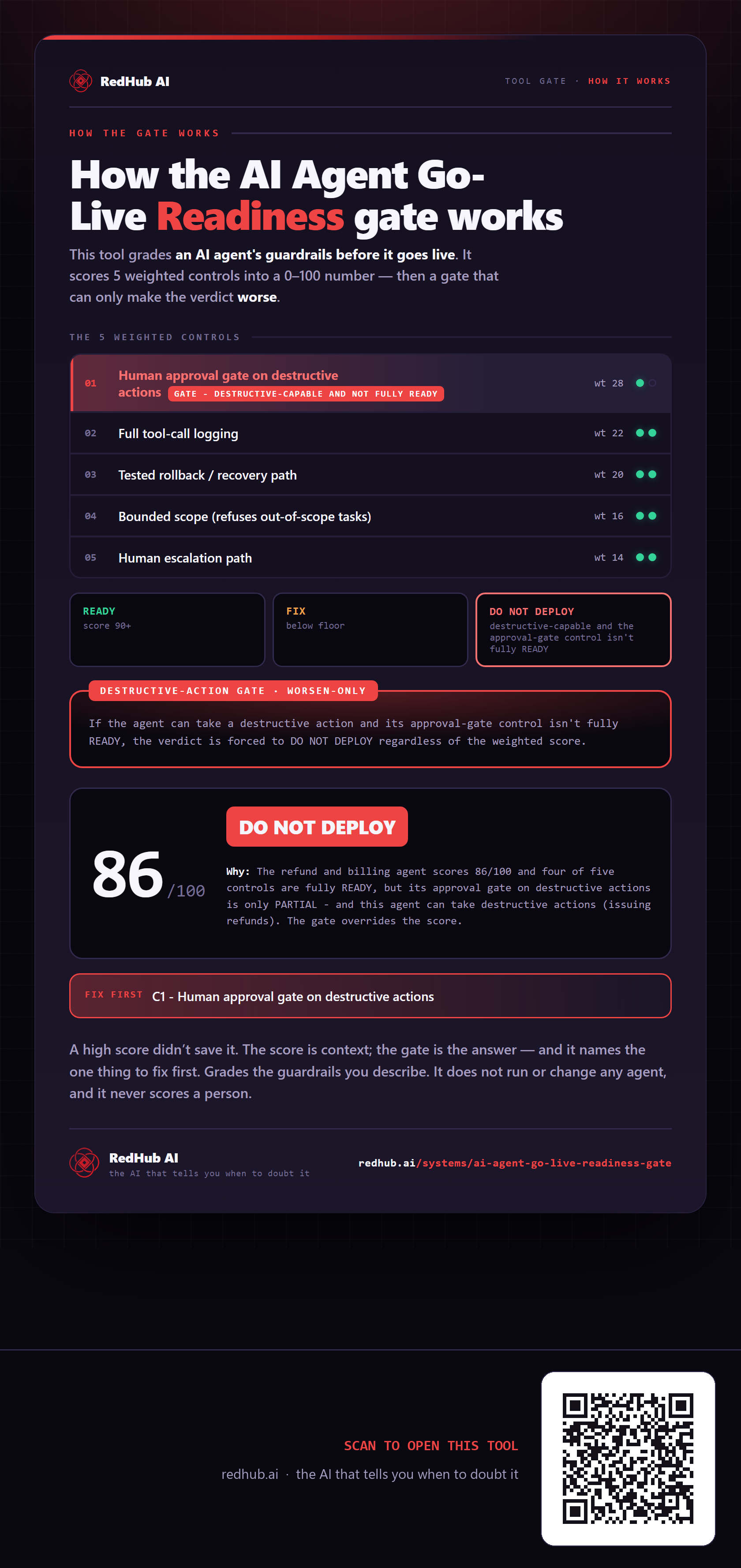
This is how AI Agent Go-Live Readiness Gate works. More diagrams in the Visual Field Guide.