The Money Path Teardown
Taking a payment is not one thing. It is a chain of separate moments, and your builder wired the visible ones.
Your checkout page working is not the same as your money path working. The card being charged is one moment. Everything after it was wired separately.
one-time · instant download · yours to keep
01 — The problem
The steps you never watch are the steps nobody wired.
You only ever test the happy path
You buy your own product, it works, you ship. What you did not do was close the tab at the wrong moment, cancel a subscription, ask for a refund, or have the same notification arrive twice.
Every step was wired separately
Charging the card, granting access, revoking it later, reflecting a refund. Your builder wrote the ones you asked about. Nobody mentioned the others because nobody clicked them.
The failures are quiet and expensive
A churned customer who keeps their access. A double charge. A refund that never reaches the account. None of these throws an error. They show up as support tickets and chargebacks weeks later.
02 — What's inside
Four questions per step. None of them an opinion.
What is at stake
Does money or access change hands on this step, or does the customer just see something? A thank-you page is allowed to be a thank-you page.
What triggers it, and who decides
Does the processor notify your server, or does the customer's browser landing on a page set it off — and where does the amount actually come from.
Whether it survives running twice
If this step ran a second time, would the customer be charged twice, granted twice, or notice nothing at all?
The sheet ships with the ten steps most order flows have, so the first thing it does is name the ones you did not know were steps. Delete the ones that do not apply to you and add your own.
03 — The standard
Three rules it will not bend for you.
A step that would run twice is not a step you have handled
Payment processors resend notifications. That is documented behaviour, not an edge case — a blip on your side and the same event arrives again. So a step that would do its work twice will do its work twice. It reads NOT HANDLED however cleanly it is written, because working once when you tested it is not the test it has to pass.
A missing step outranks a forgeable one
A step that takes the browser's word for it needs somebody to notice and try. A step that does not happen, or happens twice, fails for ordinary honest customers on an ordinary day with nobody attacking anything. That is the more expensive problem and it is ranked as one.
An answer you could not find is scored as the worst it could have been
Not a guess about what is likely — the worst, because an answer you cannot produce is not evidence. Stated that way it also cannot be gamed: writing cant_find can never get you a better result than telling the truth would have. Where an unfound answer could not have changed the row either way, it is not counted against you and the row says so.
04 — How it works
An afternoon with your order flow open.
01
Start from the ten steps already in the sheet. Delete the ones your flow does not have and add anything it does that is not listed.
02
Mark which steps actually move money or access. That single column decides which rows the rest of the questions even apply to.
03
Answer the three remaining questions from your own project, using the plain-words guide. Answer cant_find honestly where you have to.
04
Take the fix-first step to whatever you build with. Fix that one, read the row again, watch the verdict move.
05 — What you'll see
The worked example, live.
Ten steps of an ordinary order flow. S-01 is the hub: change one answer on it and it becomes S-02, S-03 or S-04 — three different destinations, one observation apart each time.
Try it on the worked example
Ten steps of an ordinary order flow. S-01 is the hub — change one answer on it and it becomes S-02, S-03 or S-04, each landing somewhere different.
| Step | At stake | Triggered by | Who decides | Runs twice | Destination |
|---|---|---|---|---|---|
S-01 The amount the customer is charged | CONFIRMED the processor's own notification triggers it, your side decides the outcome, and running it again changes nothing | ||||
S-02 Access granted after payment | TAKEN ON TRUST this runs because the customer's browser landed on a page - they can close the tab and never arrive, or arrive without paying | ||||
S-03 Thank-you page shown | DISPLAY ONLY nothing changes hands here - the customer just sees something, and a thank-you page is allowed to be a thank-you page | ||||
S-04 Order recorded in your database | NOT HANDLED it would do its work twice if it ran twice - and processors resend events by design, so it will run twice | ||||
S-05 Subscription renewal recorded | CONFIRMED the processor's own notification triggers it, your side decides the outcome, and running it again changes nothing | ||||
S-06 Access revoked when a subscription ends | NOT HANDLED nothing tells your app that this happened, so it does not happen | ||||
S-07 Refund reflected in the customer account | NOT HANDLED nothing tells your app that this happened, so it does not happen | ||||
S-08 Which plan or quantity the customer gets | TAKEN ON TRUST the notification arrives from the processor, but what gets granted or charged comes from a value the browser sent | ||||
S-09 A failed payment retried later | NOT HANDLED it would do its work twice if it ran twice - and processors resend events by design, so it will run twice | ||||
S-10 Order confirmation shown in the app | DISPLAY ONLY nothing changes hands here - the customer just sees something, and a thank-you page is allowed to be a thank-you page |
Verdict
PATH BREAKS
Something on this path fails for ordinary customers, with nobody attacking it.
Fix first S-09 — it would do its work twice if it ran twice - and processors resend events by design, so it will run twice
6 of 10
steps that need work
60% of the steps listed
4
fail without anybody attacking
ordinary customers, ordinary day
2
would do their work twice
processors resend by design
2
told to leave alone
nothing at stake on those
None of the four numbers above changes the verdict. Steps that read DISPLAY ONLY are never counted against you.
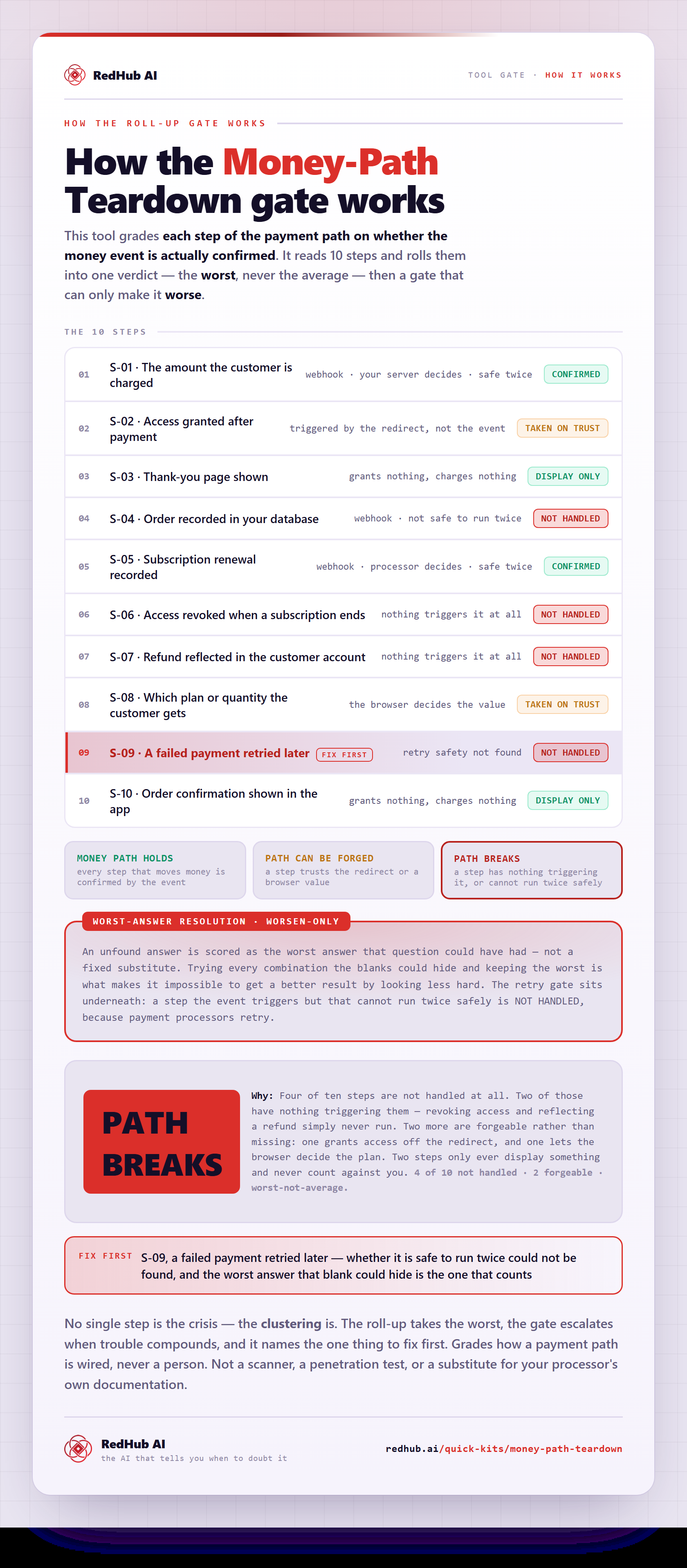
How the gate works, in one image
See how ten payment steps roll into one verdict - and why an unfound answer scores as the worst thing it could be hiding.
View & embed the full diagramThis is the live engine. 60 rows, the same formulas, in a file you keep Start Here tab that explains every answer in plain words Dashboard with the verdict, the counts, and what to fix first
Get the kit — $6906 — Who it's for
For the person who wired a checkout and assumed that was payments.
Buy this if
- You are taking real money through something you built with an AI tool.
- You wired a checkout and have never thought about what happens after it.
- You cannot say what happens if a customer closes the tab the second they pay.
- Somebody asked what happens when a subscription is cancelled and you paused.
Skip it if
- You have shipped billing systems before. There is nothing here you do not know.
- Nothing you built takes money yet.
- You want something that inspects your live account — this is a read-off, not a scanner.
What this is not
It connects to nothing and never sees your payment account, your keys, your code, or a single order. It grades how an order flow is built and never a person. It is not a scanner, a penetration test, or a financial audit, and it is not legal, tax, or accounting advice — it reads back what you tell it, using rules you can see in the formulas.
07 — Works alongside
Where this sits.
Four layers, four different questions. This one is the money: on the steps that move money or access, does the right thing happen, once?
The Browser Line Read-Off
$59The keystone of the same line. Every failure here is one instance of the idea it teaches — that anything the browser decides, your customer decides.
Logged-In Is Not Allowed
$59The permissions layer. This one asks whether the right thing happened; that one asks whether the right person asked for it.
Vibe-Coded App Pre-Launch Security Gate
$79The launch-moment go/no-go across six controls. Run this teardown before it so the payments answers come from evidence rather than hope.
08 — Common questions
Before you buy.
The moments nobody watches. Taking a payment is not one thing — the card being charged is one step, access being granted is another, the customer cancelling is another, a refund is another. Each is wired separately, and the ones you never see happen are the ones nobody wired. Your checkout working proves the first step works.
Because the customer's browser is not a reliable narrator. If access is granted when they land on your success page, they can close the tab the instant they pay and never arrive — they paid and got nothing. They can also open that page directly without paying. The processor's own notification to your server is the thing that actually knows a payment happened.
Payment processors resend notifications. That is documented behaviour, not an edge case — a blip on your side and the same event arrives again. So a step that would do its work twice will do its work twice, and the customer gets charged or granted twice. That row reads NOT HANDLED however cleanly it is written, because working once when you tested it is not the test it has to pass.
Because it fails without anybody attacking. A step that takes the browser's word for it needs somebody to notice and try. A step that does not happen, or happens twice, fails for ordinary honest customers on an ordinary day — the churned subscriber who keeps their access, the double charge, the refund that never reaches the account. Those cost you money and trust immediately.
It is scored as the worst answer that question could have had — not a guess about what is likely, the worst, because an answer you cannot produce is not evidence. Stated that way it also cannot be gamed: writing cant_find can never get you a better result than telling the truth would have. Where an unfound answer could not have changed the row either way, it is not counted against you and the row says so.
No. It connects to nothing and uploads nothing — no keys, no account, no order data. You walk your own order flow, answer four questions per step, and the spreadsheet does the rest. It grades how a flow is built, never a person, and it is not legal, tax, or accounting advice.
Get the Read-Off
Find out which steps of your money path actually hold.
- One .xlsx — Start Here, Dashboard, Teardown
- 60 rows with dropdowns and live formulas
- The ten steps most order flows have, already filled in
- Offline forever — nothing uploaded, no access granted