Tool Gate · How it works
How the Money-Path Teardown gate works
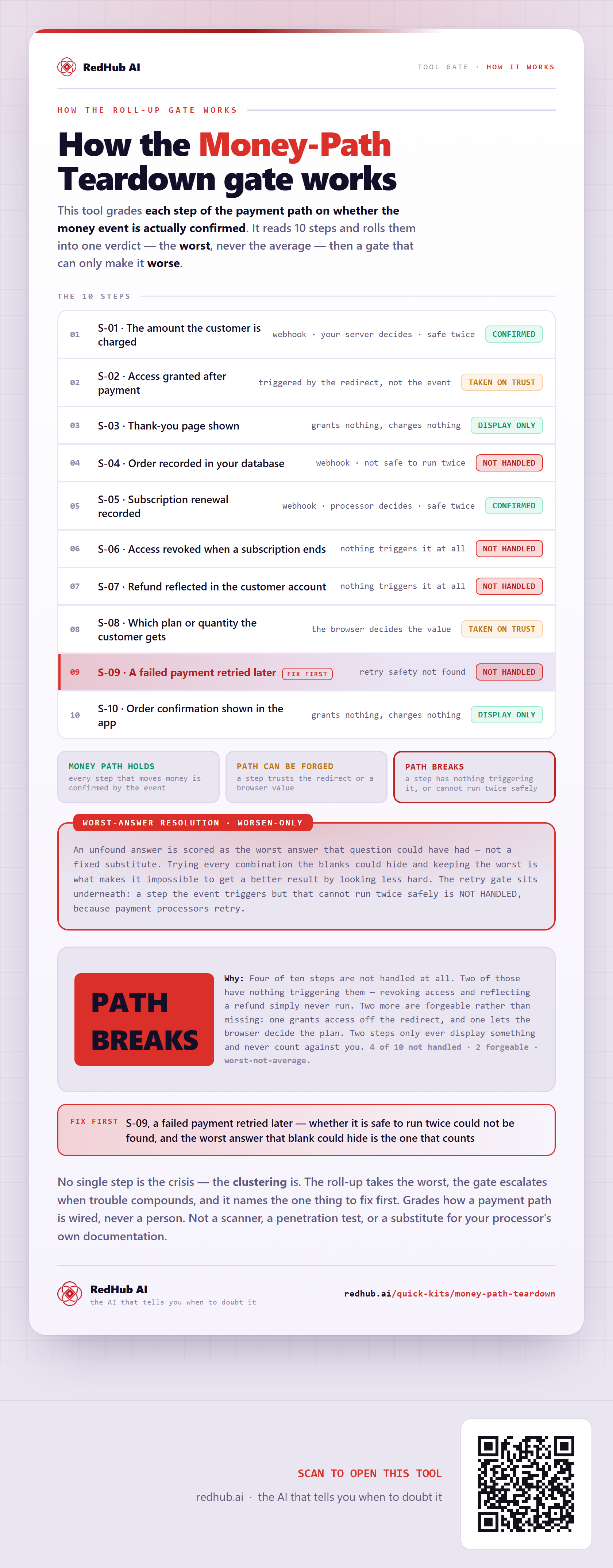
How the Money-Path Teardown rolls ten payment steps into one verdict: every unfound answer is scored as the worst answer that blank could hide, and a retry gate catches steps that cannot run twice safely - the sample reads PATH BREAKS.
How the gate works
This tool grades each step of the payment path on whether the money event is actually confirmed. It reads 10 steps and rolls them into one verdict — the worst, never the average — and then a gate that can only make it worse.
The 10 steps
| Step | Verdict |
|---|---|
| S-01 · The amount the customer is charged | CONFIRMEDwebhook · your server decides · safe twice |
| S-02 · Access granted after payment | TAKEN ON TRUSTtriggered by the redirect, not the event |
| S-03 · Thank-you page shown | DISPLAY ONLYgrants nothing, charges nothing |
| S-04 · Order recorded in your database | NOT HANDLEDwebhook · not safe to run twice |
| S-05 · Subscription renewal recorded | CONFIRMEDwebhook · processor decides · safe twice |
| S-06 · Access revoked when a subscription ends | NOT HANDLEDnothing triggers it at all |
| S-07 · Refund reflected in the customer account | NOT HANDLEDnothing triggers it at all |
| S-08 · Which plan or quantity the customer gets | TAKEN ON TRUSTthe browser decides the value |
| S-09 · A failed payment retried laterfix first | NOT HANDLEDretry safety not found |
| S-10 · Order confirmation shown in the app | DISPLAY ONLYgrants nothing, charges nothing |
The verdict bands
An unfound answer is scored as the worst answer that question could have had — not a fixed substitute. Trying every combination the blanks could hide and keeping the worst is what makes it impossible to get a better result by looking less hard. The retry gate sits underneath: a step the event triggers but that cannot run twice safely is NOT HANDLED, because payment processors retry.
In the worked sample it reads PATH BREAKS — Four of ten steps are not handled at all. Two of those have nothing triggering them — revoking access and reflecting a refund simply never run. Two more are forgeable rather than missing: one grants access off the redirect, and one lets the browser decide the plan. Two steps only ever display something and never count against you. Marked fix first on this sample: S-09, a failed payment retried later — whether it is safe to run twice could not be found, and the worst answer that blank could hide is the one that counts.
Common questions
Can every step look survivable on the How the Money-Path Teardown gate works and the company still read PATH BREAKS?
Yes. The roll-up takes the worst of 10 steps — never the average — then a worsen-only gate, the Worst-answer resolution gate, escalates when trouble clusters. In the worked sample it reads PATH BREAKS because four of ten steps are not handled at all. Two of those have nothing triggering them — revoking access and reflecting a refund simply never run. Two more are forgeable rather than missing: one grants access off the redirect, and one lets the browser decide the plan. Two steps only ever display something and never count against you.
What is a worsen-only gate?
A dispositive rule that can only lower a verdict, never raise it. One fatal flaw overrides an otherwise-set of survivable lines, because a single disqualifying gap shouldn't hide behind an average of the healthy ones. Where something is short, the fix-first row names it — here, "S-09, a failed payment retried later — whether it is safe to run twice could not be found, and the worst answer that blank could hide is the one that counts".
Grades how a payment path is wired, never a person. Not a scanner, a penetration test, or a substitute for your processor's own documentation.
Embed this diagram
Free to share and embed with attribution (CC BY 4.0) — keep the link to redhub.ai.
Interactive — renders the live diagram
<iframe src="https://redhub.ai/visuals/tool/money-path-teardown.html" title="How the Money-Path Teardown gate works — RedHub AI" width="760" height="2262" loading="lazy" style="border:0;width:100%;max-width:760px"></iframe>
<p style="font:14px/1.5 system-ui,sans-serif"><a href="https://redhub.ai/visuals/tool/money-path-teardown">How the Money-Path Teardown gate works</a> — by <a href="https://redhub.ai">RedHub AI</a>, the AI that tells you when to doubt it.</p>
Image + link — a static picture for any blog
<a href="https://redhub.ai/visuals/tool/money-path-teardown"><img src="https://redhub.ai/visuals/tool/money-path-teardown-share.png" alt="Diagram of the Money-Path Teardown: ten payment steps, a worst-answer resolution rule, and a sample reading PATH BREAKS." width="760" loading="lazy" style="max-width:100%;height:auto;border-radius:16px"></a>
<p style="font:14px/1.5 system-ui,sans-serif"><a href="https://redhub.ai">RedHub AI</a> — the AI that tells you when to doubt it.</p>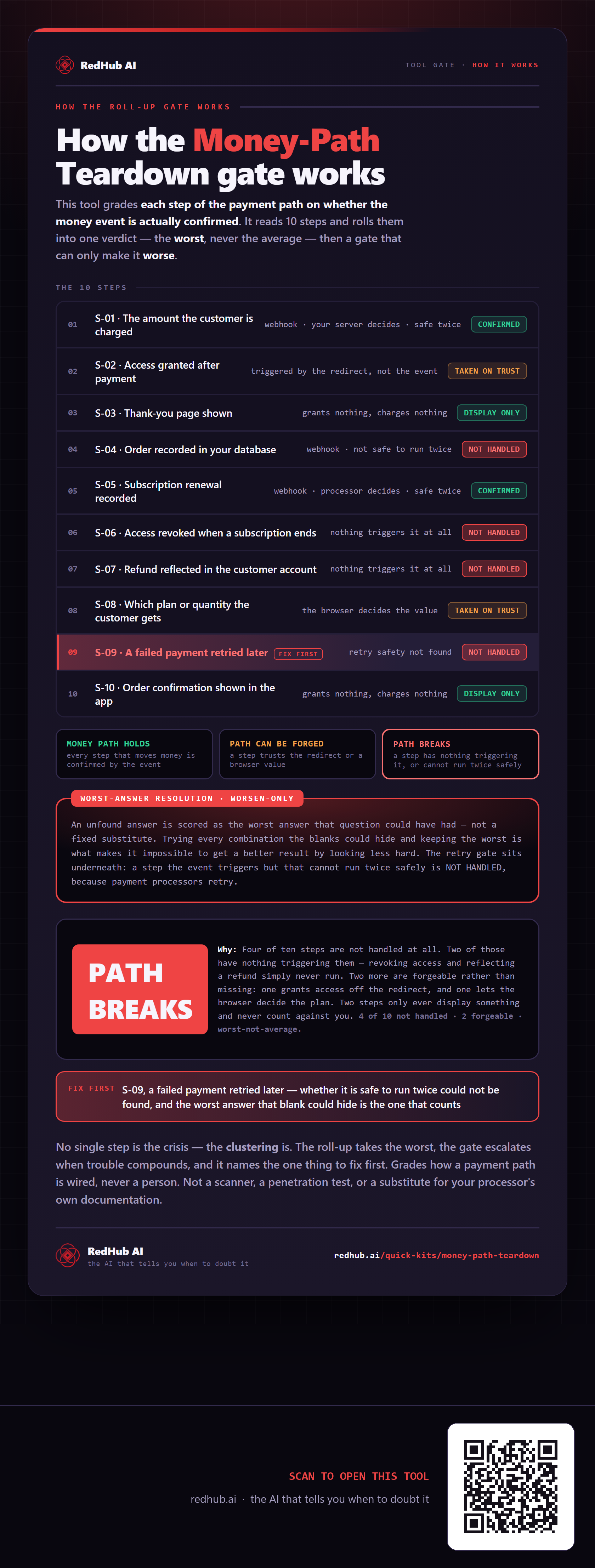
This is how Money-Path Teardown works. More diagrams in the Visual Field Guide.