Entity Identity & Functional-Key Sweep
A duplicate finder tells you two records look alike. That is where its job ends and your problem starts: alike is not the same as mergeable.
Your declared functional key is weighted 30 here, not 100. That is deliberate: if the key were genuinely enforced you would not have candidate pairs to grade in the first place. A key that matches is the strongest single signal available and still not proof.
instant download · .xlsx · yours to keep
The problem
Read the order carefully.
DISTINCT
The evidence does not say these are one entity. The quiet answer: nothing to do.
SAME ENTITY
Work you have not done. A merge waiting to happen, and a duplicate sitting in your reports until it does.
IDENTITY CONFLICT
The one that stops you. Merging would destroy a fact; not merging leaves two records claiming to be the same thing.
Five weighted signals argue the pair is one entity: your declared key (30), a strong external identifier (25), a contact point (20), the name (15), and shared context (10). At or above 60 the evidence reads SAME ENTITY. The sweep takes the worst pair: IDENTITY CLEAN, MERGES PENDING, or IDENTITY CONFLICTED.
The idea worth the $69
A contradiction needs something to contradict.
Two disqualifiers can stop a merge, and either one alone is enough: two different values for an identifier that is unique by definition, or a fact the two records assert that cannot both be true of one entity.
But they only fire on a pair the evidence already calls SAME ENTITY. Two records that are plainly different companies will of course carry two different tax IDs — that is not a contradiction, that is two companies. A rule that flagged it anyway would bury the real conflicts under noise, which is how these lists get ignored. The Dashboard counts those flags separately, so you can see they were considered rather than silently swallowed.
Try it
Two identical pairs, one flag apart.
P-01 and P-02 carry identical marks and identical evidence of 88. Toggle the disqualifier and watch one of them stop being mergeable.
P-01 · supplier · SUP-4471 ↔ SUP-9930
IDENTITY CONFLICT
Evidence 88/100, which reads SAME ENTITY. A disqualifier applies, so this pair cannot be merged as it stands. Next: Two different values for an identifier that is unique by definition.
Your declared functional key matchesweight 30
A strong external identifier matchesweight 25
A contact point matchesweight 20
The name matchesweight 15
They sit in the same contextweight 10
Sweep verdict
IDENTITY CONFLICTED
3 distinct · 3 to merge · 2 in conflict, of 8. Mean evidence 68/100 — context only, it decides nothing. 1 flag(s) present without being a conflict. Fix first: P-04.
Same arithmetic as the shipped workbook. It grades record pairs you paste in, never people, and merges nothing.
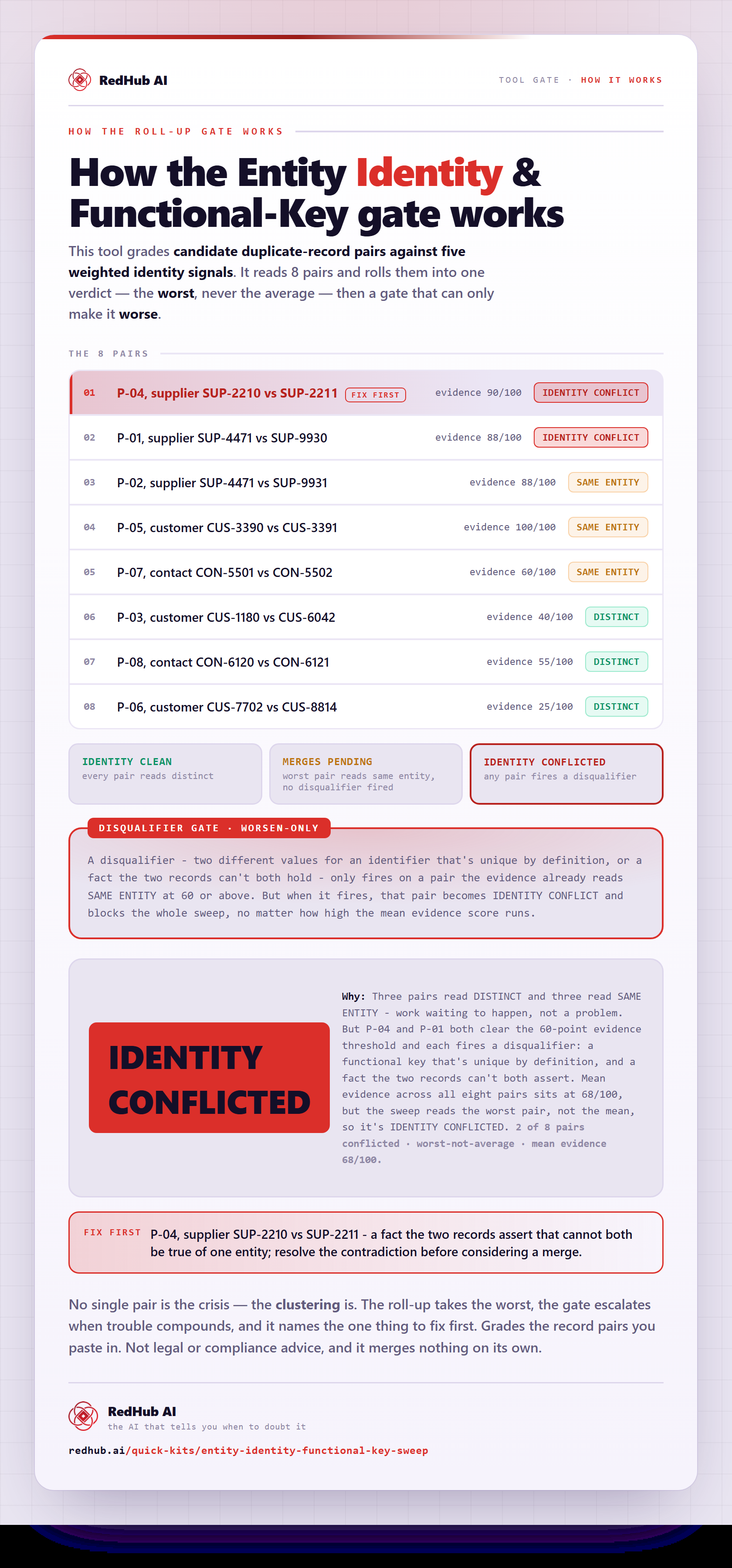
How the gate works, in one image
How the Entity Identity & Functional-Key Sweep scores candidate duplicate pairs and flags a conflict when strong IDs disagree — the same math the demo runs, as a diagram you can share or embed anywhere.
View & embed the full diagramThis is the live engine. Every candidate pair you have, not eight. Your signals, your weights, your threshold. One .xlsx, no account, yours to keep.
Get the kit — $69The worked example
What the shipped sweep says.
ENTITY IDENTITY & FUNCTIONAL-KEY SWEEP
==========================================================================

P-01  supplier: SUP-4471 <-> SUP-9930
    evidence 88/100   reads SAME ENTITY   IDENTITY CONFLICT
      2  Your declared functional key matches  (weight 30)
      1  A strong external identifier matches  (weight 25)
      2  A contact point matches               (weight 20)
      2  The name matches                      (weight 15)
      2  They sit in the same context          (weight 10)
    [DISQUALIFIER] Two different values for an identifier that is unique by definition
        the evidence says these are one entity and the data says they cannot be
    next: Two different values for an identifier that is unique by definition

P-02  supplier: SUP-4471 <-> SUP-9931
    evidence 88/100   reads SAME ENTITY   SAME ENTITY
      2  Your declared functional key matches  (weight 30)
      1  A strong external identifier matches  (weight 25)
      2  A contact point matches               (weight 20)
      2  The name matches                      (weight 15)
      2  They sit in the same context          (weight 10)
    next: merge these records

P-03  customer: CUS-1180 <-> CUS-6042
    evidence 40/100   reads DISTINCT   DISTINCT
      0  Your declared functional key matches  (weight 30)
      0  A strong external identifier matches  (weight 25)
      2  A contact point matches               (weight 20)
      2  The name matches                      (weight 15)
      1  They sit in the same context          (weight 10)
    [flag, not a conflict] Two different values for an identifier that is unique by definition
        the evidence does not say these are one entity, so a difference here is expected
    next: weakest signal: your declared functional key matches

P-04  supplier: SUP-2210 <-> SUP-2211
    evidence 90/100   reads SAME ENTITY   IDENTITY CONFLICT
      2  Your declared functional key matches  (weight 30)
      2  A strong external identifier matches  (weight 25)
      1  A contact point matches               (weight 20)
      2  The name matches                      (weight 15)
      2  They sit in the same context          (weight 10)
    [DISQUALIFIER] A fact the two records assert that cannot both be true of one entity
        the evidence says these are one entity and the data says they cannot be
    next: A fact the two records assert that cannot both be true of one entity

P-05  customer: CUS-3390 <-> CUS-3391
    evidence 100/100   reads SAME ENTITY   SAME ENTITY
      2  Your declared functional key matches  (weight 30)
      2  A strong external identifier matches  (weight 25)
      2  A contact point matches               (weight 20)
      2  The name matches                      (weight 15)
      2  They sit in the same context          (weight 10)
    next: merge these records

P-06  customer: CUS-7702 <-> CUS-8814
    evidence 25/100   reads DISTINCT   DISTINCT
      0  Your declared functional key matches  (weight 30)
      0  A strong external identifier matches  (weight 25)
      0  A contact point matches               (weight 20)
      2  The name matches                      (weight 15)
      2  They sit in the same context          (weight 10)
    next: weakest signal: your declared functional key matches

P-07  contact: CON-5501 <-> CON-5502
    evidence 60/100   reads SAME ENTITY   SAME ENTITY
      2  Your declared functional key matches  (weight 30)
      0  A strong external identifier matches  (weight 25)
      2  A contact point matches               (weight 20)
      0  The name matches                      (weight 15)
      2  They sit in the same context          (weight 10)
    next: merge these records

P-08  contact: CON-6120 <-> CON-6121
    evidence 55/100   reads DISTINCT   DISTINCT
      1  Your declared functional key matches  (weight 30)
      1  A strong external identifier matches  (weight 25)
      2  A contact point matches               (weight 20)
      1  The name matches                      (weight 15)
      0  They sit in the same context          (weight 10)
    next: weakest signal: they sit in the same context

--------------------------------------------------------------------------
SWEEP VERDICT: IDENTITY CONFLICTED
  3 distinct / 3 to merge / 2 in conflict  (of 8 pairs)
  mean evidence 68/100  -- context only, it decides nothing
  1 pair(s) carry a flag that is not a conflict, because the evidence says they are different entities
  fix first: P-04

Grades the record pairs you paste in. Not legal or compliance advice.
The .xlsx reproduces every verdict above exactly — the parity check behind this kit asserts 122 of them, cell by cell, with zero error values. Three things to notice. P-01 and P-02 differ only by a flag. P-03 carries the same kind of flag and is reported as not a conflict, because at 40/100 the evidence never claimed those records were one entity. And the mean evidence is 68/100 while the sweep reads IDENTITY CONFLICTED — the mean is context, not the verdict.
Honest limits
What it will not do.
- It does not find candidate pairs. Bring them from a duplicate finder or a key-collision query; this grades the ones you bring.
- It does not merge anything, and it will not tell you which record survives a merge. That decision needs a human who knows the domain.
- It cannot verify your marks. If you record a contact match that is really a shared switchboard, the evidence score inherits that.
- A pair that reads DISTINCT today can become a duplicate tomorrow. This grades records that already exist, so there is no evaluation date anywhere and two runs a quarter apart compare directly.
Deterministic and offline. It grades record pairs, never people, and is a working aid rather than legal or compliance advice.
Pairs with
Where this sits.
Multi-Source Data Reconciliation Engine
$89
When three systems disagree about a record. A stated identity rule is what makes that question answerable at all.
Invoice-PO-Receipt 3-Way Match
$79
Matching documents to each other. This matches records to each other, and refuses the ones that cannot be one thing.
CSV / Data-Export Schema & Quality Gate
$69
Whether an export parses and lines up before any of this. Bad keys usually show up there first.
Common Questions
Answers, caveat after.
Candidate pairs — two record IDs that might be the same entity, however you found them. For each pair you mark five signals 0, 1 or 2, and answer two yes/no questions about whether anything makes a merge impossible. It does not find candidate pairs for you; bring them from a duplicate finder or a key-collision query.
Because if that key were genuinely enforced you would not have candidate pairs to grade in the first place. A matching key is the strongest single signal here and still not proof — a perfect key match with nothing else scores 30 and reads DISTINCT. Weighting it at 100 would just restate your assumption back to you.
Because DISTINCT means there is nothing to do, SAME ENTITY means there is a merge you have not done yet, and IDENTITY CONFLICT means you cannot proceed either way — merging would destroy a fact, and not merging leaves two records claiming to be the same thing. Ordered by how much work they create, that is the right sequence.
Either of two disqualifiers, and either one alone is enough: two different values for an identifier that is unique by definition, or a fact the two records assert that cannot both be true of one entity. The shipped example includes two pairs with identical marks and identical evidence of 88 — one carries a conflicting registration number and reads IDENTITY CONFLICT, the other does not and reads SAME ENTITY.
No, and that is deliberate. A flag only disqualifies a pair the evidence already calls SAME ENTITY. Two records that are plainly different entities will of course carry different tax IDs — that is not a contradiction, that is two companies. The Dashboard counts those flags separately so you can see they were not missed rather than silently swallowed.
A duplicate finder tells you two records look alike, which is where its job ends. This grades whether you are allowed to merge them, and catches the case where your own data says you are not. They stack: the finder produces the candidate list, this sweep refuses the ones that cannot be merged. It grades record pairs, never people, and is a working aid rather than legal or compliance advice.
Get it
Find out which duplicates you are not allowed to merge.
- Every candidate pair, graded the same way twice.
- Two disqualifiers that only fire where they mean something.
- Editable weights and threshold, no account, no upload.
Sold by RedHub AI LLC · Secured by Stripe · redhub.ai