The Accept-or-Revert Ladder
An AI tool hands you a change. You read a bit of it, it looks reasonable, and the only button is Accept.
This does not tell you whether the change is right. Nobody can. It tells you whether you could get back if it is wrong — which you can actually answer.
one-time · instant download · yours to keep
01 — The problem
You will accept things you do not understand. That is the deal.
Reviewing the diff is not the answer
You cannot review your way out of this. If you could read every change well enough to catch the bad ones, you would not be using a tool that writes them for you. Pretending otherwise is how people end up rubber-stamping fifty changes and being caught by the fifty-first.
Most changes genuinely do not matter
Wording, spacing, colours, where a button sits. If those are wrong you will see it immediately and change it back. Treating them with the same ceremony as a schema change is what makes the ceremony worthless when it counts.
A very small number cannot be taken back
Dropping a column. Changing how a refund is calculated. Those do not fail loudly at the moment you accept them — they fail later, with real data or real money already gone, and no amount of reverting the code brings either back.
02 — What's inside
Four questions per change. None of them about the code.
What it could reach
How something looks, what the app does, or the shape of your data and how money is handled. That one column decides how much the rest of the questions matter.
What you have saved
Is the current version stored somewhere you could return to, and for anything touching data, is there a copy you could actually restore?
Whether undo is one step
If you accepted this and it was wrong, is putting it back a single action you already know, or something you would have to work out while it is broken?
None of the four is a judgement about the code, which is the point. They are all things you can check about your own setup in under a minute, before you click.
03 — The standard
Three rules it will not bend for you.
It never tells you whether the change is correct
Not once, anywhere. Nobody can judge a diff from four answers, and a tool that pretended to would be selling you confidence rather than a decision. Every answer here is about your own setup, which is why the sheet can be honest about it.
On data and money, "a copy was not needed" is not an answer
It is the assumption that turns out to be wrong. Code can be reverted; a dropped column cannot, and neither can a refund that already went out. Those rows are counted separately on the dashboard so you can see how often the assumption itself was the problem — in the worked example, one of the three blocked changes is blocked for exactly that reason.
An answer you could not find is scored as the worst it could have been
Not a guess about what is likely — the worst, because an answer you cannot produce is not evidence. Stated that way it also cannot be gamed: writing cant_find can never get you a better result than telling the truth would have. Where an unfound answer could not have changed the row either way, it is not counted against you and the row says so.
04 — How it works
Under a minute, before you click.
01
When a change comes back, put one line in the sheet. What it is, in your own words — nothing technical.
02
Mark what it could reach. Appearance, behaviour, or your data and money. Most weeks that column is mostly the first two.
03
Answer the three questions about what you have saved and whether undo is one step. Answer cant_find honestly where you have to.
04
Accept the green ones without ceremony, save first on the amber ones, and leave the red ones until a copy exists.
05 — What you'll see
The worked example, live.
A week of changes. C-06 is the one to sit with: saved, undoable in one step, and it still reads DO NOT ACCEPT YET — because a copy was marked “not needed” on a change to how money is handled. Three others are told to just accept, with no ceremony at all.
Try it on the worked example
A week of changes. C-06 is the one to sit with — everything about it is saved and undoable, and it still reads DO NOT ACCEPT YET because a copy was marked “not needed” on a change to how money is handled.
| Change | Touches | Version saved | Data copy | Undo is one step | Destination |
|---|---|---|---|---|---|
C-01 Change the primary button colour | NOTHING AT RISK this only changes how something looks - if it is wrong you will see it and change it back | ||||
C-02 Add a column to the orders table | SAFE TO ACCEPT if this is wrong you can put it back the way it was, in one step | ||||
C-03 Add a column to the users table | DO NOT ACCEPT YET this changes the shape of your data or how money is handled and there is no copy you could restore - code can be reverted, a dropped column cannot | ||||
C-04 Rewrite the search filter | CHECKPOINT FIRST nothing is saved to go back to, so accepting this replaces the only version you have | ||||
C-05 Rewrite the sort order | SAFE TO ACCEPT if this is wrong you can put it back the way it was, in one step | ||||
C-06 Change how refunds are calculated | DO NOT ACCEPT YET this changes the shape of your data or how money is handled, and you marked a copy as not needed - on a change like this that is not an answer, it is the thing that will be wrong | ||||
C-07 Reword the empty state | NOTHING AT RISK this only changes how something looks - if it is wrong you will see it and change it back | ||||
C-08 Merge two tables together | DO NOT ACCEPT YET this changes the shape of your data or how money is handled and there is no copy you could restore - code can be reverted, a dropped column cannot | ||||
C-09 Add pagination to the list | CHECKPOINT FIRST nothing is saved to go back to, so accepting this replaces the only version you have | ||||
C-10 Move the settings link | NOTHING AT RISK this only changes how something looks - if it is wrong you will see it and change it back |
Verdict
ONE-WAY DOOR
Something on this list cannot be undone once you accept it.
Fix first C-08 — this changes the shape of your data or how money is handled and there is no copy you could restore - code can be reverted, a dropped column cannot
5 of 10
changes that need something first
50% of the changes listed
3
you could not undo
code reverts; a dropped column does not
2
two minutes away from safe
save first, then accept
3
told to just accept
appearance only
None of the four numbers above changes the verdict, and none of this says whether a change is correct. Changes that read NOTHING AT RISK are never counted against you.
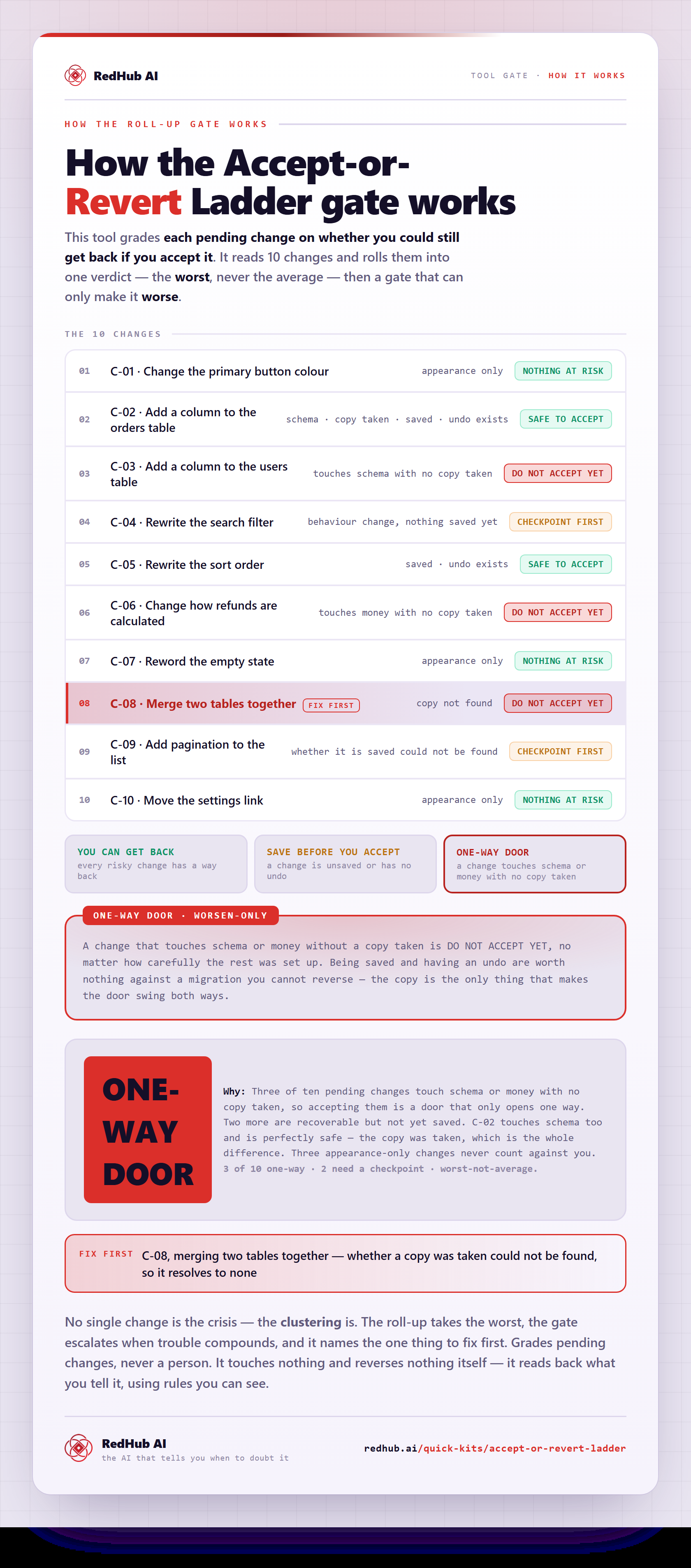
How the gate works, in one image
See how ten pending changes roll into one verdict - and why a copy is the only thing that makes the door swing both ways.
View & embed the full diagramThis is the live engine. 60 rows, the same formulas, in a file you keep Start Here tab that explains every answer in plain words Dashboard with the verdict, the counts, and what to fix first
Get the kit — $5906 — Who it's for
For the person clicking Accept forty times a week.
Buy this if
- You accept changes from an AI tool that you do not fully understand.
- You have accepted something, watched it break, and not known how to get back.
- You save your work sometimes, and you could not say exactly when you last did.
- You want a habit that takes a minute, not a code review you will never do.
Skip it if
- You review every change properly and already work on a branch. This will bore you.
- Nothing you build has data or users in it yet.
- You want something that reads the diff and tells you if it is right — nothing can do that, and this does not pretend to.
What this is not
It never reads your code and never says whether a change is correct. It connects to nothing and sees no part of your project. It grades your ability to recover, never a person and never the change itself. It is not a code review, a diff reader, or a testing tool, and it is not legal advice — it reads back what you tell it, using rules you can see in the formulas.
07 — Works alongside
Where this sits.
The rest of this line reads what you already shipped. This one is the habit that sits in front of the next thing you ship.
The Browser Line Read-Off
$59The keystone of the same line. That one is a read-off of what you already shipped; this one is the habit you run before you ship the next thing.
The Data Model Sanity Bench
$69The shape of your tables. Half the changes this ladder blocks are schema changes — that bench is where you find out which of them you were going to need anyway.
Vibe-Coded App Pre-Launch Security Gate
$79The launch-moment go/no-go across six controls. This ladder is what keeps you from undoing its answers by accident the week after you pass it.
08 — Common questions
Before you buy.
No, and it never claims to. Nobody can judge a diff from four answers, and a tool that pretended to would be lying to you. It asks a different question, and the one you can actually answer before you click: if this turns out to be wrong, can you get back? That is a question about your setup, not about the code, which is why it can be answered honestly.
It is the situation, not the problem. You are going to accept changes you do not fully understand — that is the deal you made when you chose to build this way, and it is a reasonable deal. What makes it survivable is not understanding more, it is being able to undo. This ladder sorts a week of changes into the ones you can accept freely and the small number where you genuinely cannot.
Because it needs nothing at all. If it is wrong you will see it and change it back. A ladder that makes you ceremonially back up before every wording tweak is training you to click past it, and then it is worth nothing on the change that mattered. Three of the ten changes in the worked example are told to just accept.
Because on a change that touches the shape of your data or how money is handled, "not needed" is not an answer — it is the assumption that will turn out to be wrong. Code can be reverted. A dropped column cannot, and neither can a refund that already went out. Those rows are counted separately on the dashboard so you can see how often the assumption itself was the problem.
Whether putting it back is a single action you already know how to do, or something you would have to work out while it is broken. Those are very different at two in the morning. A change where you would have to figure out the undo is not blocked — it reads CHECKPOINT FIRST, which means save where you are and then go ahead.
It is a habit, and that is why it is short. Four answers takes less than a minute once you know the questions, and the point is to run it on the change in front of you rather than on a backlog. The worked example is a week's worth so you can see the shape; in practice most rows are one line and most answers are the same every time.
Get the Read-Off
Find out which changes you could not take back.
- One .xlsx — Start Here, Dashboard, Ladder
- 60 rows with dropdowns and live formulas
- A worked ten-change example, already filled in
- Never reads your code — it grades your ability to recover