Tool Gate · How it works
How the Accept-or-Revert Ladder gate works
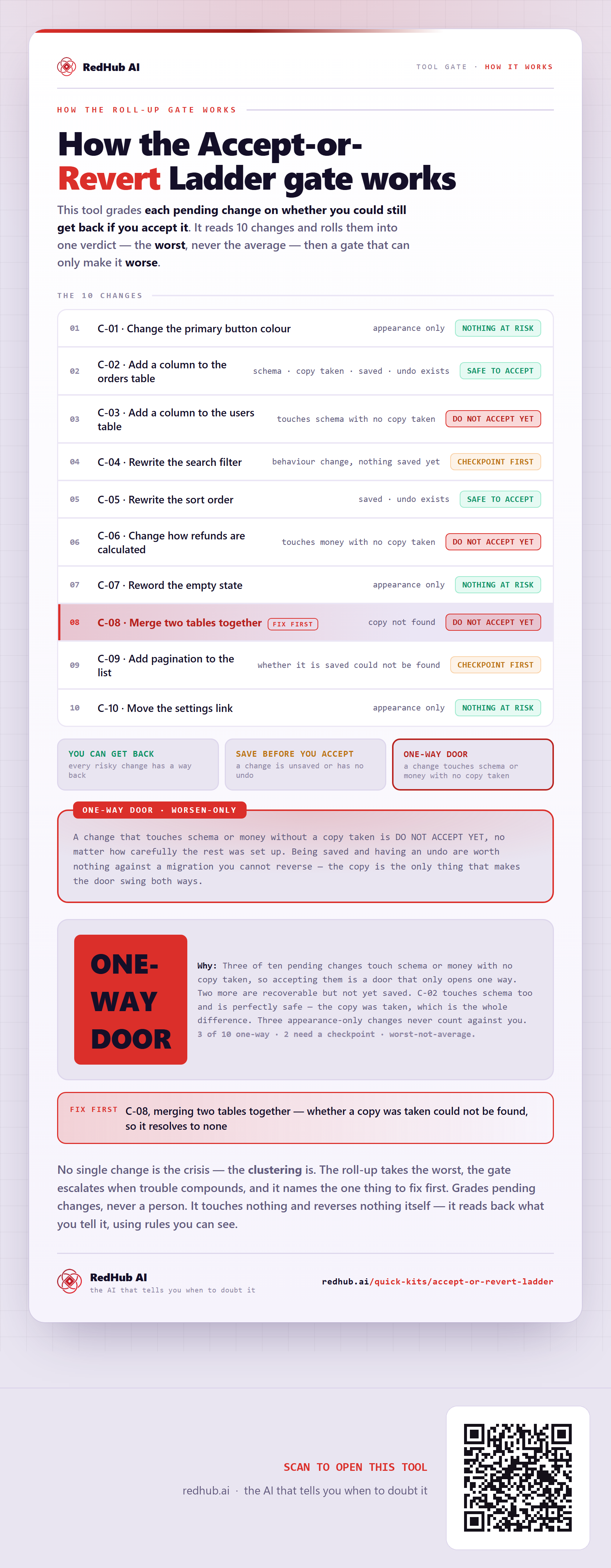
How the Accept-or-Revert Ladder rolls ten pending changes into one verdict: a one-way-door gate holds any change touching schema or money with no copy taken, however well the rest was set up - the sample reads ONE-WAY DOOR.
How the gate works
This tool grades each pending change on whether you could still get back if you accept it. It reads 10 changes and rolls them into one verdict — the worst, never the average — and then a gate that can only make it worse.
The 10 changes
| Change | Verdict |
|---|---|
| C-01 · Change the primary button colour | NOTHING AT RISKappearance only |
| C-02 · Add a column to the orders table | SAFE TO ACCEPTschema · copy taken · saved · undo exists |
| C-03 · Add a column to the users table | DO NOT ACCEPT YETtouches schema with no copy taken |
| C-04 · Rewrite the search filter | CHECKPOINT FIRSTbehaviour change, nothing saved yet |
| C-05 · Rewrite the sort order | SAFE TO ACCEPTsaved · undo exists |
| C-06 · Change how refunds are calculated | DO NOT ACCEPT YETtouches money with no copy taken |
| C-07 · Reword the empty state | NOTHING AT RISKappearance only |
| C-08 · Merge two tables togetherfix first | DO NOT ACCEPT YETcopy not found |
| C-09 · Add pagination to the list | CHECKPOINT FIRSTwhether it is saved could not be found |
| C-10 · Move the settings link | NOTHING AT RISKappearance only |
The verdict bands
A change that touches schema or money without a copy taken is DO NOT ACCEPT YET, no matter how carefully the rest was set up. Being saved and having an undo are worth nothing against a migration you cannot reverse — the copy is the only thing that makes the door swing both ways.
In the worked sample it reads ONE-WAY DOOR — Three of ten pending changes touch schema or money with no copy taken, so accepting them is a door that only opens one way. Two more are recoverable but not yet saved. C-02 touches schema too and is perfectly safe — the copy was taken, which is the whole difference. Three appearance-only changes never count against you. Marked fix first on this sample: C-08, merging two tables together — whether a copy was taken could not be found, so it resolves to none.
Common questions
Can every change look survivable on the How the Accept-or-Revert Ladder gate works and the company still read ONE-WAY DOOR?
Yes. The roll-up takes the worst of 10 changes — never the average — then a worsen-only gate, the One-way door gate, escalates when trouble clusters. In the worked sample it reads ONE-WAY DOOR because three of ten pending changes touch schema or money with no copy taken, so accepting them is a door that only opens one way. Two more are recoverable but not yet saved. C-02 touches schema too and is perfectly safe — the copy was taken, which is the whole difference. Three appearance-only changes never count against you.
What is a worsen-only gate?
A dispositive rule that can only lower a verdict, never raise it. One fatal flaw overrides an otherwise-set of survivable lines, because a single disqualifying gap shouldn't hide behind an average of the healthy ones. Where something is short, the fix-first row names it — here, "C-08, merging two tables together — whether a copy was taken could not be found, so it resolves to none".
Grades pending changes, never a person. It touches nothing and reverses nothing itself — it reads back what you tell it, using rules you can see.
Embed this diagram
Free to share and embed with attribution (CC BY 4.0) — keep the link to redhub.ai.
Interactive — renders the live diagram
<iframe src="https://redhub.ai/visuals/tool/accept-or-revert-ladder.html" title="How the Accept-or-Revert Ladder gate works — RedHub AI" width="760" height="2248" loading="lazy" style="border:0;width:100%;max-width:760px"></iframe>
<p style="font:14px/1.5 system-ui,sans-serif"><a href="https://redhub.ai/visuals/tool/accept-or-revert-ladder">How the Accept-or-Revert Ladder gate works</a> — by <a href="https://redhub.ai">RedHub AI</a>, the AI that tells you when to doubt it.</p>
Image + link — a static picture for any blog
<a href="https://redhub.ai/visuals/tool/accept-or-revert-ladder"><img src="https://redhub.ai/visuals/tool/accept-or-revert-ladder-share.png" alt="Diagram of the Accept-or-Revert Ladder: ten pending changes, a one-way-door gate, and a sample reading ONE-WAY DOOR." width="760" loading="lazy" style="max-width:100%;height:auto;border-radius:16px"></a>
<p style="font:14px/1.5 system-ui,sans-serif"><a href="https://redhub.ai">RedHub AI</a> — the AI that tells you when to doubt it.</p>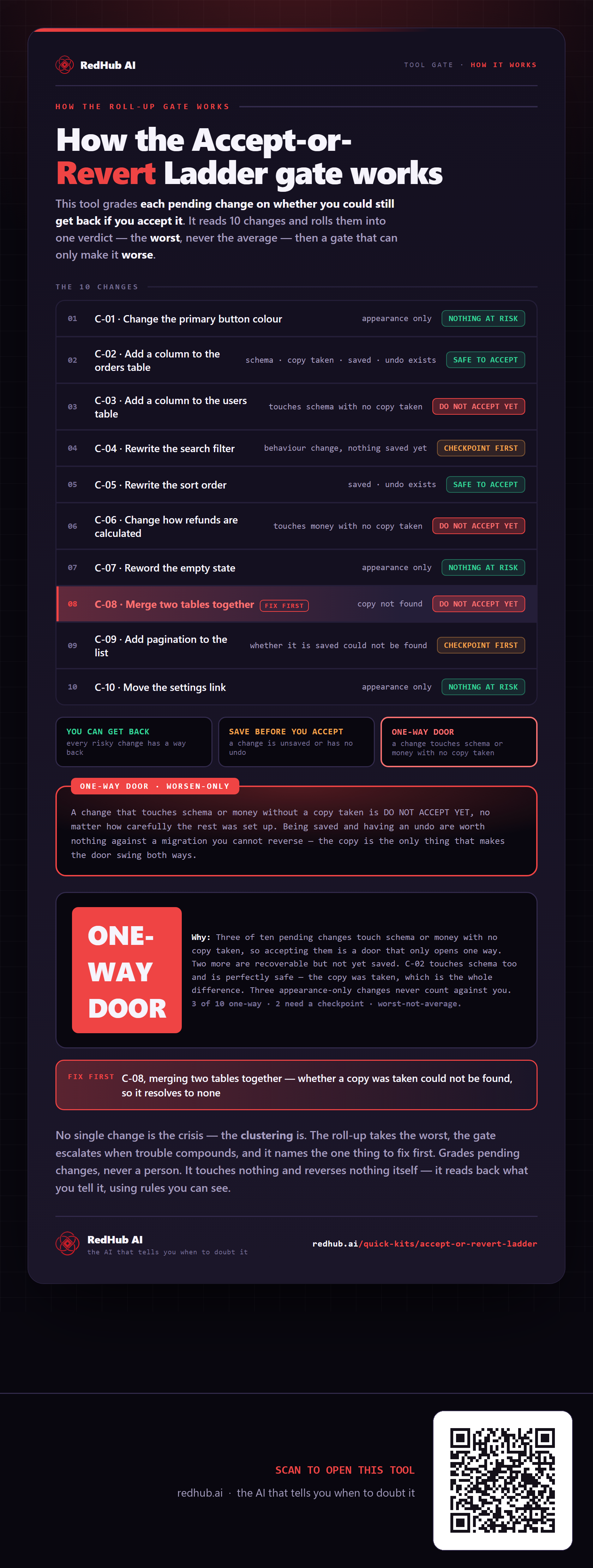
This is how Accept-or-Revert Ladder works. More diagrams in the Visual Field Guide.