Codex Migration & Refactor Pack
$99
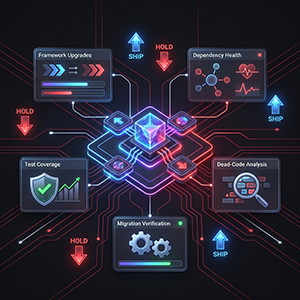
Six Codex skills + a runnable verifier for dev teams: framework upgrades (Next 15, React 19), dependency sweeps, monolith extraction, test backfill, dead-code removal. SHIP or HOLD with proof.
See all
24 items
25+ multi-agent patterns. Full code in Claude Agent SDK + LangGraph. Eval harnesses included.
Build MCP servers useful to agents and safe by default: a grounded four-phase workflow, tool-design + security patterns, an inventory + checklist workbook, and a Pass/Fix/Block tool linter (a leaked secret, over-broad scope, or dangerous capability is a hard Block). Security guidance, not a security audit.
Score the retrieval step of your RAG pipeline — Recall@k, Precision@k, MRR, nDCG — and get a ship / hold / fix verdict with every miss named. Python + TypeScript, any vector DB, gates retrieval in CI. Pairs with AutoChunk: chunk there, grade here.
Before you ground an AI on your documents, gate the corpus. Mark six 0/1/2 content controls (freshness, single source of truth, named ownership, structure & chunkability, access-permission mapping, top-question coverage); the verdict is the weakest control — ANSWER-READY / STALE / UNGROUNDED — with a dispositive worsen-only gate that forces UNGROUNDED on contradictory authoritative docs or unmapped permissions, even at a 92% score. Not a retrieval-metric grader and never touches a vector DB — it grades whether the documents are worth retrieving in the first place. Runnable Python engine + workbook that reproduces it + audit & fix-it playbooks + a 6-corpus sample. Scores the corpus, never people; reads no live data.
Prompt injection ends; a poisoned memory doesn't. A pre-deployment probe for agent memory, RAG indexes, and context stores: mark six OWASP ASI06 lifecycle controls (write-path validation, trust-aware retrieval, provenance, scope isolation, decay/TTL, audit trail) for a weighted 0-100 score and CONTAINED / HARDEN / POROUS, with a two-condition kill-chain gate that forces POROUS when poison can be both written (weak validation) and recalled as ground truth (no trust check) — even at 78/100. Names the control to fix first where a control is short; rolls a fleet up. Runnable Python engine + workbook + exposure-audit & fix-the-control playbooks + a 7-store sample. The persistence layer beside the Prompt Injection Red Team Kit. Grades the architecture, never people. Not a scanner or attack simulator.
The security check vibe-coding skips. Nearly half of AI-generated code ships with a known vulnerability — run this gate before your first public launch. Mark six controls per app (secrets out of the client bundle, server-side auth on every sensitive route, input validation & injection defense, dependency & supply-chain integrity, no verbose errors/source maps in prod, access control actually tested) for a weighted 0-100 score and LAUNCH-READY AS DESCRIBED / HARDEN FIRST / DO NOT SHIP, with a single-fault gate that forces DO NOT SHIP when either secrets or server-side auth is absent — even at 78/100, the exposed-DB-key-in-the-client pattern. Names the control to fix first where a control is short; rolls a batch up. Runnable Python engine + workbook + audit & fix-the-control playbooks + a 7-app sample. The launch-moment go/no-go beside the Vibe-Coded App Hardening Kit. Grades the posture you describe, never people. Not a scanner or pentest.
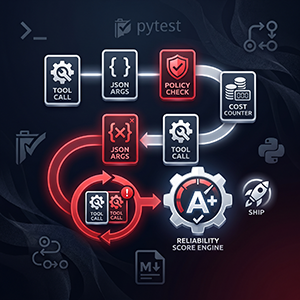
Evaluate AI agents at the trajectory level — tool choice, argument validity, step efficiency, cost, and policy — and gate CI on a ship / hold / fix verdict. Six deterministic evaluators, framework-agnostic, Python, zero dependencies. The fourth dev-tools gate: agent behavior.
Check the actions your AI agent proposes against your own domain rules before any of them execute. Four constructs — functional, disjoint, range, one_of — return ADMISSIBLE / REVIEW / INADMISSIBLE per action and a batch verdict, with no admissibility score because a contradiction cannot be scored. Deterministic, offline Python engine + reproducing workbook; grades proposed actions, never people.
Grade whether your domain is written down in a form a machine could check. Six dimensions per domain return MODELED / PARTIAL / UNMODELED, with an entity-count gate that overrides a partial model once undeclared distinctions become where contradictions come from. Deterministic, offline Python engine + reproducing workbook; grades the model you describe, never people.
Map which validation layers actually cover which decisions, then read the matrix down the columns as well as along the rows — because a layer covering three decisions out of forty is a pilot, not a layer. Returns FOUR-LAYER / THIN / UNVALIDATED per decision and a map verdict, discounting nominal layers. The lane hub. Deterministic engine + workbook; grades the map you draw, never people.
Grade whether every tool your AI agent can call has an input contract that could actually refuse a bad call. Each parameter reads TYPED / LOOSE / OPEN DOOR from its kind and its consequence — money needs a ceiling AND a cross-field rule, so a $10,000 cap that can't stop a $9,999 refund on a $12 order still reads OPEN DOOR. Deterministic engine + workbook; grades contracts, never people.
Grade whether an agent action is safe to run unattended, on two axes it prints separately: reversibility (can you undo it in time) and blast radius (how many records one call touches). Returns RUN UNATTENDED / RUN WITH APPROVAL / DO NOT AUTOMATE, and a typical count is never treated as a bound. Deterministic engine + workbook; grades the actions you describe, never people.
Grade what happens after a check says no. Six controls per validation path return FAILS CLOSED / FAILS SOFT / FAILS OPEN — because an approval step that auto-approves when nobody answers is a delay, not a control. Where a go-live gate asks whether an escalation path exists, this asks whether it works when nobody's there. Deterministic engine + workbook; grades the paths you describe, never people.
Take a finished AI-assisted deliverable apart fact by fact and sort each into ASSERTED / DERIVABLE / ASSUMED — following derivations ten levels deep, because a fact can look perfectly derived and still rest on an assumption three rows down. Fix-first names the root, not the symptom. Deterministic engine + workbook; grades the facts you record, never people.
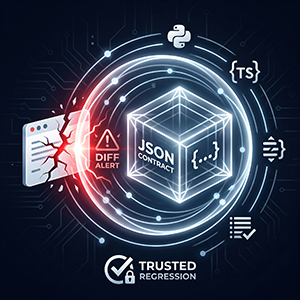
Grade every proposed change to your data model before it ships and catch the SILENT BREAK — the change where everything still validates, every consumer still runs, and the answers are quietly different. Ranks SILENT BREAK worst, above BREAKING, above ADDITIVE. Deterministic engine + workbook; grades the changes you describe, never people.