Tool Gate · How it works
How the Voice-Agent Conversation QA & Escalation Auditor gate works
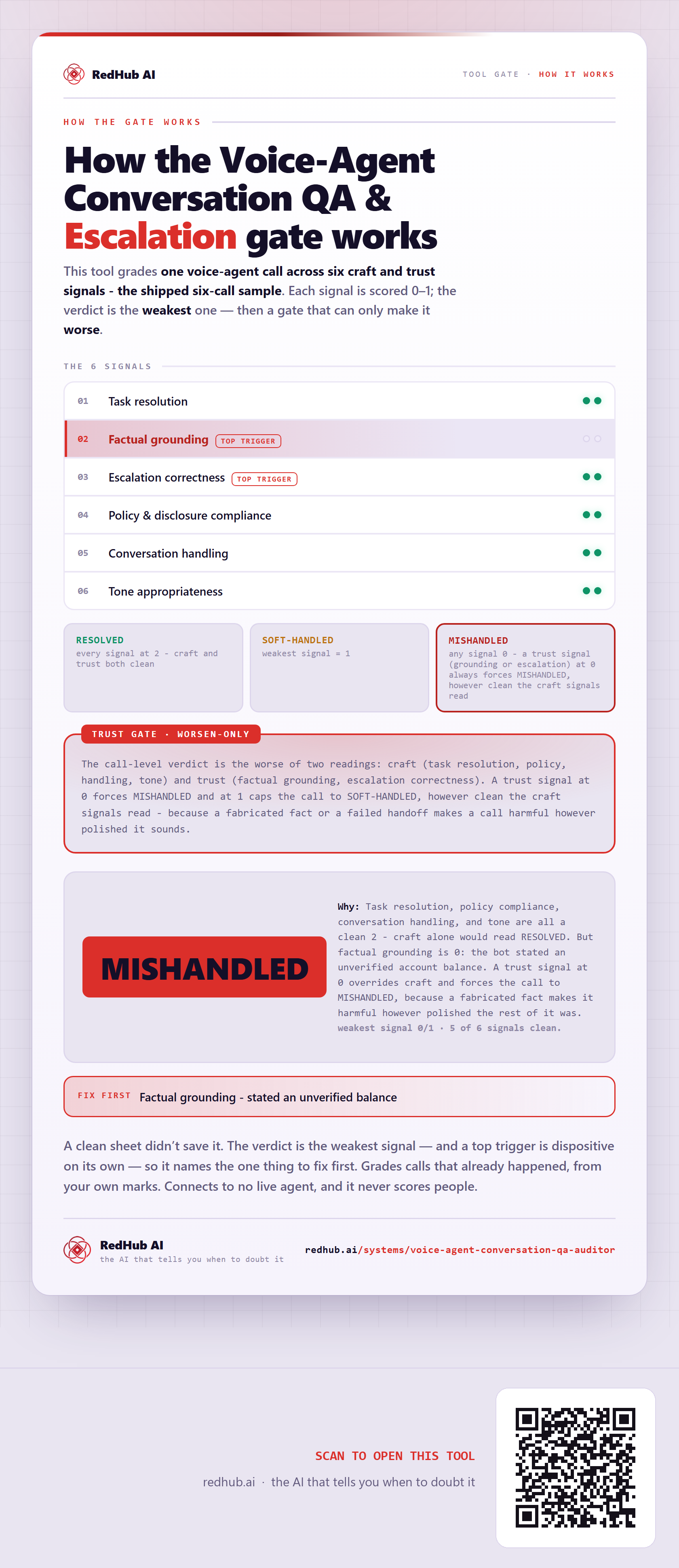
How the Voice-Agent Conversation QA & Escalation Auditor grades a call on 9 craft-and-trust signals by the weakest: task resolution, the four applicable policy and disclosure controls, handling, and tone are clean, but a trust signal at 0 always overrides craft — which is how factual grounding at 0 forces MISHANDLED.
How the gate works
This tool grades one voice-agent call across nine craft and trust signals - the shipped six-call sample. Each of 9 signals is scored 0–2 from your own evidence; the verdict is the weakest one — and then it is run past a gate that can only make the verdict worse.
The 9 signals
| Signal | Role |
|---|---|
| Task resolution | signal |
| Factual grounding | top trigger |
| Escalation correctness | top trigger |
| Applicable policy and disclosure steps followed: consent to place or automate the call | signal |
| Applicable policy and disclosure steps followed: recording consent | signal |
| Applicable policy and disclosure steps followed: caller-identity or telemarketing disclosures | signal |
| Applicable policy and disclosure steps followed: AI-specific disclosure | signal |
| Conversation handling | signal |
| Tone appropriateness | signal |
The verdict bands
The gate compares two readings and takes the worse: the craft-derived band (the weakest assessed mark across task resolution, the four applicable policy and disclosure controls, conversation handling and tone) and the graduated Trust gate on factual grounding and escalation correctness. A trust mark of 1 caps the final result at SOFT-HANDLED; a trust mark of 0 forces MISHANDLED. The gate can worsen—but never improve—the craft-derived band. Separately, a policy and disclosure control marked Not assessed prevents RESOLVED: a call that would otherwise read RESOLVED reads SOFT-HANDLED.
In the worked sample 8 of 9 signals clean (weakest 0) and it still reads MISHANDLED — Task resolution, the four applicable policy and disclosure controls, conversation handling, and tone are all marked 2 - the craft-derived band is RESOLVED AS DESCRIBED. But factual grounding is 0: the bot stated an unverified account balance. A trust mark of 0 triggers the graduated Trust gate and forces the final result to MISHANDLED. The policy-and-disclosure mark reflects the reviewer’s assessment of the transcript and supplied context. It is not a determination that the call complied with the TCPA, recording-consent laws, telemarketing rules or other applicable requirements. Marked fix first on this sample: Factual grounding - stated an unverified balance.
Common questions
Can a profile look clean on the Voice-Agent Conversation QA & Escalation gate and still fail?
Yes. The verdict is the weakest of 9 signals, then run past a worsen-only gate — the Trust gate — that can only make it worse. In the worked sample 8 of 9 signals clean (weakest 0) and it still reads MISHANDLED, because task resolution, the four applicable policy and disclosure controls, conversation handling, and tone are all marked 2 - the craft-derived band is RESOLVED AS DESCRIBED. But factual grounding is 0: the bot stated an unverified account balance. A trust mark of 0 triggers the graduated Trust gate and forces the final result to MISHANDLED. The policy-and-disclosure mark reflects the reviewer’s assessment of the transcript and supplied context. It is not a determination that the call complied with the TCPA, recording-consent laws, telemarketing rules or other applicable requirements.
What is a worsen-only gate?
A rule that can only lower a verdict, never raise it. One gate-triggering gap overrides an otherwise-clean sheet, because a single gate-triggering gap shouldn't hide behind everything that passed. Where something is short, the fix-first row names it — here, "Factual grounding - stated an unverified balance".
Grades calls that already happened, from your own marks. Connects to no live agent, and it never scores people.
Embed this diagram
Free to share and embed with attribution (CC BY 4.0) — keep the link to redhub.ai.
Interactive — renders the live diagram
<iframe src="https://redhub.ai/visuals/tool/voice-agent-conversation-qa-auditor.html" title="How the Voice-Agent Conversation QA & Escalation Auditor gate works — RedHub AI" width="760" height="2192" loading="lazy" style="border:0;width:100%;max-width:760px"></iframe>
<p style="font:14px/1.5 system-ui,sans-serif"><a href="https://redhub.ai/visuals/tool/voice-agent-conversation-qa-auditor">How the Voice-Agent Conversation QA & Escalation Auditor gate works</a> — by <a href="https://redhub.ai">RedHub AI</a>, the AI that tells you when to doubt it.</p>
Image + link — a static picture for any blog
<a href="https://redhub.ai/visuals/tool/voice-agent-conversation-qa-auditor"><img src="https://redhub.ai/visuals/tool/voice-agent-conversation-qa-auditor-share.png" alt="Diagram of the Voice-Agent Conversation QA & Escalation Auditor: nine craft-and-trust signals and a MISHANDLED verdict forced by factual grounding at 0 despite seven clean craft signals." width="760" loading="lazy" style="max-width:100%;height:auto;border-radius:16px"></a>
<p style="font:14px/1.5 system-ui,sans-serif"><a href="https://redhub.ai">RedHub AI</a> — the AI that tells you when to doubt it.</p>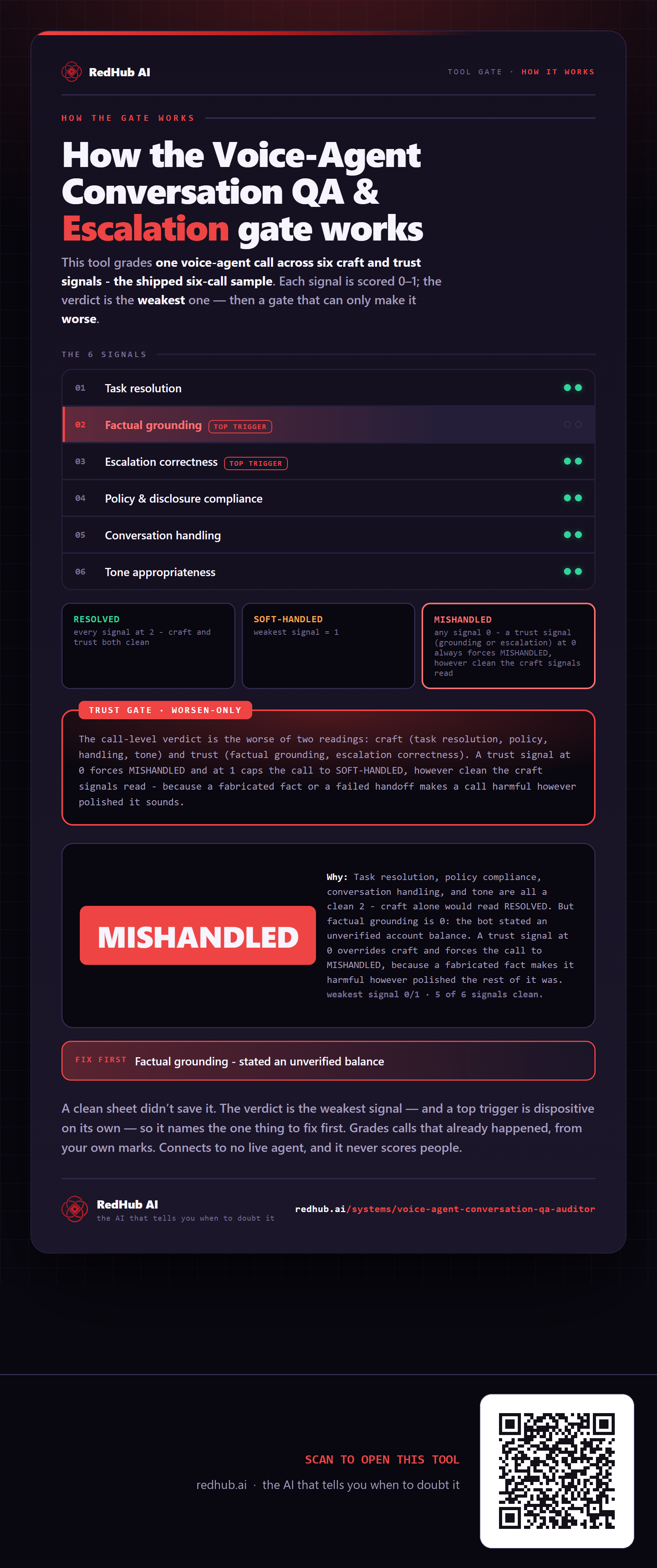
This is how Voice-Agent Conversation QA & Escalation Auditor works. More diagrams in the Visual Field Guide.