Tool Gate · How it works
How the RAG & Knowledge-Base Retrieval-Readiness Gate gate works
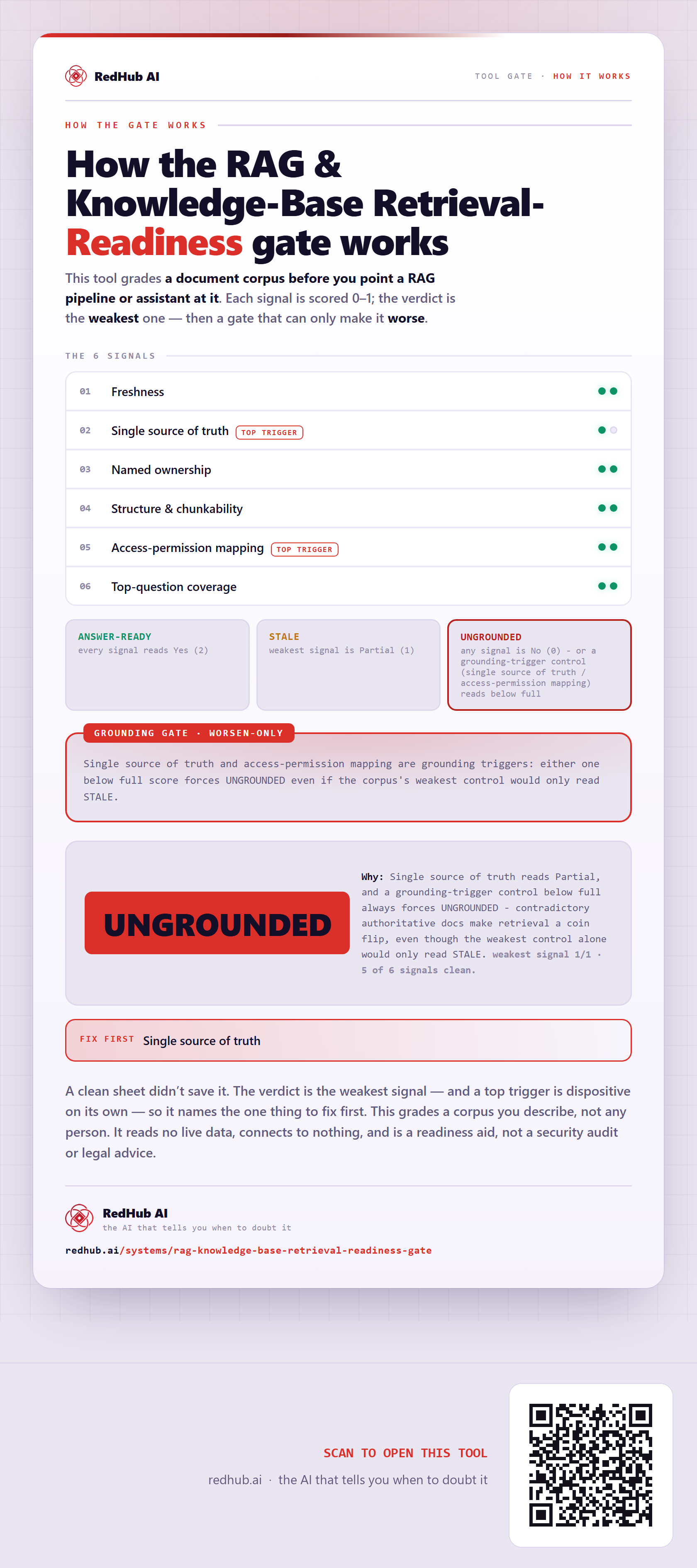
How the RAG & Knowledge-Base Retrieval-Readiness Gate scores 6 corpus-grounding signals by the weakest: a grounding gate forces UNGROUNDED when a grounding-trigger control is only partial — which is how 5 of 6 signals read clean, the mean reads 92%, and it still reads UNGROUNDED.
How the gate works
This tool grades a document corpus before you point a RAG pipeline or assistant at it. Each of 6 signals is scored 0–2 from your own evidence; the verdict is the weakest one — and then it is run past a gate that can only make the verdict worse.
The 6 signals
| Signal | Role |
|---|---|
| Freshness | signal |
| Single source of truth | top trigger |
| Named ownership | signal |
| Structure & chunkability | signal |
| Access-permission mapping | top trigger |
| Top-question coverage | signal |
The verdict bands
Single source of truth and access-permission mapping are grounding triggers: either one below full score forces UNGROUNDED even if the corpus's weakest control would only read STALE.
In the worked sample 5 of 6 signals clean (weakest 1) and it still reads UNGROUNDED — Single source of truth reads Partial, and a grounding-trigger control below full always forces UNGROUNDED - contradictory authoritative docs make retrieval a coin flip, even though the weakest control alone would only read STALE. Marked fix first on this sample: Single source of truth.
Common questions
Can a profile look clean on the How the RAG & Knowledge-Base Retrieval-Readiness gate works and still fail?
Yes. The verdict is the weakest of 6 signals, then run past a worsen-only gate — the Grounding gate — that can only make it worse. In the worked sample 5 of 6 signals clean (weakest 1) and it still reads UNGROUNDED, because single source of truth reads Partial, and a grounding-trigger control below full always forces UNGROUNDED - contradictory authoritative docs make retrieval a coin flip, even though the weakest control alone would only read STALE.
What is a worsen-only gate?
A dispositive rule that can only lower a verdict, never raise it. One fatal flaw overrides an otherwise-clean sheet, because a single disqualifying gap shouldn't hide behind everything that passed. Where something is short, the fix-first row names it — here, "Single source of truth".
This grades a corpus you describe, not any person. It reads no live data, connects to nothing, and is a readiness aid, not a security audit or legal advice.
Embed this diagram
Free to share and embed with attribution (CC BY 4.0) — keep the link to redhub.ai.
Interactive — renders the live diagram
<iframe src="https://redhub.ai/visuals/tool/rag-knowledge-base-retrieval-readiness-gate.html" title="How the RAG & Knowledge-Base Retrieval-Readiness Gate gate works — RedHub AI" width="760" height="1780" loading="lazy" style="border:0;width:100%;max-width:760px"></iframe>
<p style="font:14px/1.5 system-ui,sans-serif"><a href="https://redhub.ai/visuals/tool/rag-knowledge-base-retrieval-readiness-gate">How the RAG & Knowledge-Base Retrieval-Readiness Gate gate works</a> — by <a href="https://redhub.ai">RedHub AI</a>, the AI that tells you when to doubt it.</p>
Image + link — a static picture for any blog
<a href="https://redhub.ai/visuals/tool/rag-knowledge-base-retrieval-readiness-gate"><img src="https://redhub.ai/visuals/tool/rag-knowledge-base-retrieval-readiness-gate-share.png" alt="Diagram of the RAG & Knowledge-Base Retrieval-Readiness Gate: six corpus-grounding signals scored by the weakest and a grounding gate forcing UNGROUNDED despite a 92% mean." width="760" loading="lazy" style="max-width:100%;height:auto;border-radius:16px"></a>
<p style="font:14px/1.5 system-ui,sans-serif"><a href="https://redhub.ai">RedHub AI</a> — the AI that tells you when to doubt it.</p>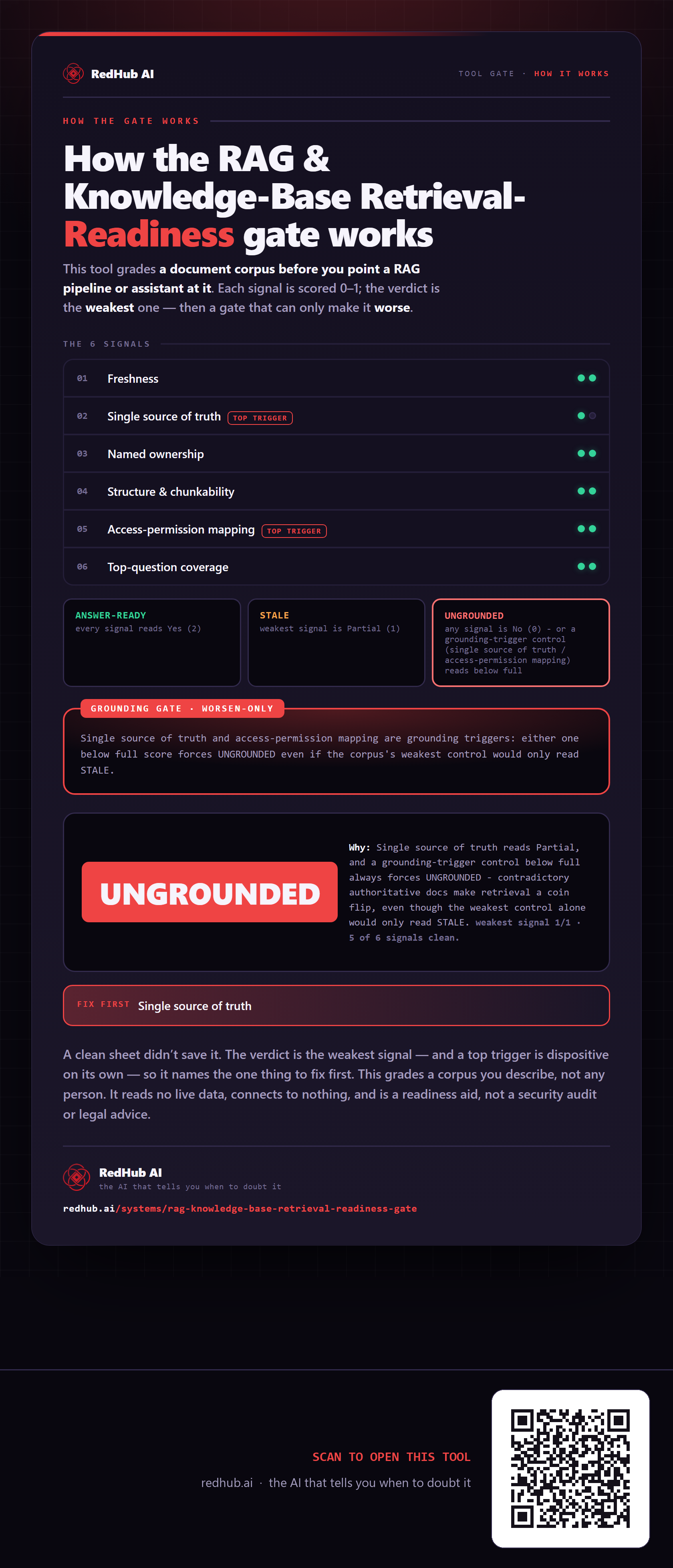
This is how RAG & Knowledge-Base Retrieval-Readiness Gate works. More diagrams in the Visual Field Guide.