Tool Gate · How it works
How the Multi-Source Data Reconciliation Engine gate works
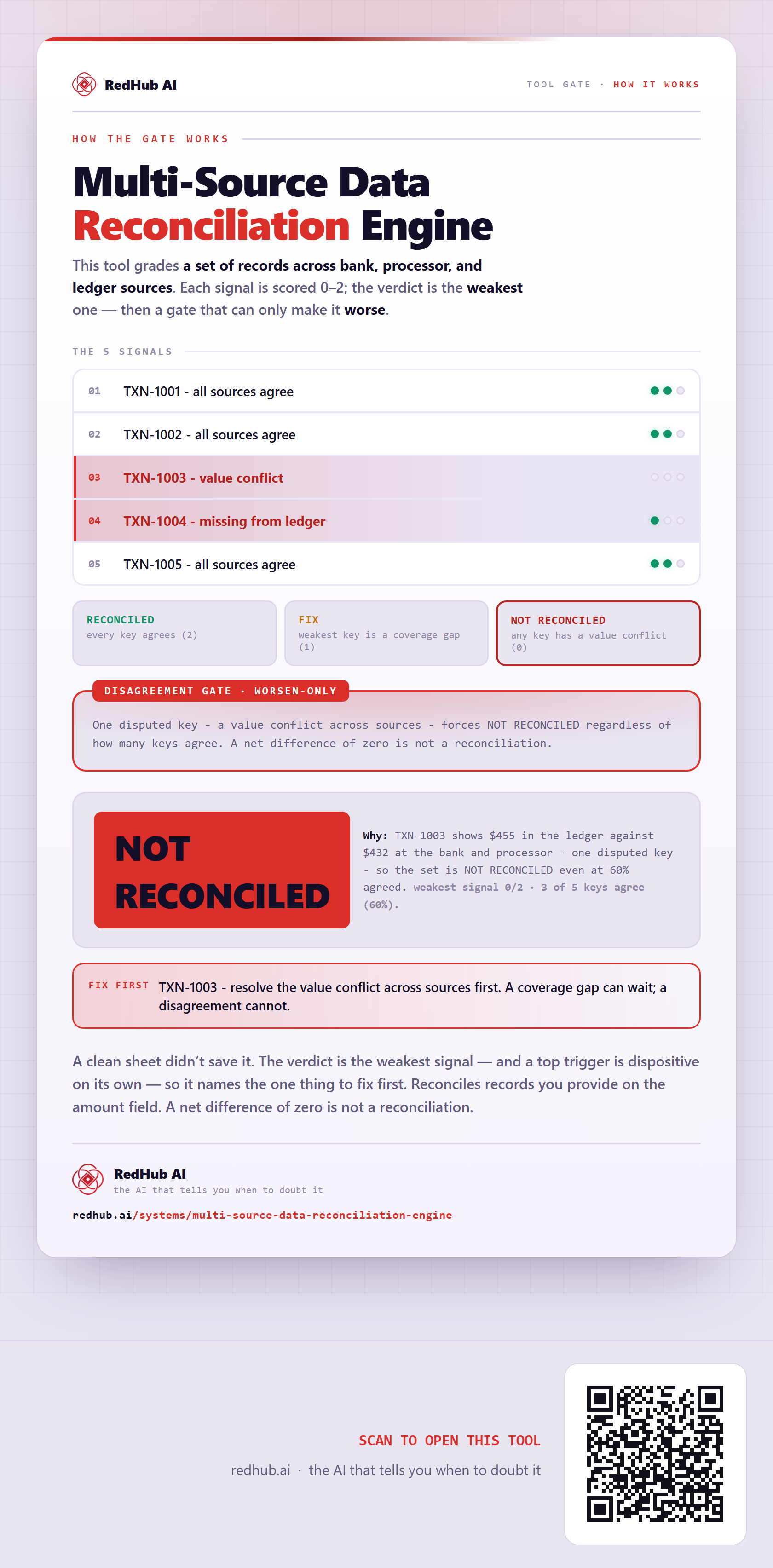
How the Multi-Source Data Reconciliation Engine grades a record set: each key is AGREED, INCOMPLETE, or DISPUTED, and one disputed key trips the disagreement gate to NOT RECONCILED — which is why a 60%-agreed set still doesn't reconcile.
How the gate works
This tool grades a set of records across bank, processor, and ledger sources. Each of 5 signals is scored 0–2 from your own evidence; the verdict is the weakest one — and then it is run past a gate that can only make the verdict worse.
The 5 signals
| Signal | Role |
|---|---|
| TXN-1001 - all sources agree | signal |
| TXN-1002 - all sources agree | signal |
| TXN-1003 - value conflict | signal |
| TXN-1004 - missing from ledger | signal |
| TXN-1005 - all sources agree | signal |
The verdict bands
One disputed key - a value conflict across sources - forces NOT RECONCILED regardless of how many keys agree. A net difference of zero is not a reconciliation.
In the worked sample 3 of 5 keys agree (60%) (weakest 0) and it still reads NOT RECONCILED — TXN-1003 shows $455 in the ledger against $432 at the bank and processor - one disputed key - so the set is NOT RECONCILED even at 60% agreed. Marked fix first on this sample: TXN-1003 - resolve the value conflict across sources first. A coverage gap can wait; a disagreement cannot.
Common questions
Can a profile look clean on the Multi-Source Data Reconciliation Engine and still fail?
Yes. The verdict is the weakest of 5 signals, then run past a worsen-only gate — the Disagreement gate — that can only make it worse. In the worked sample 3 of 5 keys agree (60%) (weakest 0) and it still reads NOT RECONCILED, because tXN-1003 shows $455 in the ledger against $432 at the bank and processor - one disputed key - so the set is NOT RECONCILED even at 60% agreed.
What is a worsen-only gate?
A rule that can only lower a verdict, never raise it. One gate-triggering gap overrides an otherwise-clean sheet, because a single gate-triggering gap shouldn't hide behind everything that passed. Where something is short, the fix-first row names it — here, "TXN-1003 - resolve the value conflict across sources first. A coverage gap can wait; a disagreement cannot.".
Reconciles records you provide on the amount field. A net difference of zero is not a reconciliation.
Embed this diagram
Free to share and embed with attribution (CC BY 4.0) — keep the link to redhub.ai.
Interactive — renders the live diagram
<iframe src="https://redhub.ai/visuals/tool/multi-source-data-reconciliation-engine.html" title="How the Multi-Source Data Reconciliation Engine gate works — RedHub AI" width="760" height="1560" loading="lazy" style="border:0;width:100%;max-width:760px"></iframe>
<p style="font:14px/1.5 system-ui,sans-serif"><a href="https://redhub.ai/visuals/tool/multi-source-data-reconciliation-engine">How the Multi-Source Data Reconciliation Engine gate works</a> — by <a href="https://redhub.ai">RedHub AI</a>, the AI that tells you when to doubt it.</p>
Image + link — a static picture for any blog
<a href="https://redhub.ai/visuals/tool/multi-source-data-reconciliation-engine"><img src="https://redhub.ai/visuals/tool/multi-source-data-reconciliation-engine-share.png" alt="Diagram of the Multi-Source Data Reconciliation Engine: five transaction keys, a disagreement gate, and a set reading NOT RECONCILED with 60% of keys agreed." width="760" loading="lazy" style="max-width:100%;height:auto;border-radius:16px"></a>
<p style="font:14px/1.5 system-ui,sans-serif"><a href="https://redhub.ai">RedHub AI</a> — the AI that tells you when to doubt it.</p>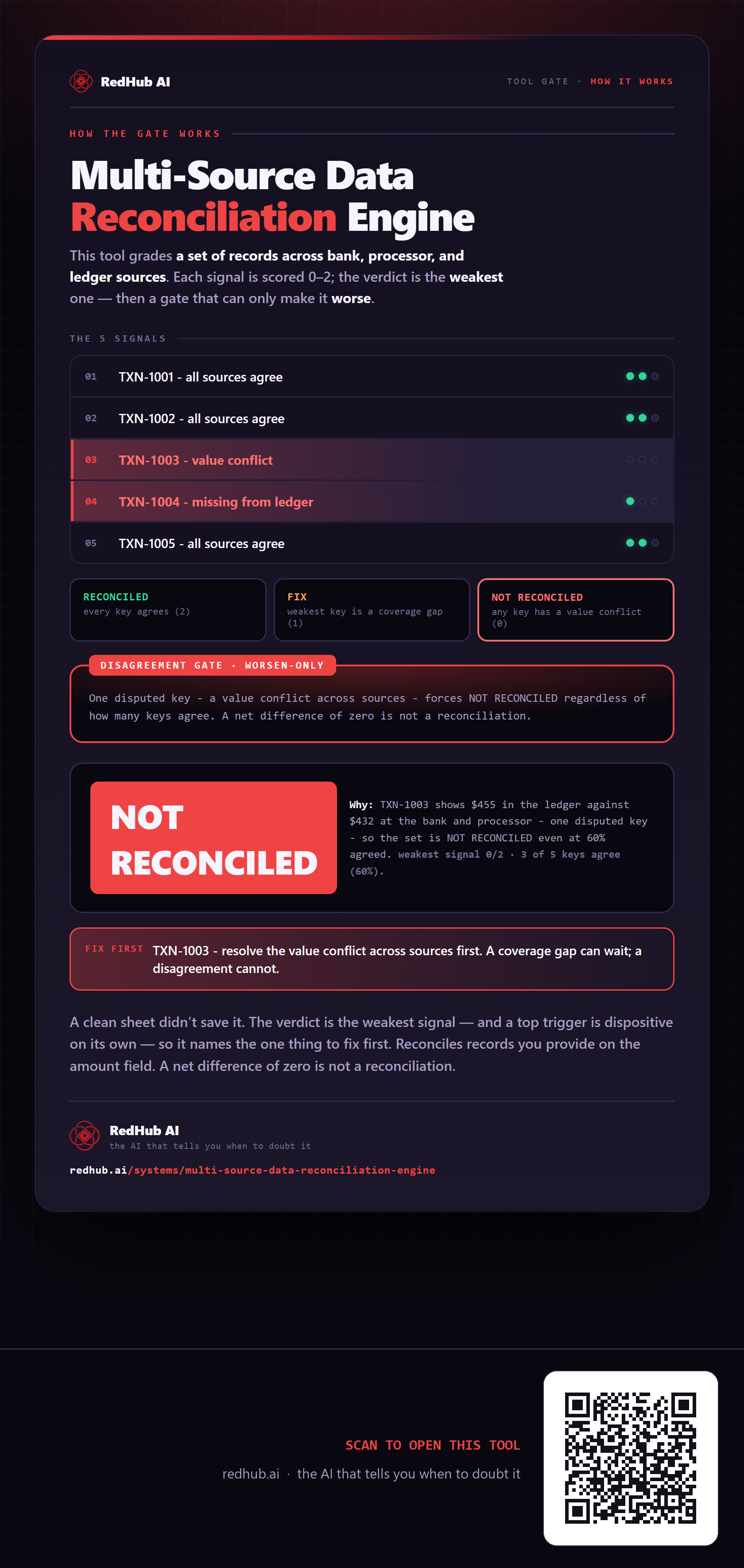
This is how Multi-Source Data Reconciliation Engine works. More diagrams in the Visual Field Guide.