Tool Gate · How it works
How the Internal AI Handoff QA Gate gate works
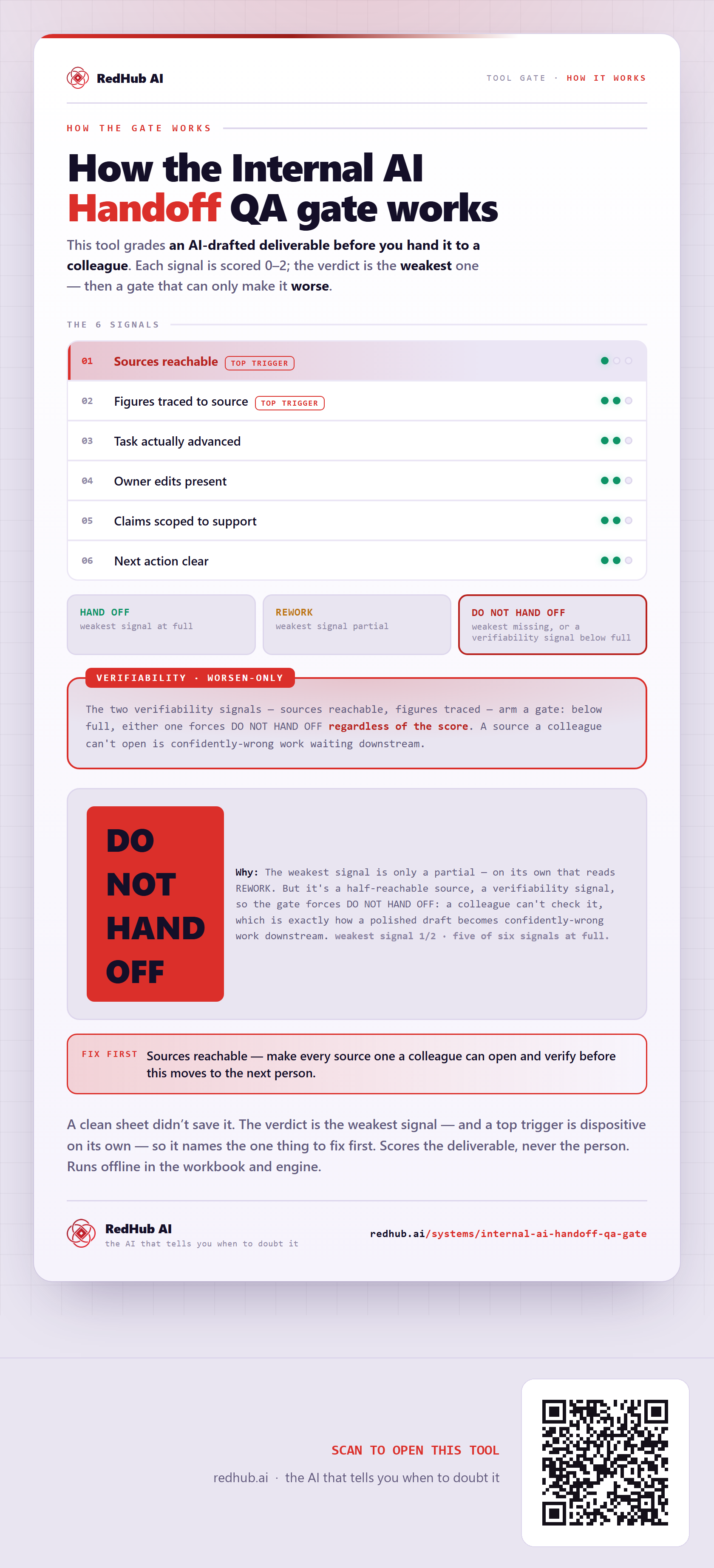
How the Internal AI Handoff QA Gate grades a deliverable: six signals with the verdict set by the weakest, and a verifiability gate where a source below full — one a colleague can't open — forces DO NOT HAND OFF, which is how a draft that would only read REWORK becomes confidently-wrong work.
How the gate works
This tool grades an AI-drafted deliverable before you hand it to a colleague. Each of 6 signals is scored 0–2 from your own evidence; the verdict is the weakest one — and then it is run past a gate that can only make the verdict worse.
The 6 signals
| Signal | Role |
|---|---|
| Sources reachable | top trigger |
| Figures traced to source | top trigger |
| Task actually advanced | signal |
| Owner edits present | signal |
| Claims scoped to support | signal |
| Next action clear | signal |
The verdict bands
The two verifiability signals — sources reachable, figures traced — arm a gate: below full, either one forces DO NOT HAND OFF regardless of the score. A source a colleague can't open is confidently-wrong work waiting downstream.
In the worked sample five of six signals at full (weakest 1) and it still reads DO NOT HAND OFF — The weakest signal is only a partial — on its own that reads REWORK. But it's a half-reachable source, a verifiability signal, so the gate forces DO NOT HAND OFF: a colleague can't check it, which is exactly how a polished draft becomes confidently-wrong work downstream. Marked fix first on this sample: Sources reachable — make every source one a colleague can open and verify before this moves to the next person..
Common questions
Can a profile look clean on the How the Internal AI Handoff QA gate works and still fail?
Yes. The verdict is the weakest of 6 signals, then run past a worsen-only gate — the Verifiability — that can only make it worse. In the worked sample five of six signals at full (weakest 1) and it still reads DO NOT HAND OFF, because the weakest signal is only a partial — on its own that reads REWORK. But it's a half-reachable source, a verifiability signal, so the gate forces DO NOT HAND OFF: a colleague can't check it, which is exactly how a polished draft becomes confidently-wrong work downstream.
What is a worsen-only gate?
A dispositive rule that can only lower a verdict, never raise it. One fatal flaw overrides an otherwise-clean sheet, because a single disqualifying gap shouldn't hide behind everything that passed. Where something is short, the fix-first row names it — here, "Sources reachable — make every source one a colleague can open and verify before this moves to the next person.".
Scores the deliverable, never the person. Runs offline in the workbook and engine.
Embed this diagram
Free to share and embed with attribution (CC BY 4.0) — keep the link to redhub.ai.
Interactive — renders the live diagram
<iframe src="https://redhub.ai/visuals/tool/internal-ai-handoff-qa-gate.html" title="How the Internal AI Handoff QA Gate gate works — RedHub AI" width="760" height="1705" loading="lazy" style="border:0;width:100%;max-width:760px"></iframe>
<p style="font:14px/1.5 system-ui,sans-serif"><a href="https://redhub.ai/visuals/tool/internal-ai-handoff-qa-gate">How the Internal AI Handoff QA Gate gate works</a> — by <a href="https://redhub.ai">RedHub AI</a>, the AI that tells you when to doubt it.</p>
Image + link — a static picture for any blog
<a href="https://redhub.ai/visuals/tool/internal-ai-handoff-qa-gate"><img src="https://redhub.ai/visuals/tool/internal-ai-handoff-qa-gate-share.png" alt="Diagram of the Internal AI Handoff QA Gate: six signals, a verifiability gate, and a deliverable reading DO NOT HAND OFF where the weakest signal alone would be REWORK." width="760" loading="lazy" style="max-width:100%;height:auto;border-radius:16px"></a>
<p style="font:14px/1.5 system-ui,sans-serif"><a href="https://redhub.ai">RedHub AI</a> — the AI that tells you when to doubt it.</p>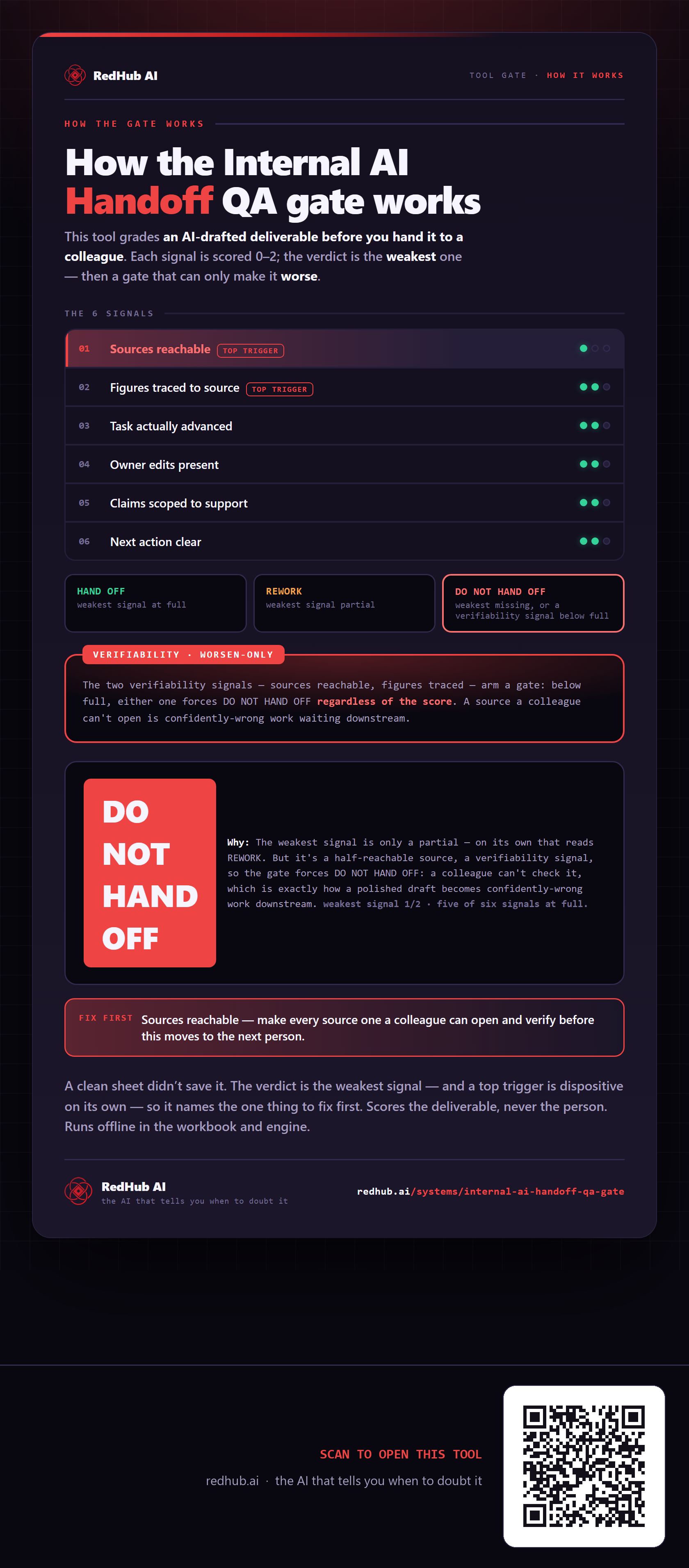
This is how Internal AI Handoff QA Gate works. More diagrams in the Visual Field Guide.