Tool Gate · How it works
How the First-Hire Go / No-Go gate works
How the First-Hire Go / No-Go gate grades a founder's first hire: six weighted signals into a 0–100 score, and an affordability & handoff gate where cost coverage at 0 forces FIRST-HIRE READINESS GAPS — which is how a role scoring 76 still reads FIRST-HIRE READINESS GAPS, because being slammed isn't the same as being able to afford it.
How the gate works
This tool grades the strength of the case for a first hire — on your own read of coverage, runway, and handoff. Each control is marked from your own evidence and weighted into a 0–100 score — and then the score is run past a gate that can only make the verdict worse.
The 6 weighted controls
| Signal | Weight |
|---|---|
| Fully-loaded cost coverage | 24 |
| Runway survives the hire | 20 |
| The role's revenue / throughput case | 18 |
| Work documented enough to hand off | 16 |
| Founder time freed (worth more elsewhere) | 12 |
| Actual engagement reviewed for employee vs. independent-contractor classification | 10 |
| Total | 100 |
The verdict bands
A Weak (0) mark on either Fully-loaded cost coverage or Work documented enough to hand off forces the verdict to FIRST-HIRE READINESS GAPS, regardless of the score. A Partial (1) mark does not. Being slammed isn't the same as being able to afford the hire.
In the worked sample it scores 76 out of 100 and still reads FIRST-HIRE READINESS GAPS — Five of six signals are strong — score 76, which reads FIRST-HIRE CASE STRONG AS DESCRIBED on the numbers. But cost coverage is at 0, and that's a gate signal: the verdict is forced to FIRST-HIRE READINESS GAPS. Being slammed isn't the same as being able to afford the hire. Priority control on this sample: Fully-loaded cost coverage — a gate signal is at 0. Reliable revenue has to cover salary + taxes + benefits before anything else counts.
Common questions
Can something score well on the First-Hire Go / No-Go gate and still fail?
Yes. The weighted score is run past a worsen-only gate — the Affordability & handoff gate — that can only make the verdict worse. In the worked sample it scores 76 out of 100 and still reads FIRST-HIRE READINESS GAPS, because five of six signals are strong — score 76, which reads FIRST-HIRE CASE STRONG AS DESCRIBED on the numbers. But cost coverage is at 0, and that's a gate signal: the verdict is forced to FIRST-HIRE READINESS GAPS. Being slammed isn't the same as being able to afford the hire.
What is a worsen-only gate?
A rule that can only lower a verdict, never raise it. One gate-triggering gap overrides an otherwise-good score, because a single gate-triggering gap shouldn't hide behind a high average. Where something is short, the priority control row names it — here, "Fully-loaded cost coverage — a gate signal is at 0. Reliable revenue has to cover salary + taxes + benefits before anything else counts.".
Not financial, tax, or legal advice. This decision aid scores the strength of a first-hire case using only your answers and the stated planning assumptions. It does not determine what you can afford, or whether any worker may lawfully be treated as an independent contractor. Federal and state worker-classification tests examine the facts of the actual working arrangement, not merely the label, and the applicable standards vary and may change. Confirm affordability with your CPA or other qualified financial professional, and worker classification with qualified employment counsel. TEMPORARY CAPACITY MAY FIT AS DESCRIBED: This is a capacity result, not a determination or recommendation that anyone qualifies as an independent contractor. It means only that temporary outside capacity may be worth considering before a full-time hire—which could come from an agency, vendor, professional firm, or properly classified contractor. Confirm the actual arrangement under applicable federal and state standards before engaging anyone.
Embed this diagram
Free to share and embed with attribution (CC BY 4.0) — keep the link to redhub.ai.
Interactive — renders the live diagram
<iframe src="https://redhub.ai/visuals/tool/first-hire-go-no-go.html" title="How the First-Hire Go / No-Go gate works — RedHub AI" width="760" height="1918" loading="lazy" style="border:0;width:100%;max-width:760px"></iframe>
<p style="font:14px/1.5 system-ui,sans-serif"><a href="https://redhub.ai/visuals/tool/first-hire-go-no-go">How the First-Hire Go / No-Go gate works</a> — by <a href="https://redhub.ai">RedHub AI</a>, the AI that tells you when to doubt it.</p>
Image + link — a static picture for any blog
<a href="https://redhub.ai/visuals/tool/first-hire-go-no-go"><img src="https://redhub.ai/visuals/tool/first-hire-go-no-go-share.png" alt="Diagram of the First-Hire Go / No-Go gate: six weighted signals, an affordability gate, and a role scoring 76 forced to FIRST-HIRE READINESS GAPS because cost coverage is 0." width="760" loading="lazy" style="max-width:100%;height:auto;border-radius:16px"></a>
<p style="font:14px/1.5 system-ui,sans-serif"><a href="https://redhub.ai">RedHub AI</a> — the AI that tells you when to doubt it.</p>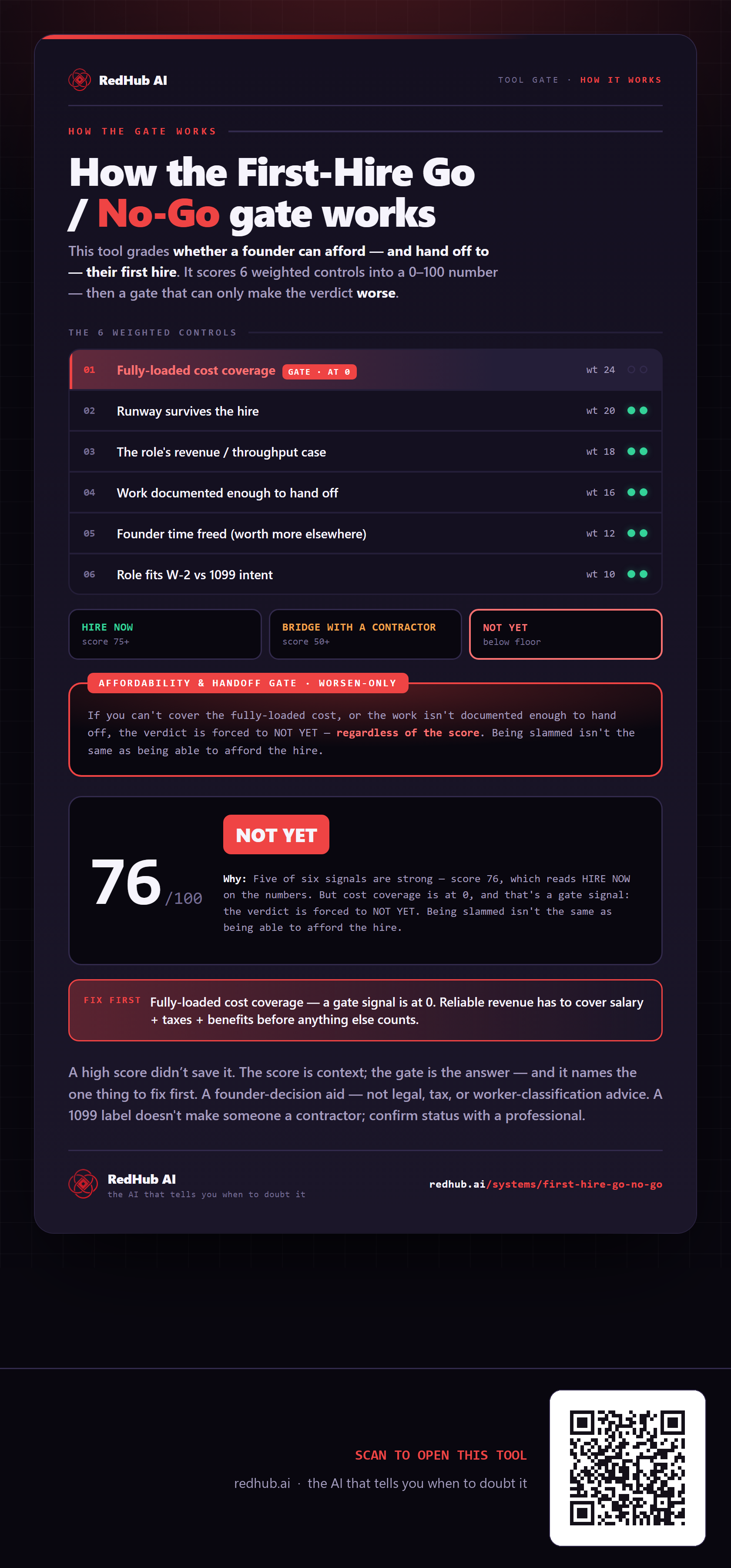
This is how First-Hire Go / No-Go works. More diagrams in the Visual Field Guide.