Tool Gate · How it works
How the Automated-Decision Transparency & Disclosure Scorecard gate works
How the Automated-Decision Transparency & Disclosure Scorecard scores a decision system's disclosures across weighted controls — then a told-and-recourse gate forces UNDISCLOSED when the subject isn't told or has no route to recourse, so a mid score with a missing recourse pair still reads undisclosed.
How the gate works
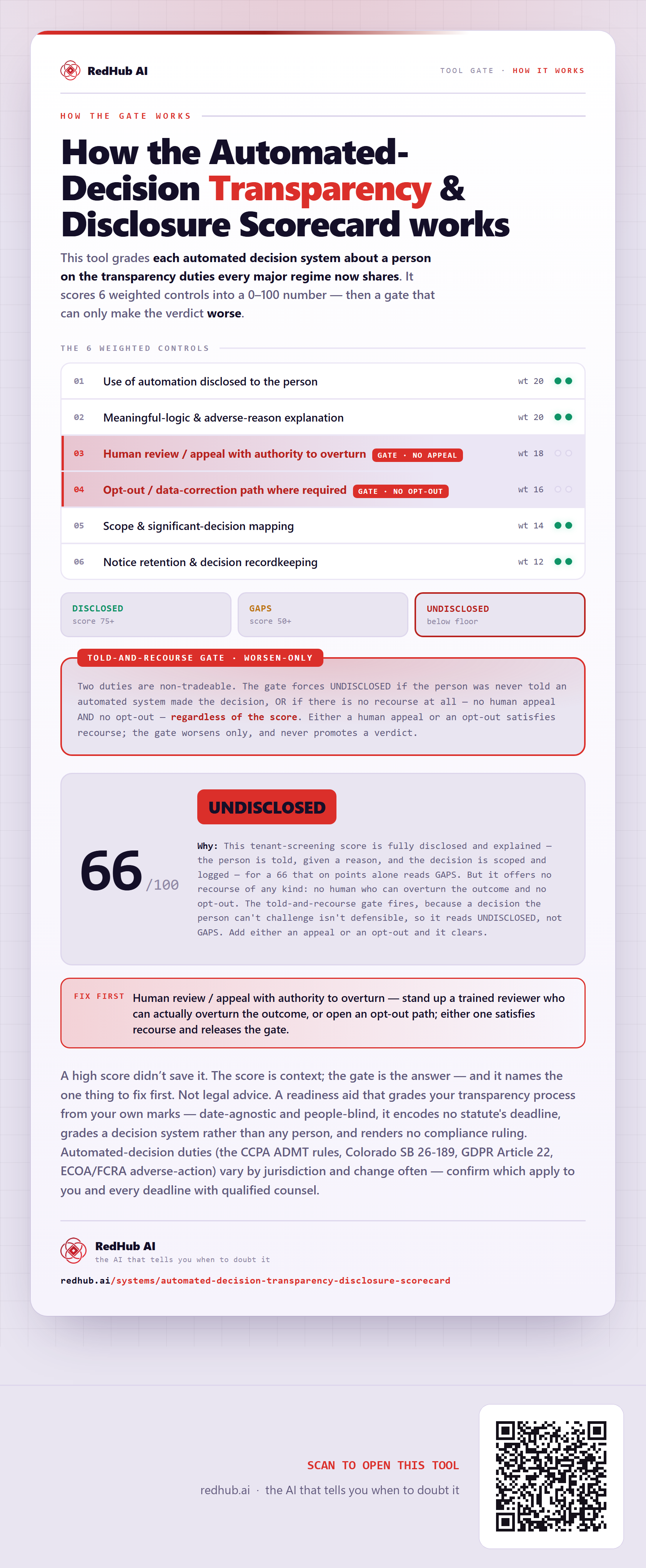
This tool grades each automated decision system about a person on six transparency and recourse practices drawn from several automated-decision regimes rather than from any one statute — so a control may read low where nothing in your jurisdiction requires it. Each control is marked from your own evidence and weighted into a 0–100 score — and then the score is run past a gate that can only make the verdict worse.
The 6 weighted controls
| Signal | Weight |
|---|---|
| Use of automation disclosed to the person | 20 |
| Meaningful-logic & adverse-reason explanation | 20 |
| Human review / appeal with authority to overturn | 18 |
| Opt-out / data-correction path where required | 16 |
| Scope & “significant decision” mapping | 14 |
| Notice retention & decision recordkeeping | 12 |
| Total | 100 |
The verdict bands
Two controls are not tradeable in this scoring. The gate forces UNDISCLOSED if you marked that the person was never told an automated system made the decision, OR that there is no recourse at all — no human appeal AND no opt-out — regardless of the score. Either a human appeal or an opt-out satisfies recourse here. The gate worsens only, and never promotes a verdict. Which duties apply to you is a question for counsel; this gate describes how this aid weights your own marks.
In the worked sample it scores 66 out of 100 and still reads UNDISCLOSED — This tenant-screening score is fully disclosed and explained — the person is told, given a reason, and the decision is scoped and logged — for a 66 that on points alone reads GAPS. But it offers no recourse of any kind: no human who can overturn the outcome and no opt-out. The told-and-recourse gate fires, because a decision the person can't challenge is the hardest kind to explain later, so it reads UNDISCLOSED, not GAPS. Add either an appeal or an opt-out and it clears. Marked fix first on this sample: Human review / appeal with authority to overturn — stand up a trained reviewer who can actually overturn the outcome, or open an opt-out path; either one satisfies recourse and releases the gate..
Common questions
Can something score well on the How the Automated-Decision Transparency & Disclosure Scorecard works and still fail?
Yes. The weighted score is run past a worsen-only gate — the Told-and-recourse gate — that can only make the verdict worse. In the worked sample it scores 66 out of 100 and still reads UNDISCLOSED, because this tenant-screening score is fully disclosed and explained — the person is told, given a reason, and the decision is scoped and logged — for a 66 that on points alone reads GAPS. But it offers no recourse of any kind: no human who can overturn the outcome and no opt-out. The told-and-recourse gate fires, because a decision the person can't challenge is the hardest kind to explain later, so it reads UNDISCLOSED, not GAPS. Add either an appeal or an opt-out and it clears.
What is a worsen-only gate?
A dispositive rule that can only lower a verdict, never raise it. One fatal flaw overrides an otherwise-good score, because a single disqualifying gap shouldn't hide behind a high average. Where something is short, the fix-first row names it — here, "Human review / appeal with authority to overturn — stand up a trained reviewer who can actually overturn the outcome, or open an opt-out path; either one satisfies recourse and releases the gate.".
Not legal advice. A readiness aid that grades your transparency process from your own marks — not a certification, an opinion of counsel, or a safe harbor, and not a ruling on whether any law applies to any decision. Date-agnostic and people-blind, it encodes no statute's deadline, grades a decision system rather than any person, files nothing, and renders no compliance ruling. Automated-decision duties come from different regimes on different timetables — the CCPA's ADMT rules and Colorado's SB 26-189 attach on 1 January 2027, while GDPR Article 22 and US ECOA/FCRA adverse-action duties apply now, to different decisions. Confirm which apply to you, and every deadline, with qualified counsel. This link encodes the marks you entered; it is your working note, not an assessment by RedHub.
Embed this diagram
Free to share and embed with attribution (CC BY 4.0) — keep the link to redhub.ai.
Interactive — renders the live diagram
<iframe src="https://redhub.ai/visuals/tool/automated-decision-transparency-disclosure-scorecard.html" title="How the Automated-Decision Transparency & Disclosure Scorecard gate works — RedHub AI" width="760" height="2161" loading="lazy" style="border:0;width:100%;max-width:760px"></iframe>
<p style="font:14px/1.5 system-ui,sans-serif"><a href="https://redhub.ai/visuals/tool/automated-decision-transparency-disclosure-scorecard">How the Automated-Decision Transparency & Disclosure Scorecard gate works</a> — by <a href="https://redhub.ai">RedHub AI</a>, the AI that tells you when to doubt it.</p>
Image + link — a static picture for any blog
<a href="https://redhub.ai/visuals/tool/automated-decision-transparency-disclosure-scorecard"><img src="https://redhub.ai/visuals/tool/automated-decision-transparency-disclosure-scorecard-share.png" alt="Diagram of the Automated-Decision Transparency & Disclosure Scorecard: disclosure controls scored to 0-100 and a told-and-recourse gate forcing UNDISCLOSED." width="760" loading="lazy" style="max-width:100%;height:auto;border-radius:16px"></a>
<p style="font:14px/1.5 system-ui,sans-serif"><a href="https://redhub.ai">RedHub AI</a> — the AI that tells you when to doubt it.</p>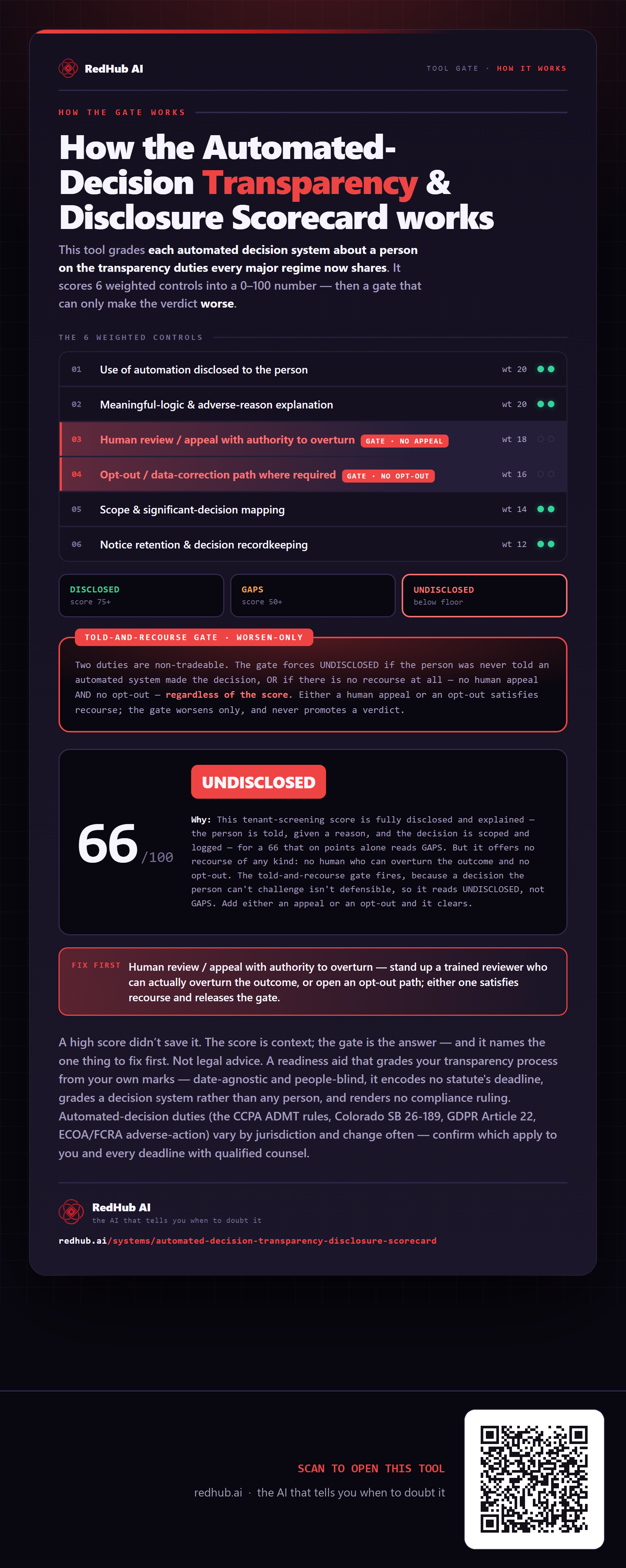
This is how Automated-Decision Transparency & Disclosure Scorecard works. More diagrams in the Visual Field Guide.