Tool Gate · How it works
How the AI Receipt-Fraud Exposure gate works
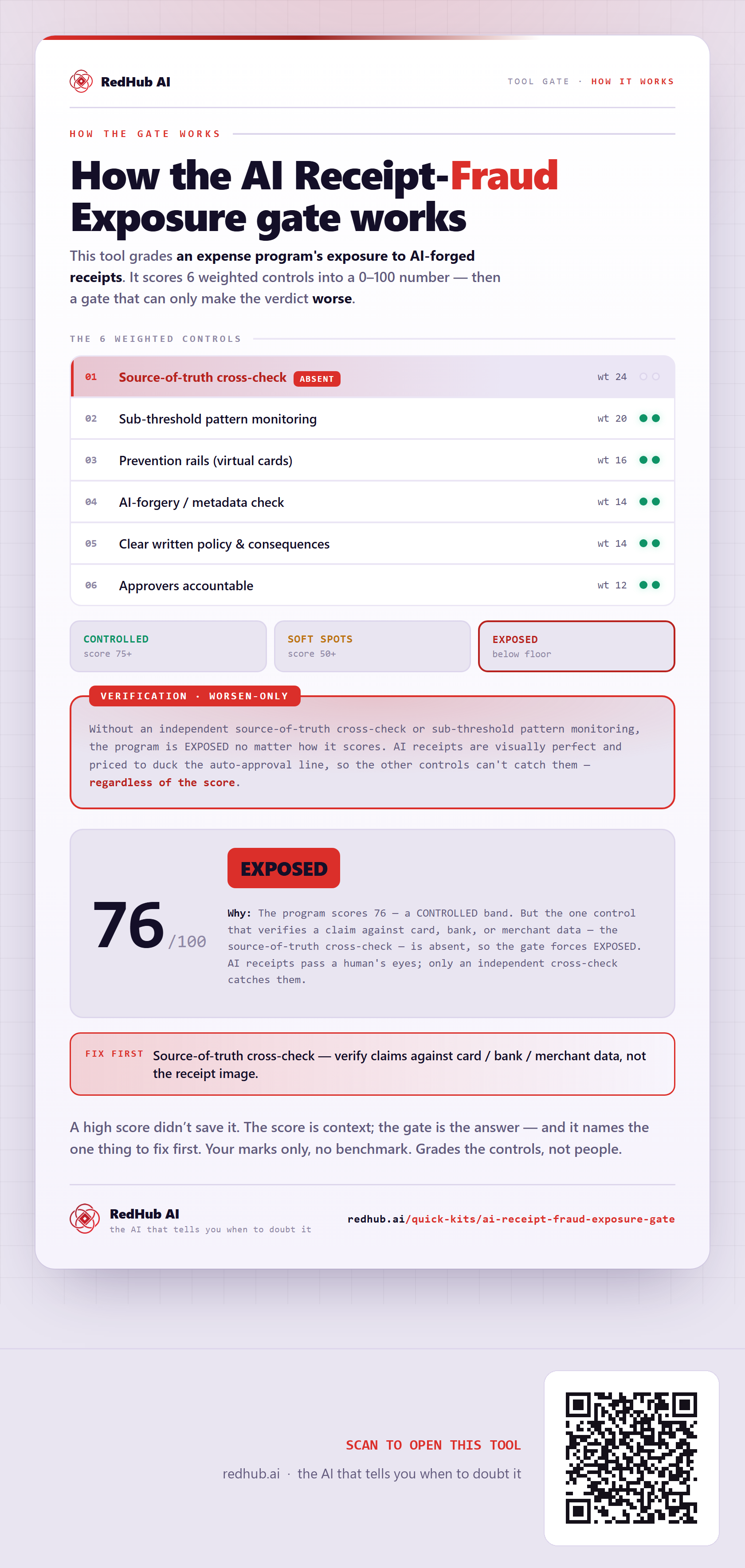
How the AI Receipt-Fraud Exposure Gate grades an expense program: six weighted controls into a 0–100 score, and a verification gate where a missing source-of-truth cross-check or sub-threshold monitoring forces EXPOSED — which is how a 76 still fails, because AI receipts pass a human's eyes.
How the gate works
This tool grades an expense program's exposure to AI-forged receipts. Each control is marked from your own evidence and weighted into a 0–100 score — and then the score is run past a gate that can only make the verdict worse.
The 6 weighted controls
| Signal | Weight |
|---|---|
| Source-of-truth cross-check | 24 |
| Sub-threshold pattern monitoring | 20 |
| Prevention rails (virtual cards) | 16 |
| AI-forgery / metadata check | 14 |
| Clear written policy & consequences | 14 |
| Approvers accountable | 12 |
| Total | 100 |
The verdict bands
Without an independent source-of-truth cross-check or sub-threshold pattern monitoring, the program is EXPOSED no matter how it scores. AI receipts are visually perfect and priced to duck the auto-approval line, so the other controls can't catch them — regardless of the score.
In the worked sample it scores 76 out of 100 and still reads EXPOSED — The program scores 76 — a CONTROLLED band. But the one control that verifies a claim against card, bank, or merchant data — the source-of-truth cross-check — is absent, so the gate forces EXPOSED. AI receipts pass a human's eyes; only an independent cross-check catches them. Marked fix first on this sample: Source-of-truth cross-check — verify claims against card / bank / merchant data, not the receipt image..
Common questions
Can something score well on the How the AI Receipt-Fraud Exposure gate works and still fail?
Yes. The weighted score is run past a worsen-only gate — the Verification — that can only make the verdict worse. In the worked sample it scores 76 out of 100 and still reads EXPOSED, because the program scores 76 — a CONTROLLED band. But the one control that verifies a claim against card, bank, or merchant data — the source-of-truth cross-check — is absent, so the gate forces EXPOSED. AI receipts pass a human's eyes; only an independent cross-check catches them.
What is a worsen-only gate?
A dispositive rule that can only lower a verdict, never raise it. One fatal flaw overrides an otherwise-good score, because a single disqualifying gap shouldn't hide behind a high average. Where something is short, the fix-first row names it — here, "Source-of-truth cross-check — verify claims against card / bank / merchant data, not the receipt image.".
Your marks only, no benchmark. Grades the controls, not people.
Embed this diagram
Free to share and embed with attribution (CC BY 4.0) — keep the link to redhub.ai.
Interactive — renders the live diagram
<iframe src="https://redhub.ai/visuals/tool/ai-receipt-fraud-exposure-gate.html" title="How the AI Receipt-Fraud Exposure gate works — RedHub AI" width="760" height="1656" loading="lazy" style="border:0;width:100%;max-width:760px"></iframe>
<p style="font:14px/1.5 system-ui,sans-serif"><a href="https://redhub.ai/visuals/tool/ai-receipt-fraud-exposure-gate">How the AI Receipt-Fraud Exposure gate works</a> — by <a href="https://redhub.ai">RedHub AI</a>, the AI that tells you when to doubt it.</p>
Image + link — a static picture for any blog
<a href="https://redhub.ai/visuals/tool/ai-receipt-fraud-exposure-gate"><img src="https://redhub.ai/visuals/tool/ai-receipt-fraud-exposure-gate-share.png" alt="Diagram of the AI Receipt-Fraud Exposure Gate: six weighted controls, a verification gate, and an expense program scoring 76 that still reads EXPOSED." width="760" loading="lazy" style="max-width:100%;height:auto;border-radius:16px"></a>
<p style="font:14px/1.5 system-ui,sans-serif"><a href="https://redhub.ai">RedHub AI</a> — the AI that tells you when to doubt it.</p>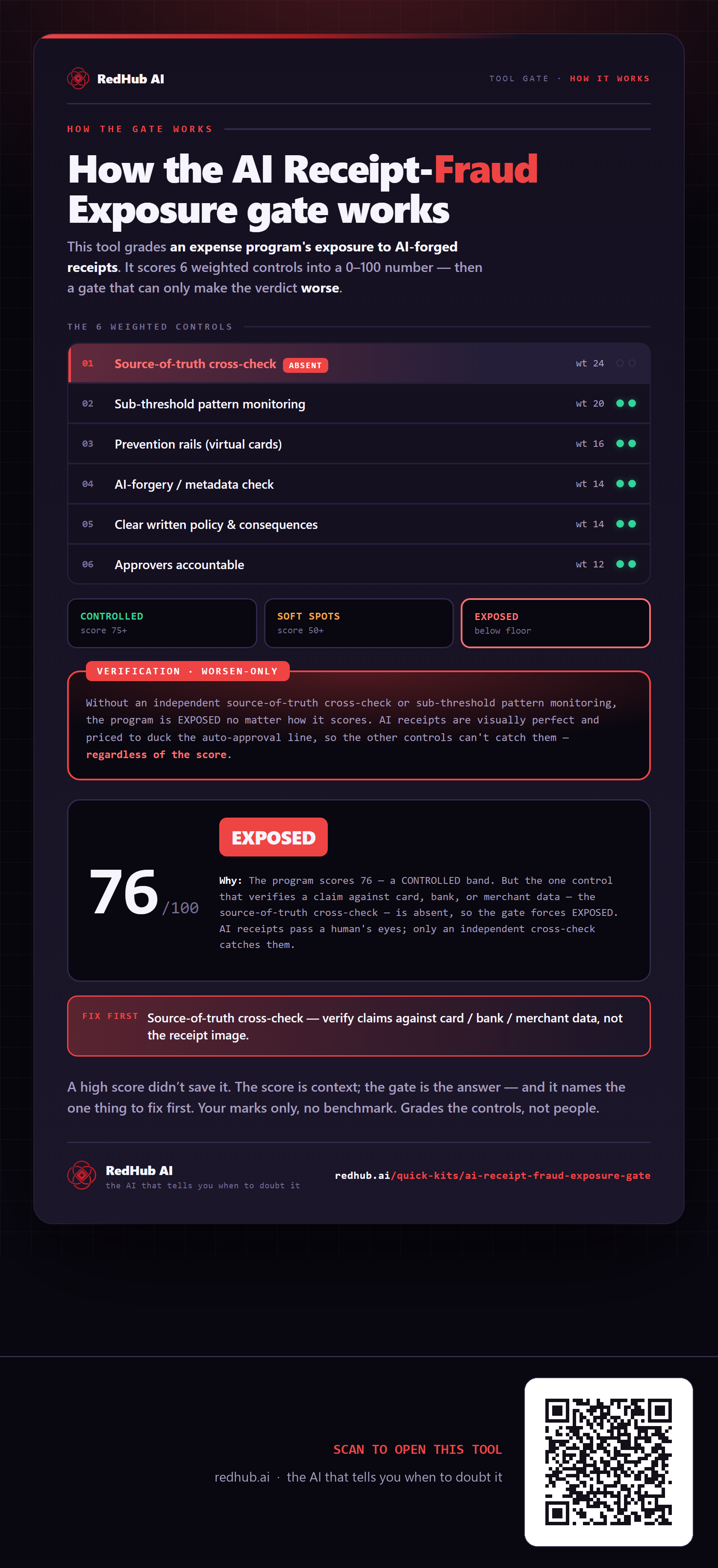
This is how AI Receipt-Fraud Exposure Gate works. More diagrams in the Visual Field Guide.