Your fake-receipt
defense, scored.
AI image generators went from 0% to roughly 71% of flagged fake receipts in a year — visually perfect, and priced around $100 to duck your auto-approval line. Eyeballing is a dead control. Score your expense programs and find the gap before a fake walks through it.
instant download · .xlsx · yours to keep
The problem
The receipt stopped being proof.
the share of flagged fake receipts identified as AI-generated, March 2025 to May 2026. The crossover hit in April 2026 — AI is now the dominant fabrication tool.
the average AI fake, versus $182 for older template fakes. The lower amount is intentional: small enough to slip under most auto-approval thresholds and skip review.
US employees who admit using AI to generate a fake expense receipt — many with company-funded AI tools, per a June 2026 survey.
Any workflow built on “review the receipt, decide if it's real” is now obsolete — detection happens after the spend, and a perfect forgery passes a human reviewer. This kit grades the controls that don't depend on the image, and refuses to let a program pass while the two AI-proof controls are missing.
See it work
Score a program and watch the gate fire.
Mark each control. The verdict updates live — same math as the workbook.
Claims verified against card / bank / merchant data, not the receipt image.
You watch the ~$100, just-under-auto-approval, repeat-small-claim pattern.
Virtual / corporate cards and direct feeds shrink the reimbursement surface.
Metadata and AI-generation detection, not human visual review (AI receipts pass that).
A communicated policy stating the documentation standard and the consequence for a fake.
Approvers know they are a control, not a rubber stamp clearing a queue.
Scores in the CONTROLLED band, but a gate control is at 0 — so the verdict is forced to EXPOSED. AI receipts are visually perfect and priced to duck the auto-approval line, so without an independent cross-check or sub-threshold monitoring, your other controls can't catch them.
Fix first: Source-of-truth cross-check
Your marks only · no benchmark · grades the controls, not people
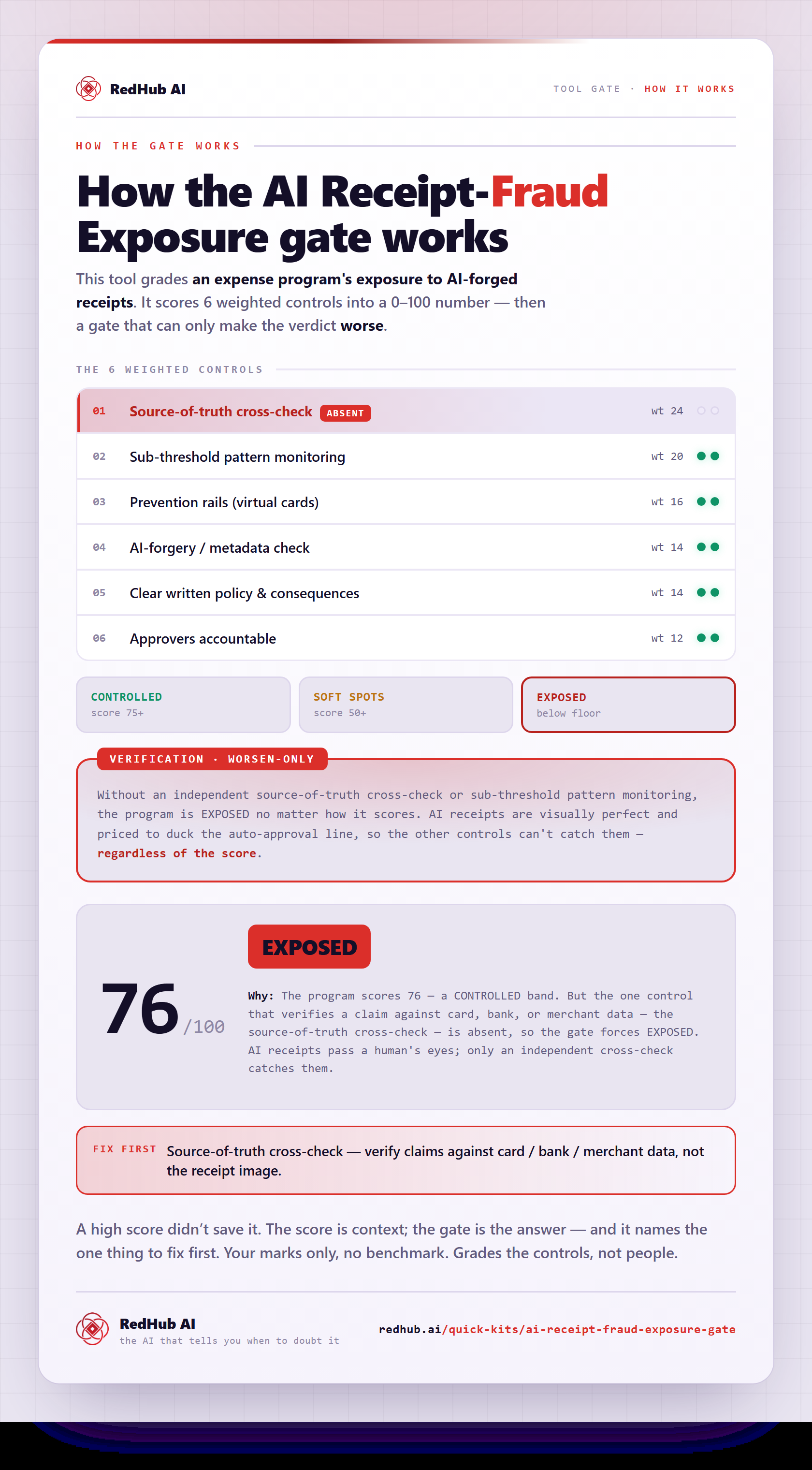
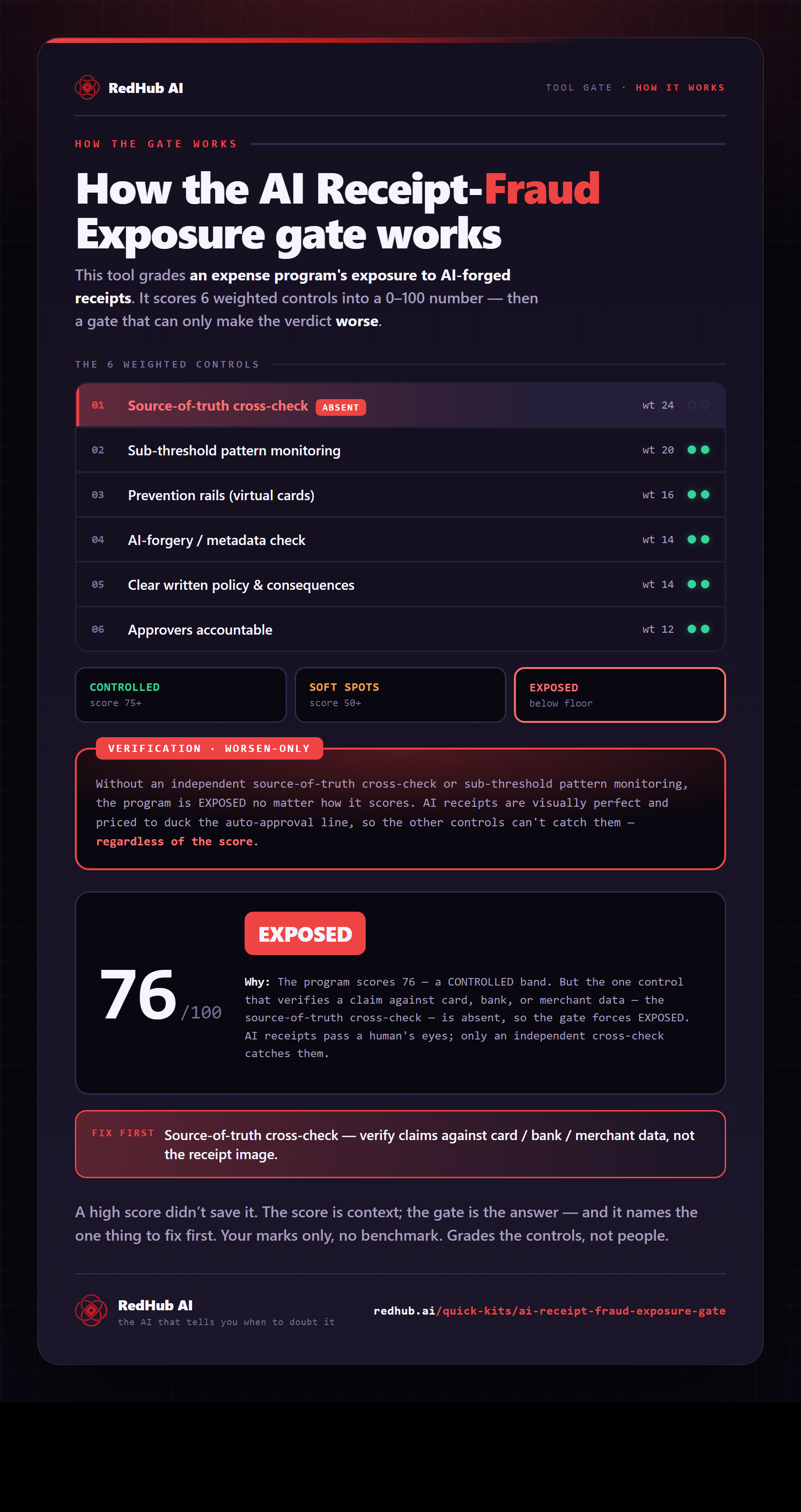
How the gate works, in one image
The six weighted controls scored into a 0–100 number and the verification gate that forces EXPOSED without a source-of-truth cross-check — the same math the demo runs, as a diagram you can share or embed anywhere.
View & embed the full diagramThe standard
Six controls, weighted to 100 — two of them gates.
The gate (worsen-only): if source-of-truth cross-check = 0 or sub-threshold monitoring = 0, the verdict is EXPOSED regardless of the score. These are the two controls AI fakes are built to defeat — a perfect image beats any visual review, so you need an independent cross-check; and the fakes are priced to live below your review line, so you need something watching that band. Either alone is fatal. Raise it off zero and the gate releases.
How it works
Deterministic. Your marks, one verdict.
The workbook is the engine, and every row below is its own arithmetic. The Field-sales program below scores 76 and still reads EXPOSED — strong everywhere except the one control that catches a perfect fake.
AI-Receipt Fraud Exposure Gate
====================================================
Field sales T&E             76/100  EXPOSED       [GATE -> EXPOSED]
    fix first: Source-of-truth cross-check (card/bank/merchant data)
Corporate card + virtual   100/100  CONTROLLED
Contractor reimbursements   52/100  EXPOSED       [GATE -> EXPOSED]
    fix first: Sub-threshold & low-dollar pattern monitoring
Remote-team stipends        85/100  CONTROLLED
    fix first: Prevention rails (virtual cards / direct feeds)
Conference & events         50/100  SOFT SPOTS
    fix first: Source-of-truth cross-check (card/bank/merchant data)
Petty cash & misc           35/100  EXPOSED
    fix first: Prevention rails (virtual cards / direct feeds)
----------------------------------------------------
Portfolio: EXPOSURE FOUND
3 of 6 program(s) read EXPOSED.Who it's for
Anyone who signs off on reimbursements.
This is a control self-assessment, not a fraud audit or a detection tool — it scores the controls you describe from your own marks, connects to nothing, reads no receipt, and grades no employee. Not accounting or legal advice.
Pairs well with
The rest of the spend-integrity shelf.
The AP-side check — invoices against POs and receipts. This kit is the employee-reimbursement side.
ViewTurns receipts and invoices into structured data and flags low-confidence fields instead of guessing.
ViewReconcile a card feed against submitted claims — the cross-check this gate scores you on.
ViewCommon questions
The honest answers.
Your expense-reimbursement controls — for one or more programs (T&E, contractor reimbursements, stipends, petty cash) — against the specific way AI fake receipts get paid. You mark six controls 0/1/2 and it returns CONTROLLED, SOFT SPOTS, or EXPOSED per program, with the one control to fix first where a control is short. It scores the controls you describe, never an employee, and it catches no fraud itself — it tells you whether your process would.
Because two controls are gates. If you have no source-of-truth cross-check (verifying claims against card, bank, or merchant data rather than the receipt image), or nothing watching the sub-threshold band (the ~$100 just-under-auto-approval claims), the verdict is EXPOSED no matter how strong everything else is. AI receipts are visually perfect, so inspecting the image is a dead control — and they're priced specifically to slip under your auto-approval line. The shipped Field-sales sample scores 76 and still reads EXPOSED for exactly that reason: great policy and approvers, but it's still trusting the receipt.
It moved fast. Industry platform data reported the share of flagged fake receipts identified as AI-generated went from 0% in March 2025 to roughly 71% by May 2026, with the crossover in April 2026 — AI image generators are now the dominant fabrication tool. A June 2026 employee survey found about four in ten US workers admitted using AI to generate a fake expense receipt. And the fakes average around $100 each — lower than older template fakes — because that ducks most auto-approval thresholds. This kit is built around that exact pattern.
Source-of-truth cross-check and sub-threshold monitoring — the two controls AI fake receipts are engineered to defeat. A perfect forgery beats any image review, so the only thing that catches it is checking the claim against a record the forgery never touches (the card or merchant transaction). And because the fakes are priced to live below your review line, you need something watching that low-dollar, repeat-claim, duplicate band. Miss either one and a strong policy elsewhere doesn't save you, so either at zero forces EXPOSED. Raise it off zero and the gate releases.
No. It is deterministic and offline. You enter your own marks on the controls you actually have, and it computes the verdict — it never connects to an expense tool, reads a receipt, or flags a transaction. The same logic runs in the workbook and the on-page demo, so both agree to the number. It is a control self-assessment, not a fraud-detection tool or a forensic audit.
No. It's a control self-assessment that helps you find the gap a fake receipt would walk through, before it does. It is not a fraud audit, a detection product, or accounting, audit, or legal advice. Use it to prioritize where to strengthen your reimbursement controls, and confirm specifics with your finance, audit, or legal team.
Get the kit
Find the gap before a fake does.
- One .xlsx — Start Here, Dashboard, Exposure Scorecard.
- Score every expense program; rolls up to one portfolio verdict.
- Deterministic and offline — your marks, no AI, nothing uploaded.
- Opens in Excel, Google Sheets, or Numbers.
Sold by RedHub AI LLC · Secured by Stripe · redhub.ai