Meeting Cost Calculator
Put a real annual dollar figure on every recurring meeting — fully loaded — with a keep / trim / kill verdict. Salaried time is real money, even when it never shows on an invoice.
TL;DR
A weekly nine-person status meeting costs about $19,700 a year — money nobody books on purpose. In the example, five recurring meetings total $95,900/yr, with roughly $61,300 flagged to trim or kill. “Could've been an email” is funnier when you see the invoice.
instant download · .xlsx · 30-day guarantee
The problem
The $20,000 meeting nobody ever approved.
A recurring meeting's cost never appears on a budget because it's already being spent — in salaried time. A weekly nine-person status meeting quietly runs about $20,000 a year, and no one ever booked it as a line item.
Make the number visible and the conversation changes. The point isn't to kill meetings — it's to stop paying $20k a year for a low-value one when a shorter, smaller, or async version would do.
annual cost of one weekly nine-person status meeting
total across five recurring meetings in the example
of that flagged to trim or kill
the standard salary-to-hourly divisor behind the math
Example figures are computed live from the workbook's seeded sample meetings — not a claim about any real organization.
What's inside
One sheet. A real price tag on every recurring meeting.
One .xlsx — open it in Excel, Google Sheets, or Numbers and price your calendar today.
Meetings tab
List your recurring meetings: attendees, average salary, duration, frequency, and a 1–5 value rating. The sheet returns the fully-loaded annual cost and a verdict for each — example data filled in, ready to overwrite.
Meeting Cost Dashboard
Your total annual meeting cost, the most expensive single meeting, and the annual cost flagged to trim or kill — the silent budget line no one ever formally approved.
The verdict
Every meeting gets one of three calls — Keep, Trim / shrink, or Kill / cut — from its fully-loaded cost and your honest value rating together.
The loaded-cost model
A transparent, editable formula that turns salaried time into a real annual dollar figure — money that's already being spent but never shows up on a budget.
How the verdict works
Cost and value, then the call
Annual cost is attendees times the loaded hourly rate times duration times frequency. That cost and your 1–5 value rating together set the verdict:
- Keep — high-value, or cheap enough to justify as-is — leave it alone
- Trim / shrink — expensive and only moderately valuable — shorten, cut attendees, or meet less often
- Kill / cut — rated low value (1–2) — the time is better spent elsewhere, or made async
The built-in example · 5 meetings
Two meetings worth keeping, two to trim, one to cut — about two-thirds of the cost worth questioning.
Try it
Put a real price tag on every recurring meeting
Total annual meeting cost
$95,885
Annual cost flagged to trim/kill
$61,269
Keep / Trim / Kill
2 / 2 / 1
Meetings tracked
5
This is the live engine. Your numbers here reset when you reload. The kit saves every meeting, totals your annual meeting cost, and shows exactly how much is flagged to trim or kill — the silent line item no one ever approved.
Get the kit — $29| Meeting | Att. | Avg salary | Hrs | Freq/mo | Value | Annual | Verdict |
|---|---|---|---|---|---|---|---|
| $19,731 | Trim / shrink | ||||||
| $19,038 | Keep | ||||||
| $15,577 | Keep | ||||||
| $27,692 | Trim / shrink | ||||||
| $13,846 | Kill / cut |
Cost uses average salary ÷ 2,080 work hours — a standard approximation, not exact payroll. The value rating is your judgment; the verdict is a prompt to question the calendar, not a mandate to cancel.
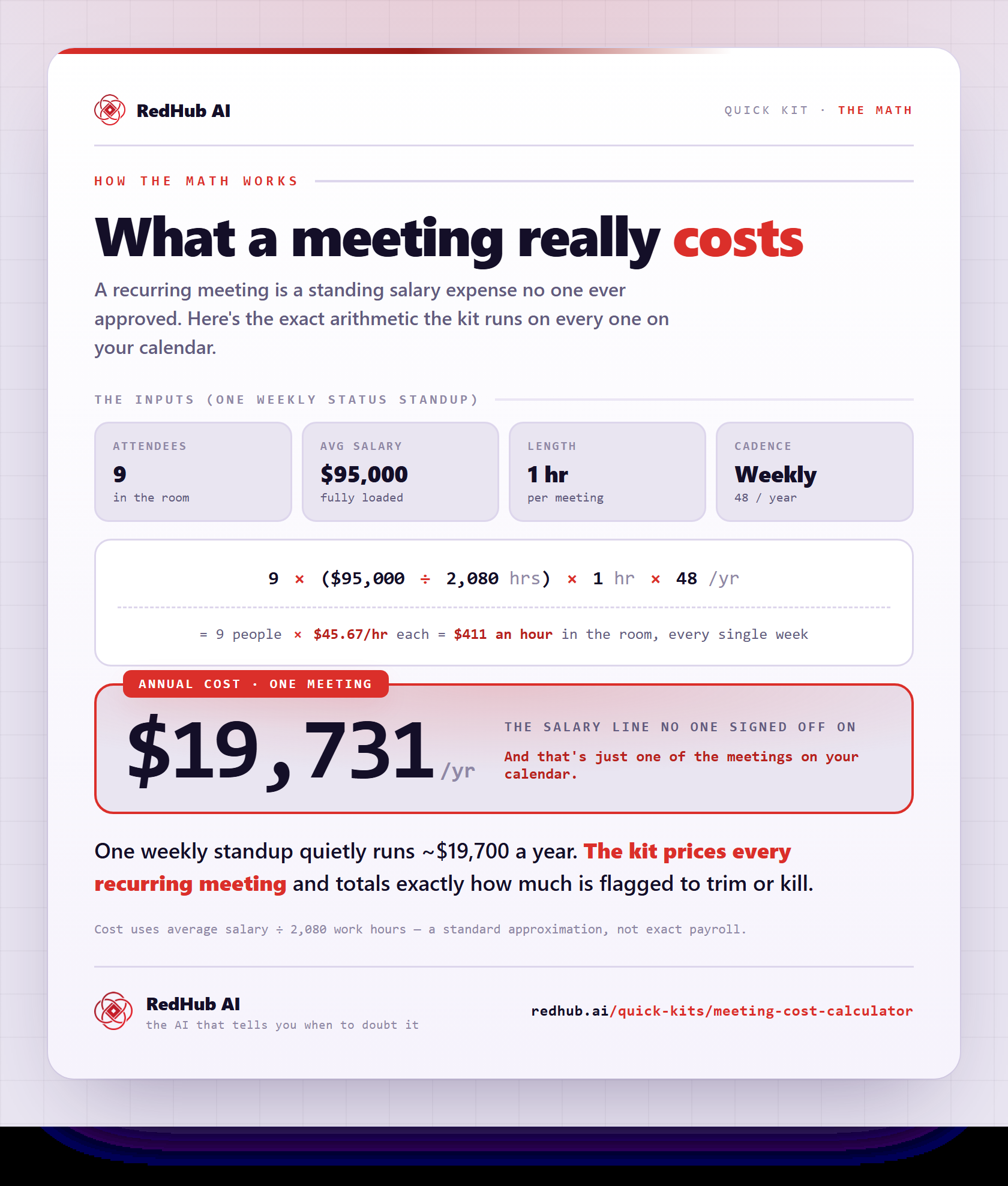
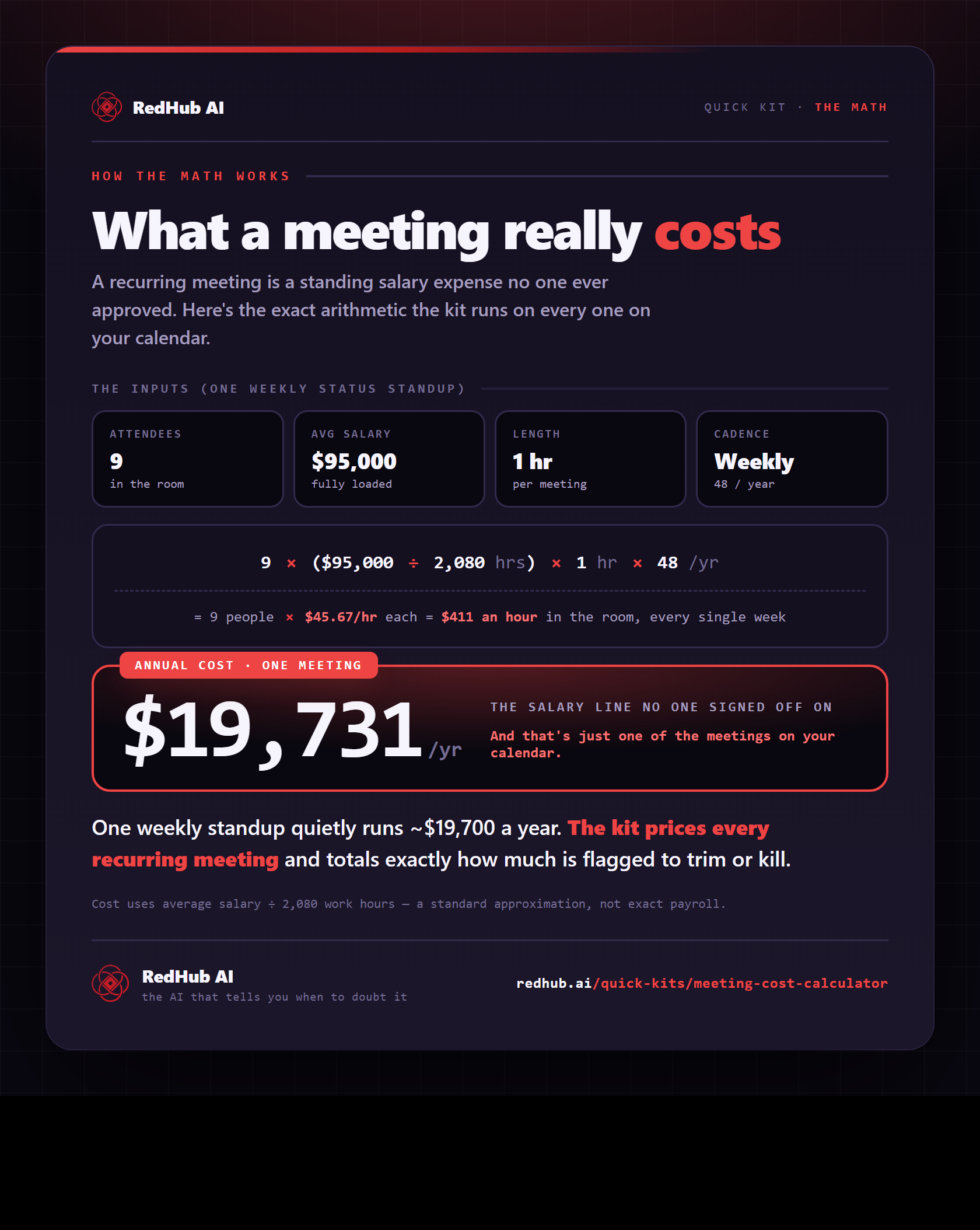
The math behind it, in one image
See the arithmetic behind every meeting: attendees × (salary ÷ 2,080 hrs) × length × yearly frequency — one weekly 9-person standup works out to ~$19,700 a year.
See the full calculationWhy it's different
Anti-expensive-low-value, not anti-meeting
Makes salaried time visible
Turns the cost that's already being spent — but never budgeted — into a real annual dollar figure you can act on.
Value rating is yours
A calculator can't price alignment or decisions, so you rate value. A high-value meeting survives even if it's expensive; only costly low-value ones get flagged.
A prompt, not a mandate
The verdict questions the calendar — it doesn't cancel anything. Trim and shrink come before kill, on purpose.
The weekly recurring meetings are the silent budget killers — one $20k/year line item that no one ever approved.
Who it's for
Clear about the lane. No inflated promises.
Built for you if…
- You run or sit in recurring meetings and suspect some aren't worth their cost
- You're a manager, founder, or ops lead who can audit the calendar
- You can estimate attendees, average salary, duration, and frequency
- You'd rather trim and shrink with evidence than argue about it
Not for you if…
- You want a calendar integration that pulls meetings and salaries automatically
- You need exact payroll cost, not a loaded-rate approximation
- You believe every recurring meeting is already perfectly run
Pairs well with
Price the meeting, then make it produce something.
Putting a number on a meeting is the first nudge; the rest makes the time count. The Meeting-to-Action Handoff Gate checks the meeting actually produced owned, tracked actions, the Capacity & Utilization Planner shows whether the team has room for all of them, and the Cost of Vacancy Calculator prices the roles you are missing instead.
Common Questions
The questions managers actually ask before they cut a meeting.
It's a one-time spreadsheet that puts a real annual price tag on every recurring meeting. You enter attendees, average salary, duration, and frequency, then rate each meeting's value 1–5; it computes the fully-loaded annual cost and gives a verdict — Keep, Trim / shrink, or Kill / cut — plus a dashboard with your total meeting cost and what's flagged to trim or kill.
One .xlsx that opens in Microsoft Excel, Google Sheets, or Apple Numbers — no subscription, no login. It ships with a worked example so it makes sense immediately; overwrite it with your own meetings.
Attendees × (average salary ÷ 2,080 work hours) × duration × frequency per month × 12. The 2,080-hour divisor is the standard salary-to-hourly conversion (40 hours × 52 weeks). It's a loaded-rate approximation, not exact payroll — but it makes the invisible cost of salaried time visible.
No — it's anti-expensive-low-value-meeting. The value rating is yours on purpose, because a calculator can't price alignment, morale, or decisions. A high-value meeting stays even if it's expensive; the verdict only flags the costly, low-value ones worth questioning.
Keep = either high-value or cheap enough to justify as-is. Trim / shrink = expensive and only moderately valuable — shorten it, cut attendees, or make it less frequent rather than killing it. Kill / cut = rated low value (1–2); the time is better spent elsewhere, or replaced with an async update.
Use it with the Meeting Intelligence System to make the meetings you keep actually useful, and the Capacity & Utilization Planner to see what the reclaimed time is worth. Price the calendar, then improve or reinvest it.
Yes — a 30-day money-back guarantee. If it doesn't change how you look at your calendar, request a refund within 30 days.
Get the kit
Price your calendar in five minutes.
Instant download, yours to keep, 12 months of updates. Trimming one expensive low-value meeting covers it hundreds of times over.
- 3-tab .xlsx: Start Here, Meetings, Cost Dashboard
- Fully-loaded annual cost engine + keep / trim / kill verdict
- Value rating built in — anti-expensive-low-value, not anti-meeting
- Works in Excel, Google Sheets, or Numbers · 30-day guarantee