Meeting-to-Action Handoff Gate
The meeting ended with a list of action items. The question is whether they were actually handed off — owned, dated, accepted, logged. A decision nobody owns didn't happen.
Your notes tool makes the list. This checks the list will get done — and, where an item is short, names the one quietly slipping through.
instant download · .xlsx · yours to keep
The problem
The action items were captured. They still didn't happen.
Modern tools are great at capturing what a meeting decided — summaries, decisions, neat action-item lists. None of that guarantees the work moves. Items show up with no owner, no date, no acceptance, living only in a transcript nobody reopens. By the next meeting they've quietly evaporated. This gate checks the handoff — the part that actually fails — before everyone leaves the room.
Try it
Toggle the checks. Watch one missing owner break the meeting.
Grade the handoff
No owner — dropped no matter how complete the rest (★ is the gate).
1 tracked · 1 to chase · 2 dropped — one dropped action breaks the handoff for the whole meeting.
Fix first — “Draft the partner outreach list”: Assign one named owner — “the team” owns nothing, and an unowned action quietly dies.
Grades the handoff, not people · your marks, not a benchmark · same marks, same verdict
This is the live engine. The full .xlsx — Start Here, Dashboard, Handoff Gate Room for several action items, the owner gate, the roll-up A worked example, pre-filled and ready to overwrite
Get the kit — $49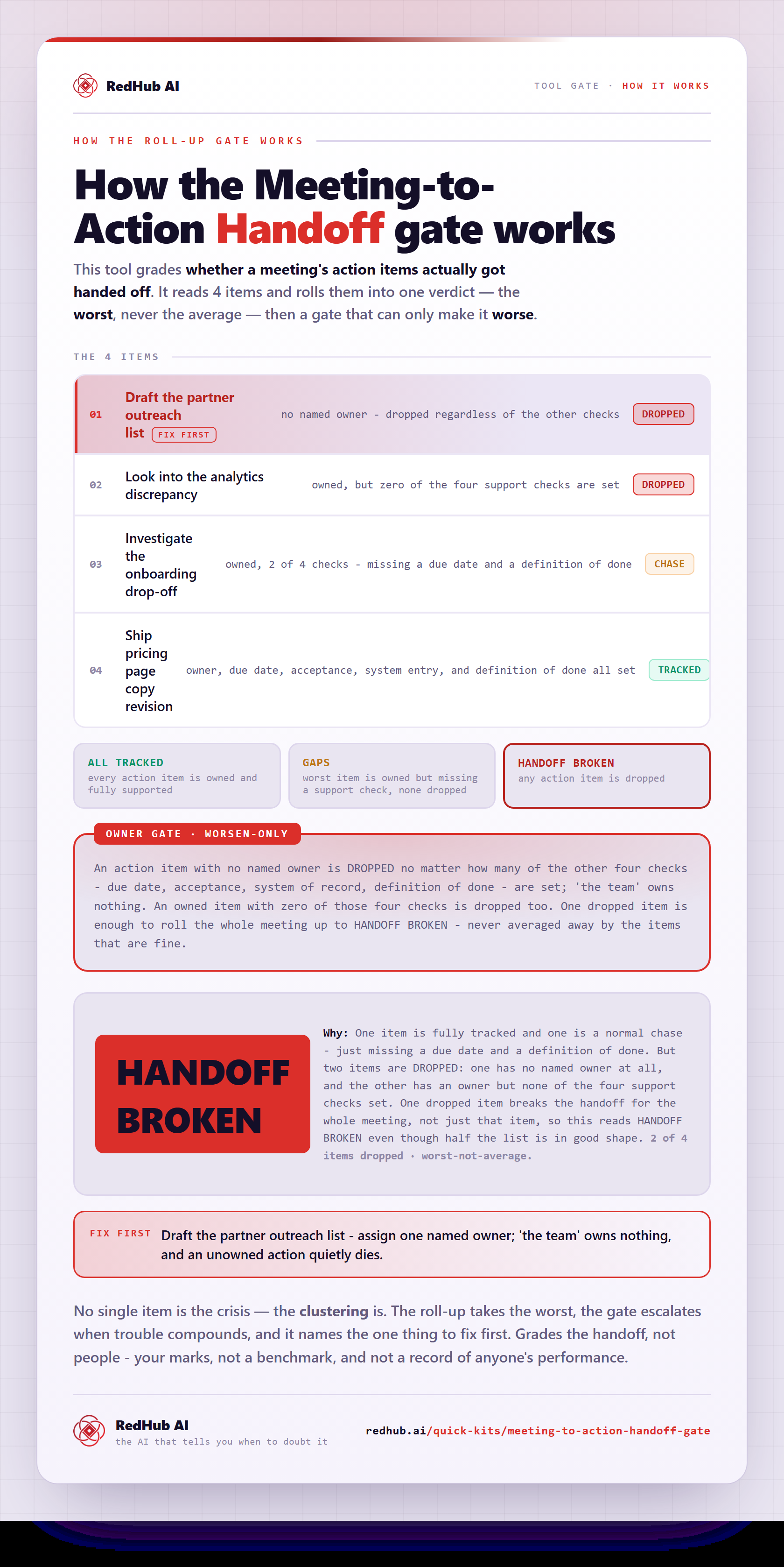
How the gate works, in one image
How the Meeting-to-Action Handoff Gate scores a meeting's action items and drops any item with no named owner, whatever the rest — the same math the demo runs, as a diagram you can share or embed anywhere.
View & embed the full diagramThe standard
The worst item sets the ceiling.
Ownership is load-bearing
An item with a date, acceptance, a system entry, and a clear definition of done is still DROPPED if nobody owns it. 'The team will handle it' means nobody will.
No averaging away a gap
One dropped action rolls the whole meeting up to HANDOFF BROKEN. An average would hide the single unowned decision — which is exactly the one that matters.
Process, not people
It grades whether the handoff happened, not anyone's performance. A dropped item is a missing owner or date, not a verdict on a person.
How it works
Five checks per item, one roll-up.
- 1List each action item the meeting produced.
- 2Mark five checks per item: named owner, due date, owner accepted, in a system of record, definition of done.
- 3Read each item's verdict — TRACKED, CHASE, or DROPPED — and the meeting's roll-up.
- 4Fix the dropped items before you close the meeting; the missing owner is almost always the culprit.
What you'll see
A verdict per item and one for the meeting.
Per item
TRACKED, CHASE, or DROPPED for every action item, with the missing check called out.
For the meeting
ALL TRACKED, GAPS, or HANDOFF BROKEN — plus, where an item is short, the single item and check to fix first.
Who it's for
For anyone who runs the meeting and owns the follow-through.
For you if
- You run recurring syncs, standups, or planning meetings.
- You're tired of last week's action items reappearing untouched.
- You want a 60-second close-out check, not another process doc.
Not for you if
- You need to generate the summary and action items — that's the Meeting Intelligence System.
- You want to price your meetings — that's the Meeting Cost Calculator.
- You want a tool that auto-reads transcripts (this never does — you mark the checks).
Common questions
Straight answers before you buy.
The Meeting Intelligence System produces the artifacts — it turns a transcript into a summary, decisions, action items, and follow-ups. This grades whether those action items actually got handed off: a named owner, a due date, acceptance, a system of record, a definition of done. One makes the list; this checks the list will get done. They pair naturally — produce, then gate.
Because the worst item sets the ceiling. A roll-up that averaged would hide the single unowned decision that quietly dies — and that's usually the one that matters. So any DROPPED item rolls the meeting up to HANDOFF BROKEN, regardless of how many others are tracked. The worked example has two clean tracked items and still reads HANDOFF BROKEN because two items dropped.
The owner gate. An action with a date, acceptance, a system entry, and a clear definition of done is still DROPPED if no single person owns it — because 'the team will handle it' means nobody will. Ownership is the load-bearing handoff property. The worked example shows an item with all four supports dropped purely for lack of an owner. Assign one name and it flips to TRACKED.
No. You mark the five checks for each action item — it reads nothing automatically and nothing is uploaded. That keeps it honest and private: the verdict comes from your own marks. Run it straight after the meeting, or paste your action items in and check them off in under a minute.
No. It grades the meeting's handoff process — whether items were captured completely — not any individual's performance. A DROPPED item is a process gap (no owner was named, no date was set), not a verdict on a person. Use it to fix the handoff, not to score people.
One polished .xlsx with three tabs — Start Here, Dashboard, and the Handoff Gate — with room for several action items, the owner gate, the roll-up, and a worked example. Opens in Excel, Google Sheets, or Numbers. Yours to keep, with 12 months of updates.
Get the Gate
Close the meeting clean.
- Five handoff checks per item + the owner gate.
- A roll-up that won't average away a dropped item.
- One .xlsx, yours to keep, 12 months of updates.
Sold by RedHub AI LLC · Secured by Stripe · redhub.ai