Early-Pay Discount Capture & Payment-Timing Leak Audit
Payment timing leaks cash three different ways — a discount you didn't grab, a bill you paid too early for nothing, a discount already gone — and most AP reviews only look at one. This audit reads each invoice, tells you which way it's leaking, and headlines the real dollars. The annualized rate is just the yardstick you hold against your cost of capital.
- Payment-timing audit workbook.xlsx
- Timing-leak enginepython
- Discount-Capture Playbook.docx
- Cycle-Time Fix Runbook.docx
- Worked 6-invoice sample.csv
Every invoice leaks in one of three directions.
They're not the same problem — missing a discount and paying too early are opposite mistakes — so a single "timing score" would bury them. Each invoice gets one directional verdict instead.
A discount is open and its annualized return beats your cost of capital. Pay in the window and bank it.
No discount worth taking, or the window's closed, and you're not paying early for nothing. Pay at net.
You're paying materially before net with no discount earned — free financing for the vendor. Hold to net.
Watch the cash-buffer gate override a 37% return.
The invoice below has a 2/10 net 30 discount that annualizes to 37% — far above the 12% cost of capital, so on paper you take it. But the cash buffer is 18 days, under the 30-day threshold. A return you can't fund is an overdraft, so the gate floors it to PAY ON TIME. Restore the buffer and it flips back.
Enter one invoice. Watch the cash-buffer gate override a discount you can't afford.
Audits the invoice you enter. Pays nothing, schedules nothing, moves no money. The annualized rate assumes reinvestment and is a yardstick vs your cost of capital, not a promised return. Not financial, accounting, or legal advice.
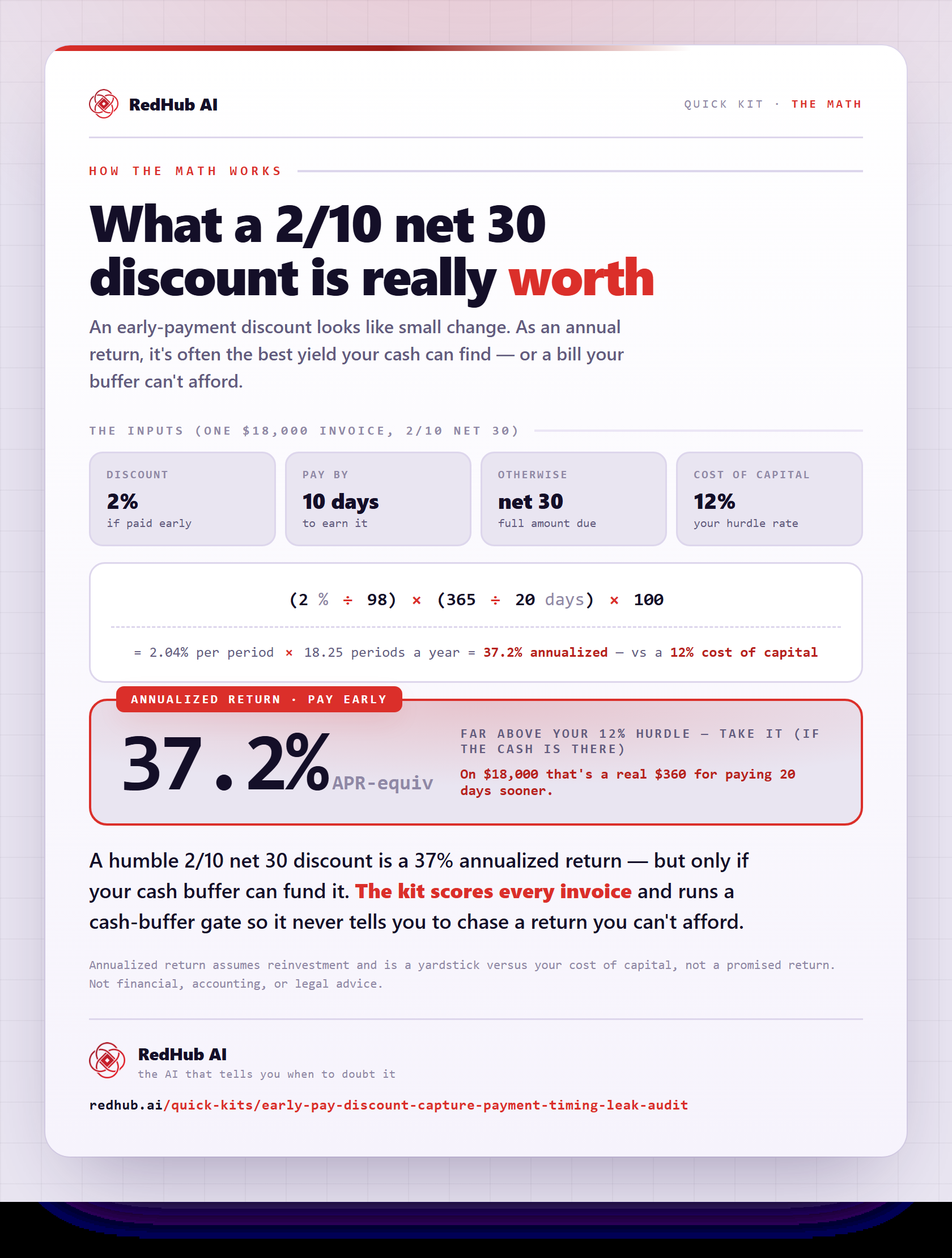
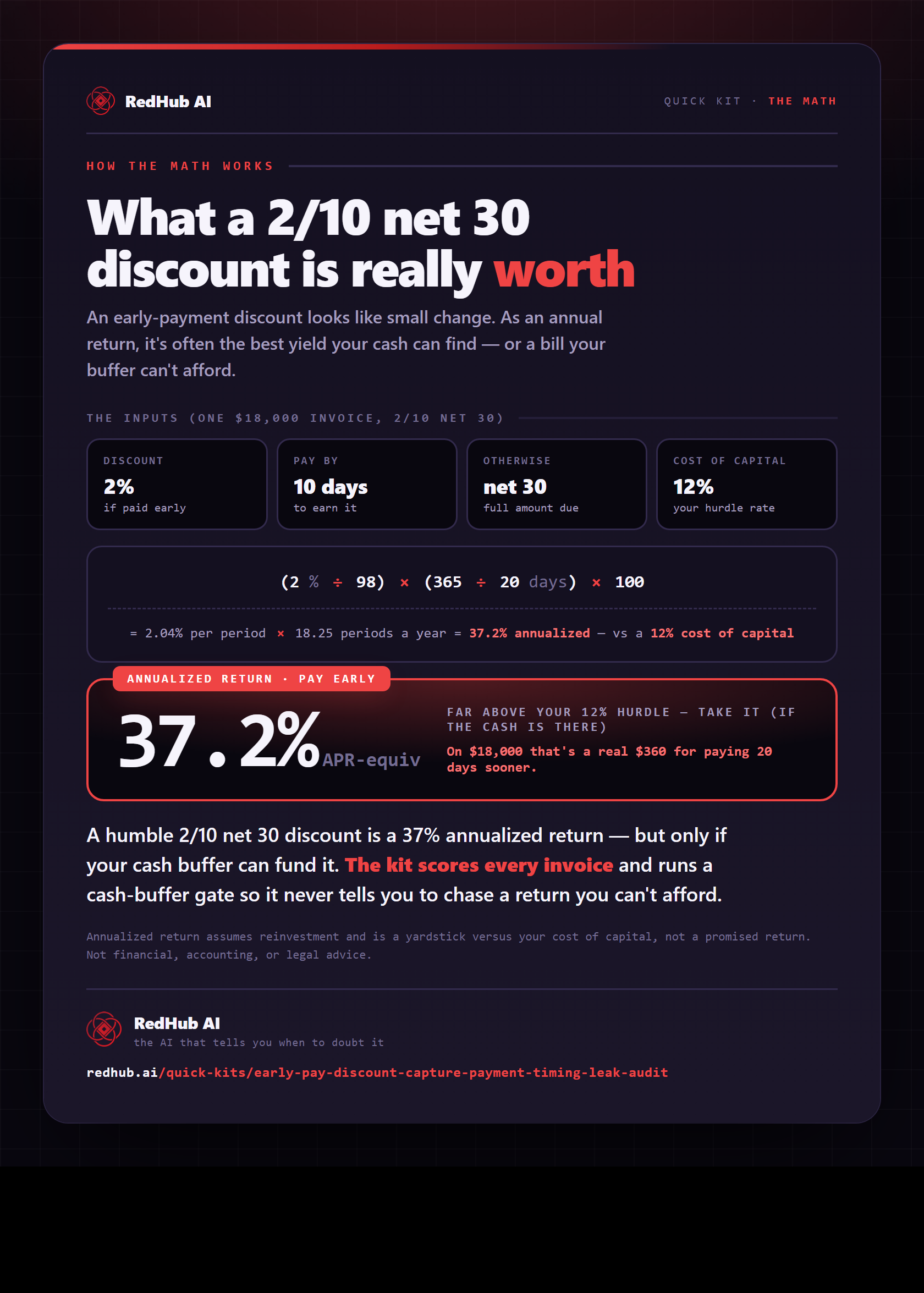
The math behind it, in one image
See what an early-pay discount is really worth: 2/10 net 30 = 37.2% annualized (2/98 times 365/20), far above a 12% cost of capital.
See the full calculationThis is the live engine. Audit your whole AP run at once, not one invoice at a time Portfolio rollup, biggest-leak ranking, and total dollars leaking The runnable engine, both playbooks, and the worked sample
Get the kit — $49The problem is cycle time, not policy.
Discounts die in the queue
Most missed discounts aren't a decision — the invoice sits waiting for approval until the 10-day window has already passed. The fix is removing the delay, not loosening control.
Early payment is invisible
Paying a net-45 bill on day 12 hands the vendor free use of your cash, but it shows up as no fee and no missed discount — so nothing flags it unless you measure timing directly.
The dollars are the truth
The annualized rate is a yardstick against your cost of capital; the real number is the cash captured, left on the table, or given away. The audit headlines that, per invoice and across the run.
What it is — and isn't.
- A deterministic, offline audit of the invoices you paste, from your own numbers.
- Three directional verdicts — a discount to grab, a bill to hold, a discount already lost.
- A cash-buffer gate that keeps you from chasing a return you can't fund.
- The real dollar leak per invoice, the biggest one to fix first where an invoice leaks, and your total timing leak.
- Not connected to your accounting system — it pays nothing and moves no money.
- Not a promise of the annualized return — that's a yardstick, not a literal yield.
- Not a benchmark tool — your cost of capital and buffer threshold are yours to set.
- Not a scorer of people; it grades invoices and timing, never a person.
Not financial, accounting, or legal advice. This kit grades your own AP invoices and payment timing — the annualized-return day-basis, your cost of capital, and your cash-buffer threshold are inputs you confirm, not figures asserted here. The annualized rate assumes reinvestment and is a yardstick, not a promised return. It pays nothing, schedules nothing, and moves no money.
More found money on the same desk.
Finds the margin leaks across your P&L. This works the AP payment-timing line specifically.
Gates the pay decision on whether the invoice matches the PO and receipt. Match it, then time it.
The same found-money discipline for your software stack — cancel what you don't use.
Before you audit your first AP run.
Almost always — but not literally always, and this audit is honest about the two exceptions. A 2/10 net 30 discount annualizes to roughly 37%, which beats nearly any cost of capital, so the tool marks it TAKE THE DISCOUNT. But two things override that: if the discount's annualized return is actually below your cost of capital (common on weak terms like 1/15 net 60, which annualizes near 8%), it's not worth it; and if your cash buffer is too thin to fund the early payment, chasing a paper return means borrowing at a higher rate or risking an overdraft. The cash-buffer gate floors those to PAY ON TIME.
Paying early is only good when you're earning a discount for it. If you pay a net-45 invoice on day 12 with no discount, you've handed the vendor 33 days of free use of your cash — money that could have sat in your account or covered something that actually earns a return. The tool quantifies that as a free-financing cost (your amount × cost of capital × early days ÷ 365) and tells you to hold payment until net. This is the leak almost no AP review looks for, because it doesn't show up as a fee or a missed discount — it's invisible unless you measure payment timing directly.
No, and the audit is deliberate about this. The annualized figure assumes you could reinvest the same cash in that discount over and over all year. In reality each discount applies to one invoice, so your true lifetime return is lower. The annualized rate is a yardstick — the honest way to compare a 20-day discount against your annual cost of capital on equal footing. The number that matters for your decision is the dollar figure the tool headlines: the actual cash captured, left on the table, or given away as free financing.
Because a return you can't fund isn't a return. Public treasury guidance is consistent: below roughly 30 days of cash buffer, preserve cash regardless of discount economics — a 37% paper return that forces you to borrow at a higher rate or risk missing payroll is a loss, not a gain. The gate is worsen-only: it floors a TAKE THE DISCOUNT to PAY ON TIME when your buffer falls under your threshold, and it never pushes you to be more aggressive. Both your current buffer and the threshold are yours to set — the default is 30 days.
Cycle time, not policy. Public 2026 AP data is blunt about it: most missed discounts are missed in the approval queue, not the payment run — the invoice sits waiting for sign-off until the 10-day window has already passed. That's why this audit shows you the window status and days of runway per invoice: the fix is almost never 'loosen approval,' it's 'remove the delay before it.' Flag discount terms in the vendor record, surface discount deadlines in the approval queue, and the captures follow.
No. It's a deterministic, offline spreadsheet plus a runnable engine. You paste your invoices; it grades each one's timing and totals the leak. It pays nothing, schedules nothing, and moves no money — every decision stays yours. Because it runs on your own numbers and your own confirmed cost of capital and buffer threshold, there's no hidden benchmark and nothing to go stale. It's a one-time tool you own, not a subscription that sits between you and your ledger.
Stop leaking cash on timing.
One purchase, lifetime access. Audit every AP run before the discounts die in the queue.
Not financial, accounting, or legal advice. This kit grades your own AP invoices and payment timing — the annualized-return day-basis, your cost of capital, and your cash-buffer threshold are inputs you confirm, not figures asserted here. The annualized rate assumes reinvestment and is a yardstick, not a promised return. It pays nothing, schedules nothing, and moves no money.
Sold by RedHub AI LLC · Secured by Stripe · redhub.ai