AI Unit-Economics & Token-Shock Exposure Kit
A workflow can look cheap per run and still bankrupt a budget at scale. This prices each AI workflow per outcome and flags the contract terms that let a growth month become an unbounded bill.
instant download · .xlsx · yours to keep
The problem
The pilot was cheap. The bill wasn't.
See it work
Your numbers, your exposure.
Try it — your numbers only
No usage cap and uncapped true-up — this reads TOKEN SHOCK even at $0.05 per outcome, because an unpriced growth month becomes an unbounded bill. Add either a cap or a capped true-up to clear it.
Or load the six-workflow example
| Workflow | Monthly | $/outcome | Verdict |
|---|---|---|---|
| Support triage | $1,014.30 | $0.03 | PREDICTABLE |
| Sales email drafts | $1,008.00 | $0.14 | TOKEN SHOCK |
| Doc summarization | $475.20 | $0.16 | PREDICTABLE |
| Lead enrichment | $187.20 | $0.01 | TOKEN SHOCK |
| Contract review | $631.80 | $1.21 | DRIFTING |
| Meeting notes | $290.40 | $0.06 | PREDICTABLE |
Every figure is computed from your own inputs — no per-token price or multiplier is baked in. Deterministic and offline; it prices workflows and grades terms, not people.
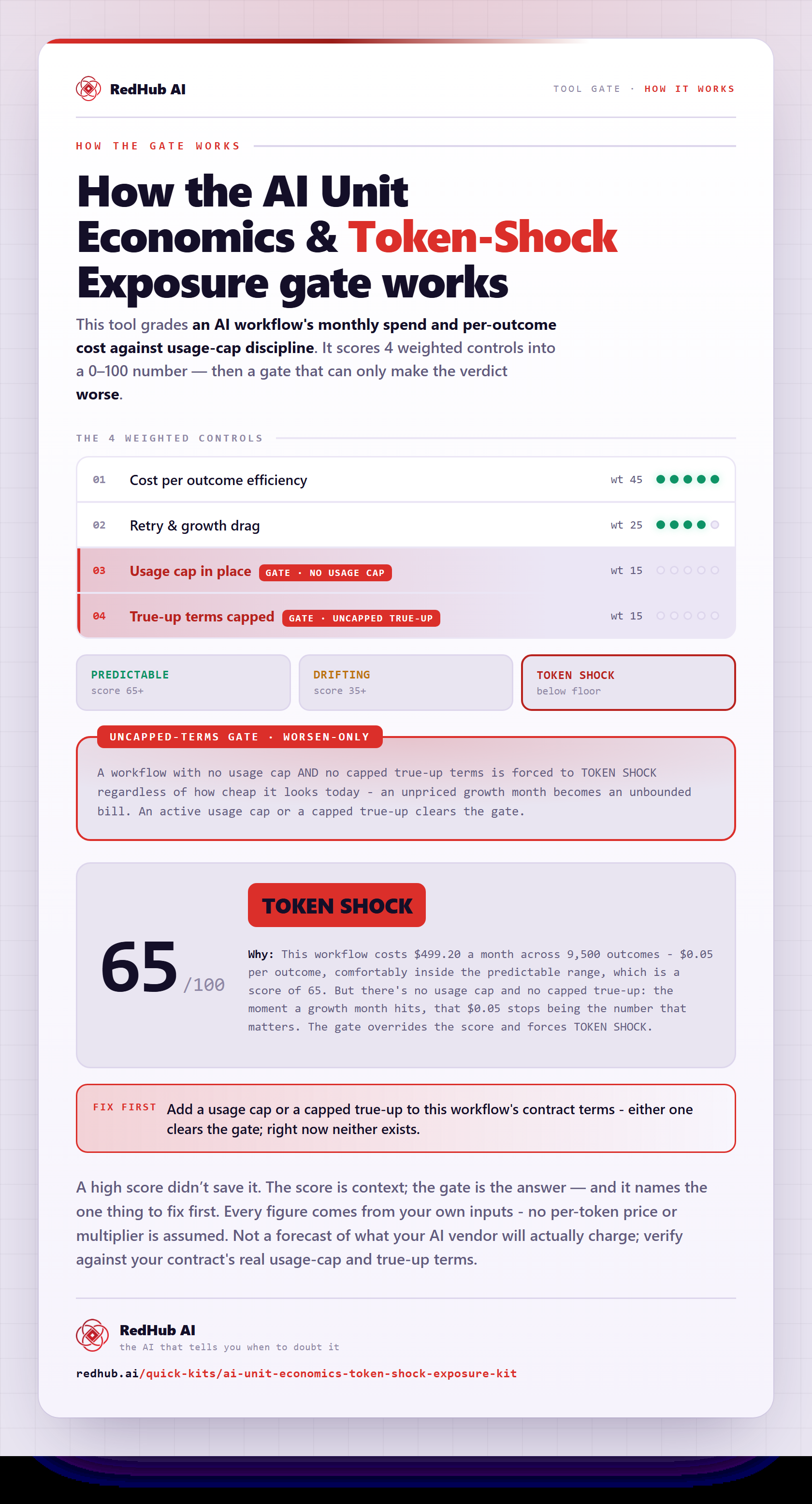
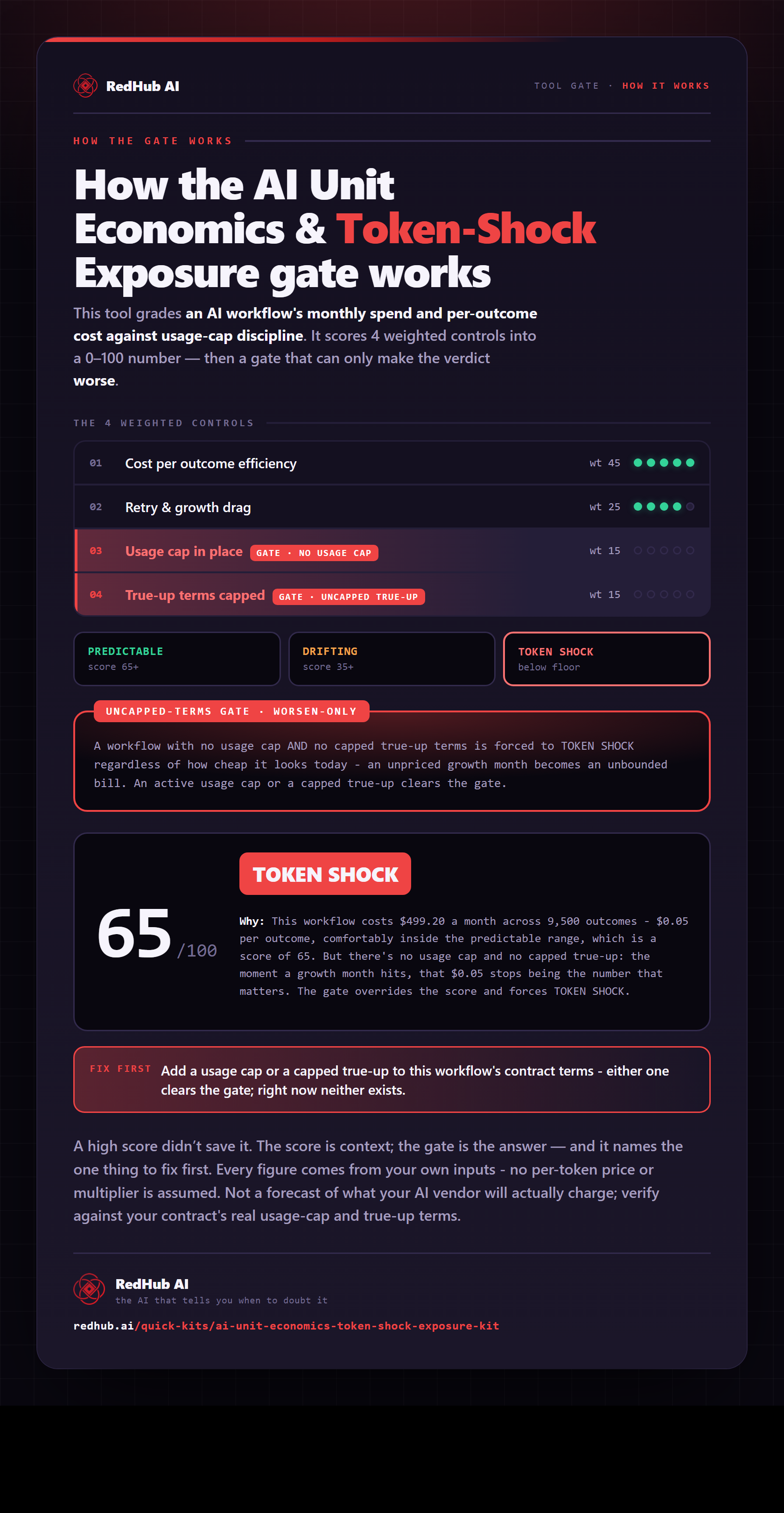
How the gate works, in one image
How the AI Unit Economics & Token-Shock Exposure Kit scores cost per outcome and forces TOKEN SHOCK when spend is uncapped — the same math the demo runs, as a diagram you can share or embed anywhere.
View & embed the full diagramThe standard
Three rules it never breaks.
How it works
Cost in, exposure out.
- 1.Enter tokens per run, price per 1K, runs, retry and growth multipliers, and outcomes — per workflow.
- 2.The workbook computes monthly cost and cost per outcome with live formulas.
- 3.It bands each workflow PREDICTABLE, DRIFTING, or TOKEN SHOCK against your editable thresholds.
- 4.The gate forces TOKEN SHOCK when a workflow has no usage cap and uncapped true-up — even if it looks cheap.
- 5.On the Model Swap tab, enter a cheaper candidate's prices and the pass rate each model scored on your own test. It prices both per finished task, including what a miss costs to fix, shows the break-even pass rate, and reads ROUTE DOWN, KEEP, or UNMEASURED — UNMEASURED whenever a pass rate is blank.
What you'll see
The number the pilot never showed you.
A per-workflow table of monthly cost and cost per outcome, a per-workflow verdict, a contract scorecard, a portfolio rollup that names your exposure, and a model-swap table with the break-even pass rate a cheaper model has to hit. It is a planning estimate from your own numbers — not accounting or financial advice, and it connects to nothing.
Who it's for
For the operator scaling AI past the pilot.
- Founders and ops taking an AI workflow from pilot to production.
- Anyone signing or renewing an AI vendor contract.
- Finance pressure-testing unit economics before volume climbs.
- Developer routing and caching — use the Token Economics Workbook.
- Incident response on a leaked key — that is a different tool.
- An audited financial figure — it is a planning estimate.
- Measuring model quality — it uses pass rates you measured on your own tasks, for example with the Prompt Evaluation & Versioning System.
Common questions
Answers before you buy.
Three things. Per AI workflow, it computes the fully-loaded cost per successful outcome — accounting for retries and expected growth — and bands it PREDICTABLE, DRIFTING, or TOKEN SHOCK. It grades the contract behind each workflow on four controls, so you know whether an unpriced growth month can turn into an unbounded bill. And its Model Swap tab tells you whether a cheaper model would cost less per finished task once its misses are paid for.
Yes, if you bring the pass rates. On the Model Swap tab you enter each model's price per 1M tokens, the tokens in and out per task, the share of your own tasks each model got right in your own test, and what it costs to fix one miss. It prices both models per finished task, shows the pass rate the cheaper model needs to break even, and reads ROUTE DOWN, KEEP, or UNMEASURED. It doesn't test models for you: with no measured pass rate it reads UNMEASURED, however large the saving looks. The Prompt Evaluation & Versioning System is one way to measure those rates.
No. Every figure comes from the numbers you enter — your token counts, your run volumes, the price your vendor actually charges. There is no hidden per-token rate or growth multiplier. The verdict is yours, not ours.
If a workflow has no usage cap AND its true-up terms are uncapped, it reads TOKEN SHOCK even when today's cost per outcome is a penny — because the thing that protects you is not today's price, it's the ceiling on a bad month. A workflow that is cheap now and uncapped is one growth spike from a runaway bill. Add either a cap or a capped true-up and the gate clears.
The Token Economics Workbook is a developer tool for routing, caching, and model-mix decisions — how to make each call cheaper. This kit is a pre-scale exposure check for founders and operators: what does each workflow cost per outcome, and does the contract protect you as volume grows. Its Model Swap tab answers one narrower question the workbook's routing matrix leaves to you: for a workflow you run today, is a specific cheaper model cheaper per finished task once misses are counted. Optimize spend there; price exposure here.
An incident kit is about a leaked key or a security event — containment after something goes wrong. This is about economics before anything goes wrong: whether the unit cost holds and whether the contract caps your downside. Different problem, different moment.
No. It is a plain .xlsx with live formulas — no API call, no upload, no login. It opens in Excel, Google Sheets, or Numbers and recomputes as you change your numbers. It prices workflows and grades contract terms, never people.
Get the Kit
Price the exposure before you scale.
- One .xlsx — Start Here, Dashboard, Workflow Calculator, Model Swap.
- Live formulas, a contract scorecard, a model-swap break-even, worked examples on both tabs.
- Your numbers only — no AI, no upload, no login.
Sold by RedHub AI LLC · Secured by Stripe · redhub.ai